
Data gravity is real, and fighting it is expensive. In a hybrid cloud world—where you might train models on-premise using data stored in AWS—Egress Fees (data transfer out) can silently become your second largest cloud cost.
AWS, Azure, and Google Cloud typically charge $0.09 per GB for data leaving their network. That sounds small, but 1 Petabyte of egress equals $90,000. Here is how to engineer your way around the Egress Trap.
1. The "Data Locality" Rule
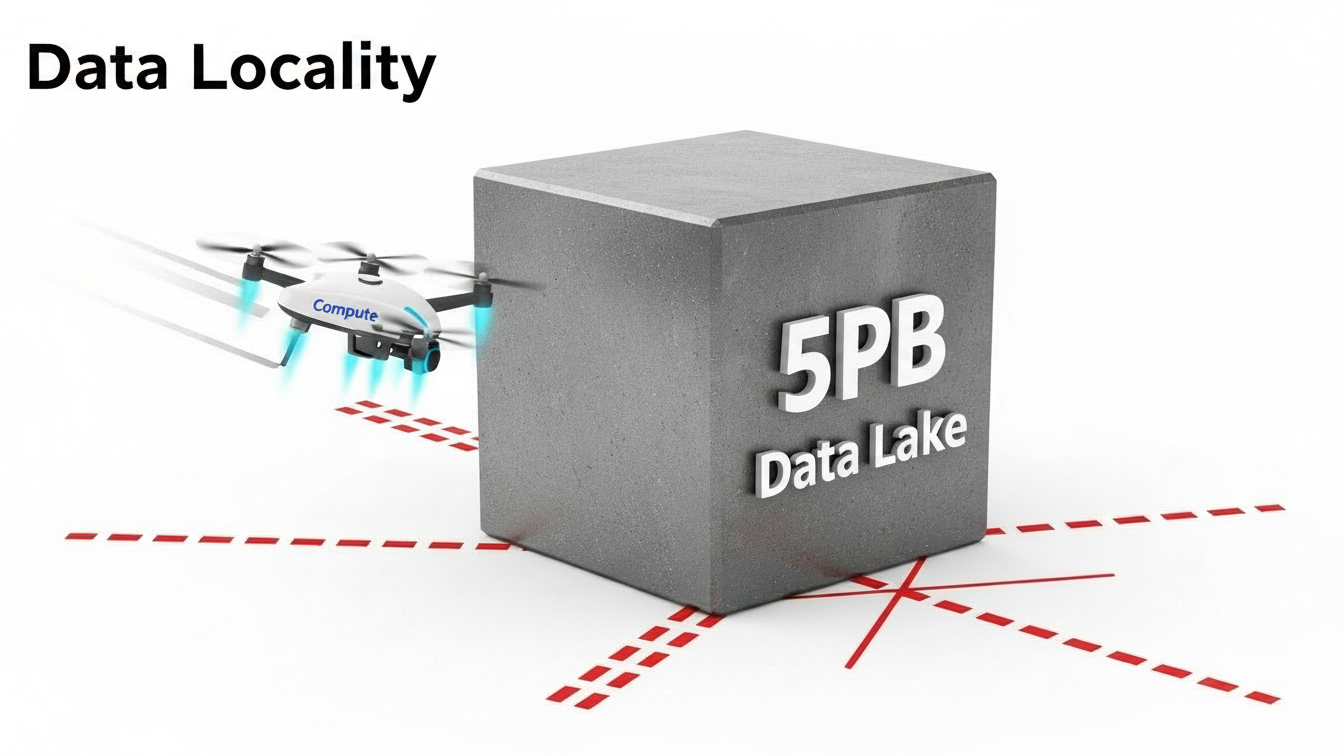
The golden rule of 2025 infrastructure: Move Compute to Data, not Data to Compute.
If your 5PB data lake is in AWS S3, do not download it to your on-prem GPU cluster for training. The $450,000 egress fee will wipe out any hardware savings.
Solution: Use ephemeral compute (Spot Instances) in the same cloud region as the data to process it into a smaller, denser format (like embeddings or summaries) before moving only that processed subset on-prem.
2. Private Networking (Direct Connect / Express Route)
If you must move data, stop using the public internet.
Public Internet Egress: ~$0.09/GB.
Direct Connect / Express Route: Pricing tiers often drop to $0.02-$0.03/GB (plus port fees).
ROI: If you transfer more than 50TB/month, a dedicated line usually pays for itself. It also provides predictable latency and enhanced security.
3. The Cloudflare R2 / Wasabi Strategy
A growing architectural pattern is to use "Egress-Free" object storage as a buffer.
Strategy: Instead of serving heavy assets (images, model weights) directly from S3 to users or other clouds, replicate them to Cloudflare R2.
The Math: R2 charges $0 for egress. You pay once to move data from S3 to R2 (or migrate entirely), and then you can serve it to millions of users or multi-cloud endpoints for free.
Savings: For a media-heavy application serving 500TB/month, moving the origin to R2 can save $45,000/month.
4. Query Caching at the Edge
For hybrid apps (e.g., on-prem app querying cloud DB), 80% of egress is often redundant queries.
Implementation: Deploy a read-through cache (Redis) or a GraphQL edge cache on the cloud side.
Ensure that only new or unique data traverses the expensive network boundary.
Summary: Egress fees are a tax on poor architecture. By enforcing data locality and utilizing modern storage tiers, you can effectively eliminate this line item.
All in One Place
Atler Pilot decodes your cloud spend story by bringing monitoring, automation, and intelligent insights together for faster and better cloud operations.