
1. The Multi-Region Dilemma: High Availability vs. Cost and Complexity
For modern global enterprises, single-region deployment is a single point of failure. Whether due to physical fiber cuts, localized power grid failures, or cloud provider control plane outages, relying on one geographic region exposes your business to catastrophic downtime. However, moving to a multi-region architecture is not a simple checkbox exercise. It introduces a fundamental engineering trade-off: balancing the CAP theorem (Consistency, Availability, and Partition Tolerance) against your organization’s financial and operational budgets.
When designing a multi-region infrastructure, architects must align their technical decisions with two primary business metrics: Recovery Time Objective (RTO) and Recovery Point Objective (RPO). Achieving an RTO of near-zero and an RPO of zero requires an active-active configuration where data is synchronously replicated across geographic boundaries. However, physical constraints—specifically the speed of light in fiber-optic cables (approximately 200 km per millisecond)—make synchronous replication over long distances impractical for write-heavy, low-latency applications.
Beyond the physical latency limits, multi-region deployments introduce significant financial overhead. Cloud providers charge premium rates for Cross-Region Data Transfer (CRDT), often ranging from $0.01 to $0.02 per gigabyte. For enterprises processing petabytes of data daily, these egress fees can quickly eclipse compute and storage costs. Therefore, the goal of any enterprise cloud architect is to design a multi-region deployment that minimizes user-facing latency and maximizes availability, while implementing rigorous operational safeguards to keep cloud spend predictable and secure.
2. Architectural Patterns: Active-Active vs. Active-Passive
The choice between active-active and active-passive architectures dictates your entire application design, database selection, and traffic routing strategy.
Active-Passive (Warm Standby or Pilot Light)
In an active-passive setup, one primary region serves 100% of the live traffic, while a secondary region remains on standby.
Pilot Light: The database and critical storage are continuously replicated to the secondary region, but application servers are either turned off or running at minimal capacity. In the event of a disaster, infrastructure-as-code (IaC) pipelines and autoscaling groups must rapidly provision the web and application tiers. This model yields low run-time costs but results in an RTO ranging from 15 minutes to several hours.
Warm Standby: A scaled-down version of the fully functional application runs in the secondary region. Databases are actively replicated, and application instances are running but not taking traffic. Failover is faster (RTO under 15 minutes), but compute costs are higher.
Active-Active (Multi-Region Write/Read)
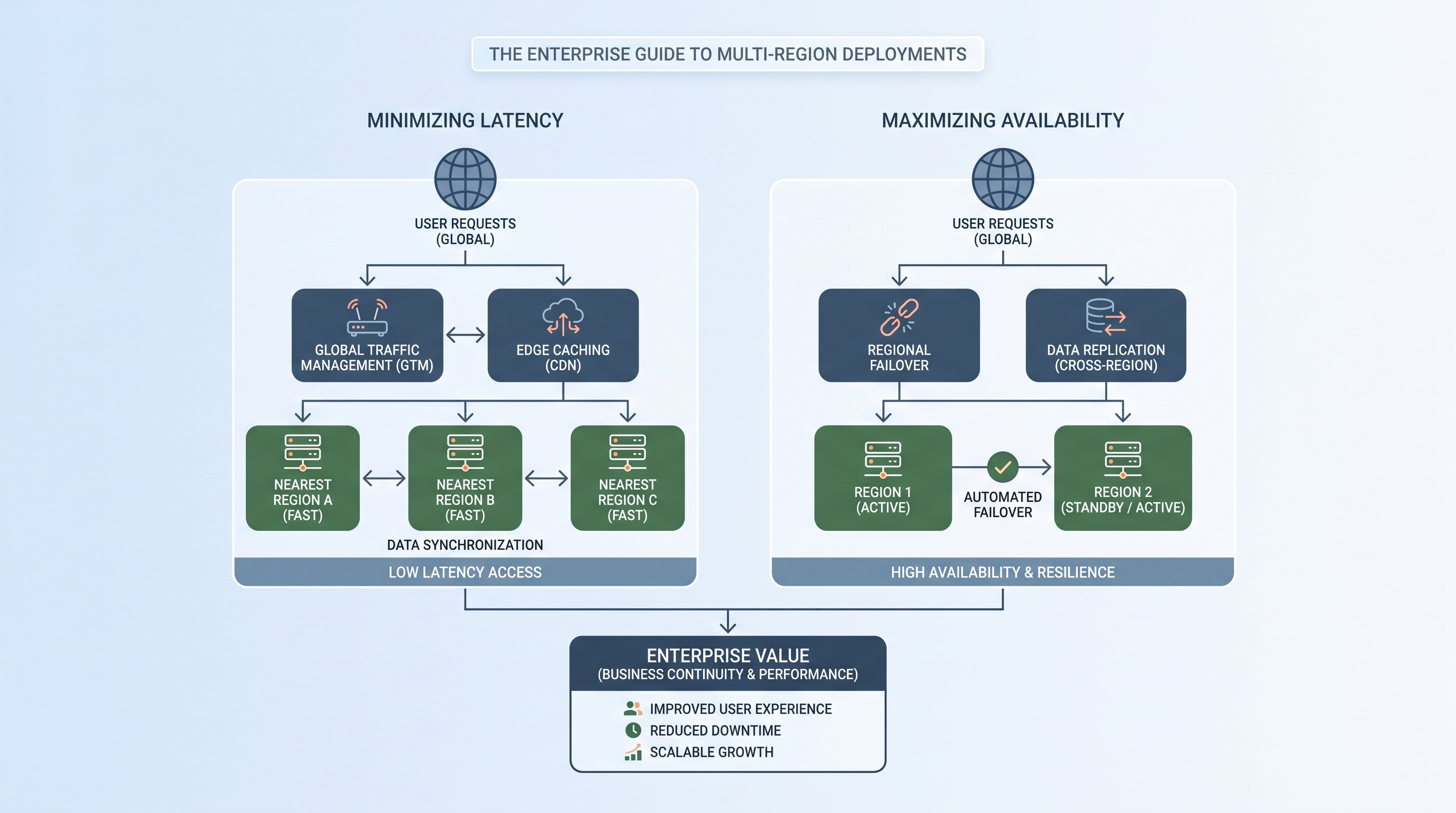
In an active-active architecture, all deployment regions actively receive and process user requests. This pattern offers the lowest possible latency because users are routed to the geographically closest healthy region. It also provides the highest availability; if one region experiences an outage, traffic is dynamically rerouted to the remaining operational regions without manual intervention or cold-start delays.
However, active-active architectures introduce immense complexity in data consistency. If a user in London updates their profile at the same millisecond a user in Tokyo updates theirs, the application must reconcile these writes across regions. SRE and platform engineering teams must deploy advanced SRE and infrastructure solutions to establish automated health checks, circuit breakers, and traffic-shifting policies to prevent regional failures from cascading globally.
3. Low-Latency Traffic Routing: Global Load Balancing and Edge Networking
To successfully route global user traffic to the optimal region, enterprises must bypass standard DNS-based routing in favor of Anycast-based global load balancing and edge networking.
The Limits of DNS-Based Routing
Traditional DNS routing relies on policies like latency-based or geolocation routing to return the IP address of the closest regional load balancer. While simple to implement, DNS-based routing suffers from a major flaw: client-side DNS caching. Internet Service Providers (ISPs), operating systems, and web browsers frequently ignore short Time-To-Live (TTL) settings. During a regional outage, even if you update your DNS records to point away from the failed region, a significant portion of your users will continue sending traffic to the dead region for minutes or hours, rendering your RTO targets unachievable.
Anycast IP Routing and Global Load Balancers
To overcome DNS caching limitations, modern enterprise architectures leverage Anycast IP routing. Under an Anycast model, multiple geographically distributed edge locations advertise the exact same public IP address using Border Gateway Protocol (BGP). When a user initiates a request, the public internet routers naturally send the packets to the physically closest edge location (Point of Presence, or PoP) advertising that IP.
Feature | DNS-Based Routing (e.g., AWS Route 53) | Anycast Global Load Balancing (e.g., AWS Global Accelerator, GCP HTTP(S) LB) |
|---|---|---|
Failover Speed | Slow (minutes to hours due to client-side DNS caching/TTL) | Near-instantaneous (seconds; traffic is rerouted at the edge layer) |
IP Address Stability | Variable (returns different regional IPs) | Static (provides fixed Anycast IPs that never change) |
Network Path | Traverses public internet to reach the regional endpoint | Enters the cloud provider's private, high-speed global backbone immediately at the edge |
TCP Handshake Latency | High (handshake occurs at the destination region) | Low (handshake is terminated at the closest edge PoP) |
By terminating the TCP connection at the edge PoP, the round-trip time (RTT) for the initial TLS handshake is drastically reduced. From the edge PoP, the traffic is routed over the cloud provider's private, fiber-optic global backbone network directly to the target region, avoiding the congested public internet and significantly decreasing packet loss and jitter.
4. Data Layer Architecture: Multi-Region Databases and Replication Topologies
The core bottleneck of any multi-region deployment is the database. While compute and stateless API gateways can scale horizontally across regions with ease, data is bound by the laws of physics and consistency models.
The CAP Theorem and Distributed Consensus
The CAP theorem states that a distributed system can guarantee at most two out of three properties: Consistency, Availability, and Partition Tolerance. In a multi-region deployment, network partitions (P) are an eventual certainty. Therefore, database architects must choose between Consistency (C) and Availability (A).
CP Databases (Consistency & Partition Tolerance): These databases prioritize absolute consistency. Systems like Google Cloud Spanner utilize atomic clocks and GPS receivers (TrueTime API) to execute distributed transactions across regions using Paxos consensus. While this guarantees that all regions read the exact same data simultaneously, write operations incur high latency overhead because a quorum of regions must acknowledge the write before it commits.
AP Databases (Availability & Partition Tolerance): These databases prioritize uptime and low latency. Systems like Amazon DynamoDB Global Tables or Apache Cassandra replicate data asynchronously across regions. Writes are committed locally in milliseconds, and the database engine replicates the changes to other regions in the background (typically under one second). However, this introduces the risk of "dirty reads" where users in different regions see different states of the same record temporarily.
Handling Write Conflicts in Multi-Region Active-Active Databases
When multiple regions accept writes on the same data set, conflicts are inevitable. To handle these conflicts without locking database tables globally, systems utilize several resolution strategies:
Last-Writer-Wins (LWW): The database compares the timestamps of conflicting writes and keeps the latest one. While simple, LWW is highly dependent on NTP clock synchronization. If regional server clocks drift by even a few milliseconds, valid data can be silently overwritten.
Conflict-Free Replicated Data Types (CRDTs): Specialized data structures (like G-Counters or PN-Counters) that can be updated independently and concurrently in different regions. The database engine mathematically merges these states without conflict, ensuring eventual consistency.
Application-Level Resolution: The database preserves both versions of the conflicting write and flags them for the application layer or the user to resolve manually (similar to Git merge conflicts).
5. Securing the Multi-Region Perimeter: IAM, Encryption, and Compliance
A multi-region footprint vastly expands an enterprise's attack surface. Securing this distributed perimeter requires a unified identity plane, localized cryptographic operations, and strict data residency guardrails.
Unified IAM and Policy Drift
Maintaining security posture consistency across multiple regions is one of the greatest operational challenges in public cloud environments. A security group rule, IAM policy, or VPC peering configuration that is correctly applied in us-east-1 might be missing or misconfigured in eu-west-1, creating an exploitable vulnerability. Enterprises must implement continuous, automated cloud security management to monitor and remediate policy drift across all regions, clouds, and accounts in real-time.
Cryptographic Keys: Multi-Region vs. Replica Keys
When encrypting data at rest in a multi-region environment, managing Key Management Service (KMS) cryptographic keys is highly critical. If your application in ap-northeast-1 (Tokyo) needs to decrypt data that was encrypted in us-west-2 (Oregon), making a cross-region API call to Oregon's KMS endpoint for every decryption request adds hundreds of milliseconds of latency and introduces a cross-region dependency.
To solve this, cloud providers offer Multi-Region Keys. These are specialized KMS keys that share the same key ID and key material, allowing them to be replicated across regions. This enables local decryption of ciphertexts in any region without cross-region network hops, maintaining both low latency and high availability.
Data Residency and Sovereign Cloud Compliance
With regulations like GDPR in Europe, CCPA in California, and APRA in Australia, enterprises cannot freely replicate user data globally. Architects must implement regional data partitioning (sharding) strategies. Under this model, while the application's stateless front-end is globally distributed, the database layer is partitioned so that European citizen data remains strictly within EU boundaries, while North American data is stored in US-based regions. Global load balancers must be configured to inspect incoming requests and route traffic to the appropriate regional partition based on user location and data compliance rules.
6. Multi-Region FinOps: Optimizing Cross-Region Data Transfer and Idle Resource Costs
Multi-region architectures are notorious for driving up cloud spend. Without strict FinOps governance, the cost of redundant compute instances, idle standby databases, and cross-region data transfer (CRDT) can quickly exceed the business value of the high-availability architecture.
The Silent Killer: Cross-Region Data Transfer (CRDT)
Cloud providers charge for data that leaves a regional boundary. This applies to database replication, application-to-application communication across VPCs in different regions, and file replication (e.g., S3 cross-region replication). To optimize these costs, engineers must implement the following architectural practices:
Data Compression: Compress payloads using high-performance compression algorithms like Zstandard (zstd) or Brotli before transmitting them across regional boundaries.
Binary Serialization Protocols: Replace verbose JSON or XML payloads with compact binary protocols like Protocol Buffers (Protobuf) or Apache Avro for cross-region internal RPC communication.
Local Caching: Implement aggressive local caching layers (e.g., Redis or Memcached) in each region to minimize the need for cross-region read requests to primary database clusters.
Eliminating Idle Compute and Storage Overhead
Running a 1:1 replica of your primary region's compute infrastructure in a standby region is highly inefficient. To align cloud spend with actual demand, enterprises must deploy a comprehensive financial operations platform that analyzes real-time utilization patterns across all regions and clouds. Standing up active-active environments should be paired with aggressive autoscaling policies that scale down compute and container capacity in regions during their local off-peak hours (e.g., scaling down the European region while Europe sleeps, and scaling up the Asian region as its business day begins).
7. Operational Intelligence: Monitoring and Observability Across Regions
Observability in a single-region deployment is straightforward; in a multi-region, multi-cloud environment, it becomes a distributed systems challenge. Standard monitoring tools often fail to capture the latency anomalies, network partitions, and replication lag that occur across regional boundaries.
Distributed Tracing and Context Propagation
When a user request traverses a global load balancer, hits an edge PoP, routes to a regional API gateway, and triggers an asynchronous database write to another region, tracking that request's lifecycle requires distributed tracing. By utilizing OpenTelemetry standards, applications can inject trace context headers into every network call. This allows operations teams to trace the exact path of a transaction across regions and pinpoint whether a latency spike is occurring in the regional database replication, the edge network, or the local application code.
AI-Driven Anomaly Detection
Traditional threshold-based alerting (e.g., alert if CPU usage exceeds 80%) is insufficient for multi-region architectures. A network partition between two regions might not trigger a CPU alert, but it will cause replication queues to spike, leading to data inconsistency. Enterprises require an advanced Atler AI engine to continuously analyze multi-dimensional telemetry data, automatically baseline normal cross-region latency, and detect subtle anomalies before they escalate into global outages.
Furthermore, managing these complex operational environments requires a centralized command center. By integrating your metrics, logs, traces, and financial data into a unified dashboard for cross-cloud visibility, your SRE, SecOps, and FinOps teams can collaborate from a single pane of glass, ensuring that performance optimizations do not compromise security posture or exceed budget guardrails.
8. Conclusion: Unifying Your Multi-Region Operations with CloudAtler
Building a resilient, low-latency, and cost-effective multi-region cloud architecture is a monumental task. It requires deep expertise in edge networking, distributed databases, cloud security compliance, and financial operations. Trying to manage these disparate domains using native, cloud-specific consoles leads to operational silos, visibility gaps, and runaway costs.
CloudAtler bridges this gap by providing an AI-powered platform that unifies FinOps, cloud security, and automated operations across AWS, Azure, GCP, and Oracle Cloud. With CloudAtler, you can continuously monitor cross-region data transfer costs, automatically detect and remediate security drift across global regions, and leverage predictive AI to optimize your compute and storage footprints in real-time.
Don't let multi-region complexity compromise your availability or drain your budget. Unify your cloud operations with CloudAtler today and take complete control of your global cloud footprint.
All in One Place
Atler Pilot decodes your cloud spend story by bringing monitoring, automation, and intelligent insights together for faster and better cloud operations.