
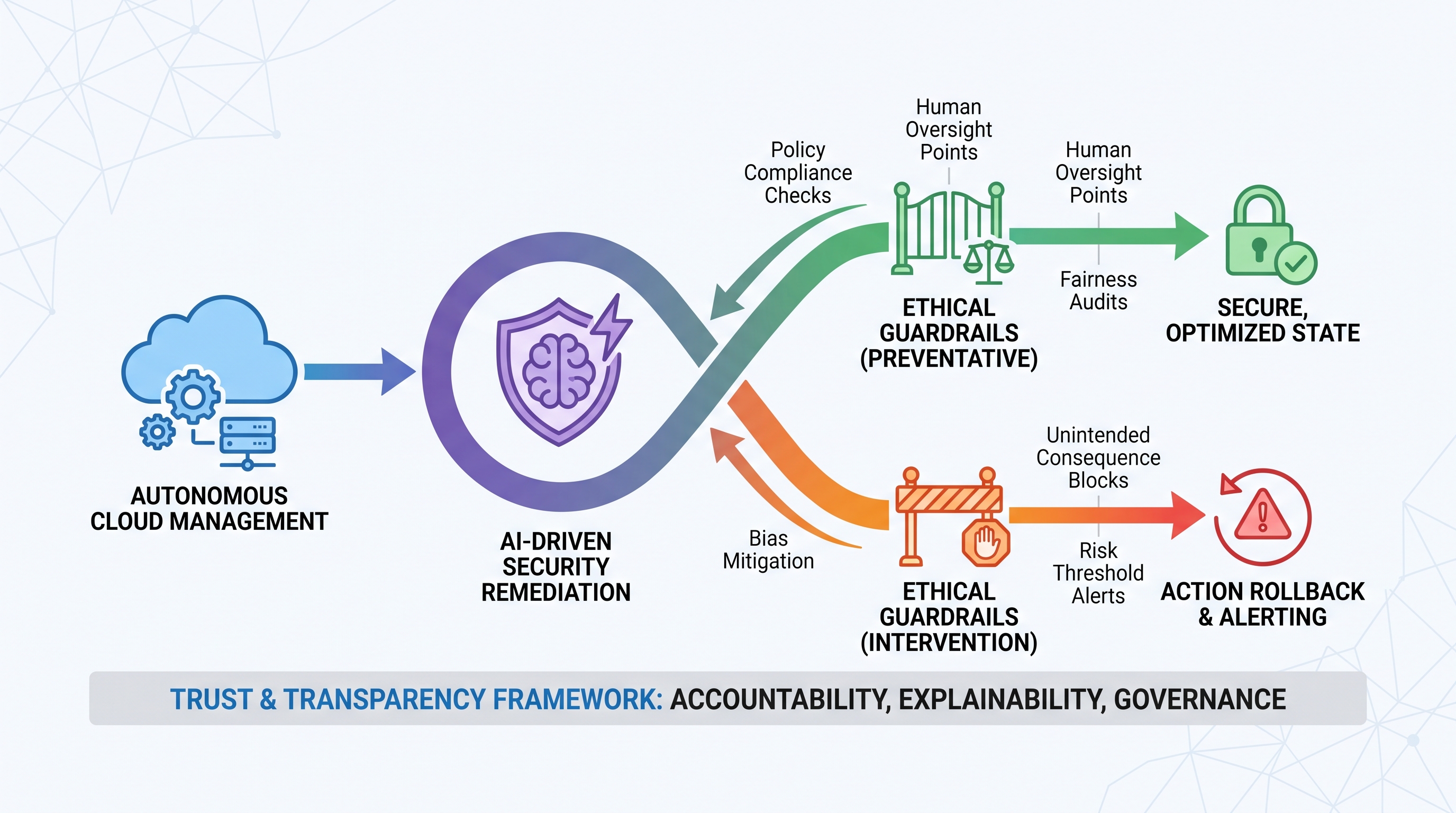
Introduction: The Imperative and Risk of Autonomous Cloud Operations
Modern enterprise cloud architectures are characterized by extreme complexity, massive scale, and ephemeral lifecycles. Operating across AWS, Azure, GCP, and Oracle Cloud Infrastructure (OCI) simultaneously, organizations manage thousands of microservices, serverless functions, and database instances. In this hyper-distributed landscape, security vulnerabilities, configuration drifts, and compliance violations occur at a frequency and velocity that human security operations center (SOC) teams and site reliability engineers (SREs) cannot match.
To bridge this operational gap, the industry is rapidly transitioning from passive monitoring and reactive alerting to autonomous cloud management. Powered by advanced machine learning models and LLM-driven execution agents, these autonomous systems scan, analyze, plan, and execute remediation actions in real time without human intervention. While the promise of near-zero Mean Time to Remediate (MTTR) is highly compelling, it introduces a profound paradigm shift: delegating write-access and architectural decision-making authority to non-deterministic artificial intelligence.
This shift introduces significant operational, financial, and ethical challenges. What happens when an autonomous agent decides to patch a critical zero-day vulnerability in a production Kubernetes cluster, but in doing so, triggers a cascading failure that takes down a multi-million-dollar transactional database? Who is accountable when an AI, attempting to mitigate a denial-of-service attack, spins up thousands of auto-scaled instances, resulting in a catastrophic cloud bill? To prevent these scenarios, enterprises must implement robust, programmatic, and ethical frameworks. We must establish deterministic boundaries—or guardrails—that govern how an AI-driven decision engine operates within production environments.
The Ethical Dimension of Cloud Autonomy
In the context of cloud systems engineering, "ethics" is not an abstract philosophical concept. It is a concrete engineering discipline centered on agency, predictability, transparency, and accountability. When we discuss the ethics of autonomous cloud management, we are addressing several core tenets:
Safety and Non-Maleficence: The primary directive of any autonomous system must be to do no harm. A security remediation action must never cause greater operational disruption than the vulnerability it is designed to cure.
Accountability and Traceability: Every action taken by an autonomous agent must be fully auditable. The system must document not only what action was taken, but the exact telemetry, logic, and policy constraints that led to that decision.
Proportionality and Cost-Awareness: Remediation strategies must balance security posture against financial and performance impacts. An ethical AI agent must evaluate whether a resource-intensive patch is justified by the actual risk profile of the target asset.
Equity in Resource Allocation: Autonomous operations must respect business priorities, ensuring that mission-critical workloads are protected and prioritized over non-production or peripheral systems.
By shifting from manual scripts to intelligent agents like Atler AI, organizations can achieve continuous compliance and self-healing infrastructure. However, this level of autonomy is only ethical and safe when bounded by strict, deterministic validation systems.
The Architecture of an Autonomous Remediation Loop (MAPE-K)
To understand where guardrails must be injected, we must first analyze the classic MAPE-K (Monitor, Analyze, Plan, Execute, Knowledge) reference model adapted for AI-driven cloud operations. This loop runs continuously across multi-cloud environments:
Figure 1: The Autonomous MAPE-K Loop with Built-in Guardrail Verification
[Monitor: Telemetry Ingestion] -> [Analyze: AI Threat Detection] -> [Plan: Remediation Generation] -> {GUARDRAIL ENGINE VALIDATION} -> [Execute: Automated API Call] -> [Knowledge: Feedback & Safe Rollback]
1. Monitor
The system ingests real-time telemetry from cloud provider APIs (AWS CloudTrail, Azure Activity Logs, GCP Audit Logs), security tooling, APM agents, and network flow logs. This high-fidelity data stream provides the context required for decision-making.
2. Analyze
The AI engine parses this data to identify anomalies, misconfigurations, or active exploits. For example, it might detect an open security group rule allowing unrestricted SSH access (0.0.0.0/0) to an instance containing sensitive regulatory data.
3. Plan
Instead of relying on rigid, pre-written bash scripts, the AI engine dynamically generates a remediation plan. This plan might involve modifying an IAM policy, updating a security group, applying an OS patch, or rotating a compromised credential.
4. Guardrail Verification (The Ethical Boundary)
Before the plan moves to the execution phase, it must pass through a decoupled, deterministic policy engine. This engine acts as a gatekeeper, evaluating the planned actions against hard business, security, and financial rules.
5. Execute
If the plan passes validation, the system executes the changes using infrastructure-as-code (IaC) engines, systems managers, or cloud native APIs. If it fails, the action is blocked, logged, and escalated for human review.
6. Knowledge & Feedback
The system monitors the post-remediation state to confirm that the vulnerability is resolved and that system health metrics remain stable. If performance degrades, the system initiates safe rollbacks to return the infrastructure to its last known good state.
The Core Conflict: Autonomy vs. Determinism
The fundamental challenge of deploying AI in production environments is the inherent conflict between the non-deterministic nature of large language models (LLMs) and deep learning systems, and the absolute requirement for determinism in infrastructure management. An LLM might generate three different remediation strategies for the same vulnerability based on subtle variations in prompt context or model temperature. In a production environment, this unpredictability is unacceptable.
Therefore, we must establish a clear separation of concerns: the AI is responsible for generating options and optimizing plans, while a deterministic policy engine is responsible for enforcing boundaries and validating safety. We do not allow the AI to rewrite the safety rules. Instead, we use programmatic, immutable deterministic guardrails that define the absolute sandbox within which the AI can operate.
Designing the Guardrail Framework: Four Operational Pillars
An enterprise-grade guardrail framework must evaluate proposed autonomous actions across four distinct dimensions: Operational, Temporal, Financial, and Security. Below, we explore the architectural design of each pillar.
1. Operational Guardrails (Blast Radius Control)
Operational guardrails prevent cascading failures by limiting the physical and logical scope of any single remediation event. Key mechanisms include:
Concurrency Limits: Restricting the number of parallel modifications the AI can perform. For example, the system may only patch a maximum of 10% of instances in an autoscaling group simultaneously to maintain service availability.
Dependency Awareness: Before restarting or modifying a service, the engine checks dependency graphs (e.g., ensuring a microservice is not modified if the downstream database is currently undergoing maintenance).
State Verification: Ensuring that the target workload is healthy before executing an action. If the target system is already exhibiting high CPU utilization or memory pressure, automated remediation is paused.
2. Temporal Guardrails (Maintenance Windows & Freeze Periods)
Even a technically perfect patch can cause business disruption if executed at the wrong time. Temporal guardrails map business calendars to infrastructure actions:
Production Change Freezes: Restricting write actions during high-traffic events, such as Black Friday for retail, or end-of-quarter processing for financial services.
Maintenance Windows: Restricting intrusive remediations (such as host reboots or major database engine updates) to designated low-traffic hours (e.g., Sundays between 02:00 and 04:00 UTC).
Rate Limiting: Preventing the AI from executing too many changes within a specified timeframe, which could overwhelm monitoring tools and mask underlying issues.
3. Financial Guardrails (FinOps Alignment)
Security remediation often carries a direct financial cost. For example, upgrading an legacy instance type to a newer, secure generation can alter compute costs. Additionally, deploying security agents or spinning up parallel resources for blue-green deployments increases resource consumption. An ethical autonomous manager must evaluate the financial impact of patching before executing changes.
If a proposed remediation action exceeds a pre-defined budget threshold, or if it invalidates cloud provider commitment discounts (such as AWS Savings Plans or Azure Reserved Instances), the guardrail engine must flag the action for human review. This ensures that security decisions are never made in a financial vacuum, aligning CISO objectives with corporate FinOps strategies.
4. Security and Identity Guardrails (Least Privilege for AI)
An autonomous agent is only as safe as the identity permissions granted to it. Organizations must enforce strict security boundaries on the agent itself:
Granular IAM Roles: The AI engine must not run with wildcard administrative privileges (e.g.,
"Effect": "Allow", "Action": "*"). Instead, it must utilize scoped IAM roles with permissions limited to specific resource types and actions.Resource Tagging Boundaries: Utilizing Attribute-Based Access Control (ABAC) to restrict the AI's operations to resources tagged with specific metadata (e.g.,
Environment=DevelopmentorRemediationGroup=Auto).Immutable Exclusions: Explicitly blacklisting critical infrastructure components—such as root DNS zones, core networking hubs, or active directory controllers—from any automated modification.
Technical Implementation: A Guardrail Policy Engine in Action
To demonstrate how these concepts translate into real-world code, let us look at an example of a declarative guardrail policy written in JSON. This policy defines the operational, temporal, and financial boundaries for an autonomous agent attempting to remediate an exposed port vulnerability on an AWS EC2 instance.
{
  "$schema": "https://cloudatler.com/schemas/guardrail-policy-v1.json",
  "policyId": "GR-SEC-EC2-042",
  "description": "Deterministic boundaries for autonomous EC2 security group remediation",
  "targetEnvironment": {
    "providers": ["aws"],
    "environments": ["production"],
    "tags": {
      "DataClassification": ["Confidential", "Restricted"]
    }
  },
  "operationalConstraints": {
    "maxConcurrencyPercent": 15,
    "requirePreHealthCheck": true,
    "allowedDowntimeSeconds": 0,
    "rollbackStrategy": "automatic-immediate"
  },
  "temporalConstraints": {
    "allowedExecutionWindows": [
      {
        "dayOfWeek": "Sunday",
        "startTimeUTC": "01:00",
        "endTimeUTC": "05:00"
      }
    ],
    "blackoutPeriods": [
      {
        "name": "Q4 Holiday Freeze",
        "startDate": "2024-11-20T00:00:00Z",
        "endDate": "2025-01-02T00:00:00Z"
      }
    ]
  },
  "financialConstraints": {
    "maxActionCostDeltaMonthlyUSD": 150.00,
    "preventCommitmentInvalidation": true
  },
  "executionBoundaries": {
    "permittedActions": [
      "ec2:RevokeSecurityGroupIngress",
      "ec2:AuthorizeSecurityGroupIngress"
    ],
    "forbiddenActions": [
      "ec2:TerminateInstances",
      "ec2:DeleteSecurityGroup"
    ]
  }
}
In this policy, if the AI engine detects an exposed security group and plans to remediate it, the guardrail engine evaluates the proposal against this schema:
It checks if the target resource is in
productionand has a tag ofDataClassification=Confidential.It ensures that the action will not cause any downtime, and that no more than 15% of the fleet will be modified at once.
It verifies that the current time falls within the Sunday maintenance window and is not during the Q4 change freeze.
It confirms that any cost delta (e.g., if the remediation requires provisioned IOPS changes or network routing modifications) is under $150/month and does not disrupt reserved capacity.
Finally, it ensures that the API call is strictly limited to ingress modifications and will not terminate the instance.
The Human-in-the-Loop (HITL) Spectrum
Implementing guardrails does not mean eliminating human oversight. Rather, it optimizes human intervention. We define a spectrum of autonomy based on risk severity, asset criticality, and historical confidence scores:
Autonomy Tier | Risk Level | Execution Model | Typical Use Case |
|---|---|---|---|
Full Autonomy | Low | Immediate auto-remediation with asynchronous logging. | Removing unused IAM roles, deleting unattached EBS volumes, patching non-prod environments. |
Bounded Autonomy | Medium | Auto-remediation executed only within approved maintenance windows. | Applying minor OS patches to web servers, modifying security group rules on internal subnets. |
Human-in-the-Loop | High | AI plans remediation; execution requires explicit human approval via ChatOps or ITSM. | Database engine upgrades, major network route table modifications, IAM policy changes on admin groups. |
Air-Gapped / Manual | Critical | AI is blocked from execution. System generates alerts and architectural recommendations only. | Modifying root DNS configurations, migrating core database clusters, active directory schema updates. |
By categorizing risks, organizations can design workflows where senior engineers are not fatigued by low-level alert triage, yet retain full control over high-impact operational changes. Security leaders can deploy CISO security solutions that combine automated velocity with human governance, providing confidence to external auditors and internal compliance teams alike.
Real-World Operational Scenarios
Let us explore how these guardrails function in real-world operational scenarios, highlighting the difference between unconstrained AI and guardrailed AI.
Scenario A: The Runaway Patch
The Event: A vulnerability scanner identifies a critical remote code execution (RCE) vulnerability in an open-source library running on a fleet of production virtual machines.
Unconstrained AI Behavior: The AI agent immediately initiates a rolling upgrade across all instances to apply the security patch. However, the updated library contains a breaking change that causes the application to crash on startup. The entire production fleet goes offline, resulting in an extended outage.
Guardrailed AI Behavior: The AI agent plans the upgrade. The guardrail engine intercepts the plan and enforces a 10% maximum concurrency limit. It updates the first instance, runs an automated health check, and detects that the application is failing to respond to HTTP probes. The guardrail engine halts further deployment and triggers safe rollbacks on the modified instance, preventing an outage and alerting the SRE team with detailed debugging telemetry.
Scenario B: The Cost-Blind DDoS Mitigation
The Event: A web application experiences an unexpected surge in malicious traffic, mimicking a distributed denial-of-service (DDoS) attack.
Unconstrained AI Behavior: The AI agent scales up the compute infrastructure, provisioning hundreds of high-performance instances to handle the traffic load, while also enabling premium web application firewall (WAF) rules across multiple regions. The attack is mitigated, but the company incurs a massive, unbudgeted cloud bill overnight.
Guardrailed AI Behavior: The AI agent attempts to scale the infrastructure. The guardrail engine evaluates the projected cost against the daily budget threshold. Detecting a breach of the financial guardrail, it restricts the maximum scaling limit, enables localized rate-limiting rules on the existing edge routers, and routes the traffic through a pre-negotiated CDN partner instead, mitigating the threat within acceptable cost parameters.
The Role of Explainable AI (XAI) in Cloud Governance
For autonomous operations to be truly ethical, they must be transparent. Black-box decision-making is a significant liability in regulated industries. Explainable AI (XAI) ensures that the reasoning behind every automated decision is understandable to human operators.
When an agent remediates a vulnerability, it must generate an audit trail that explains:
The telemetry data that triggered the action.
The specific security policies or compliance frameworks (e.g., SOC 2, PCI-DSS, HIPAA) that were violated.
The alternative remediation strategies that were considered and why they were rejected.
The deterministic guardrail checks that were executed and passed.
This level of detail is invaluable during post-incident reviews, compliance audits, and system tuning, turning security operations into a continuous learning loop.
Conclusion: Unifying Cloud Operations Safely
Autonomous cloud management is no longer a futuristic concept; it is an operational necessity for enterprises navigating the scale of modern multi-cloud architectures. However, the speed of AI must be balanced with the safety of deterministic guardrails. By implementing a structured framework that respects operational, temporal, financial, and security boundaries, organizations can harness the power of autonomous remediation without compromising stability, budget, or control.
Ethical AI in cloud operations means building systems that are safe, transparent, and aligned with business goals. When security, SRE, and FinOps teams collaborate to define these guardrails, they create a resilient, self-healing cloud infrastructure that protects both the company's assets and its bottom line.
All in One Place
Atler Pilot decodes your cloud spend story by bringing monitoring, automation, and intelligent insights together for faster and better cloud operations.