
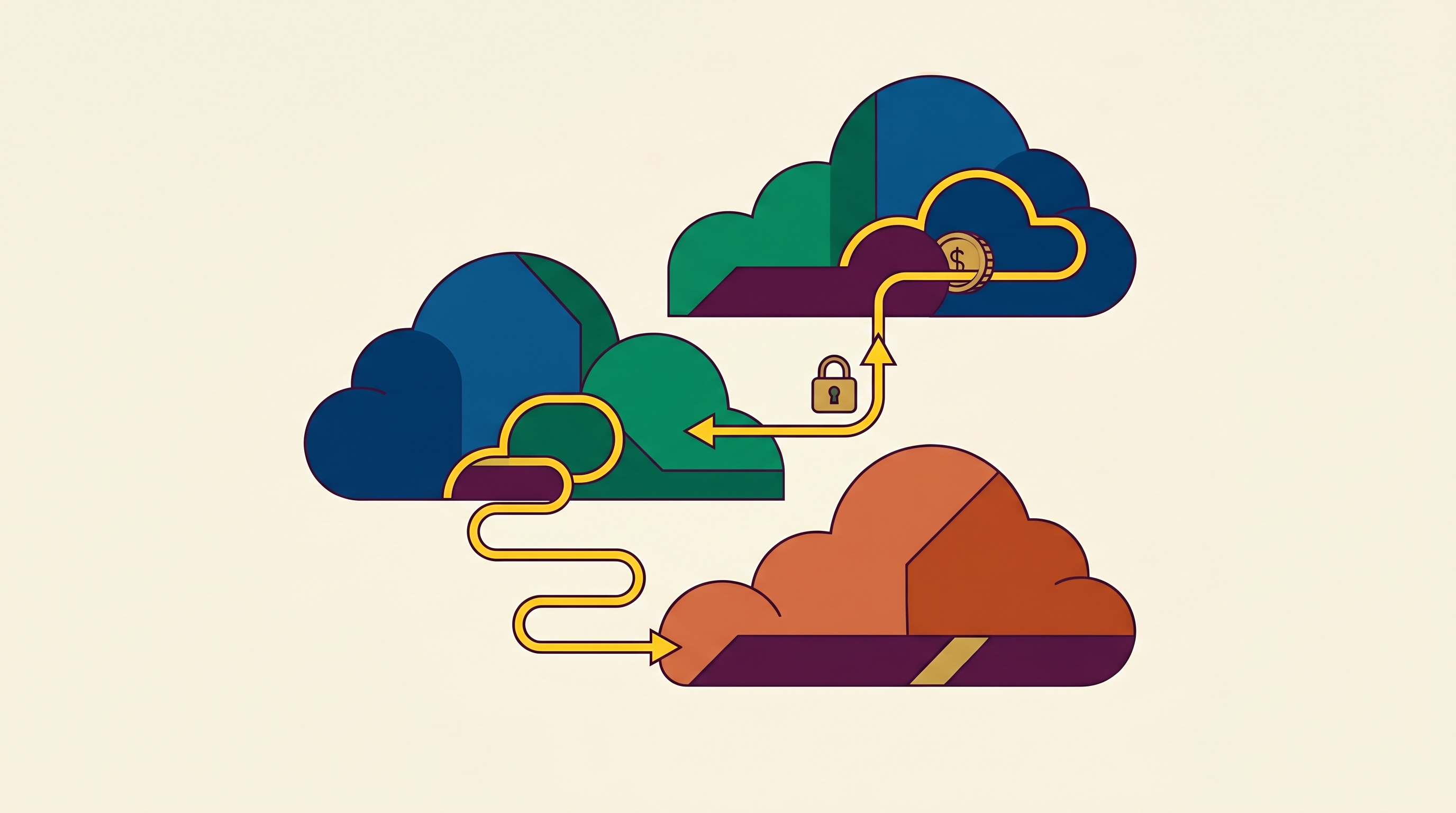
The Deceptive Economics of Cloud Networking
When engineering teams architect massive, globally distributed cloud platforms, the financial models typically fixate on compute provisioning (EC2, GCE, Kubernetes nodes) and persistent storage (S3, EBS, BigQuery). These metrics are tangible, easily conceptualized, and prominently displayed on cloud provider pricing calculators. However, lurking beneath these massive line items is the most insidious, opaque, and frequently catastrophic driver of cloud expenditure: network egress. Cloud providers structure their network billing to enforce data gravity. Ingress—the act of moving data into the cloud provider's ecosystem—is almost universally free, encouraging massive data centralization. Conversely, egress—moving data out to the internet, across geographical regions, or to competitor clouds—incurs steep, volumetric charges. In modern multi-cloud, microservices-driven architectures, where petabytes of data traverse complex topological boundaries daily, unchecked egress can rapidly mutate into the single largest component of an enterprise's monthly cloud invoice. This comprehensive technical analysis deconstructs the mechanics of cloud network billing, exposing the hidden architectural decisions that generate massive egress costs, and detailing advanced FinOps strategies to neutralize them.
The transition from monolithic applications to heavily decoupled, multi-cloud architectures dramatically amplifies network traffic. A single user request that previously resulted in a local function call within an on-premises server now triggers a cascade of gRPC and REST API calls traversing virtual private clouds (VPCs), availability zones (AZs), and occasionally entirely different cloud providers. If a massive enterprise embraces a multi-cloud strategy—perhaps utilizing AWS for raw compute and Google Cloud for specialized machine learning—the requisite data transfer between these disparate environments crosses the internet boundary, triggering the highest possible tier of egress pricing. Managing this complexity requires a profound shift in architectural thinking. Network topologies must be explicitly designed with financial efficiency as a primary constraint, mandating the rigorous application of caching, topological localization, and advanced routing intelligence.
Deconstructing the Egress Billing Vectors
To optimize egress, Cloud Architects must first decipher the granular billing vectors implemented by hyperscalers like AWS, Azure, and GCP. The cost of transferring a gigabyte of data is not absolute; it is entirely dependent on the topological boundaries the data crosses. Understanding these boundaries is the foundation of FinOps network optimization.
Intra-Availability Zone (Intra-AZ) Transfer
Data transfer within the same Availability Zone (e.g., from an EC2 instance to an ElastiCache Redis node located within us-east-1a) using private IP addresses is generally free. This represents the optimal topological baseline. The core FinOps directive is to maximize intra-AZ traffic by ensuring that highly interdependent microservices, caching layers, and database primary nodes are tightly colocated within the same physical datacenter boundary.
Cross-Availability Zone (Cross-AZ) Transfer
To achieve high availability (HA), architectures mandate spanning multiple AZs. However, crossing an AZ boundary (e.g., traffic between us-east-1a and us-east-1b) incurs a charge, typically $0.01 per GB in both directions (egress from AZ-a and ingress into AZ-b, effectively costing $0.02 per GB transferred). While seemingly nominal, in highly chatty microservice environments—where massive JSON payloads or uncompressed video streams are constantly synchronized between primary and replica database nodes or distributed message queues like Kafka—these micro-charges accumulate massively. A seemingly robust architecture utilizing active-active database replication across three AZs can silently generate thousands of dollars in monthly network fees purely to maintain data consistency.
Cross-Region and Inter-Cloud Transfer
Data leaving a specific geographical region (e.g., replicating a database from us-east-1 in Virginia to eu-west-1 in Ireland) incurs significantly higher egress fees, typically ranging from $0.02 to $0.09 per GB depending on the destination. This is the primary financial risk of global disaster recovery (DR) architectures. If an enterprise blindly implements synchronous replication of all data across oceans, the egress costs will frequently eclipse the cost of the storage itself. Inter-cloud transfer—moving data from AWS directly to Google Cloud or Azure over the public internet—is billed at the standard outbound internet data transfer rate, which is the most punitive tier, often exceeding $0.09 per GB. This punitive pricing tier is specifically designed by cloud providers to penalize multi-cloud architectures and enforce vendor lock-in via data gravity.
NAT Gateway Architecture: The Silent Cost Multiplier
A classic architectural blunder causing massive egress bloat involves the mismanagement of Network Address Translation (NAT) Gateways. Security best practices dictate placing compute nodes in private subnets with no direct internet access. To download software updates or access external third-party APIs, these nodes route traffic through a NAT Gateway located in a public subnet. Cloud providers bill for NAT Gateways based on an hourly provisioning fee and, crucially, a per-GB data processing fee (typically $0.045 per GB in AWS). If massive EC2 instances in private subnets are heavily pulling data from external internet sources, or worse, downloading massive objects from S3 via the NAT Gateway rather than utilizing a free VPC Endpoint, the organization pays a massive, entirely avoidable processing tax. Identifying and eliminating redundant NAT Gateway traffic is frequently the most immediate, high-impact victory for a FinOps engineering team.
The Multi-Cloud Trap and Data Gravity
The strategic allure of multi-cloud architectures is undeniable: avoiding vendor lock-in, leveraging best-of-breed services (e.g., AWS EC2 combined with GCP BigQuery), and negotiating pricing leverage. However, the operational reality is frequently a FinOps nightmare dominated by data egress. Data has mass; it is relatively cheap to store but exorbitantly expensive to move.
Consider a retail enterprise utilizing AWS for its primary e-commerce web fleet and transaction processing, while utilizing Google Cloud BigQuery for massive, organization-wide data analytics. To populate BigQuery, the enterprise must extract terabytes of transactional data daily from AWS RDS databases and stream it across the internet to Google Cloud Storage. AWS will bill the enterprise heavily for this outbound internet egress. The enterprise is effectively paying a massive daily tax purely to maintain its multi-cloud posture. To mitigate this, architects must minimize the volume of data crossing the cloud boundary. This involves aggressive pre-aggregation: running lightweight Spark jobs within AWS to summarize the transactional data into highly compressed, aggregated Parquet files before initiating the cross-cloud transfer. Sending summary statistics rather than raw atomic event logs can reduce inter-cloud egress by 99%.
Dedicated Interconnects and Peering Agreements
For enterprises committed to massive, continuous multi-cloud architectures, routing traffic over the public internet is financially suicidal. The FinOps solution is establishing dedicated, private network connections, such as AWS Direct Connect, Google Cloud Interconnect, or Azure ExpressRoute. These services provide a physical, dedicated fiber connection between the enterprise's on-premises data centers and the cloud provider, or via third-party colocation facilities (like Equinix) to peer multiple clouds directly.
While Direct Connect incurs a significant fixed hourly port fee, it drastically reduces the variable per-GB data transfer rate (often dropping egress costs from $0.09/GB to $0.02/GB). The FinOps calculation involves determining the exact breakeven point. If an organization consistently transfers hundreds of terabytes monthly across cloud boundaries, the massive reduction in the per-GB rate vastly outweighs the fixed monthly cost of maintaining the physical Direct Connect circuit. Furthermore, dedicated interconnects provide consistent, low-latency performance immune to internet congestion routing anomalies, delivering simultaneous financial and operational benefits.
Content Delivery Networks (CDNs) and Egress Shielding
For applications serving massive volumes of static assets (images, CSS, JavaScript files) or streaming video to global end-users, serving this data directly from central cloud servers (like S3 or EC2) across the outbound internet boundary is financially ruinous. A 5MB image downloaded one million times per day generates 5 Terabytes of daily internet egress, resulting in massive, compounding cloud bills.
The indispensable architectural defense is the implementation of a Content Delivery Network (CDN) like Amazon CloudFront, Cloudflare, or Fastly. A CDN caches static assets at edge locations globally distributed close to the end-users. When a user requests an image, it is served directly from the local edge cache rather than traversing the internet back to the origin cloud server. This drastically reduces latency and fundamentally alters the FinOps equation.
The Economics of the Origin Shield
Cloud providers heavily incentivize utilizing their native CDNs. For example, AWS explicitly waives the egress data transfer fees for data moving from an AWS origin (like S3 or EC2) into Amazon CloudFront. You only pay the CloudFront egress rates, which are significantly lower than standard EC2 internet egress rates, and benefit from substantial volume discount tiers. Furthermore, by implementing aggressive cache-control headers, organizations can achieve cache hit ratios exceeding 95%. This means 95% of user traffic is served cheaply from the edge, while only 5% of traffic hits the origin servers, massively shielding the core cloud infrastructure from expensive internet egress charges.
However, if an enterprise utilizes a third-party CDN (like Cloudflare) while maintaining origins in AWS, they must be extremely cautious. Data transferring from AWS S3 to Cloudflare traverses the internet boundary and incurs standard AWS internet egress fees. If the cache hit ratio is poor, the enterprise will pay massive AWS egress fees to populate the Cloudflare cache, negating the financial purpose of the CDN. Advanced FinOps architectures address this by utilizing Cloudflare's Bandwidth Alliance (which partners with specific cloud providers to waive egress fees) or by implementing an intermediate "Origin Shield" layer—a centralized caching tier within the cloud provider that aggregates requests from global edge nodes, radically minimizing the frequency of expensive pulls from the primary storage buckets.
Optimizing Container Registry Propagation
In modern CI/CD pipelines deploying massive Kubernetes clusters, container registry egress is a pervasive, silent cost driver. Production-grade container images (Docker images) are frequently massive, often exceeding 500MB due to underlying OS layers, language runtimes, and machine learning models. Every time a new microservice version is deployed, hundreds or thousands of worker nodes across multiple Availability Zones or geographical regions must pull this updated image from a central registry (e.g., AWS Elastic Container Registry - ECR).
If a massive Kubernetes cluster spanning three AZs pulls a 1GB image update to 1,000 nodes, that single deployment generates 1 Terabyte of cross-AZ or internet egress traffic depending on network configuration. If the organization deploys ten times a day, the resulting network bill is catastrophic. Optimizing this requires structural changes to the CI/CD pipeline and node configuration.
VPC Endpoints and Image Optimization
The primary FinOps defense against registry egress is deploying VPC Endpoints (AWS PrivateLink). A VPC Endpoint establishes a direct, private connection between the VPC housing the Kubernetes nodes and the ECR service, entirely bypassing the NAT Gateway and the public internet. This eliminates the massive NAT Gateway data processing fees associated with pulling images. Furthermore, engineering teams must mandate rigorous container image optimization. Transitioning from massive Ubuntu base images to ultra-lean Alpine Linux or distroless images can shrink container sizes by 80%. Adopting multi-stage Docker builds ensures that massive compile-time dependencies are stripped from the final runtime artifact. By combining private VPC Endpoints with heavily optimized, minified container images, organizations radically fractionalize the volume of network traffic generated during continuous deployment operations.
Kafka, Data Replication, and Chatty Architectures
Distributed messaging systems, most notably Apache Kafka, are the central nervous systems of modern event-driven architectures. They process billions of events daily, decoupling microservices and providing robust asynchronous communication. However, this robust decoupling involves continuous, high-velocity data transfer. In highly available deployments, Kafka clusters span multiple Availability Zones. Every message published to the primary partition in AZ-A must be synchronously replicated to the follower partitions in AZ-B and AZ-C to ensure zero data loss during a failure.
This intra-cluster replication generates colossal volumes of cross-AZ network traffic. Furthermore, microservices consuming these massive message streams are frequently located in different AZs than the primary Kafka brokers. A FinOps analysis of a massive Kafka deployment frequently reveals that the underlying EC2 compute costs are dwarfed by the cross-AZ egress charges incurred simply by moving the events between producers, brokers, and consumers. Optimizing this requires deep architectural surgery.
Topology-Aware Routing and Payload Compression
The most effective strategy to mitigate Kafka cross-AZ costs is implementing Topology-Aware Routing (or Rack Awareness). Modern Kafka clients and brokers can be configured to prioritize fetching data from replicas located within their own specific physical Availability Zone. If a consumer application resides in AZ-B, it should read data from the local Kafka follower in AZ-B, rather than traversing the AZ boundary to read from the primary broker in AZ-A. This single configuration change localizes massive volumes of read traffic, instantly eliminating a massive vector of cross-AZ billing.
Simultaneously, aggressive payload compression is mandatory. Transmitting massive, uncompressed JSON payloads via Kafka is exceptionally inefficient. Engineering teams must implement strong schema registries and utilize efficient binary serialization formats like Apache Avro or Protocol Buffers (Protobuf). Furthermore, enabling aggressive network-level compression (like Snappy or LZ4) at the Kafka producer level ensures that the data traversing the cross-AZ replication links is as compact as possible. A transition from uncompressed JSON to Snappy-compressed Protobuf routinely reduces Kafka network egress volumes by 70% to 90%, yielding commensurate financial savings.
Implementing Advanced FinOps Observability with CloudAtler
Optimizing egress is fundamentally an exercise in visibility. Cloud provider invoices present egress costs as massive, aggregated line items, making it utterly impossible to attribute the expenditure to specific applications, microservices, or engineering teams. Without granular visibility, FinOps practitioners are reduced to guessing which systems are generating the traffic.
Achieving absolute visibility requires the pervasive deployment and rigorous analysis of VPC Flow Logs. VPC Flow Logs capture detailed metadata regarding every IP packet traversing the cloud network interfaces, detailing the source IP, destination IP, port, protocol, and exact byte volume. However, raw VPC Flow Logs generate terabytes of unreadable data daily. Processing this data manually using Athena or generic BI tools is an immense operational burden.
This is the domain where specialized FinOps platforms like CloudAtler are indispensable. CloudAtler ingests the massive streams of VPC Flow Logs, enriches them with active cloud metadata (EC2 instance tags, Kubernetes pod namespaces, ELB identifiers), and applies advanced heuristic analysis. CloudAtler visually maps the entire enterprise network topology, instantaneously identifying highly anomalous egress vectors. It pinpoints the specific EC2 instance in a private subnet downloading gigabytes of data via an expensive NAT Gateway. It identifies the specific Kubernetes namespace generating excessive cross-AZ Kafka traffic due to misconfigured routing. By transforming billions of raw network packets into actionable, human-readable FinOps intelligence, CloudAtler enables engineering teams to execute surgical architectural interventions, eliminating wasteful egress at the source rather than reacting to massive invoices at the end of the month.
The Financial Impact of Database Architectural Patterns
Database synchronization strategies frequently mask massive egress liabilities. Consider a global application architecture utilizing an active-active, multi-region database (like DynamoDB Global Tables or CockroachDB). This architecture provides unparalleled resilience and low-latency reads for global users. However, every write operation performed in the US-East region must be asynchronously replicated over the cloud provider's global backbone to the EU-West and AP-South regions to maintain eventual consistency.
This continuous, global replication incurs premium inter-region data transfer charges. If the application is highly write-intensive—for example, logging high-frequency IoT telemetry data or granular user clickstreams—the cross-region egress costs will rapidly escalate into the tens of thousands of dollars monthly. FinOps optimization demands a critical evaluation of consistency requirements. Does raw, atomic clickstream data genuinely require synchronous global replication? Frequently, the answer is no. A significantly cheaper architecture involves keeping atomic, high-volume write data localized to its origin region. The enterprise then executes lightweight, asynchronous batch jobs to aggregate the telemetry into summarized metrics, and only replicates the highly compressed, low-volume summary data across the global backbone for central reporting. Distinguishing between data that demands global consistency and data that can remain fiercely localized is a hallmark of sophisticated, cost-aware cloud architecture.
Negotiation Strategies and Strategic FinOps Commitments
While architectural optimization is paramount, massive enterprises possessing significant cloud spend must leverage financial negotiation to mitigate egress pain. Hyperscalers publicly publish standard egress rates, but these rates are highly negotiable for massive commit tier customers.
Enterprises transferring petabytes of data monthly should negotiate a Discounted Data Transfer pricing tier or an Enterprise Discount Program (EDP). Furthermore, organizations heavily utilizing AWS CloudFront should negotiate custom private pricing agreements based on committed monthly traffic volumes, often securing discounts exceeding 50% off the public rates. The most advanced FinOps teams align their architectural optimization efforts with these negotiation cycles. By demonstrating deep control over their infrastructure and the capability to aggressively shift traffic to cheaper routing paths (or alternative CDNs if negotiations fail), organizations maximize their leverage during contract renewals. The ultimate goal is a synthesis of engineering discipline and financial acumen: architecting the platform to fundamentally minimize the raw bytes traversing expensive boundaries, while simultaneously negotiating the lowest possible unit cost for the irreducible traffic that remains.
Conclusion: The Imperative of Network Localization
In the expansive, heavily abstracted reality of modern cloud computing, the physical constraints of networking have reasserted themselves primarily through financial penalties. The era of carelessly transmitting massive JSON payloads across global availability zones without regard for the underlying topological implications has ended. As microservice architectures continue to fragment application logic, the network is no longer merely the connective tissue; it is a primary driver of operational expenditure.
Mastering the FinOps of multi-cloud architectures demands a ruthless commitment to data localization. Cloud Architects must prioritize intra-AZ connectivity, aggressively deploy intelligent caching layers at the edge to shield origin servers, heavily scrutinize the necessity of multi-region replication, and immediately dismantle redundant NAT Gateway routing. By embedding advanced network observability tools like CloudAtler directly into the CI/CD pipeline, organizations can shift egress cost analysis left, detecting and remediating inefficient traffic patterns before they manifest on the monthly invoice. The organizations that thrive in the multi-cloud era will not be those with the most complex distributed architectures, but those who engineer deep financial efficiency directly into the routing fabric of their digital platforms.
All in One Place
Atler Pilot decodes your cloud spend story by bringing monitoring, automation, and intelligent insights together for faster and better cloud operations.