
The Illusion of "Free" Internal Cloud Traffic
To the application developer, a Kubernetes cluster presents itself as a unified, homogeneous pool of compute, memory, and network resources. You define a Service, deploy your Pods, and let the control plane handle the placement. Under the hood, however, this abstraction layer sits atop a highly complex, physical, and multi-zoned cloud infrastructure. In public cloud environments like AWS, Azure, and GCP, this abstraction comes with a significant, often invisible financial premium: cross-Availability Zone (AZ) data transfer fees.
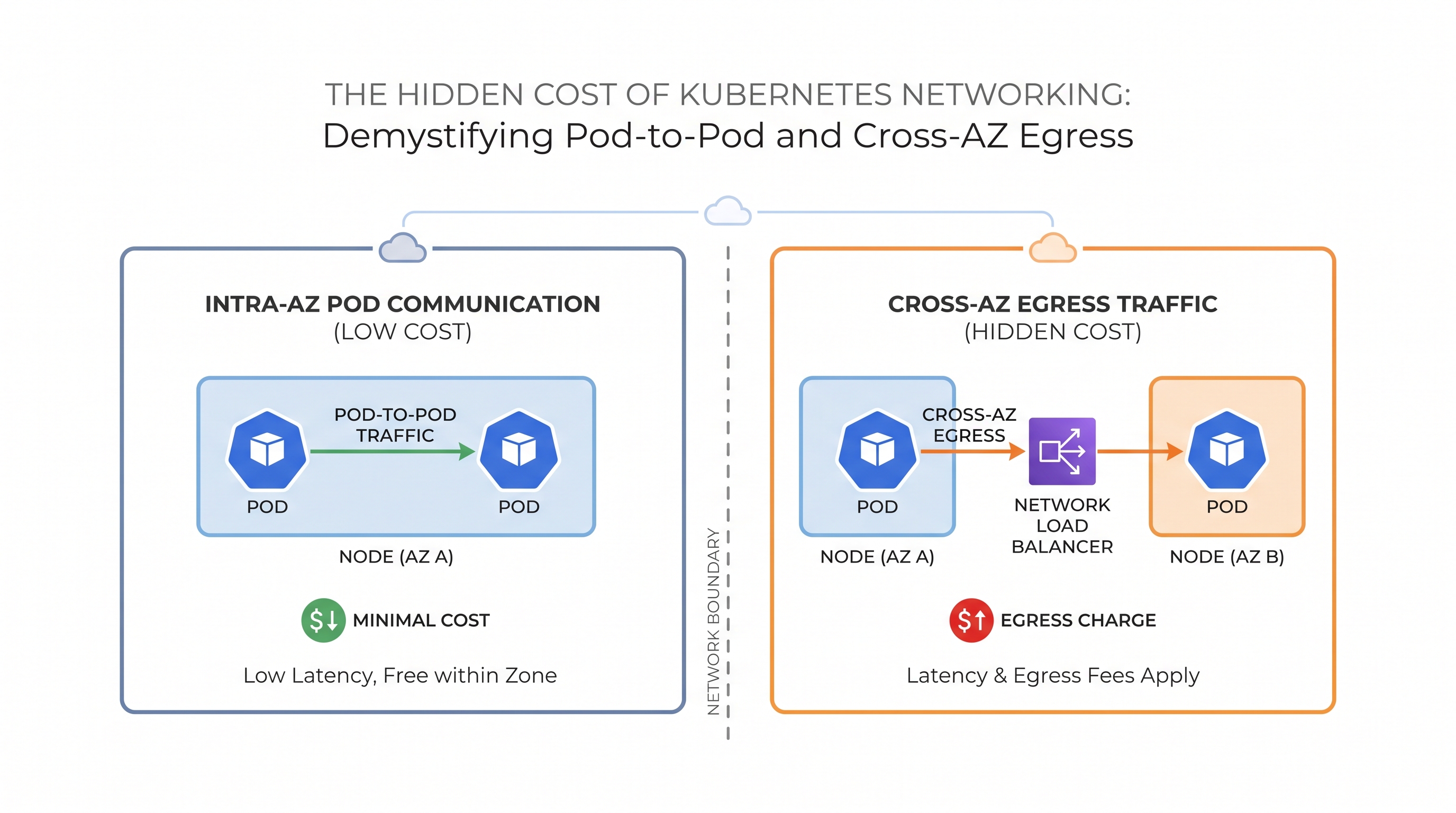
By default, the Kubernetes scheduler (kube-scheduler) prioritizes high availability and resource utilization when distributing workloads. It spreads replica sets across as many fault domains (nodes and AZs) as possible. While this design pattern is ideal for disaster recovery and fault tolerance, it ignores the physical topology of the network. When Pod A in Availability Zone East-1a communicates with Pod B in Availability Zone East-1b, the traffic traverses the cloud provider's physical inter-AZ fiber network.
Cloud providers do not charge for network traffic within the same Availability Zone. However, the moment a packet crosses an AZ boundary, billing meters begin to spin. Because Kubernetes services default to a round-robin routing mechanism across all available endpoints, a massive percentage of your internal microservice communication is silently routing across AZs, incurring data transfer charges in both directions. Managing these variable costs requires a robust financial operations platform that correlates cluster topology with real-time billing metrics to expose these hidden inefficiencies.
The Anatomy of a Cross-AZ Network Packet
To understand why cross-AZ traffic is so expensive and latency-inducing, we must trace the precise path of a network packet as it travels from one Pod to another across zone boundaries. Let us examine a standard Kubernetes cluster utilizing a Virtual Extensible LAN (VXLAN) overlay network, which is common in CNIs like Calico, Flannel, or Cilium in overlay mode.
Consider Pod A, running on Node 1 in us-east-1a, attempting to send an HTTP POST request to Pod B, running on Node 2 in us-east-1b. The logical path is a simple API call. The physical path, however, is far more tortuous:
Socket Creation & CNI Interception: The application in Pod A initiates a TCP connection. The packet leaves the Pod's network namespace via a virtual ethernet pair (
veth) connected to the host's root network namespace.Encapsulation: The Container Network Interface (CNI) agent on Node 1 intercepts the packet. Because Node 2 is on a different subnet, the CNI encapsulates the original inner Ethernet/IP packet inside an outer UDP packet (typically using destination port 4789 for VXLAN). This encapsulation adds a 50-byte overhead (VXLAN, UDP, IP, and Ethernet headers) to every single packet, reducing the effective Maximum Transmission Unit (MTU) and increasing CPU serialization overhead.
Host Routing & Hypervisor Egress: The host operating system routes the encapsulated UDP packet through its physical interface (e.g.,
eth0). The packet hits the cloud provider's hypervisor layer.Physical Transit & Egress Metering: The hypervisor identifies that the destination IP (Node 2) resides in a different physical datacenter (AZ
us-east-1b). The cloud provider's software-defined network (SDN) routes the packet across the inter-AZ backbone. At this exact boundary, the cloud provider's billing infrastructure logs the source IP, destination IP, and packet size in bytes for egress billing.Ingress & Decapsulation: The packet arrives at the hypervisor of Node 2 in
us-east-1b. It is delivered to the host's physical interface. The CNI on Node 2 intercepts the UDP port 4789 packet, strips the outer VXLAN headers, and injects the original inner packet into Pod B’s network namespace.
This process introduces latency (typically 1 to 2 milliseconds of inter-AZ transit time compared to sub-millisecond intra-AZ transit) and incurs a standard cloud charge. In AWS, for example, inter-AZ data transfer is priced at $0.01 per GB in each direction (sending and receiving), resulting in a total round-trip cost of $0.02 per GB of transferred data. For high-throughput applications, such as distributed databases, log aggregators, or real-time streaming engines, this cost quickly scales from a minor line item to tens of thousands of dollars per month.
Quantifying the Financial Blast Radius
To illustrate the financial impact, let us calculate the monthly networking cost of a standard microservice architecture. Imagine a transaction processing system consisting of three tiers: an API Gateway, a Transaction Service, and a Database cluster. The system processes 500 million requests per day, with an average payload size of 150 KB per internal request (including headers, metadata, and responses).
Because the services are deployed across three Availability Zones for high availability, and because default Kubernetes routing does not account for topology, traffic is distributed randomly. Statistically, 66.6% of all internal network hops will cross an AZ boundary. Let us calculate the daily and monthly data volume and associated costs:
Total Daily Requests: 500,000,000
Average Payload Size: 150 KB (0.00015 GB)
Total Daily Data Transferred: 500,000,000 * 0.00015 GB = 75,000 GB (75 TB)
Cross-AZ Traffic Ratio: 66.6%
Daily Cross-AZ Data Volume: 75,000 GB * 0.666 = 49,950 GB
Cost per GB (Bidirectional): $0.02
Daily Cross-AZ Cost: 49,950 GB * $0.02 = $999.00
Monthly Cross-AZ Cost: $999.00 * 30 = $29,970.00
In this scenario, the organization is spending nearly $30,000 per month ($360,000 annually) purely on the physical movement of packets between datacenters located only miles apart. This expenditure provides zero business value, does not improve application performance, and actually introduces latency. Before embarking on a costly manual refactoring of your microservices, executing a precise cost impact calculation allows SREs and platform engineers to forecast the exact ROI of topology-aware scheduling and routing optimizations.
Architectural Mitigations: Locality-Aware Routing
To eliminate unnecessary cross-AZ traffic, platform architects must implement network routing policies that prioritize keeping traffic within the same Availability Zone. Kubernetes offers several native and service-mesh-based mechanisms to achieve this.
1. Topology-Aware Hints (Topology-Aware Routing)
Introduced to address this exact problem, Topology-Aware Hints (now known as Topology-Aware Routing in modern Kubernetes versions) allows the kube-proxy or CNI to prefer endpoints that are in the same zone as the originating Pod. When enabled, the EndpointSlice controller generates hints for each endpoint, indicating which zone it belongs to. The local proxy then filters the routing table to favor local endpoints.
To enable Topology-Aware Routing, you must annotate your Kubernetes Service manifest with the service.kubernetes.io/topology-mode: Auto annotation:
apiVersion: v1
kind: Service
metadata:
  name: transaction-service
  namespace: production
  annotations:
    service.kubernetes.io/topology-mode: Auto
spec:
  selector:
    app: transaction-service
  ports:
    - protocol: TCP
      port: 80
      targetPort: 8080
While elegant, Topology-Aware Routing has strict safeguards. The EndpointSlice controller will not apply hints if the distribution of endpoints across zones is highly asymmetric. For example, if Zone A has 3 Pods and Zone B has only 1 Pod, routing all local traffic in Zone B to its single Pod could easily overload it. Therefore, the controller requires a minimum threshold of endpoint distribution across zones before hints are activated. If your workloads scale dynamically and unevenly, this mechanism may silently deactivate, reverting your cluster to expensive cross-AZ routing.
2. Istio Locality-Prioritized Load Balancing
For organizations utilizing a service mesh like Istio, locality-prioritized load balancing provides a more granular and resilient solution. Istio reads the zone topology labels injected by the cloud provider onto the Kubernetes nodes (such as topology.kubernetes.io/zone) and uses them to construct a hierarchical routing table.
By default, Istio will attempt to route 100% of the traffic to endpoints in the same zone. If all local endpoints fail or become overloaded, Istio gracefully spills over a configurable percentage of traffic to the nearest neighboring zone. This is configured via a DestinationRule:
apiVersion: networking.istio.io/v1beta1
kind: DestinationRule
metadata:
  name: transaction-service-destination
  namespace: production
spec:
  host: transaction-service.production.svc.cluster.local
  trafficPolicy:
    loadBalancer:
      localityLbSetting:
        enabled: true
        failover:
          - from: us-east-1a
            to: us-east-1b
    connectionPool:
      tcp:
        maxConnections: 100
By configuring locality-prioritized routing, organizations can achieve a 90%+ reduction in cross-AZ traffic while maintaining a robust failover posture. Our specialized infrastructure and SRE solutions empower teams to automate the detection of these suboptimal routing paths, ensuring that service meshes are configured optimally without manual, error-prone intervention.
Workload Colocation: Node and Pod Affinity
While routing optimizations prevent network packets from crossing AZ boundaries at the Service layer, they do not prevent the scheduler from scattering tightly coupled services across different zones. If Service A and Service B are highly chatty—meaning they exchange thousands of small payloads per transaction—the optimal architectural decision is to schedule them onto the same physical node or, at a minimum, within the same Availability Zone.
We can achieve this tight coupling using Kubernetes Pod Affinity and Pod Anti-Affinity. By instructing the scheduler to place dependent Pods on nodes that share the same zone topology key, we eliminate the physical network distance between them.
apiVersion: apps/v1
kind: Deployment
metadata:
  name: processing-worker
  namespace: production
spec:
  replicas: 6
  selector:
    matchLabels:
      app: processing-worker
  template:
    metadata:
      labels:
        app: processing-worker
    spec:
      affinity:
        podAffinity:
          requiredDuringSchedulingIgnoredDuringExecution:
            - labelSelector:
                matchExpressions:
                  - key: app
                    operator: In
                    values:
                      - transaction-db
              topologyKey: topology.kubernetes.io/zone
In this manifest, the scheduler is forced to place the processing-worker Pods in the exact same Availability Zones where the transaction-db Pods are currently running. While this drastically reduces inter-AZ network egress and latency, it introduces a critical structural risk: if a single Availability Zone experiences an outage, both the worker and the database instances within that zone will fail simultaneously. Platform engineers must balance this risk-reward profile, reserving hard affinity constraints (requiredDuringSchedulingIgnoredDuringExecution) for highly optimized, non-critical processing batches, and utilizing soft affinity (preferredDuringSchedulingIgnoredDuringExecution) for user-facing production systems.
The Performance and Cost Overhead of CNIs and mTLS
When optimizing Kubernetes networking costs, we cannot look at bandwidth in isolation. The software stack processing these packets introduces its own resource and financial overhead. Two primary culprits are legacy CNI routing tables and Mutual TLS (mTLS) encapsulation.
IPtables vs. IPVS vs. eBPF (Cilium)
Traditional Kubernetes networking relies on kube-proxy manipulating the host’s iptables rules to route traffic. As a cluster scales to hundreds of Services and thousands of Pods, the list of iptables rules grows sequentially. Every network packet must evaluate these rules one by one, consuming significant CPU cycles on the host. This processing overhead directly increases your compute bill by requiring larger, more expensive instance types to handle high-throughput network traffic.
By migrating to an eBPF-based CNI like Cilium, the network routing bypasses the host’s TCP/IP stack and iptables altogether. eBPF programs are compiled into bytecode and executed directly within the Linux kernel context. This reduces packet processing times from microseconds to nanoseconds, increases maximum throughput, and frees up valuable CPU cycles on your worker nodes—directly lowering compute resource consumption.
The mTLS Performance Tax
In modern zero-trust architectures, encrypting transit data is non-negotiable. Service meshes implement this by injecting sidecar proxies (like Envoy) that intercept all incoming and outgoing traffic to establish mTLS tunnels. While critical for security, this architecture introduces a double-whammy to your cloud bill:
CPU Overhead: Cryptographic handshakes and payload encryption/decryption are CPU-intensive. Sidecar proxies can easily consume 0.5 to 1.5 CPU cores per Pod under heavy load, requiring you to over-provision your node pools.
Packet Bloat: The addition of TLS headers and encapsulation wrappers increases the physical size of every packet. If your application sends millions of small payloads, this header overhead can increase your total billed data transfer volume by 5% to 15%.
Implementing zero-trust network policies must be balanced with performance; a unified cloud security management system ensures that encryption protocols do not inadvertently bloat cross-AZ data transfer costs or degrade service latency beyond acceptable thresholds.
A Comparative Framework: Optimization Strategies
To help guide your engineering roadmap, the following table compares the primary methods for mitigating Kubernetes networking costs, evaluating their financial impact, implementation complexity, and operational risk:
Optimization Strategy | Egress Cost Reduction | Latency Impact | Implementation Complexity | Operational Risk |
|---|---|---|---|---|
Topology-Aware Routing | High (50-70%) | Improves (Intra-AZ) | Low (Service Annotation) | Medium (Risk of Pod overloading) |
Istio Locality LB | Very High (80-90%) | Improves (Intra-AZ) | Medium-High (Mesh Config) | Low (Built-in failover) |
Pod Affinity / Colocation | Maximum (95%+) | Best (Local socket/host) | Medium (Manifest changes) | High (SPOF in single AZ) |
eBPF CNI (Cilium) | Low (Directly) / Med (CPU) | Excellent (No iptables) | High (Cluster rebuild/CNI swap) | Low-Medium (Kernel dependencies) |
Actionable SRE Playbook: Auditing Your Network Costs
If you suspect your Kubernetes clusters are leaking money through cross-AZ network egress, you can execute this diagnostic playbook to identify, quantify, and remediate the issue:
Step 1: Identify the Flow Volume
Before making architectural changes, you must establish a baseline. If you are running in AWS, enable VPC Flow Logs on your cluster’s subnets. Use an Amazon Athena query to aggregate inter-AZ traffic by looking for flows where the source and destination IP addresses belong to different subnets mapped to different Availability Zones:
SELECT
    srcaddr,
    dstaddr,
    sum(bytes)/1024/1024/1024 AS gigabytes_transferred,
    (sum(bytes)/1024/1024/1024) * 0.01 AS estimated_cost_usd
FROM
    vpc_flow_logs
WHERE
    action = 'ACCEPT'
    AND srcaddr LIKE '10.%' -- Assuming internal RFC1918 range
    AND dstaddr LIKE '10.%'
GROUP BY
    srcaddr, dstaddr
ORDER BY
    gigabytes_transferred DESC
LIMIT 50;
Step 2: Map IPs back to Kubernetes Pods
Once you have identified the top-talking IP pairs, map them to specific workloads using the Kubernetes API. Run the following command to find the pods associated with the high-cost IP addresses:
kubectl get pods -A -o wide | grep <HIGH_COST_IP>
This pinpoint analysis will immediately expose which microservices are responsible for the vast majority of your cross-zone network spend.
Step 3: Implement Topology-Aware Routing on Hotspots
Do not apply topology routing to the entire cluster at once. Start with your highest-volume internal services. Apply the service.kubernetes.io/topology-mode: Auto annotation to the target Services, and monitor both the CPU utilization of the destination Pods (to ensure they are not overloaded) and your VPC Flow Logs to verify the drop in cross-AZ traffic.
Continuous Optimization with CloudAtler
Manually auditing VPC Flow Logs, writing custom Athena queries, and adjusting Kubernetes manifests is an unsustainable approach to modern, dynamic cloud environments. Workloads scale, node groups recycle, and microservice architectures evolve daily. What is optimized today can easily become a major cost driver tomorrow.
This is where CloudAtler transforms your cloud operations. As an AI-powered platform unifying FinOps, cloud security, and automated operations across AWS, Azure, GCP, and Oracle environments, CloudAtler continuously monitors your cluster topologies and network flows. It automatically identifies inefficient cross-AZ traffic routing, detects over-provisioned network paths, and calculates the exact cost-benefit analysis of implementing topology-aware routing or workload colocation.
By integrating deep infrastructure visibility with automated execution, CloudAtler does more than just show you where you are losing money—it provides the automated guardrails and remediation playbooks to fix it. Our platform bridges the gap between SRE performance requirements and FinOps cost-control initiatives, ensuring your Kubernetes deployments remain highly available, fully secure, and financially optimized.
To fully demystify your cloud spend and operational risks, visit CloudAtler today and discover how our unified platform can streamline your cloud operations, secure your infrastructure, and maximize your engineering ROI.
All in One Place
Atler Pilot decodes your cloud spend story by bringing monitoring, automation, and intelligent insights together for faster and better cloud operations.