
Adopting Infrastructure as Code (IaC) is a transformative step toward efficient, scalable, and repeatable cloud management. However, it is not a silver bullet for cost control. Without proper governance and a disciplined approach, IaC can introduce a new set of complex challenges that lead to unforeseen expenses and operational friction. Understanding these hidden costs is the first step toward building a truly cost-effective and resilient infrastructure practice.
Challenge 1: Unmanaged Resources and Shadow IT
One of the most significant hidden costs comes from "unmanaged resources"—cloud assets that exist in your environment but are not managed by any IaC process. These resources represent the "Wild West" of an organization's cloud infrastructure, created manually through the console for a quick test or a temporary fix and then forgotten. The cost implications are twofold. First, with no defined configuration, their sizing is unknown and often excessive, leading to over-provisioning and wasted spend. Second, these resources are subject to uncontrolled changes; any team member can enlarge them without checks or balances, leading to unexpected and unaccounted-for cost spikes.
Solution: The most effective solution is to enforce a strict policy where all infrastructure provisioning must go through the established IaC workflow. This should be paired with drift detection tools that regularly scan the cloud environment and compare it against the IaC state files to identify any resources that exist in the cloud but not in the code.
Challenge 2: Configuration Drift
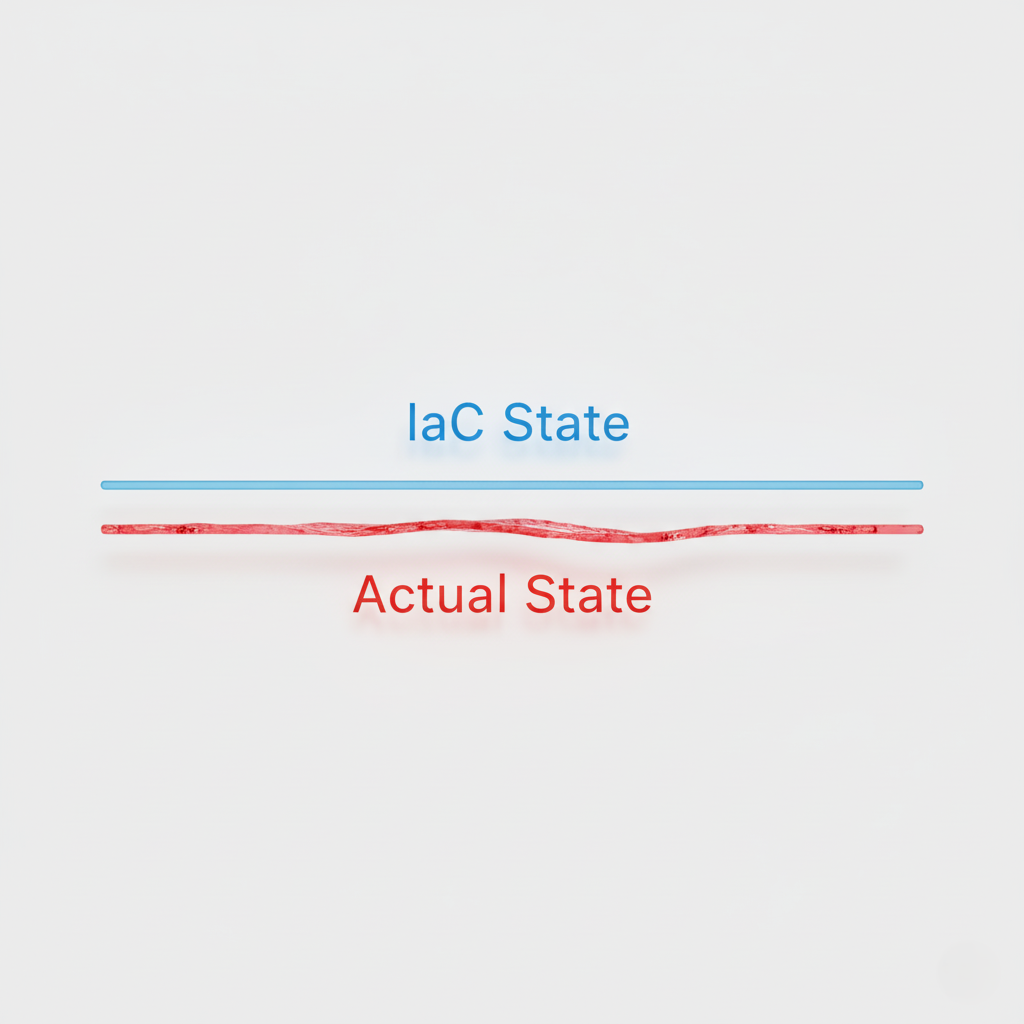
Configuration drift occurs when the real-world state of your infrastructure no longer matches the definition in your IaC files. This often happens when engineers make manual "hotfixes" directly in the cloud console to resolve an urgent issue, bypassing the standard code review and deployment process.
This creates a dangerous and costly situation. In one real-world scenario, an engineer manually added a port rule to a security group to fix a production outage. Days later, a different teammate ran a routine terraform apply for an unrelated change. Because the manual hotfix wasn't in Terraform's state file, the tool saw it as drift and "corrected" it by removing the rule, causing the service to break again during peak hours. The cost of drift is therefore not just the direct expense of misconfigured resources but also the significant business impact of downtime and the erosion of trust in the automation pipeline.
Solution: Implement automated drift detection tools that continuously monitor for discrepancies and alert the team. Culturally, it's vital to discourage "click ops" and establish a process for incorporating emergency changes back into the IaC codebase quickly, either through code updates or commands like terraform import.
Challenge 3: Lack of Pre-Deployment Visibility
A common failure mode in IaC cost management is discovering the financial impact of a change only when the monthly bill arrives. Engineers, focused on functionality and speed, may not be fully aware of the financial implications of their infrastructure choices, such as selecting a more expensive instance type or provisioning a large storage volume.
Solution: The solution is to "shift cost left" by integrating cost estimation tools directly into the CI/CD pipeline. These tools analyze IaC changes within a pull or merge request and post a comment detailing the estimated cost impact. This provides immediate, actionable feedback to engineers and reviewers, making cost a visible and discussable part of the development workflow before any resources are deployed.
Challenge 4: Complexity and Lack of Standardization
As an organization's infrastructure grows, IaC can become complex and unwieldy. Without clear standards, teams may implement IaC in inconsistent ways, leading to duplicated code, fragmented practices, and maintenance headaches. This lack of standardization makes it incredibly difficult to track costs, apply global changes, or enforce governance policies.
Solution: Adopt a modular approach to IaC. Break down infrastructure into smaller, reusable components or modules that encapsulate common patterns, such as a standard virtual network or a database setup. These modules should be designed with cost-aware defaults, such as choosing cheaper instance families or including lifecycle policies for storage, ensuring teams consistently use cost-effective practices.
Challenge 5: Ephemeral and Non-Production Environment Waste
A significant and often-overlooked source of wasted cloud spend is non-production environments—such as development, staging, and testing—that are left running 24/7 even though they are only used during business hours.
Solution: Leverage IaC to automate the entire lifecycle of these environments. Configure CI/CD pipelines to provision testing and staging environments on-demand when a pull request is opened or a new feature needs to be validated. Once the tests are complete and the changes are merged, the pipeline should automatically trigger a terraform destroy to tear down the environment, ensuring the organization only pays for these resources when they are actively in use.
Conclusion
While Infrastructure as Code provides the tools for efficient cloud management, it does not automatically guarantee cost control. The hidden costs of unmanaged resources, configuration drift, and operational complexity can quickly erode the financial benefits. Overcoming these challenges requires a holistic approach that combines technology with process. By implementing automated drift detection, shifting cost visibility into the CI/CD pipeline, standardizing through modules, and automating the lifecycle of non-production environments, organizations can unlock the full potential of IaC to build a truly cost-effective, predictable, and resilient cloud infrastructure. This disciplined approach is essential to prevent the automation pipeline from becoming a source of instability and mistrust, which can lead teams to revert to manual practices and perpetuate a cycle of drift and failure.
All in One Place
Atler Pilot decodes your cloud spend story by bringing monitoring, automation, and intelligent insights together for faster and better cloud operations.