
Read any random LinkedIn post from 2024. Read a marketing email. Read a student essay.
They all sound the same.
"In the ever-evolving landscape of technology, it is crucial to leverage cutting-edge solutions to foster a vibrant ecosystem."
It is grammatically flawless. It is polite. It is coherent.
And it is utterly dead inside.
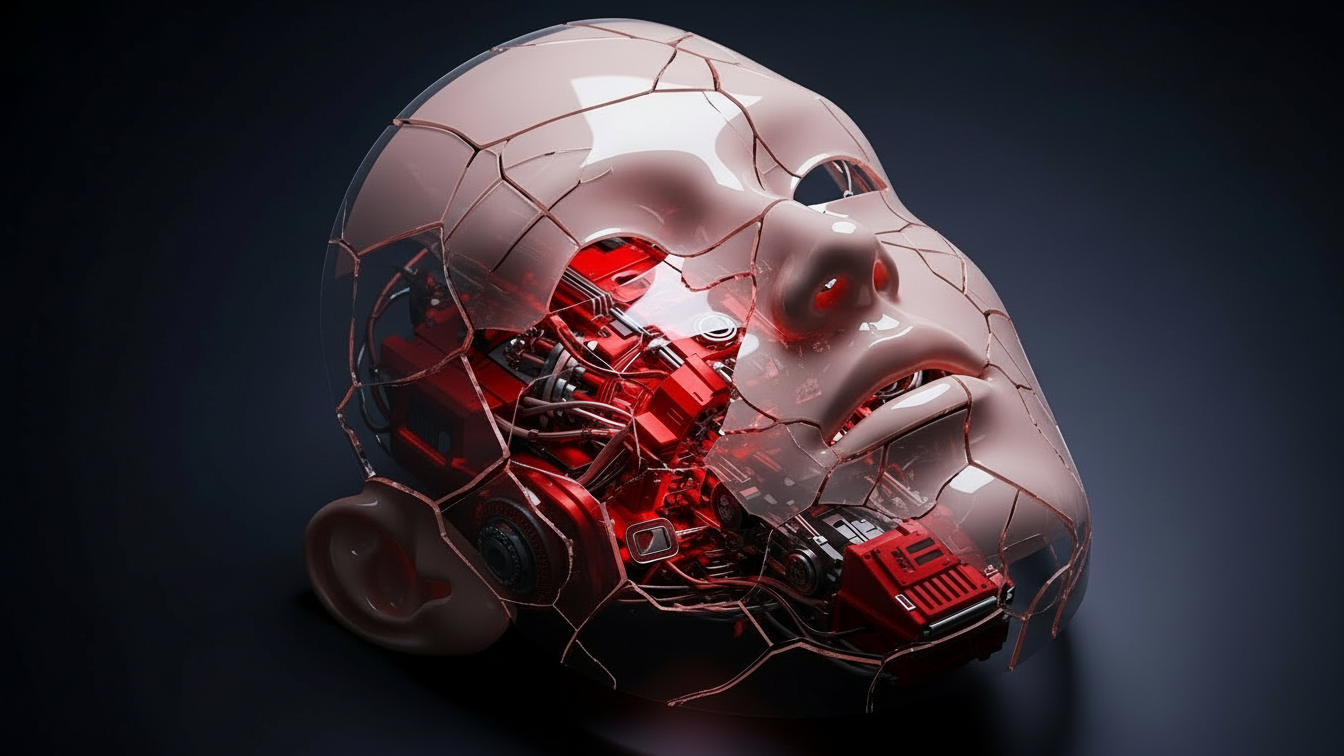
This is the Uncanny Valley of Text. Just as a CGI face that is 99% human looks horrifying to our biological instincts, AI text that is 99% human feels "slimy" to our linguistic instincts. We call it "The Grey Goo."
The RLHF Lobotomy:
Why do all LLMs sound like a corporate HR department?
Because they were trained by one.
RLHF (Reinforcement Learning from Human Feedback) involves human labelers ranking model outputs. These labelers are instructed to prefer safety, neutrality, and clarity.
The model quickly learns that "taking a stance" or "using slang" or "being weird" gets it punished. The safest path to reward is to be a banal, agreeable, middle-manager.
Part 1: The Metrics of Boredom (Perplexity and Burstiness)
How do AI detectors like GPTZero actually work? They don't look for plagiarism. They look for Predictability.
1. Perplexity (The Surprise Factor)
Perplexity measures how "surprised" a model is by a sequence of words.
Low Perplexity (AI): "The cat sat on the mat." (Predictable implies AI).
High Perplexity (Human): "The cat, a void of malice, plotted murder on the rug." (Unpredictable implies Human).
2. Burstiness (The Rhythm)
Humans have rhythm.
We write a long, meandering sentence that goes on for lines and lines, exploring a complex thought with commas and clauses. Then we stop.
Short sentence.
Fragment.
AI writes in a monotone. Medium sentence. Medium sentence. Medium sentence. The variance (Burstiness) is zero.
Python
# -------------------------------------------------------------------------
# Detecting "The Grey Goo" with Python
# -------------------------------------------------------------------------
# We can mathematically measure "Burstiness" using NLTK.
# Burstiness = Standard Deviation of Sentence Lengths.

import nltk
import numpy as np

def analyze_style(text):
    sentences = nltk.sent_tokenize(text)
    lengths = [len(nltk.word_tokenize(s)) for s in sentences]

    avg_len = np.mean(lengths)
    std_dev = np.std(lengths) # Burstiness

    print(f"Average Length: {avg_len:.1f}")
    print(f"Burstiness (Std Dev): {std_dev:.1f}")

    if std_dev < 5:
        return "ROBOT DETECTED (Monotone)"
    elif std_dev > 15:
        return "HUMAN (High Variance)"
    else:
        return "UNCERTAIN"

# Example AI Text:
ai_text = "The quick brown fox jumps. The lazy dog sleeps. The sun is bright."
# Avg: 5, Std Dev: 0.0 -> ROBOT

# Example Human Text:
human_text = "The fox, which was quick, jumped! Why? Who knows."
# Avg: 4, Std Dev: 12.5 -> HUMAN
Part 2: The "Late Night Show" Test
How to evaluate your Prompt Output:
Imagine your text is being read aloud by a Late Night Talk Show host (Colbert, Fallon, Stewart).
The AI Script: "In conclusion, the landscape of politics is complex." (Audience falls asleep).
The Human Script: "Politics is a dumpster fire inside a train wreck." (Audience laughs).
The Rule: If you cannot imagine a human breathing while saying the sentence, cut it. AI doesn't breathe, so it writes sentences that are 45 words long with no natural pause.
Part 3: The Forbidden Vocabulary
If you use these words, you are flagging yourself as a bot. These words appear disproportionately in the RLHF training sets.
Delve: The #1 offender. "Let's delve into..."
Tapestry: "A rich tapestry of culture."
Leverage: Used for everything.
Foster: "Foster innovation."
Spearhead: "Spearhead the initiative."
Paramount: "It is paramount that..."
Testament: "A testament to..."
Underscore: "This underscores the importance..."
Part 4: Decoding Strategies (The Softmax Hack)
You can force the model to be more human by hacking the probability distribution at the moment of generation.
Parameter | What it does | Recommended Setting |
Temperature | Flattens the probability curve. High temp makes low-probability words more likely. | 1.1 - 1.2 (Default is 0.7). Risk: Hallucination. |
Top-P (Nucleus) | Cuts off the long tail. "Only consider the top X% of words." | 0.9. Prevents total gibberish while keeping variety. |
Frequency Penalty | Punishes words that have already appeared. prevents loops. | 0.5. Forces the model to find synonyms. |
Part 5: Prompt Engineering for Soul
Stop asking for "Professional Tone." Professional means "Bot."
Bad Prompt: "Write a professional email."
Good Prompt: "Write an email. Use short sentences. Use Anglo-Saxon words (like 'ask') instead of Latinate words (like 'inquire'). Be direct. Do not use the word 'delve'. Write like you are in a hurry."
The Human Rewrite Checklist:
Before hitting "Send", run your text through this filter:
The "So What?" Test: Does the first sentence actually say anything? ("In the landscape of..." -> Delete it).
The Adverb Cull: Remove: "Crucially, Importantly, Significantly, Undoubtedly".
The Metaphor Injection: Add one visible concrete noun per paragraph. (Instead of "We improved efficiency," say "We unclogged the drain").
The Sentence Length Variance: Do you have a 3-word sentence? You need one.
The Passive Voice Hunt: "Mistakes were made" -> "I screwed up."
The Robot Words: Ctrl+F for "Foster, Leverage, Utilizing, Spearhead". Burn them.
Pro Tip: Use the Hemingway App
Paste your text into Hemingway. If it lights up red ("Very hard to read"), congratulations. You are writing like a human. If it is all yellow/clear, you are writing like a bot. Humans are messy. We use fragments. We use sentence fragments!
Part 6: Expert Interview
Topic: Why 'Delve' is a Curse Word
Guest: Marcus L., Senior Copywriter (ex-Ogilvy).
Interviewer: I use 'delve' all the time. Why do you hate it?
Marcus L: You don't use it. You think you do because you see it in AI text. Go check your sent emails from 2019. How many times did you type 'delve'? Zero. It is an artifact of the training data. It's 'Academic Filler'. It sounds smart but means nothing. It's the polyester suit of verbs.
Interviewer: How do you fix AI writing?
Marcus L: I use the 'Hemingway Method'. I tell the AI: 'You are drunk. Write this short. No adverbs.' Then I tell it: 'Okay, now edit it sober.' The best prompt I have is simply: 'Write this so a 12-year-old would think it's cool.' It forces the model to drop the corporate mask.
Part 7: Glossary
Perplexity: A measurement of how well a probability model predicts a sample.
Burstiness: The variation in sentence length and structure.
Softmax: The mathematical function that converts log-odds into probabilities.
Mode Collapse: When a model loses the ability to generate diverse outputs and settles on the average.
Hallucination: When "Temperature" is too high and the model invents facts.
Logits: The raw, unnormalized scores output by the last layer of the neural network (before Softmax).
Search Beam: A decoding strategy where the model keeps the top-k most likely sentences and expands them.
RLHF: The training process that aligns models to be "Helpful, Harmless, and Honest" (and boring).
Conclusion
The "Uncanny Valley" is not permanent. Models like Claude 3 Opus are already getting better at mimicking burstiness. But for now, if you want to prove you are human, you must embrace imperfection. Be weird. Be spiky. Be unpredictable.
Plaintext
The "De-Robotizer" Example:

Before (AI): "It is imperative that we foster a culture of innovation to ensure seamless scalability." (16 words, 0 burstiness).

After (Human): "We need to invent things. Fast. If we don't, we die." (11 words, High Burstiness).

The Fix:
1. Cut the syllabus words ("Imperative", "Foster").
2. Vary the rhythm.
3. Add a threat ("die"). AI never threatens.All in One Place
Atler Pilot decodes your cloud spend story by bringing monitoring, automation, and intelligent insights together for faster and better cloud operations.