
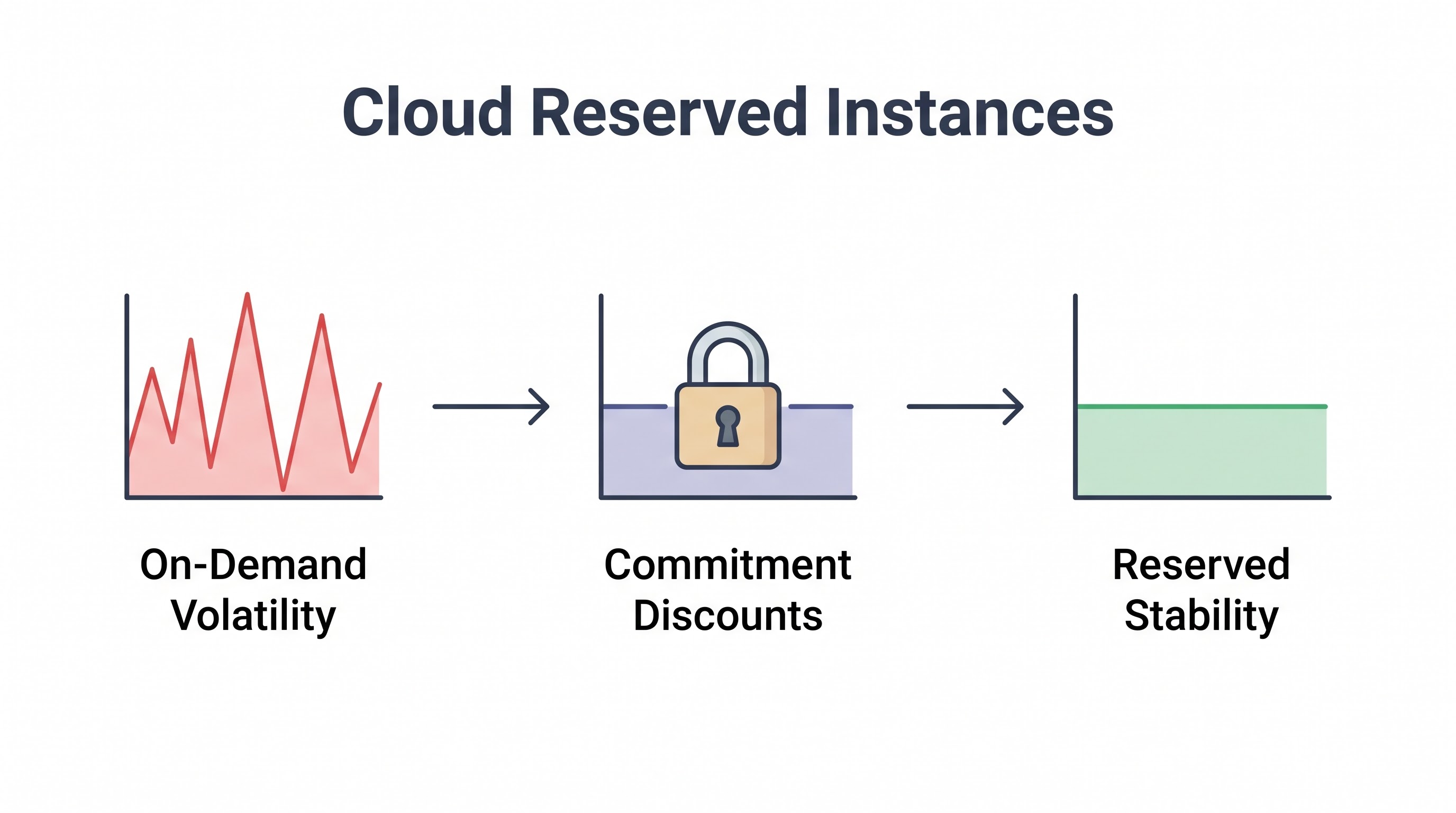
The Discount Lever
In the discipline of FinOps, there are two primary ways to reduce your cloud bill: use less infrastructure (optimization), or pay less for the infrastructure you use (commitments). While optimization requires engineering effort (refactoring code, rightsizing instances), commitments are purely a financial exercise.
Cloud providers operate massive data centers with immense fixed costs. To ensure predictable revenue and capacity utilization, they offer steep discounts—up to 72% off On-Demand prices—if you are willing to commit to using a specific amount of compute for 1 or 3 years. This is the domain of Reserved Instances (RIs) and Savings Plans.
However, an incorrect commitment strategy is a financial liability. Committing to a 3-year term for legacy infrastructure that the engineering team plans to retire next year will result in paying thousands of dollars for "air." This guide demystifies the mathematics of cloud commitments and outlines a low-risk purchasing strategy.
The Golden Rule: Optimize Before You Commit
The most common mistake organizations make is purchasing commitments for an unoptimized environment.
If you have an m5.4xlarge instance running at 5% CPU utilization, and you purchase a 3-year Reserved Instance for it, you have successfully secured a 50% discount on a server you shouldn't be running in the first place. You have institutionalized waste. You must rightsize your instances and terminate zombie resources before calculating your commitment baseline.
Reserved Instances vs. Savings Plans (AWS)
AWS offers two primary commitment models. Understanding the difference is critical.
Reserved Instances (RIs)
The legacy model. RIs are highly inflexible. You commit to a specific instance type (e.g., m5.xlarge) running a specific OS (Linux) in a specific Region (us-east-1).
Standard RIs: Offer the highest discount but cannot be modified. If your engineering team decides to upgrade from
m5to the newer, fasterm6iinstances, your Standard RI will not apply, and you will pay On-Demand prices for the new instances while continuing to pay for the unused RI.Convertible RIs: Offer a lower discount, but allow you to exchange them for different instance types. (Largely superseded by Compute Savings Plans).
Savings Plans (The Modern Standard)
Introduced in 2019, Savings Plans drastically simplified commitments by shifting from a capacity commitment to a dollar commitment.
EC2 Instance Savings Plans: You commit to a specific instance family in a specific region (e.g., $10/hour of
m5usage inus-east-1). It applies regardless of size (it covers anm5.largeor anm5.4xlarge) or OS.Compute Savings Plans: The most flexible option. You commit to a dollar amount (e.g., $50/hour of compute). This discount applies automatically across any instance family, any region, and even extends to AWS Fargate (serverless containers) and AWS Lambda. While the discount percentage is slightly lower than EC2 plans, the extreme flexibility makes Compute Savings Plans the default choice for modern organizations.
Commitments in Azure and GCP
The concepts map closely across providers:
Azure: Offers "Azure Reserved Virtual Machine Instances" (similar to AWS RIs) and "Azure Savings Plans for Compute" (identical to AWS Compute Savings Plans).
GCP: Offers "Committed Use Discounts" (CUDs). GCP is unique in that you commit to raw hardware components (e.g., a specific amount of vCPUs and RAM) rather than named instance types, providing inherent flexibility.
The Math: Upfront vs. No Upfront
When purchasing a commitment, you must choose a term length (1 or 3 years) and a payment option (No Upfront, Partial Upfront, All Upfront).
3-Year All Upfront: Provides the absolute highest discount (often 60-72%). The CFO writes a massive check today for three years of compute. Use only for infrastructure that is guaranteed to remain static (e.g., a core transactional database).
1-Year No Upfront: Provides a moderate discount (25-35%), but requires zero capital outlay. You simply commit to paying the discounted hourly rate for the next 12 months. This is the "sweet spot" for most agile organizations, balancing meaningful savings with financial flexibility.
Key Metrics: Coverage and Utilization
Managing a commitment portfolio relies on tracking two metrics via a FinOps platform:
Utilization: Out of the commitments you purchased, what percentage are you actually using? If you committed to $100/hour, but you are only running $80/hour of compute, your utilization is 80%. You are wasting $20/hour. Target: >95%.
Coverage: Out of your total eligible compute spend, what percentage is covered by a commitment? If you are running 1,000 instances, and 700 are covered by a Savings Plan, your coverage is 70%. The remaining 30% are running at expensive On-Demand rates. Target: 70-85% (leaving room for elasticity).
A Layered Commitment Strategy
A mature organization never purchases all their commitments at once. They build a "waterfall" or layered portfolio.
The Baseline (Compute Savings Plans): Calculate your absolute minimum, 24/7/365 compute footprint across the entire organization. Cover 80% of this baseline with a 1-Year or 3-Year Compute Savings Plan for maximum flexibility.
The Steady State (EC2/Specific Plans): For highly stable, predictable workloads (like massive RDS databases or dedicated node pools), purchase 1-Year, specific RIs or Instance Savings Plans to capture the higher discount margin.
The Volatile (Spot Instances): Leave the remaining 10-20% of your compute uncommitted. Use this buffer to handle traffic spikes, and aggressively utilize Spot Instances for ephemeral workloads to achieve 90% discounts without any long-term commitment.
Purchase commitments in smaller tranches every quarter rather than a massive annual buy. This smooths out expiration dates and allows you to constantly adjust to architectural changes.
The Role of Automation
Managing the intersection of expiring RIs, new Savings Plan recommendations, and fluctuating utilization rates in an Excel spreadsheet is prone to expensive errors. Organizations must rely on FinOps platforms to ingest billing data, model different commitment scenarios, and automatically generate the optimal purchase recommendations to maintain the target coverage ratio without risking under-utilization.
Key Takeaway
Commitment discounts are a powerful financial tool, but they require discipline. Always rightsize infrastructure before committing to it. Default to highly flexible Compute Savings Plans (or Azure/GCP equivalents) over rigid Reserved Instances to avoid lock-in as your architecture evolves. Implement a layered purchasing strategy, establishing a high-coverage baseline with Savings Plans and utilizing Spot instances for burst capacity.
All in One Place
Atler Pilot decodes your cloud spend story by bringing monitoring, automation, and intelligent insights together for faster and better cloud operations.