
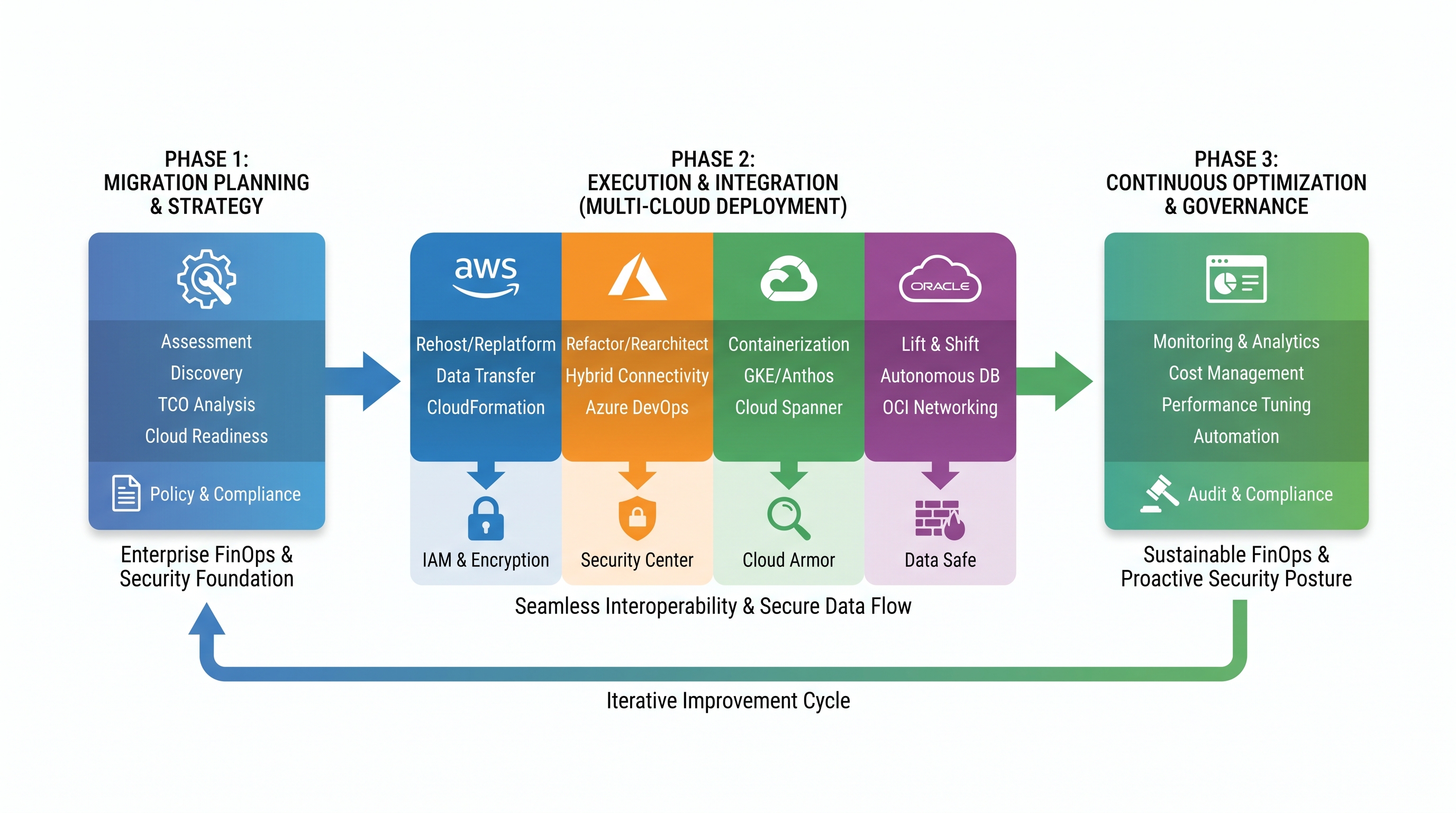
In the contemporary enterprise landscape, the question is no longer if an organization will embrace cloud, but how many clouds it will operate within. Multi-cloud strategies, involving simultaneous utilization of services from multiple public cloud providers like Amazon Web Services (AWS), Microsoft Azure, Google Cloud Platform (GCP), and Oracle Cloud Infrastructure (OCI), have become a cornerstone of digital transformation. This approach offers unparalleled resilience, mitigates vendor lock-in, and enables organizations to leverage best-of-breed services tailored to specific workload requirements. However, this power introduces significant complexity, particularly concerning FinOps (Cloud Financial Operations) and cloud security.
Navigating a multi-cloud migration requires a meticulously planned and executed playbook. It demands a holistic view that transcends individual cloud provider nuances, focusing instead on standardized processes, unified governance, and intelligent automation. This guide, crafted by CloudAtler's expert cloud architects, provides a highly technical, actionable framework to successfully migrate and operate in a multi-cloud environment, emphasizing the critical interplay of FinOps and security at every stage.
Phase 1: Strategic Planning & Assessment – Laying the Multi-Cloud Foundation
The initial phase of any multi-cloud migration is arguably the most critical. It involves deep introspection into existing IT assets, a clear articulation of business objectives, and a thorough assessment of cloud suitability. Without a robust foundation, subsequent phases are prone to costly rework and security vulnerabilities.
Workload Analysis and Cloud Suitability Mapping
Before any migration begins, a comprehensive application rationalization exercise is paramount. This involves categorizing applications based on the "6 Rs" strategy:
Rehost (Lift-and-Shift): Moving applications with minimal changes, often to IaaS. Suitable for applications with high migration urgency or those difficult to refactor.
Replatform (Lift-Tinker-and-Shift): Making minor cloud-native optimizations (e.g., migrating from self-managed PostgreSQL to AWS RDS, Azure Database for PostgreSQL, or GCP Cloud SQL).
Refactor/Rearchitect: Modifying or rewriting application code to leverage cloud-native features fully (e.g., monolith to microservices on Kubernetes, serverless functions). This offers significant long-term benefits in scalability and cost but is resource-intensive.
Repurchase (Drop-and-Shop): Moving to a SaaS solution (e.g., CRM from on-prem to Salesforce).
Retain: Keeping certain applications on-premises due to compliance, performance, or technical constraints.
Retire: Decommissioning applications that are no longer needed.
For each application, detailed attributes must be documented:
Technical Dependencies: Identify all upstream and downstream systems, network flows, and data interactions. Map these using tools like application dependency mapping (ADM).
Performance Requirements: Latency, throughput, IOPS. Crucial for selecting appropriate compute, storage, and networking services across clouds.
Data Gravity: Understand where data resides and the implications of moving it. Large datasets incur significant egress costs and migration complexity.
Compliance & Regulatory Constraints: Data residency, industry-specific regulations (HIPAA, PCI-DSS, GDPR, FedRAMP). This often dictates specific regions, services, and security controls across providers. For instance, an application processing PCI data might require dedicated instances and specific encryption standards, which must be consistently applied across AWS EC2, Azure VMs, GCP Compute Engine, and OCI Compute.
From a FinOps perspective, this phase involves a rigorous Total Cost of Ownership (TCO) analysis for each potential cloud target. This means going beyond simple compute costs to factor in networking (ingress/egress), storage (various tiers), managed services (databases, queues), licensing, support, and operational overhead. Compare AWS EC2 pricing models (On-Demand, Reserved Instances, Savings Plans, Spot) against Azure Virtual Machines (Pay-as-you-go, Reserved VM Instances, Spot), GCP Compute Engine (On-Demand, Committed Use Discounts, Spot), and OCI Compute (On-Demand, Universal Credits, Reserved Capacity). Understanding these nuances is key to optimizing spend even before migration.
Security best practices here involve data classification: categorizing data by sensitivity (public, internal, confidential, restricted). This classification directly influences the security controls, encryption standards, and access policies that will be implemented in the target cloud environments.
Target Cloud Provider Selection & Architecture Definition
Based on the workload analysis, organizations can strategically select specific cloud providers for particular application types. This is not about choosing a "winner" but rather leveraging the strengths of each:
AWS: Often chosen for its vast breadth of services, mature serverless ecosystem (Lambda, Fargate), and deep analytics capabilities.
Azure: Preferred by enterprises with existing Microsoft investments (Active Directory, SQL Server, .NET) and strong hybrid cloud offerings (Azure Stack, Azure Arc).
GCP: Excels in AI/ML, big data analytics (BigQuery, Dataflow), and Kubernetes orchestration (GKE).
OCI: Strong contender for enterprise databases (Exadata Cloud Service, Autonomous Database) and high-performance computing, often offering compelling price-performance for specific workloads.
The architectural definition phase translates business and technical requirements into concrete cloud designs. This involves:
Network Topology: Designing robust inter-cloud connectivity. This often involves a hub-and-spoke model within each cloud (e.g., AWS Transit Gateway, Azure Virtual WAN, GCP Shared VPC with Network Connectivity Center, OCI DRG with FastConnect). Secure peering between these hubs via VPN or dedicated interconnects (AWS Direct Connect, Azure ExpressRoute, GCP Cloud Interconnect, OCI FastConnect) is critical for hybrid and multi-cloud communication.
Identity and Access Management (IAM) Federation: A central IAM solution (e.g., Okta, Azure Active Directory) federating identities to AWS IAM, Azure AD, GCP Cloud Identity, and OCI IAM. This ensures consistent access policies and simplifies user management across all clouds.
Shared Services Design: Identifying common services (DNS, logging, monitoring, security tools) that can be centralized or distributed consistently across clouds.
From a FinOps perspective, ensure architectural choices align with cost optimization goals. For instance, leveraging serverless functions (AWS Lambda, Azure Functions, GCP Cloud Functions, OCI Functions) for event-driven workloads can significantly reduce operational overhead and costs compared to always-on compute. Conversely, understanding the egress charges for data moving between clouds or back to on-premises is paramount – a common source of unexpected expenditure.
For security, this phase establishes the Zero Trust principles: never trust, always verify. Implement granular network segmentation, micro-segmentation, and ensure all communication is encrypted. Define security baselines for each cloud provider and region, mapping them to compliance requirements.
Phase 2: Design & Implementation – Building the Multi-Cloud Infrastructure
With the strategic foundation laid, this phase focuses on the technical execution of the migration, emphasizing automation, consistency, and security by design.
Standardized Infrastructure as Code (IaC)
Manual provisioning in a multi-cloud environment is a recipe for inconsistency, errors, and security gaps. Infrastructure as Code (IaC) is non-negotiable. Tools like Terraform and Pulumi are multi-cloud native, allowing for the definition and provisioning of resources across AWS, Azure, GCP, and OCI using a consistent syntax. Crossplane extends Kubernetes to manage external infrastructure, offering another powerful IaC abstraction layer.
Implementation details:
Modular Design: Create reusable IaC modules for common components (e.g., VPCs/VNets, subnets, security groups/NSGs, compute instances, load balancers). These modules should be version-controlled and parameterized to allow for cloud-specific configurations while maintaining a common structure.
Example: A Terraform module for a network segment might abstract away the differences between an AWS VPC, Azure VNet, GCP VPC, and OCI VCN, exposing common inputs like CIDR block and region, while internally handling provider-specific resource declarations.
GitOps Workflows: Implement GitOps for IaC, where desired state is declared in Git repositories, and automated pipelines apply changes to cloud environments. This ensures auditability, version control, and automated deployments.
FinOps integration: IaC is a powerful tool for cost governance. Embed cost guardrails directly into your IaC templates. Examples include:
Enforcing specific instance types or families (e.g., only allow
m5.largeorE_seriesfor general purpose, disallowg_serieswithout specific approval).Mandating resource tagging for cost allocation and chargeback.
Automating resource lifecycle management (e.g., shutting down non-production environments after hours).
Security integration: IaC ensures security baselines are applied consistently. This includes:
Mandatory encryption for all storage and data in transit.
Strict network ACLs and security group rules.
Automated deployment of security monitoring agents.
Prevention of publicly exposed resources without explicit justification.
Data Migration Strategies
Data is the lifeblood of any enterprise, and its migration is often the most complex and risk-prone aspect of a multi-cloud transition. Strategies vary based on data volume, type, and downtime tolerance.
Database Migration:
Homogeneous (e.g., Oracle to Oracle on OCI): Tools like Oracle Zero Downtime Migration (ZDM) provide efficient, minimal-downtime migrations.
Heterogeneous (e.g., SQL Server to AWS RDS for PostgreSQL): Requires schema conversion and data transformation. Cloud providers offer specialized services: AWS Database Migration Service (DMS), Azure Database Migration Service, GCP Database Migration Service.
Data Replication: For minimal downtime, continuous replication (CDC - Change Data Capture) is often employed, allowing for a cutover with synchronized data.
Storage Migration:
Object Storage: For large datasets, use cloud-native transfer services (AWS S3 Transfer Acceleration, Azure Data Box, GCP Transfer Service, OCI Object Storage Data Transfer). For petabyte-scale migrations, physical appliances like AWS Snowball Edge or Azure Data Box Heavy can be more efficient than network transfers.
Block/File Storage: Requires careful planning, often involving snapshots, replication, or specialized third-party tools.
Network Considerations: For large-scale data migrations, leveraging dedicated interconnects (Direct Connect, ExpressRoute, Cloud Interconnect, FastConnect) is crucial to ensure sufficient bandwidth and predictable latency, bypassing the public internet.
FinOps impact: Data transfer costs, particularly egress, can quickly spiral out of control. Strategize data residency to minimize cross-region or cross-cloud transfers. Optimize storage tiering (e.g., AWS S3 Intelligent-Tiering, Azure Blob Storage Hot/Cool/Archive, GCP Cloud Storage Standard/Nearline/Coldline/Archive) to match access patterns and reduce costs.
Security considerations: Ensure data is encrypted at rest (e.g., KMS, Azure Key Vault, GCP Cloud KMS, OCI Vault) and in transit (TLS/SSL). Implement strict access controls (IAM policies) for data stores and regularly audit access patterns. Data masking and tokenization should be applied for sensitive non-production data.
Networking & Connectivity for Multi-Cloud Environments
Effective multi-cloud networking is the backbone of a unified operational environment. It goes beyond simple VPNs to encompass resilient, low-latency, and secure inter-cloud communication.
Inter-Cloud Connectivity Patterns:
Direct Peering: For specific, high-bandwidth application-to-application communication (e.g., AWS VPC Peering, Azure VNet Peering, GCP VPC Network Peering).
Transit Hubs: Centralized network hubs within each cloud (Transit Gateway, Virtual WAN, Network Connectivity Center, DRG) connected via dedicated interconnects or encrypted VPNs. This allows spoke networks in different clouds to communicate securely through a central point.
SD-WAN Overlay: Leveraging Software-Defined Wide Area Network (SD-WAN) solutions to create a unified, policy-driven network fabric across on-premises and multiple cloud environments.
DNS Resolution: Centralized DNS (e.g., using a hybrid DNS resolver or a cloud-agnostic DNS service like Infoblox) is vital for seamless service discovery across clouds. Conditional forwarders can route queries to respective cloud DNS services (AWS Route 53, Azure DNS, GCP Cloud DNS, OCI DNS).
Global Load Balancing: For applications spanning multiple regions or clouds, global load balancers (AWS Global Accelerator, Azure Front Door, GCP Global External Load Balancing) distribute traffic based on latency, availability, and health checks, enhancing resilience and user experience.
FinOps implications: Network egress charges are notorious for unexpected costs. Design network architectures to minimize data egress from expensive regions or between clouds. Leverage private connectivity options where feasible, as they can sometimes offer more predictable pricing than public internet egress. Monitor network flow logs diligently to identify high-cost traffic patterns.
Security implications: Implement robust DDoS protection (AWS Shield, Azure DDoS Protection, GCP Cloud Armor, OCI DDoS Protection). Deploy Web Application Firewalls (WAFs) consistently across all entry points. Centralize network flow logging (AWS VPC Flow Logs, Azure Network Watcher, GCP VPC Flow Logs, OCI Flow Logs) into a Security Information and Event Management (SIEM) system for unified threat detection and incident response.
Phase 3: Operations & Optimization – Sustaining Multi-Cloud Excellence
Migration is not the destination; it's the beginning of a continuous journey of operational excellence, cost optimization, and security hardening. This phase focuses on establishing robust, automated processes for ongoing management.
Unified FinOps Management
Managing costs across multiple, disparate cloud billing systems is one of the biggest challenges in multi-cloud. Effective FinOps requires a unified approach to visibility, allocation, and optimization.
Cost Visibility & Allocation: Implement a consistent tagging strategy across all clouds (e.g.,
Project,CostCenter,Environment,Owner). This enables accurate cost allocation, chargeback, and showback. Consolidate billing data from AWS Cost Explorer, Azure Cost Management, GCP Billing Reports, and OCI Cost Analysis into a single platform.Budgeting & Forecasting: Develop a centralized budget for all cloud spend. Leverage AI-powered platforms to provide accurate budget forecasting and anomaly detection. These platforms can analyze historical spend, resource utilization, and market trends to predict future costs and flag deviations.
Reserved Instances/Savings Plans Optimization: Optimize commitment-based discounts across providers. This requires sophisticated analysis to identify optimal commitments (e.g., AWS Reserved Instances/Savings Plans, Azure Reserved VM Instances, GCP Committed Use Discounts). Tools that can model reserved savings optimization across diverse cloud portfolios are invaluable.
Rightsizing & Waste Elimination: Continuously monitor resource utilization (CPU, memory, network I/O) to identify over-provisioned instances and storage. Implement automated rightsizing recommendations. Detect and eliminate idle resources (e.g., unattached EBS volumes, unassigned public IPs).
CloudAtler's platform unifies FinOps across AWS, Azure, GCP, and OCI, offering deep insights into cloud spend and providing a centralized cost impact calculation for proposed changes, ensuring every decision is budget-aware.
Multi-Cloud Security Posture Management
Maintaining a strong security posture across heterogeneous cloud environments is paramount. This requires centralized visibility, consistent policy enforcement, and automated remediation.
Centralized Identity and Access Management (IAM): Extend the federated IAM established in Phase 1 with granular role-based access control (RBAC) across all cloud resources. Implement multi-factor authentication (MFA) universally. Regularly audit IAM policies for least privilege enforcement.
Policy Enforcement & Compliance Auditing: Define security policies as code and enforce them across all clouds using native services (AWS Config, Azure Policy, GCP Policy Intelligence, OCI Cloud Guard) augmented by third-party Cloud Security Posture Management (CSPM) tools. These tools provide a unified view of compliance against industry standards (e.g., CIS Benchmarks, NIST, ISO 27001) and identify misconfigurations.
Vulnerability Management & Patch Intelligence: Establish a unified vulnerability management program. This includes regular scanning of workloads and container images. Crucially, multi-cloud environments demand patch intelligence that can identify, prioritize, and automate the remediation of vulnerabilities across diverse operating systems and applications running on AWS EC2, Azure VMs, GCP Compute Engine, and OCI Compute instances. This extends to managed services where applicable.
Threat Detection & Incident Response: Aggregate security logs and alerts from all cloud providers into a central SIEM. Implement automated incident response playbooks that can trigger actions (e.g., isolate compromised instances, block malicious IPs) across different cloud environments.
CloudAtler provides unified security management, offering a single pane of glass to monitor, audit, and enforce security policies across your entire multi-cloud footprint, enabling proactive threat mitigation and compliance.
Automated Operations & Observability
Operational complexity scales exponentially with the number of clouds. Automation and comprehensive observability are essential for maintaining agility and reliability.
Centralized Logging & Monitoring: Consolidate logs from AWS CloudWatch, Azure Monitor, GCP Cloud Logging, and OCI Logging into a central platform (e.g., Splunk, ELK Stack, Datadog, or CloudAtler's operational intelligence). This provides a holistic view of system health and facilitates faster troubleshooting. Implement consistent monitoring dashboards and alerting rules across all cloud environments.
Automated Incident Response: Beyond security incidents, automate responses to operational events. For example, if an application in GCP experiences high latency, an automated playbook might scale out resources in GCP, alert relevant teams, and potentially failover traffic to an application instance in Azure, if designed for active-active multi-cloud resilience.
Performance Management & Optimization: Continuously monitor application performance and infrastructure health. Use AI-powered tools for predictive monitoring and operations to anticipate issues before they impact users. This includes analyzing trends in resource utilization, network latency, and application response times to proactively scale resources or identify bottlenecks.
Runbook Automation: Develop and automate runbooks for common operational tasks, such as patching, backup and recovery, and environment provisioning, ensuring consistency and reducing manual effort across clouds.
Common Pitfalls to Avoid in Multi-Cloud Migration
Even with a detailed playbook, certain traps can derail a multi-cloud strategy:
Ignoring FinOps from Day One: Treating cost management as an afterthought inevitably leads to budget overruns. Embed FinOps into every decision.
Lack of a Robust Security Framework: Assuming native cloud security is sufficient. A unified, layered security approach is critical.
Over-Engineering or Premature Optimization: Don't try to make every application cloud-native immediately. Start with rehost/replatform for quick wins and iterate.
Insufficient Training for Operations Teams: Multi-cloud requires new skill sets. Invest in continuous education for your engineering and operations staff.
Vendor Lock-in Disguised as Multi-Cloud: Ensure applications are truly portable or strategically tied to a specific cloud service for a strong reason, rather than accidentally becoming locked into multiple providers.
Conclusion: Unifying Your Multi-Cloud Journey with CloudAtler
The multi-cloud migration journey is complex, demanding meticulous planning, deep technical expertise, and continuous operational rigor. While the benefits of resilience, flexibility, and cost optimization are immense, achieving them requires a unified approach to FinOps, cloud security, and automated operations across all your cloud environments.
To navigate the complexities of multi-cloud migration with confidence, unifying your FinOps, security, and operational intelligence is paramount. CloudAtler provides the AI-powered platform to achieve this, delivering a single pane of glass for comprehensive visibility, automated governance, and predictive insights across AWS, Azure, GCP, and Oracle environments. Discover how CloudAtler can transform your multi-cloud journey from a challenge into a strategic advantage, ensuring your enterprise achieves optimal cost efficiency, robust security, and unparalleled operational excellence.
All in One Place
Atler Pilot decodes your cloud spend story by bringing monitoring, automation, and intelligent insights together for faster and better cloud operations.