
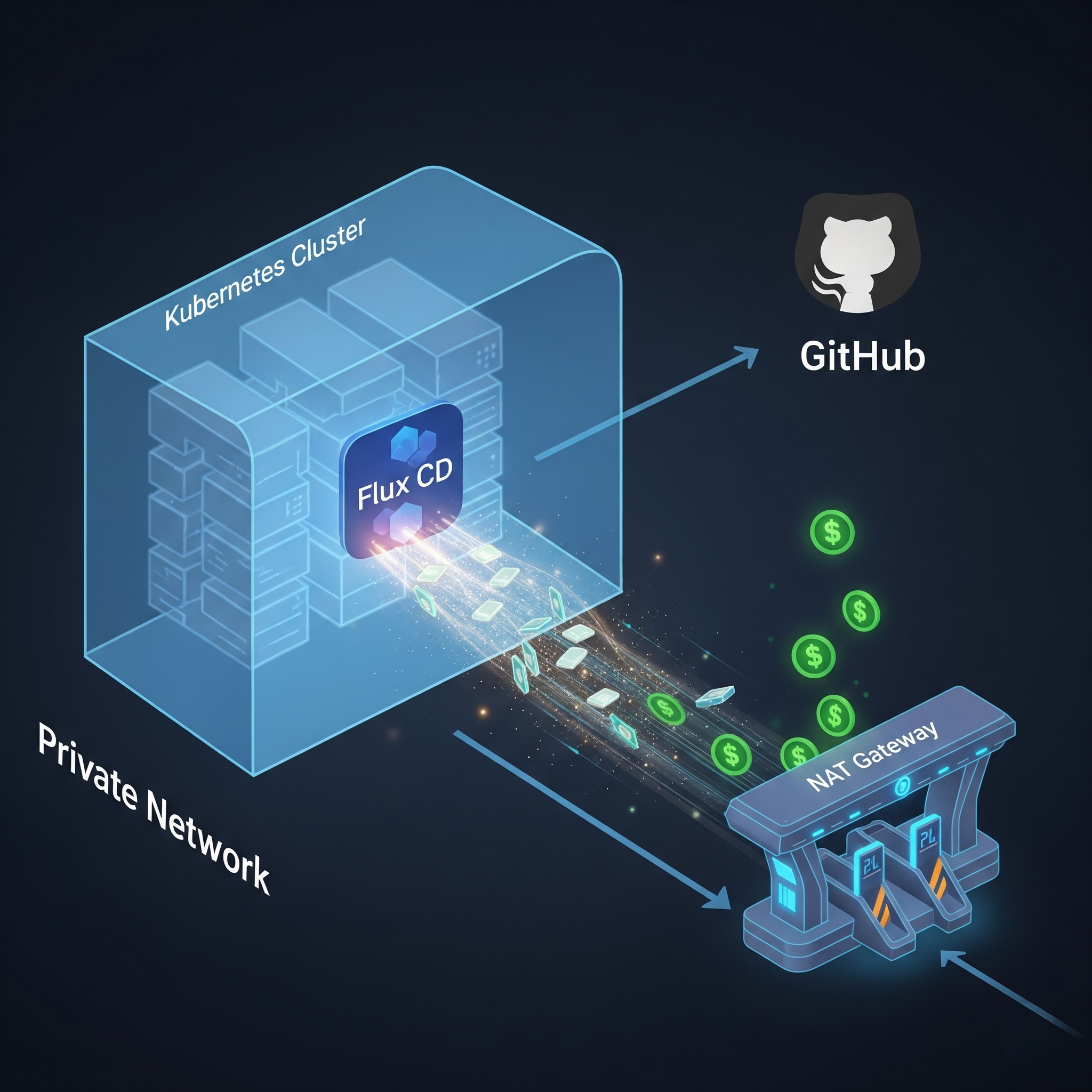
Flux CD is a cornerstone of the modern GitOps movement, providing a lightweight way to keep Kubernetes clusters synchronized with a Git repository. Its controller-based architecture continuously polls a repository for changes and automatically applies them.
However, this constant polling has a hidden side effect: network traffic. For every cluster managed with Flux, a controller regularly fetches data from an external location like GitHub. While small for a single repository, this traffic can accumulate at scale, leading to a significant Flux CD sync cost impact on your cloud provider's bill for network egress.
The Problem: How GitOps Polling Drives Up Costs
The cost issue arises from the interaction between Flux's behavior and cloud networking pricing.
The Sync Interval: By default, Flux's
GitRepositorycontroller checks for changes in your remote Git repository every few minutes, with each check involving agit fetchoperation.The NAT Gateway: If your cluster is in a private VPC, this outbound traffic to GitHub.com must pass through a NAT Gateway. AWS, GCP, and Azure all charge a per-gigabyte data processing fee for this traffic.
The Monorepo Multiplier: The problem is amplified if you are using a large monorepo. If a 1 GB monorepo is polled every 2 minutes from 10 different clusters, you generate a massive amount of billable outbound network traffic.
One engineering team discovered their daily NAT Gateway costs doubled from $200 to $400 because a single large file was accidentally committed to a monorepo being polled by multiple Flux instances, resulting in an estimated $70,000 in unnecessary annual network costs.
Strategies for Reducing Flux CD Network Costs
Managing this hidden GitOps cost requires tuning Flux's configuration and optimizing your repository strategy.
1. Increase the Sync Interval
This is the most direct lever for reducing polling traffic.
How it Works: In your
GitRepositorycustom resource, adjust thespec.intervalfield from the default of2mto10mor20m. This will reduce the frequency ofgit fetchoperations and network traffic proportionally.The Trade-Off: The downside is increased deployment latency; a change might take up to 20 minutes to be reconciled. This must be balanced against the cost savings.
2. Use Webhook-Based Reconciliation
Instead of relying solely on polling, configure Flux to listen for webhook notifications from your Git provider.
How it Works: Set up a webhook in GitHub that sends a notification to Flux every time a commit is pushed. This triggers an immediate reconciliation.
The Benefit: This allows you to set a much longer, cost-effective polling interval (e.g.,
1h) as a fallback while still getting near-instantaneous deployments.
3. Optimize Your Repository Structure
Avoid using large, monolithic repositories with Flux if possible.
Break Up Monorepos: Consider a multi-repo strategy where each team has its own smaller, focused repository to reduce the size of each
git fetchoperation.Use Artifact-Only Repositories: For Helm charts, use a CI process to package them and push them to a dedicated, lightweight Helm repository or OCI registry for Flux to pull from.
4. Be Wary of Shallow Clones
While a "shallow clone" (
--depth=1) can reduce clone size, it's important to note that Flux CD does not currently support shallow clones for its GitRepository source.
Conclusion
Flux CD's default polling mechanism can lead to unexpected network costs, especially at scale. This cost impact appears on your cloud bill as NAT Gateway or data egress charges. By carefully tuning sync intervals, leveraging webhooks, and adopting a more granular repository strategy, you can significantly reduce this network overhead and ensure your GitOps practice is both efficient and financially sustainable.
All in One Place
Atler Pilot decodes your cloud spend story by bringing monitoring, automation, and intelligent insights together for faster and better cloud operations.