
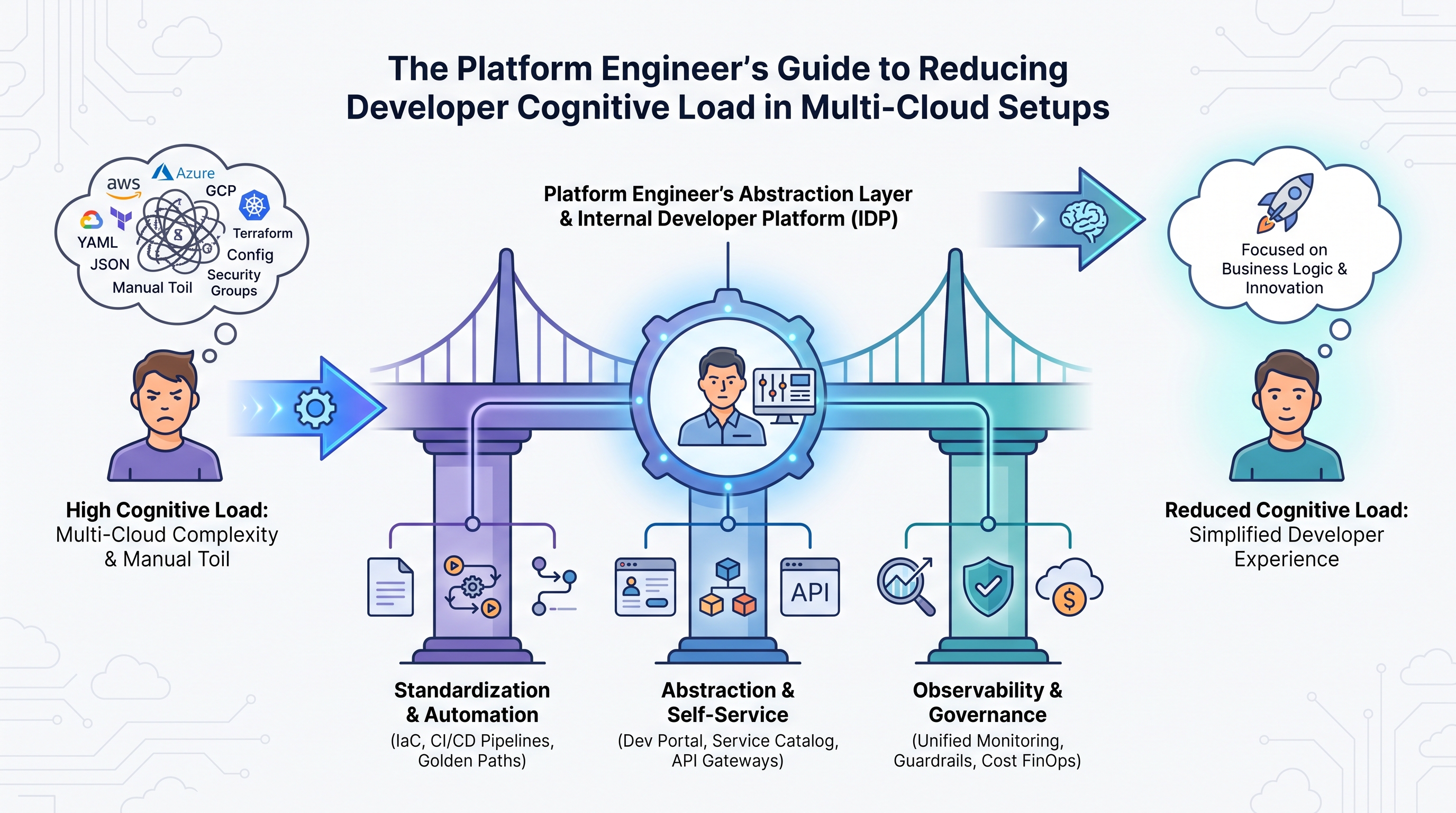
The Multi-Cloud Cognitive Tax on Product Teams
In modern enterprise environments, multi-cloud is no longer a strategic choice—it is an operational reality. Whether driven by regional availability, compliance requirements, pricing dynamics, or legacy acquisitions, engineering organizations find themselves operating across Amazon Web Services (AWS), Microsoft Azure, Google Cloud Platform (GCP), and Oracle Cloud Infrastructure (OCI). While this heterogeneous approach offers unparalleled flexibility and mitigates vendor lock-in, it introduces a severe, often unquantified cost: the multi-cloud cognitive tax.
Cognitive load, a concept borrowed from cognitive psychology, represents the total amount of mental effort being used in the working memory. In software engineering, we categorize cognitive load into three distinct types:
Intrinsic Load: The fundamental difficulty of the task itself (e.g., designing an algorithm to process real-time financial transactions).
Germane Load: The beneficial cognitive processing devoted to constructing mental schemas and learning (e.g., understanding the business logic of a new microservice).
Extraneous Load: The mental effort wasted on tasks that do not directly contribute to the goal (e.g., remembering whether a security group in AWS is equivalent to a Network Security Group in Azure, or wrestling with different CLI authentication schemes).
In a multi-cloud setup, extraneous cognitive load skyrockets. A developer who simply wants to deploy a containerized API must navigate different IAM paradigms, disparate deployment APIs, varying observability pipelines, and distinct cost-attribution frameworks. This friction manifests as delayed release cycles, configuration drift, security vulnerabilities, and runaway cloud spend. The primary mission of a platform engineering team is to eliminate this extraneous load, establishing a "Golden Path" that allows developers to focus on delivering business value.
Architecting the Golden Path: Abstraction Without Restriction
Reducing developer cognitive load does not mean stripping away the power of cloud-native services. Instead, platform engineers must build abstractions that encapsulate complexity while remaining extensible. The industry has shifted away from the "Golden Cage"—where developers are restricted to a rigid, over-simplified internal portal—toward the "Golden Path," a paved road of self-service templates, APIs, and tools that make the right way the easiest way.
To achieve this in a multi-cloud environment, platform teams must establish a unified abstraction layer. Rather than exposing raw cloud provider APIs or raw Terraform modules to product teams, platform engineers should leverage declarative infrastructure specifications. Tools like Crossplane or custom Terraform/OpenTofu modules wrapped in an Internal Developer Platform (IDP) allow developers to declare their intent rather than their implementation details.
The Declarative Infrastructure Pattern
Consider a scenario where a product team requires a relational database and an object storage bucket. In a raw multi-cloud setup, the developer would need to write distinct Terraform configurations for AWS RDS/S3, Azure SQL/Blob Storage, or GCP Cloud SQL/Cloud Storage, depending on where the application is hosted. This requires deep domain knowledge of each provider's specific resource arguments, networking requirements, and encryption standards.
By implementing a platform-driven abstraction, the developer defines a generic, cloud-agnostic manifest. Below is an conceptual example of a custom resource definition (CRD) or declarative schema that a developer might submit to an IDP:
apiVersion: platform.cloudatler.internal/v1alpha1
kind: ApplicationEnvironment
metadata:
  name: payment-processing-prod
  namespace: finance-team
spec:
  targetRegion: us-east-1
  compute:
    type: ServerlessContainer
    cpu: "2.0"
    memory: "4Gi"
    scaling:
      minReplicas: 3
      maxReplicas: 10
  storage:
    - name: transaction-ledger
      type: RelationalDatabase
      engine: postgresql
      version: "15"
      allocatedStorageGB: 100
    - name: receipt-archive
      type: ObjectStorage
      retentionDays: 365
The platform's orchestration engine ingests this schema and maps it to the target cloud provider's native resources, automatically injecting enterprise-mandated defaults for encryption-at-rest, backup schedules, network isolation, and cost allocation. Developers no longer need to know the difference between an AWS KMS Key and an Azure Key Vault Key; the platform handles the underlying cryptographic operations transparently.
To monitor these disparate resources effectively without forcing developers to log into multiple cloud consoles, platform teams must provide a unified dashboard. This single pane of glass consolidates operational metrics, deployment statuses, and resource health across all cloud environments, significantly reducing context-switching and troubleshooting time.
Shifting Security Left with Automated Guardrails
Traditional cloud security paradigms rely heavily on reactive auditing: security teams scan deployed infrastructure, find non-compliant resources, and open Jira tickets for developers to remediate. This model is highly disruptive, injecting friction late in the software development lifecycle (SDLC) and increasing cognitive load as developers must revisit code they wrote weeks prior.
Platform engineering teams must shift security left by embedding proactive compliance directly into the developer workflow. This requires a transition from manual Change Advisory Board (CAB) reviews to continuous, automated compliance policy enforcement. By integrating robust cloud security management practices into the CI/CD pipeline, platform teams can catch misconfigurations before they are ever provisioned.
Implementing Policy-as-Code Guardrails
Policy-as-Code (PaC) frameworks, such as Open Policy Agent (OPA) or Kyverno, allow platform teams to define security policies mathematically and evaluate IaC configurations pre-commit or pre-merge. These automated guardrails act as a safety net, giving developers the confidence to move fast without fear of violating compliance standards (such as SOC2, ISO 27001, or PCI-DSS).
Let us examine a concrete Open Policy Agent (Rego) policy designed to prevent developers from provisioning publicly accessible virtual machines or storage buckets across any cloud provider. This policy analyzes a Terraform plan JSON output and blocks execution if an ingress security group or firewall rule allows 0.0.0.0/0 on non-standard ports:
package terraform.security

default allow = false

# Allow deployment only if there are no critical violations
allow {
    count(violations) == 0
}

# Rule to detect open SSH/RDP ingress in AWS Security Groups
violations[msg] {
    resource := input.resource_changes[_]
    resource.type == "aws_security_group"
    ingress := resource.change.after.ingress[_]

    is_public_cidr(ingress.cidr_blocks[_])
    is_insecure_port(ingress.from_port, ingress.to_port)

    msg := sprintf("CRITICAL SECURITY VIOLATION: AWS Security Group '%v' allows public access (0.0.0.0/0) on management ports.", [resource.name])
}

# Rule to detect open SSH/RDP ingress in Azure Network Security Rules
violations[msg] {
    resource := input.resource_changes[_]
    resource.type == "azurerm_network_security_rule"
    resource.change.after.access == "Allow"
    resource.change.after.direction == "Inbound"

    is_public_cidr(resource.change.after.source_address_prefix)
    is_insecure_port_string(resource.change.after.destination_port_range)

    msg := sprintf("CRITICAL SECURITY VIOLATION: Azure Network Security Rule '%v' allows inbound public access on management ports.", [resource.name])
}

# Helper functions
is_public_cidr(cidr) {
    cidr == "0.0.0.0/0"
}

is_insecure_port(from, to) {
    # Port 22 (SSH) or Port 3389 (RDP)
    from <= 22; 22 <= to
}
is_insecure_port(from, to) {
    from <= 3389; 3389 <= to
}

is_insecure_port_string(port_range) {
    port_range == "22"
}
is_insecure_port_string(port_range) {
    port_range == "3389"
}
is_insecure_port_string(port_range) {
    port_range == "*"
}
By embedding this OPA evaluation into the pull request (PR) pipeline, developers receive immediate, actionable feedback directly within their Git interface. Instead of navigating a complex security dashboard or waiting for a security analyst's review, the developer is alerted instantly that their PR cannot be merged due to a specific compliance violation. The cognitive load of understanding security policies is abstracted away into a simple, automated test suite.
FinOps as a Platform Service: Democratizing Cost Optimization
One of the most significant challenges in multi-cloud engineering is the democratization of cost control. Historically, FinOps has been treated as a centralized accounting function, resulting in monthly "sticker shock" when finance teams analyze cloud bills. When developers are disconnected from the financial impact of their architectural decisions, they default to over-provisioning resources to guarantee application performance.
To build a high-performing engineering culture, platform teams must treat FinOps as a core platform capability. This involves shifting cost visibility left, embedding cost estimation into developer tooling, and automating resource lifecycle management. Developers should not have to master AWS Cost Explorer, Azure Cost Management, and GCP Billing to understand their spend; instead, they need a unified, contextualized financial operations platform that correlates costs directly to applications, microservices, and teams.
Automated Tagging and Allocation Strategies
Accurate cost allocation is the foundation of any successful FinOps practice. In a multi-cloud environment, enforcing a consistent tagging schema is notoriously difficult due to differing API constraints and nomenclature (e.g., "tags" in AWS/Azure vs. "labels" in GCP). When tags are missing or malformed, untagged resources become a financial black hole.
Rather than relying on developers to manually write tagging blocks in every IaC resource, the platform should inject mandatory tags dynamically during deployment. Below is an architectural blueprint of how a platform pipeline can intercept deployment artifacts and enforce standardized metadata:
Standard Tag Key | AWS Equivalent | Azure Equivalent | GCP Equivalent | Resolution Mechanism |
|---|---|---|---|---|
env |
|
|
| Injected by CI/CD runner based on target environment context. |
owner |
|
|
| Resolved via Git repository metadata or CODEOWNERS file. |
cost-center |
|
|
| Looked up dynamically from the platform team's active directory registry. |
By automating this metadata injection, developers are completely freed from the cognitive overhead of tag compliance, while the enterprise guarantees 100% cost-attribution accuracy across its entire multi-cloud footprint.
In-Pipeline Cost Feedback
In addition to automated tagging, platform teams should integrate cost feedback directly into the developer's pull request workflow. Using tools like Infracost, the CI/CD pipeline can parse the output of a terraform plan, calculate the delta in monthly spend, and post a markdown comment directly on the PR. For example:
Multi-Cloud Cost Impact Analysis:
This pull request modifies infrastructure in AWS (us-east-1) and Azure (eastus).
- AWS RDS instance type upgraded fromdb.t3.mediumtodb.r6g.large(+$146.00/mo)
- Azure Storage Account replication changed from LRS to GRS (+$32.50/mo)
Total Estimated Change: +$178.50/month
This contextualized feedback loop educates developers on the financial consequences of their architectural designs in real-time, preventing accidental over-provisioning before code is merged into production.
AI-Driven Operations: Abstracting the Infrastructure Lifecycle
Even with robust Golden Paths and Policy-as-Code, the sheer volume of operational alerts, vulnerability disclosures, and performance anomalies across a multi-cloud environment can overwhelm platform teams and developers alike. The next frontier of platform engineering lies in leveraging intelligent automation to transition from reactive troubleshooting to proactive, self-healing systems.
Traditional operations rely on static threshold-based alerts (e.g., trigger an alert if CPU utilization exceeds 80%). In a multi-cloud environment, these thresholds lead to alert fatigue, as workloads behave differently across varying hypervisors and hardware generations. To combat this, advanced platform teams are deploying Atler AI and intelligent orchestration engines to analyze multi-dimensional telemetry data, identify real anomalies, and automate remediation workflows.
Automated Vulnerability and Patch Management
One of the most significant contributors to developer cognitive load is patch management. When a new CVE is disclosed, developers are typically interrupted to rebuild container images, update virtual machine base images, and redeploy services. This manual intervention is slow, error-prone, and highly disruptive to product roadmaps.
An intelligent platform abstracts this lifecycle by orchestrating automated, canary-based patch rollouts. When a vulnerability is detected, the platform automatically generates a pull request with the updated dependencies or base image, runs the integration test suite, deploys the change to a staging environment, and monitors telemetry for regression. If performance and error rates remain stable, the platform promotes the change to production using safe progressive delivery techniques. If an anomaly is detected, the platform executes an automated rollback—all without requiring a developer to write a single line of code or log into a cloud console.
Building the Platform Organization: Culture and Metrics
Successfully reducing developer cognitive load requires more than just technical tooling; it demands a fundamental shift in organizational culture. Platform teams must treat their platform as a product, and developers as their customers. This means establishing product management practices within the platform team, conducting developer experience (DevEx) surveys, and defining clear metrics to measure success.
To evaluate the impact of platform engineering initiatives, organizations should track key performance indicators (KPIs) focused on developer velocity and operational efficiency:
Time to First Commit: How long it takes a newly onboarded developer to set up their local environment, provision a development stack, and merge their first pull request.
Deployment Frequency: How often product teams can deploy code to production safely.
Lead Time for Changes: The amount of time it takes for a commit to go from code-complete to running in production.
Mean Time to Recovery (MTTR): The average time required to resolve a production incident.
Untagged/Orphaned Resource Ratio: The percentage of cloud spend associated with unallocated or abandoned infrastructure.
By focusing on these metrics, platform engineering teams can empirically prove the business value of their abstractions, demonstrating how reducing developer friction directly correlates with accelerated product delivery, enhanced security posture, and optimized cloud spend.
Conclusion: Unifying Multi-Cloud Operations with CloudAtler
Navigating the complexities of multi-cloud architectures does not have to come at the expense of developer velocity. By building robust abstraction layers, shifting security left with Policy-as-Code, democratizing FinOps, and leveraging intelligent operational automation, platform engineering teams can eliminate extraneous cognitive load and empower product teams to deliver value at scale.
However, building and maintaining an in-house internal developer platform across AWS, Azure, GCP, and OCI is a massive, multi-year undertaking that diverts critical engineering resources away from your core business offerings. This is where CloudAtler comes in.
CloudAtler is the industry's premier AI-powered platform designed to unify FinOps, cloud security, and automated operations across heterogeneous multi-cloud environments. By integrating seamlessly with your existing infrastructure-as-code and CI/CD pipelines, CloudAtler provides your platform engineering team with the out-of-the-box abstractions, automated guardrails, and predictive analytics needed to deliver a world-class developer experience.
Ready to eliminate multi-cloud complexity and unleash your developers' full potential? Explore CloudAtler today or request a personalized demo with one of our cloud architects to see our unified operational intelligence platform in action.
All in One Place
Atler Pilot decodes your cloud spend story by bringing monitoring, automation, and intelligent insights together for faster and better cloud operations.