
Over the past decade, software development has evolved dramatically. Organizations have moved from monolithic architectures to microservices, adopted containerization, and embraced cloud-native infrastructure. While these innovations have enabled faster product development and greater scalability, they have also introduced a new level of complexity for engineering teams.
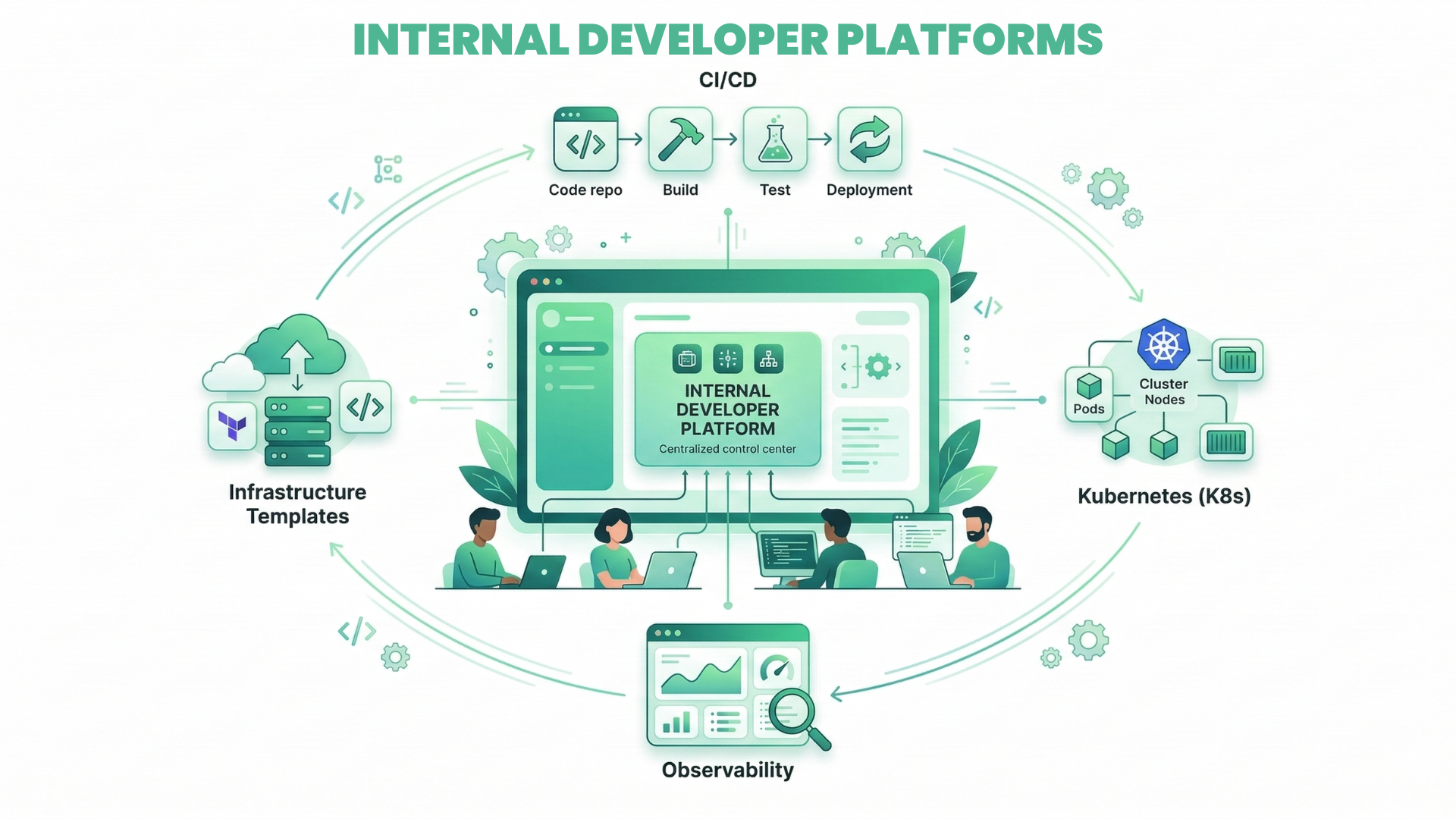
Developers today must navigate a wide array of tools and systems: Kubernetes clusters, CI/CD pipelines, infrastructure-as-code frameworks, observability platforms, and multiple cloud services. Although these technologies offer tremendous flexibility, managing them effectively requires significant operational knowledge.
As a result, many organizations have discovered an unexpected challenge: developers are spending too much time managing infrastructure rather than building software.
This challenge has led to the emergence of a new concept in modern software engineering: Internal Developer Platforms (IDPs).
Internal Developer Platforms are designed to simplify infrastructure complexity by providing developers with a standardized environment where they can build, deploy, and operate applications without needing to manage the underlying infrastructure directly.
These platforms have quickly gained popularity among engineering organizations seeking to improve developer productivity. However, while Internal Developer Platforms can significantly streamline development workflows, they also introduce important cost implications that organizations must carefully consider.
Let’s understand how IDPs impact infrastructure spending, resource utilization, and operational efficiency to become increasingly important for modern engineering teams.
What Is an Internal Developer Platform?
An Internal Developer Platform (IDP) is a centralized platform built by platform engineering teams to provide developers with self-service access to infrastructure, deployment pipelines, and operational tools.
Instead of requiring developers to configure cloud infrastructure manually, an IDP abstracts away much of the complexity. Developers interact with a simplified interface or portal that allows them to deploy applications, provision services, and manage environments using standardized templates.
A typical Internal Developer Platform may include:
Self-service application deployment tools
Automated CI/CD pipelines
Preconfigured infrastructure templates
Integrated monitoring and observability tools
Security and compliance guardrails
Service catalogs and documentation
By consolidating these capabilities into a unified platform, organizations create a more streamlined development experience.
Developers can focus on writing code and shipping features, while the platform engineering team ensures that infrastructure is secure, scalable, and compliant with organizational standards.
Why Are Internal Developer Platforms Gaining Momentum?
The growing popularity of Internal Developer Platforms is closely tied to the rise of platform engineering, a discipline focused on building internal infrastructure systems that improve developer experience.
Modern software environments have become incredibly complex. A single application may depend on multiple microservices, container orchestration platforms, managed databases, message queues, and distributed monitoring systems.
Although cloud-native tools enable this level of sophistication, they also create a steep learning curve for developers.
Internal Developer Platforms help address this complexity by providing a standardized abstraction layer between developers and infrastructure. This approach offers several benefits.
Improved Developer Productivity
When developers no longer need to configure infrastructure manually, they can focus more time on building product features. Standardized deployment workflows reduce friction and accelerate development cycles.
Faster Onboarding
New engineers can begin contributing more quickly because they interact with a simplified platform rather than learning a complex infrastructure stack.
Consistent Environments
Standardized templates ensure that development, staging, and production environments are configured consistently, reducing the risk of configuration drift.
Better Governance
Platform teams can enforce security policies, compliance requirements, and operational standards through the platform itself.
These advantages have made IDPs an increasingly attractive solution for organizations scaling their engineering teams.
The Hidden Infrastructure Costs of IDPs
Despite their productivity benefits, Internal Developer Platforms also introduce a set of financial and operational considerations.
While IDPs simplify infrastructure management for developers, they do not eliminate infrastructure complexity. Instead, they centralize it within the platform layer.
If not carefully managed, this centralization can lead to increased cloud spending.
Infrastructure Overprovisioning
To ensure smooth developer experiences, platform teams often provision infrastructure resources generously. This helps avoid performance issues but can lead to unused compute capacity.
For example, standardized templates may allocate larger instances than necessary for smaller workloads.
Environment Proliferation
Self-service environments are one of the most valuable features of Internal Developer Platforms. Developers can quickly spin up development or testing environments for new features.
However, these environments sometimes remain active long after they are needed, consuming cloud resources continuously.
Resource Abstraction
Because IDPs abstract infrastructure details, developers may lose visibility into the resources being consumed by their applications.
Without clear feedback mechanisms, teams may unintentionally deploy resource-intensive workloads.
Platform Maintenance Costs
Building and maintaining an Internal Developer Platform requires dedicated platform engineering teams. The infrastructure supporting the platform itself also introduces operational expenses. These costs are often justified by productivity gains, yet they still require careful monitoring.
Balancing Developer Experience and Cost Efficiency
One of the most important challenges organizations face when adopting Internal Developer Platforms is balancing developer experience with infrastructure efficiency. A platform designed solely for convenience may encourage excessive resource usage. Conversely, overly restrictive platforms can slow down development and frustrate engineering teams. Successful organizations aim to strike a balance between these two priorities.
Implementing Resource Guardrails
Platform engineering teams often implement guardrails that limit resource allocations, enforce infrastructure policies, and prevent inefficient configurations. These guardrails allow developers to remain productive while ensuring that infrastructure usage remains controlled.
Encouraging Cost Awareness
Even though IDPs abstract infrastructure complexity, developers still benefit from understanding how their architectural decisions affect infrastructure costs. Providing cost visibility at the service or application level helps teams make more informed design decisions.
Monitoring Infrastructure Utilization
Continuous monitoring of resource utilization helps identify inefficiencies such as idle environments or underutilized compute resources. When teams understand how infrastructure is being consumed across the platform, they can optimize workloads more effectively.
Observability and Cost Visibility in Platform Engineering
As Internal Developer Platforms scale, gaining clear visibility into infrastructure usage becomes increasingly important.
Platform teams must understand how different services, teams, and environments interact with cloud infrastructure.
This visibility enables organizations to answer critical questions:
Which services consume the most infrastructure resources?
Are development environments being used efficiently?
Are autoscaling policies working as expected?
How do platform decisions impact cloud spending?
Without comprehensive insights into these factors, managing infrastructure efficiency becomes difficult.
This is where modern cloud management platforms can play an important role.
Our Intelligent cloud management platform, Atler Pilot helps organizations gain deeper visibility into cloud infrastructure usage and spending patterns across complex environments. For companies operating Internal Developer Platforms, having centralized insights into resource utilization can help identify inefficiencies early and ensure that infrastructure scaling remains aligned with business objectives.
By analyzing infrastructure trends and detecting anomalies in cloud spending, tools like Atler Pilot enable platform engineering teams to maintain both developer productivity and financial discipline.
The Role of FinOps in Internal Developer Platforms
The adoption of Internal Developer Platforms has also accelerated the importance of FinOps practices. FinOps encourages collaboration between engineering, finance, and operations teams to ensure that cloud infrastructure is used efficiently.
In the context of IDPs, FinOps principles help organizations:
Track infrastructure costs across services and teams
Identify inefficient resource allocations
Encourage responsible infrastructure usage
Align engineering decisions with financial objectives
By integrating FinOps practices into platform engineering workflows, organizations can ensure that productivity improvements do not come at the expense of uncontrolled cloud spending.
The Future of Platform Engineering
Internal Developer Platforms represent a major shift in how organizations manage software infrastructure. As engineering teams continue to grow and cloud-native architectures become more complex, the demand for streamlined development environments will only increase. At the same time, organizations will place greater emphasis on infrastructure efficiency and cost transparency. Future Internal Developer Platforms are likely to include:
Automated cost visibility tools
Intelligent infrastructure recommendations
AI-driven resource optimization
Integrated FinOps dashboards
These capabilities will help organizations maintain a healthy balance between developer productivity and operational efficiency.
Conclusion
Internal Developer Platforms are rapidly becoming a foundational component of modern engineering organizations. By simplifying infrastructure complexity and providing standardized development environments, they empower developers to focus on innovation rather than operational overhead. However, like any powerful tool, IDPs must be implemented thoughtfully.
While they improve developer productivity and accelerate software delivery, they can also introduce new infrastructure costs if resource usage is not carefully monitored. The most successful organizations recognize that platform engineering is not only about improving developer experience. It is also about creating systems that scale efficiently and sustainably.
By combining strong platform engineering practices with clear infrastructure visibility and cost intelligence, organizations can ensure that Internal Developer Platforms deliver long-term value without compromising operational efficiency. In an increasingly complex cloud landscape, the true success of Internal Developer Platforms will not be measured only by how easily developers can deploy applications but by how effectively organizations manage the infrastructure that powers those deployments.
All in One Place
Atler Pilot decodes your cloud spend story by bringing monitoring, automation, and intelligent insights together for faster and better cloud operations.