
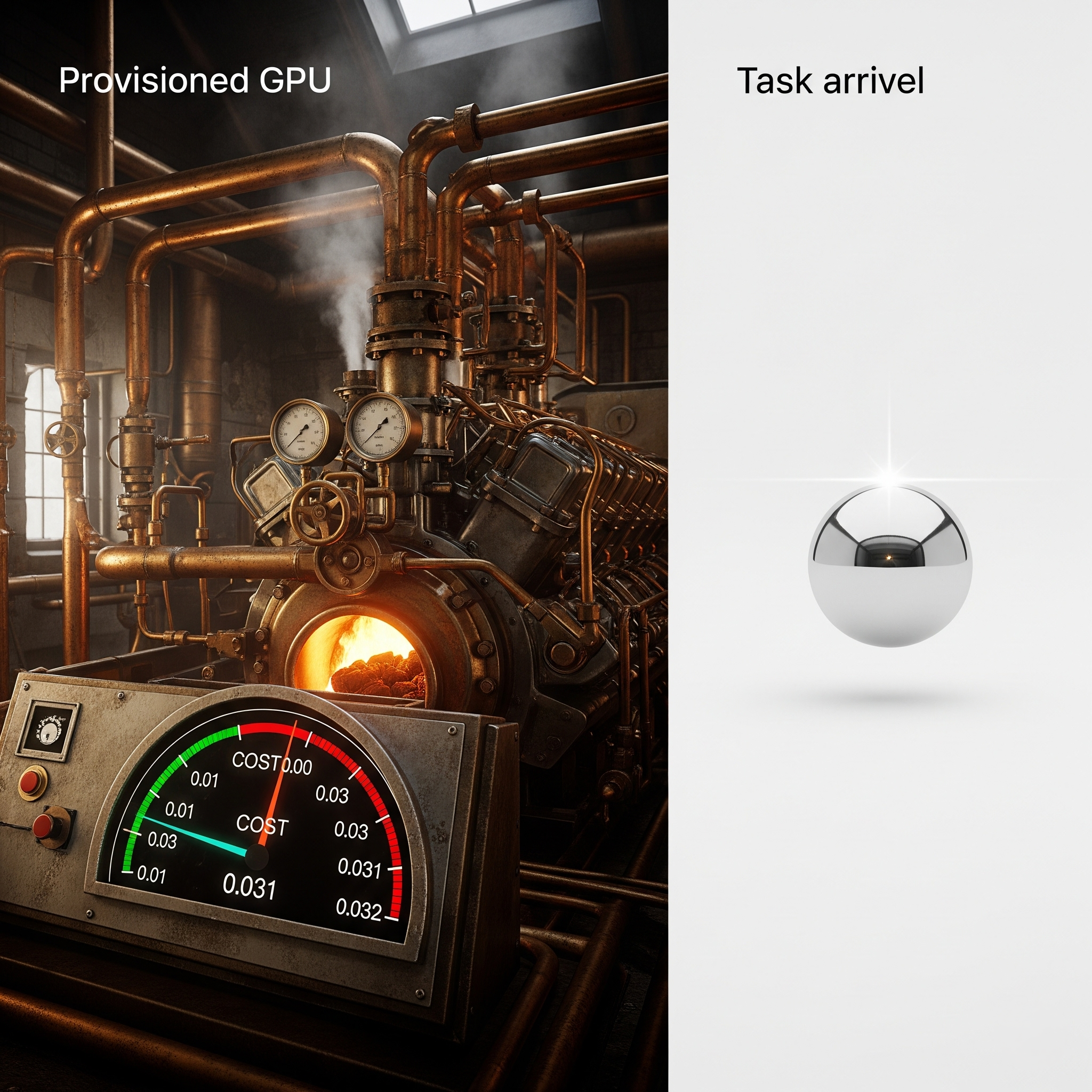
For years, running AI inference workloads in production meant provisioning and managing a fleet of expensive GPU instances. You had to predict peak traffic and pay for servers 24/7, even when they were idle. This model is costly and operationally complex.
A new paradigm is emerging:
serverless GPU inference. Platforms like AWS Lambda and Google Cloud Run now offer the ability to run GPU-accelerated code in a fully managed, pay-per-use environment. This approach promises to lower the barrier to entry for deploying AI models and offers a more cost-effective alternative for many use cases.
What is Serverless GPU Inference?
Serverless GPU inference abstracts away the underlying servers entirely. Instead of managing GPU instances, you simply package your model into a container, specify that it requires GPU acceleration, and deploy it to a serverless platform. The platform then handles everything: provisioning, execution, scaling from zero to thousands of requests, and teardown. Crucially, you only pay for the time your code is actually running, typically billed in milliseconds.
The Cost-Benefit Analysis: Serverless vs. Provisioned GPUs
The decision to use serverless GPUs is a trade-off between per-request cost and the elimination of idle capacity costs.
The Cost Model of Serverless GPUs
The serverless GPU inference cost is a function of two main variables:
Execution Duration: How long your model takes to process a request, measured in milliseconds.
Memory Allocation: How much memory (RAM and GPU memory) you allocate to your function.
This is a purely variable cost model. If your application receives no traffic, your bill is zero.
When is Serverless More Cost-Effective?
Serverless GPUs are almost always more cost-effective for workloads that are
intermittent, unpredictable, or have long periods of inactivity. Consider these scenarios:
Development and Staging Environments: A staging model might receive only a handful of requests per hour. Paying for a dedicated GPU to sit idle is pure waste.
Low-Traffic Production Applications: A new AI feature might be used by a small subset of users. Serverless allows you to launch without committing to expensive, always-on infrastructure.
Bursty or Spiky Workloads: An internal tool used heavily for a few hours a month but idle the rest of the time is a perfect fit for a serverless model.
When are Provisioned GPUs a Better Choice?
Provisioned, always-on GPU instances can be more cost-effective for workloads with
very high, sustained, and predictable traffic. If you know you will keep a GPU instance consistently utilized at >80% capacity, 24/7, then the lower hourly rate of a provisioned instance (especially with a Savings Plan) can result in a lower total cost.
Beyond Cost: The Operational Benefits of Serverless
The financial benefits are compelling, but the operational advantages are just as significant.
Zero Infrastructure Management: Your team is freed from patching, scaling, and managing GPU servers.
Infinite Scalability: The platform handles scaling automatically without complex configuration.
Faster Time-to-Market: The simplified deployment process allows you to get new models into production much more quickly.
Conclusion
Serverless GPU inference is a powerful and transformative new option in the MLOps toolkit. By eliminating the problem of idle capacity, it dramatically reduces the cost per prediction for a huge class of AI workloads. For any team building applications with intermittent or unpredictable traffic, the combination of cost savings and operational simplicity makes serverless GPUs a compelling choice
All in One Place
Atler Pilot decodes your cloud spend story by bringing monitoring, automation, and intelligent insights together for faster and better cloud operations.