
Introduction: The Scalability Crisis of Modern Cloud Operations
Modern enterprise cloud environments have outgrown human cognitive limits. As organizations migrate from monolithic architectures to highly distributed, multi-cloud microservices across AWS, Azure, GCP, and Oracle Cloud Infrastructure (OCI), the sheer volume of telemetry data has exploded. Site Reliability Engineers (SREs) are no longer just managing servers; they are orchestrating thousands of ephemeral containers, managing complex service meshes, and trying to make sense of millions of metrics, logs, traces, and events (MELT) generated every second.
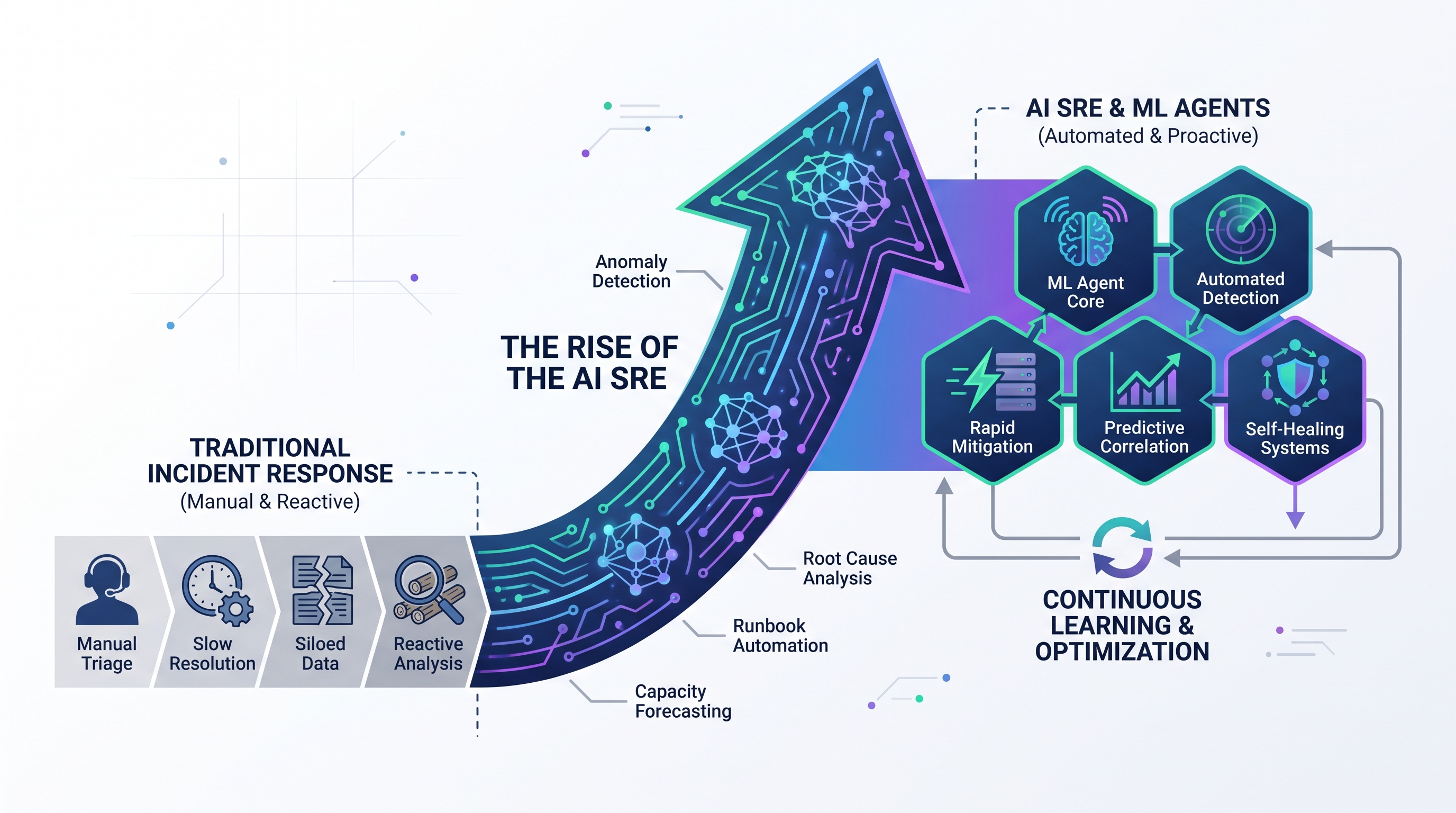
Traditional incident response relies heavily on static thresholds, reactive alerting, and human-authored runbooks. When an incident occurs, SREs are bombarded with alert storms, leading to cognitive overload and delayed Mean Time to Resolution (MTTR). This reactive posture is not only detrimental to system availability but also introduces massive security vulnerabilities and uncontrolled cloud spend. The industry requires a paradigm shift: transitioning from human-driven operations to autonomous, machine learning-driven systems. Enter the AI SRE.
An AI SRE is not merely a chatbot that summarizes alerts. It is an agentic, stateful machine learning system capable of continuous observation, causal reasoning, autonomous decision-making, and closed-loop remediation across diverse cloud infrastructures. By integrating deeply with observability pipelines, security frameworks, and cost management APIs, AI SREs are redefining how modern enterprises approach uptime, fiscal responsibility, and platform security. To understand how this transformation occurs, we must first look at the underlying architecture of these advanced machine learning agents.
The Architecture of an AI SRE Agent
At its core, an AI SRE agent operates as a continuous, closed-loop control system, analogous to a Kubernetes control loop but operating at a higher layer of abstraction. It consists of four fundamental pillars: the Ingestion & Normalization Layer, the Causal Reasoning Engine, the Safety & Guardrails Layer, and the Execution & Remediation Engine.
1. Ingestion & Normalization Layer
Enterprise cloud environments are notoriously heterogeneous. An AI SRE must ingest structured and unstructured data from disparate sources, including OpenTelemetry collectors, Prometheus metrics, AWS CloudWatch, Azure Monitor, GCP Cloud Logging, eBPF-based kernel telemetry, and application-level APM tools. The ingestion layer normalizes these diverse data streams into a unified semantic model, mapping resources, dependencies, and historical baselines.
2. Causal Reasoning Engine (LLMs + RAG + ReAct)
Unlike traditional AIOps, which relies on simple statistical correlation (e.g., "CPU spiked at the same time as error rates"), an AI SRE utilizes Large Language Models (LLMs) combined with Retrieval-Augmented Generation (RAG) and the ReAct (Reasoning and Action) framework. This allows the agent to reason through complex failure modes. When an anomaly is detected, the agent queries a vector database containing internal runbooks, past incident post-mortems, architectural diagrams, and API documentation to formulate hypotheses about the root cause.
3. Safety & Guardrails Layer
An autonomous agent must never be allowed to execute arbitrary code without constraints. The safety layer acts as a policy engine (often powered by Open Policy Agent or similar Policy-as-Code frameworks) that validates proposed remediations against security policies, compliance standards, and budget constraints before any action is taken.
4. Execution & Remediation Engine
Once a remediation plan is validated, the execution engine interacts with the cloud environment via APIs, Infrastructure as Code (IaC) tools (like Terraform or OpenTofu), and configuration management systems (like Ansible). This allows the agent to safely scale resources, roll back deployments, modify security group rules, or apply hot patches in real-time.
To visualize how these systems interact, consider the following architecture diagram representing the agentic workflow of an AI SRE:
+---------------------------------------------------------------------------------+
|                           MULTI-CLOUD TELEMETRY INGESTION                        |
|  [AWS CloudWatch]    [Azure Monitor]    [GCP Cloud Logging]    [eBPF / OTel]    |
+------------------------------------+--------------------------------------------+
                                     |
                                     v
+---------------------------------------------------------------------------------+
|                         CAUSAL REASONING & ANOMALY ENGINE                       |
|  - Anomaly Detection (Isolation Forests, Dynamic Thresholding)                  |
|  - Vector DB Lookup (RAG over Runbooks, Commits, Post-Mortems)                  |
|  - ReAct Loop: Reason -> Action -> Observe                                      |
+------------------------------------+--------------------------------------------+
                                     | Proposed Action Plan
                                     v
+---------------------------------------------------------------------------------+
|                       INTELLIGENT POLICY & FINOPS GUARDRAILS                    |
|  - Cost Impact Calculation (Will this action exceed budget limits?)            |
|  - Security & IAM Validation (Does this violate least privilege?)               |
+------------------------------------+--------------------------------------------+
                                     | Approved Action
                                     v
+---------------------------------------------------------------------------------+
|                         REMEDIATION & EXECUTION ENGINE                          |
|  - Terraform / Ansible Execution  - API-Driven Auto-Scaling  - Safe Rollbacks   |
+---------------------------------------------------------------------------------+
Multi-Cloud Incident Response: Navigating AWS, Azure, GCP, and Oracle
Operating in a single cloud provider is complex; managing incidents across a multi-cloud topology is exponentially harder. A typical enterprise application might run its front-end on AWS Elastic Kubernetes Service (EKS), process data through GCP BigQuery, store transactional data in Oracle Autonomous Database, and handle identity management through Microsoft Entra ID. When a latency spike occurs on the front-end, pinpointing the root cause across these cloud boundaries is a monumental task for human operators.
An AI SRE bridges this gap by maintaining a global, stateful graph of all resources and their cross-cloud dependencies. By leveraging CloudAtler's autonomous infrastructure SRE solutions, organizations can deploy machine learning agents that continuously map these multi-cloud relationships. For instance, if an API gateway in AWS experiences timeout errors, the AI SRE does not look at AWS metrics in isolation. It traces the transaction downstream, identifying that a database connection pool exhaustion in Oracle Cloud is stalling the entire microservice chain.
Furthermore, cloud providers have completely different terminologies, API behaviors, and throttling limits. An AI SRE abstracts these differences, translating high-level operational intent into cloud-specific API calls. Through advanced predictive monitoring and operations, the agent can anticipate failures before they impact end-users. For example, if the agent detects a pattern of gradual memory degradation on an Azure Virtual Machine scale set coupled with an uptick in GCP-hosted database queries, it can proactively trigger a micro-reboot or optimize the database connection pooling parameters without human intervention.
The Convergence of SRE, Security, and FinOps
Historically, SRE, Security (SecOps), and Financial Operations (FinOps) operated in siloed departments. SREs optimized for uptime and performance; SecOps focused on risk mitigation and vulnerability management; FinOps worked to control spiraling cloud budgets. However, in modern cloud-native architectures, these three domains are deeply intertwined. An operational decision made by an SRE can have massive security and financial repercussions.
Consider a classic incident: an application experiences a sudden, massive spike in traffic, causing CPU utilization to reach 100%. A traditional auto-scaling policy or a naive SRE runbook would immediately spin up dozens of new compute instances to handle the load. But what if this traffic spike is actually a Distributed Denial of Service (DDoS) attack, or a rogue recursive API loop in a newly deployed container? Scaling up compute instances does not solve the root cause; instead, it plays directly into the attacker's hands and results in a catastrophic cloud bill at the end of the month.
This is where the Atler AI engine excels. By unifying operational telemetry, security vulnerability data, and real-time cost metrics, it ensures that every proposed remediation is evaluated through a three-dimensional lens:
Operational Feasibility: Will this action resolve the degradation and restore the target Service Level Objectives (SLOs)?
Security Posture: Does this action introduce new vulnerabilities? (e.g., spinning up unpatched legacy images or opening insecure ports).
FinOps Efficiency: What is the financial impact of this action? Is there a more cost-effective way to achieve the same operational resilience?
By leveraging sophisticated cost impact calculation tools, the AI SRE can evaluate alternative remediation strategies in real-time. If an application cluster is running hot, instead of blindly scaling out expensive on-demand instances, the agent can analyze the current spot market availability across AWS, Azure, and GCP, evaluate existing savings plans, and choose to scale using pre-purchased reserved capacity or spot instances protected by automated failover mechanisms.
Implementing Autonomous Patching and Vulnerability Remediation
One of the most time-consuming and error-prone tasks for any SRE team is vulnerability management and patch application. When a critical Common Vulnerabilities and Exposures (CVE) alert is published (such as Log4j or Heartbleed), SRE and security teams must manually identify all affected systems, test the patch in a staging environment, coordinate a maintenance window, apply the patch, and verify that the application did not break.
An AI SRE completely revolutionizes this workflow. By integrating vulnerability scanners directly into the operational feedback loop, the agent can execute automated patch remediation with minimal human oversight. The workflow operates as follows:
Detection & Prioritization: The agent continuously monitors the package manifests and active runtimes of all containers and virtual machines. When a new CVE is announced, it assesses not just whether the vulnerable library is present, but whether it is actually loaded into memory and exposed to network traffic.
Impact Analysis: Before applying a patch, the agent evaluates the dependency tree to ensure the update won't cause breaking changes. It queries historical deployment data to see if previous updates to this library caused regression issues.
Canary Deployment & Testing: The AI SRE orchestrates a canary deployment, applying the patch to a tiny fraction of production traffic (e.g., 2%). It then monitors operational metrics (error rates, latency, memory consumption) and security logs to verify stability.
Automated Rollback: If any anomaly is detected during the canary phase, the agent immediately triggers an automated rollback, isolates the affected node, and generates a detailed post-mortem report for the engineering team. If the canary succeeds, the patch is progressively rolled out to the entire fleet.
Designing Safety Nets: Guardrails and Policy-as-Code
The concept of allowing an artificial intelligence agent to modify production infrastructure can understandably cause anxiety among engineering leaders. To build trust and ensure operational stability, organizations must implement robust safety nets, fine-grained access controls, and strict policy-as-code frameworks.
This is achieved by implementing intelligent guardrails that define the boundaries within which the AI SRE is allowed to operate autonomously. These guardrails are typically written in declarative policy languages and enforced at the API gateway layer. For example, a policy might state: "The AI SRE is authorized to restart services and scale out compute resources up to a maximum budget increase of $500/hour. Any action exceeding this cost, or any action involving the deletion of stateful databases or modifications to IAM policies, must require explicit human approval."
By defining these boundaries, enterprises can safely transition from a state of "Human-in-the-Loop" (where the AI suggests actions and a human must click 'approve') to "Human-on-the-Loop" (where the AI executes actions autonomously within defined guardrails, and humans are notified of the actions taken), and eventually to full autonomy for well-defined, low-risk operational procedures.
Comparative Analysis: Traditional Ops vs. Predictive AI SRE
To highlight the stark contrast between legacy operations and the new era of machine learning-driven reliability, let us examine how both paradigms respond to a critical database connection exhaustion incident:
Operational Phase | Traditional SRE Playbook | Predictive AI SRE Agent |
|---|---|---|
Detection | Static threshold alerts fire after 5 minutes of 95% connection limit usage. Alert storm floods Slack. | Anomaly detection identifies non-linear connection growth 15 minutes before thresholds are breached by analyzing query patterns. |
Triage & RCA | On-call engineer is paged, logs into multiple dashboards, queries logs manually, and tries to correlate events across AWS and GCP. | Agent uses RAG to correlate telemetry. Identifies a rogue deployment in GCP leaking database connections to an AWS RDS instance. |
Mitigation | Engineer manually scales up database size (causing brief downtime) or kills database connections, which quickly reappear. | Agent dynamically throttles the offending GCP service, applies an optimized connection pool configuration, and initiates a safe rollback. |
FinOps Impact | Unplanned database up-sizing increases cloud spend permanently until someone remembers to downsize it. | Remediation executed within strict budget guardrails. No unnecessary resource scaling; zero permanent cost increase. |
Conclusion: Unifying Cloud Operations with CloudAtler
The rise of the AI SRE represents an inevitable evolution in cloud infrastructure management. As systems grow more complex, ephemeral, and distributed, human-only operations teams will find it impossible to maintain high availability while simultaneously controlling costs and securing the perimeter. The future belongs to organizations that can successfully pair human expertise with autonomous machine learning agents.
By integrating operations, security, and FinOps into a single, unified control plane, CloudAtler enables enterprises to transition from reactive firefighting to proactive, autonomous cloud management. Whether you are running complex microservices on AWS, managing hybrid workloads on Azure and GCP, or orchestrating mission-critical databases on Oracle, CloudAtler provides the intelligence, guardrails, and automation tools you need to guarantee uptime, slash operational overhead, and optimize every dollar spent on the cloud.
Are you ready to eliminate alert fatigue, secure your multi-cloud environment, and bring autonomous efficiency to your SRE team? Explore the CloudAtler Platform today and discover how our unified, AI-powered cloud operations platform can transform your enterprise infrastructure.
All in One Place
Atler Pilot decodes your cloud spend story by bringing monitoring, automation, and intelligent insights together for faster and better cloud operations.