
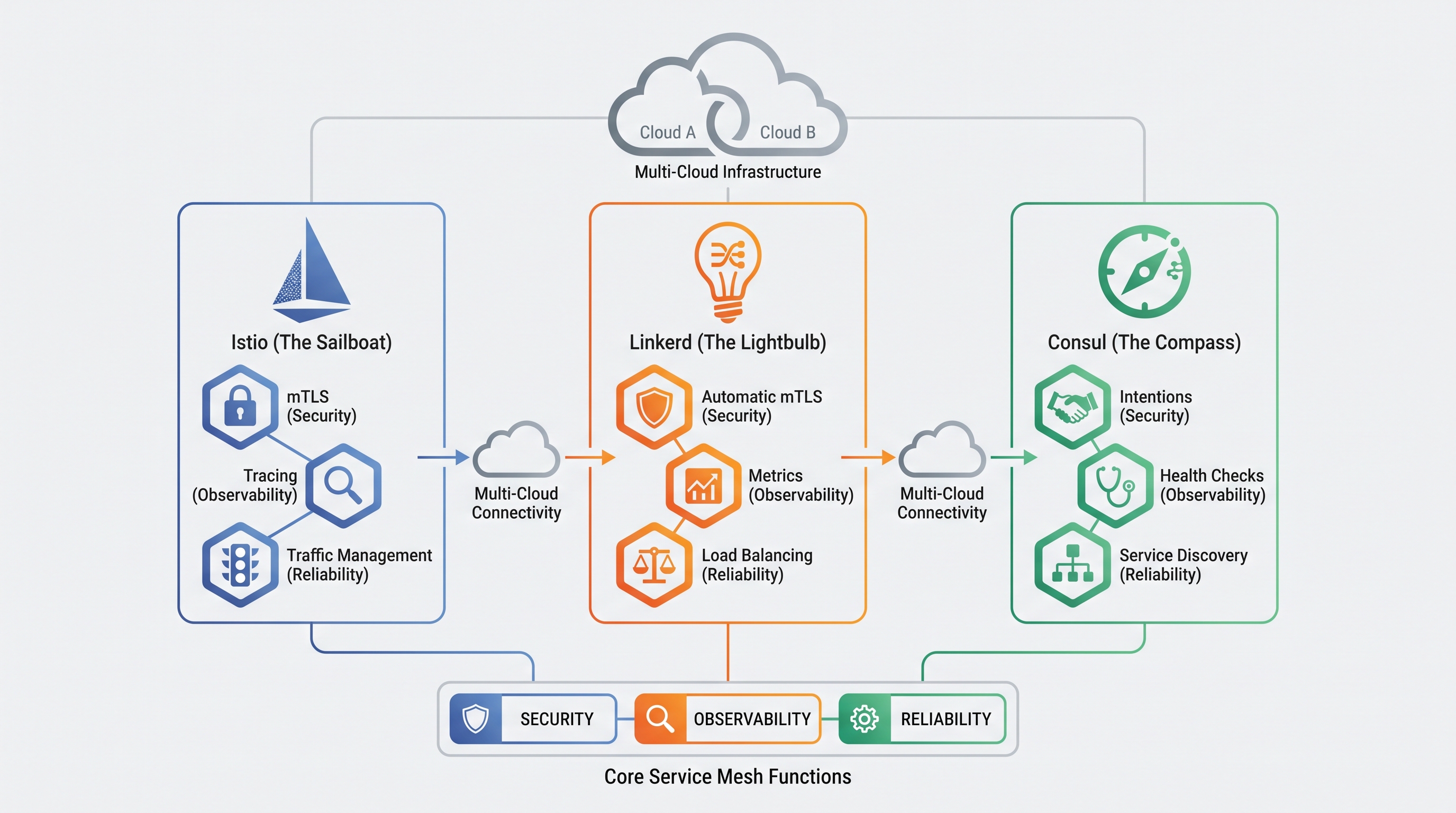
1. Introduction: The Multi-Cloud Network Conundrum
Modern enterprise architectures are increasingly distributed across multiple cloud providers, such as AWS, Azure, GCP, and Oracle Cloud Infrastructure (OCI). While a multi-cloud strategy mitigates vendor lock-in and improves disaster recovery postures, it introduces severe networking, security, and operational complexities. At the core of these complexities is the challenge of establishing reliable, secure, and observable service-to-service communication across heterogeneous cloud environments.
Traditional networking approaches, such as VPC peering, IPSec VPNs, and SD-WANs, operate primarily at Layer 3 and Layer 4 of the OSI model. While these technologies establish basic IP connectivity, they fall short in modern cloud-native environments for several reasons:
IP Address Space Exhaustion and Overlap: Coordinating non-overlapping CIDR blocks across multiple cloud providers and legacy on-premises datacenters is an administrative nightmare that frequently leads to complex NAT (Network Address Translation) configurations.
Coarse-Grained Security Policies: L3/L4 firewalls and Security Groups control traffic based on IP addresses and ports. In dynamic, containerized environments where IPs are ephemeral, maintaining these rules is highly error-prone and fails to enforce zero-trust principles.
Lack of Application-Layer Visibility: Traditional network devices cannot inspect Layer 7 (HTTP, gRPC, database protocols) traffic without resource-intensive SSL decryption proxies, making distributed tracing and request-level metrics difficult to obtain.
To bridge these gaps, enterprise architects turn to service meshes. A service mesh abstracts the network by injecting lightweight sidecar proxies (or utilizing node-level proxies) alongside application workloads. This shifts the responsibility of traffic routing, mutual TLS (mTLS) encryption, and telemetry collection from the application code and underlying infrastructure to a dedicated infrastructure layer. In a multi-cloud context, the service mesh acts as a unified logical overlay, enabling a service running in AWS EKS to communicate with a service in Google GKE as if they were running in the same local cluster.
2. Architectural Deep Dive: How Service Meshes Connect Heterogeneous Environments
To successfully orchestrate traffic across cloud boundaries, a service mesh must solve two primary problems: control plane synchronization and data plane routing. The control plane acts as the brain, distributing service discovery data, configuration, and cryptographic identities. The data plane consists of the proxies that intercept and route the actual application traffic.
There are two primary multi-cluster/multi-cloud topologies used by modern service meshes:
Flat Network Topology
In a flat network configuration, all pods or workloads across all clouds can assign and route directly to each other's IP addresses. This requires underlying VPNs, Direct Connects, or interconnects to handle routing. While this simplifies the service mesh configuration, it places a heavy burden on the network engineering team and does not solve the overlapping IP problem.
Multi-Network (Gateway-to-Gateway) Topology
In a multi-network topology, clusters exist on distinct networks without direct IP-to-IP routing. Instead, traffic destined for a service in another cloud is routed to an Egress Gateway in the source cluster, which forwards it over the public internet or a private interconnect to an Ingress Gateway in the destination cluster. The destination Ingress Gateway then routes the traffic to the target workload. This model is highly resilient, avoids IP collision issues, and is the preferred architecture for true multi-cloud deployments.
When implementing these architectures, enterprise platforms require deep visibility into both performance and cost. Utilizing an advanced unified dashboard allows cloud platform teams to observe these cross-cloud connections, ensuring that latency anomalies or unexpected cross-cloud data transfer costs are immediately visible.
+-----------------------------------------------------------------------------+
|                                MULTI-CLOUD OVERLAY                          |
|                                                                             |
|   +-----------------------+                    +-----------------------+    |
|   |       AWS (EKS)       |                    |      GCP (GKE)       |    |
|   |  +-----------------+  |                    |  +-----------------+  |    |
|   |  |   Service A     |  |                    |  |   Service B     |  |    |
|   |  | (Sidecar Proxy) |  |                    |  | (Sidecar Proxy) |  |    |
|   |  +--------+--------+  |                    |  +--------+--------+  |    |
|   |           |           |                    |           ^           |    |
|   |           v           |                    |           |           |    |
|   |  +-----------------+  |                    |  +--------+--------+  |    |
|   |  | Egress Gateway  |  |                    |  | Ingress Gateway |  |    |
|   |  +--------+--------+  |                    |  +-----------------+  |    |
|   +-----------|-----------+                    +-----------^-----------+    |
|               |                                            |                |
|               +----------- mTLS over WAN (HTTPS) ----------+                |
+-----------------------------------------------------------------------------+
3. Istio: The Enterprise Heavyweight
Istio is the most widely adopted service mesh in the enterprise space. Built on top of the Envoy proxy, Istio offers an exhaustive feature set designed for complex, heterogeneous environments.
Architecture & Multi-Cloud Topology
Istio’s control plane, istiod, acts as a single daemon that combines CA (Certificate Authority), injection webhook, and endpoint discovery. In a multi-cloud configuration, Istio supports two primary topologies:
Multi-Primary: Each cluster has its own
istiodcontrol plane instance. The control planes replicate service endpoints across clusters by scraping the Kubernetes API servers of all participating clusters. This topology is highly resilient; if one cloud provider experiences a control plane outage, the other clusters continue to function independently.Primary-Remote: A single cluster hosts the primary
istiodcontrol plane, which manages remote clusters. While simpler to configure, this introduces a single point of failure across cloud boundaries and is rarely recommended for critical multi-cloud production workloads.
Security and Identity Federation
For cross-cloud security, Istio relies on SPIFFE (Secure Production Identity Framework for Enterprise) IDs. Cryptographic identities are distributed to workloads via local Envoy proxies. To federate identity across clouds, Istio clusters must share a common root of trust. This is achieved by configuring a shared root CA and issuing intermediate CAs to each cluster's istiod instance, or by using SPIFFE Trust Bundles to allow runtime verification of certificates issued by different CAs.
Using Istio’s AuthorizationPolicy, platform teams can enforce strict zero-trust constraints across clouds. For example, a service in AWS can be restricted to only accept mTLS-encrypted requests from a specific service account in GCP:
apiVersion: security.istio.io/v1beta1
kind: AuthorizationPolicy
metadata:
  name: cross-cloud-access
  namespace: payments
spec:
  selector:
    matchLabels:
      app: payment-processor
  action: ALLOW
  rules:
  - from:
    - source:
        principals: ["gcp-project-123.svc.id.goog/ns/checkout/sa/checkout-service-account"]
FinOps and Operational Impact
While Istio is incredibly powerful, its architectural complexity comes with a steep resource tax. Envoy sidecars typically consume 50MB to 100MB of memory per container, depending on the number of endpoints in the mesh. In a cluster with thousands of pods, this sidecar overhead can lead to significant compute costs. To optimize this, teams can use Istio's Sidecar resource to scope down the configuration sent to each proxy, reducing memory consumption and CPU overhead.
Additionally, managing the security policies of such a complex mesh requires dedicated expertise. Organizations often utilize specialized automated cloud security management solutions to audit these configurations and ensure no misconfigured gateways expose internal services to the public internet.
4. Linkerd: The Ultra-Lightweight, Security-First Alternative
Linkerd, a CNCF graduated project, takes a radically different approach than Istio. Designed with simplicity and performance as its core tenets, Linkerd avoids the feature-bloat of Envoy by utilizing its own custom-built, Rust-based data plane proxy: linkerd2-proxy.
Architecture & Multi-Cluster Topology
Linkerd’s multi-cluster architecture is built around the concept of "service mirroring." Instead of requiring the control planes to directly query remote API servers, Linkerd uses a lightweight linkerd-multicluster controller. This controller watches a target cluster for services flagged for mirroring and creates local Kubernetes ExternalName services in the source cluster.
When a local service calls a mirrored service, the traffic is intercepted by the local Linkerd proxy, encrypted via mTLS, and sent directly to the public or private IP of the remote cluster's gateway (the linkerd-gateway). The gateway then forwards the traffic to the appropriate backend pod.
Security and mTLS
Linkerd’s security model is "on by default." Unlike Istio, which allows permissive mTLS configurations, Linkerd enforces mTLS for all mesh communication out-of-the-box. For cross-cloud communication, Linkerd requires that all clusters share a common trust anchor. During installation, users must provide a root certificate and localized issuer certificates for each cluster. Because Linkerd’s proxy is written in Rust, it is inherently immune to many of the memory-safety vulnerabilities that plague C++ based proxies like Envoy, significantly reducing the security attack surface of the data plane.
FinOps and Performance Advantages
From a FinOps perspective, Linkerd is highly efficient. The linkerd2-proxy typically consumes less than 15-20MB of memory and has sub-millisecond p99 latency overhead. It avoids the heavy control-plane-to-data-plane synchronization traffic that can inflate internal network costs in large Istio deployments. For platform engineers focused on infrastructure and site reliability engineering (SRE), Linkerd provides a low-maintenance, high-performance alternative that minimizes compute overhead on Kubernetes nodes.
5. HashiCorp Consul: The Hybrid and Multi-Runtime Bridge
While Istio and Linkerd are primarily Kubernetes-centric, HashiCorp Consul was designed from the ground up to support heterogeneous runtimes, including bare-metal servers, virtual machines (such as AWS EC2 or Azure VMs), and container orchestrators like Kubernetes, ECS, and Nomad.
Architecture & Multi-Cloud WAN Federation
Consul Service Mesh utilizes Envoy as its data plane, but relies on Consul’s own distributed key-value store and consensus protocol (Raft) for its control plane. In a multi-cloud architecture, Consul connects disparate environments using WAN Federation.
Each cloud environment is defined as a Consul "datacenter." These datacenters communicate over the WAN via Consul Mesh Gateways. Consul’s control plane synchronizes service registration across datacenters, allowing services in AWS to discover services in GCP or on-premises environments via standard DNS queries (e.g., payment.service.gcp.consul) or HTTP API calls.
+-----------------------------------------------------------------------------+
|                              CONSUL WAN FEDERATION                          |
|                                                                             |
|   +-----------------------+                    +-----------------------+    |
|   |  AWS Datacenter (VMs) |                    | GCP Datacenter (K8s)  |    |
|   |  +-----------------+  |                    |  +-----------------+  |    |
|   |  |   Consul Client |  |                    |  |   Consul Client |  |    |
|   |  +--------+--------+  |                    |  +--------+--------+  |    |
|   |           |           |                    |           ^           |    |
|   |           v           |                    |           |           |    |
|   |  +-----------------+  |                    |  +--------+--------+  |    |
|   |  |  Mesh Gateway   |  |                    |  |  Mesh Gateway   |  |    |
|   |  +--------+--------+  |                    |  +-----------------+  |    |
|   +-----------|-----------+                    +-----------^-----------+    |
|               |                                            |                |
|               +------- WAN Gossip & mTLS over Internet ----+                |
+-----------------------------------------------------------------------------+
Security and Hybrid Governance
Consul uses "Intentions" to define service-to-service authorization. Intentions can be managed via Consul’s UI, CLI, or API, as well as declaratively via Terraform. Because Consul spans both VM and container workloads, it allows enterprises to enforce a single, unified zero-trust policy across legacy monolithic applications and modern microservices. For security teams, this bridges the visibility gap that often exists during cloud migration phases.
FinOps Impact
Consul’s resource consumption is highly dependent on deployment topology. Because it requires a Consul client agent on every VM or Kubernetes node, as well as a cluster of Consul Servers (typically 3 or 5 instances per datacenter), the base infrastructure cost is higher than Linkerd. However, Consul’s ability to run natively on VMs eliminates the need to containerize legacy workloads purely to bring them into a secure service mesh, saving millions in refactoring and migration costs.
6. Side-by-Side Comparison Matrix
The following table provides a detailed, feature-by-feature comparison of Istio, Linkerd, and Consul in the context of multi-cloud deployments:
Feature / Dimension | Istio | Linkerd | HashiCorp Consul |
|---|---|---|---|
Data Plane Proxy | Envoy (C++) | linkerd2-proxy (Rust) | Envoy (C++) |
Control Plane Footprint | Moderate to High (istiod) | Very Low (Go-based micro-services) | High (Consul Servers + Client Agents) |
Multi-Cloud Topology | Multi-Primary or Primary-Remote with Ingress/Egress Gateways | Service Mirroring via | WAN Federation via Mesh Gateways |
VM / Non-K8s Support | Complex (requires WorkloadEntry and manual sidecar installation) | No (Kubernetes-native only) | Excellent (First-class VM, Bare Metal, and ECS support) |
mTLS & Cryptography | SPIFFE/SPIRE, intermediate CA federation, highly customizable | SPIFFE compliant, automatic and strict mTLS with shared root anchor | SPIFFE compliant, auto-mTLS, integrates with HashiCorp Vault |
Traffic Management | Advanced (L7 routing, fault injection, mirroring, circuit breaking) | Basic to Moderate (Traffic splitting, retries, timeouts) | Advanced (L7 traffic splitting, failover, routing tables) |
FinOps / Resource Tax | High memory/CPU usage per sidecar; telemetry processing is costly | Extremely low CPU/memory footprint; optimized Rust proxy | Moderate to High depending on Consul cluster size and Envoy configs |
7. FinOps and Security Optimization Strategies in Multi-Cloud Service Meshes
Deploying a service mesh across multiple clouds without strict optimization can quickly lead to astronomical cloud bills and security vulnerabilities. To keep your multi-cloud infrastructure secure and cost-efficient, implement the following architectural strategies.
Egress Cost Mitigation via Locality-Prioritized Routing
Cloud providers charge significant fees for data leaving their network (egress fees) and even for data traversing Availability Zones (AZs) within the same region. When a service in AWS needs to call a database service, and replicas exist both in AWS and Azure, routing that traffic across the cloud boundary should be a last resort.
To prevent unnecessary cross-cloud egress costs, configure Locality-Prioritized Load Balancing. In Istio, this is managed via the LocalityLoadBalancerSetting. This configuration instructs the proxy to always route traffic to a local instance of the destination service within the same AZ or region. Only if all local instances fail (failover scenario) will the proxy route traffic through the egress gateway to the remote cloud provider.
apiVersion: networking.istio.io/v1beta1
kind: DestinationRule
metadata:
  name: payment-service-locality
spec:
  host: payment-service.prod.svc.cluster.local
  trafficPolicy:
    loadBalancer:
      localityLbSetting:
        enabled: true
        failover:
          - from: us-east-1
            to: us-east-2
          - from: us-east-1
            to: centralus # Failover to Azure only if AWS regions are down
Tracking these complex, cross-cloud egress pathways and their financial impact requires specialized financial intelligence. Organizations can leverage a financial command center to visualize real-time cost spikes associated with inter-cloud network traffic, allowing engineering teams to adjust their locality routing policies before costs spiral out of control.
Managing Certificate Lifecycle and Trust Federation
In a multi-cloud zero-trust environment, identity is paramount. The primary risk is certificate expiration or compromise. If the root certificate or intermediate CA expires in one cloud, communication between clouds will instantly fail, resulting in cascading application outages.
To mitigate this risk:
Automate Certificate Rotation: Integrate your service mesh with external secret management solutions like HashiCorp Vault, AWS Secrets Manager, or Google Secret Manager. Use cert-manager in Kubernetes to automatically renew intermediate certificates before they reach 70% of their lifespan.
Isolate Trust Domains: Avoid using a single, global private key across all clouds. Instead, establish a secure root CA offline, and issue distinct intermediate CAs to each cloud cluster. If one cluster is compromised, its intermediate certificate can be revoked without affecting the security posture of the other cloud environments.
Optimizing Telemetry and Metrics Ingestion
Service meshes generate massive volumes of telemetry data (metrics, logs, and traces). Sidecar proxies emit detailed metrics for every single network request. In a high-throughput multi-cloud environment, sending all these metrics to a centralized monitoring platform can result in a "metrics explosion," costing more than the actual compute resources running the application.
To optimize telemetry costs:
Filter Metrics at the Source: Configure your proxies to drop high-cardinality metrics that are not critical for operational visibility. For example, disable client-side metrics for external HTTP requests if server-side metrics are already captured.
Apply Trace Sampling: Never trace 100% of requests in production. Implement adaptive sampling (e.g., sample 1% of successful requests and 100% of failed requests) to drastically reduce tracing ingestion costs.
Correlate Data with Operational Intelligence: Use operational intelligence platforms to identify which telemetry streams are actually being utilized in dashboards and alerts, and programmatically prune unused metrics.
8. Conclusion: Unifying Multi-Cloud Operations
Choosing the right service mesh for your multi-cloud infrastructure depends heavily on your existing workload architecture and resource constraints. If your organization is fully containerized on Kubernetes and demands maximum performance with minimal resource overhead, Linkerd is the clear choice. If you require advanced L7 routing, deep customization, and have the engineering bandwidth to manage its complexity, Istio remains the industry standard. For organizations bridging legacy VM infrastructure with modern Kubernetes clusters across hybrid environments, HashiCorp Consul provides the most robust multi-runtime federation capabilities.
However, implementing a service mesh is only one piece of the multi-cloud puzzle. Managing the intersection of security policies, network routing, and the resulting cloud spend across AWS, Azure, GCP, and OCI requires a unified approach. Without centralized governance, platform teams are forced to jump between disparate cloud consoles, APM tools, and budgeting spreadsheets.
This is where CloudAtler excels. CloudAtler provides an AI-powered platform that unifies FinOps, cloud security, and automated operations into a single pane of glass. By correlating service mesh telemetry with real-time billing data and security compliance frameworks, CloudAtler enables you to optimize cross-cloud egress costs, detect anomalous network traffic, and automate governance policies across your entire multi-cloud estate.
Ready to eliminate multi-cloud complexity and regain control over your infrastructure costs and security posture? Explore CloudAtler today or schedule a demo with our cloud architecture experts.
All in One Place
Atler Pilot decodes your cloud spend story by bringing monitoring, automation, and intelligent insights together for faster and better cloud operations.