
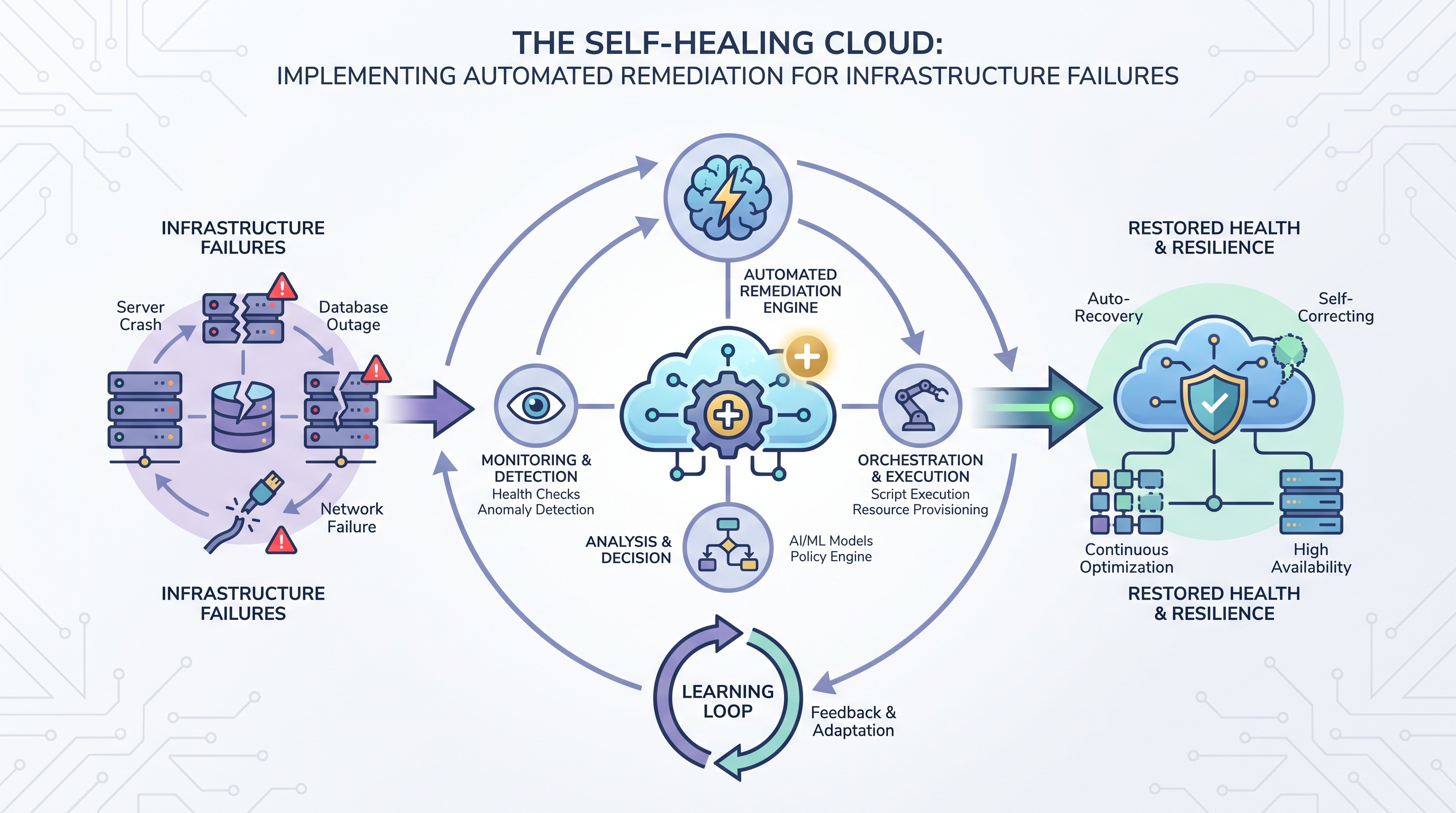
The Paradigm Shift: From Reactive Alerting to Autonomous Healing
For over a decade, cloud operations have relied on a reactive telemetry model: a metric crosses a static threshold, an alert is triggered, a pager goes off, and an on-call engineer manually intervenes to remediate the issue. In modern, highly distributed multi-cloud architectures spanning AWS, Azure, GCP, and Oracle Cloud Infrastructure (OCI), this manual intervention model is fundamentally broken. The sheer velocity, scale, and complexity of microservice deployments make human-in-the-loop operations a primary vector for extended Mean Time to Resolution (MTTR), operational fatigue, and catastrophic downtime.
The solution is the Self-Healing Cloud—an architectural paradigm where infrastructure autonomously detects, diagnoses, and remediates failures, security drifts, and cost inefficiencies in real time. By closing the loop between observability and orchestration, organizations can transition from passive monitoring to active, policy-driven automation. This paradigm shift requires a deep integration of cloud-native APIs, serverless computing, event-driven architectures, and unified management platforms.
To successfully execute this transition, modern enterprises leverage a unified single-pane dashboard to consolidate telemetry across disparate environments. Without this centralized visibility, automated remediation scripts operate in silos, creating a high risk of conflicting actions, race conditions, and uncontrolled feedback loops. This guide explores the technical blueprints, concrete code implementations, and strict operational guardrails necessary to build a production-grade, self-healing cloud infrastructure.
The Closed-Loop Remediation Architecture
At the core of any self-healing system lies the control theory concept of a closed-loop system, often mapped to the OODA (Observe, Orient, Decide, Act) loop. In a cloud-native context, this loop is engineered using four distinct, decoupled layers:
Phase | Component | Technologies Used | Primary Objective |
|---|---|---|---|
Observe | Telemetry Pipeline | OpenTelemetry, Prometheus, AWS CloudWatch, Azure Monitor | Continuous ingestion of metrics, logs, traces, and audit events. |
Orient | State Engine | CloudAtler Policy Engine, OPA (Open Policy Agent) | Contextualizing events against baseline state, compliance, and budget. |
Decide | Orchestration Layer | AWS EventBridge, GCP Pub/Sub, Azure Event Grid | Evaluating the violation and selecting the appropriate remediation playbook. |
Act | Remediation Runner | AWS Lambda, Azure Functions, Terraform, Ansible | Executing API calls to mutate infrastructure back to its desired state. |
The telemetry pipeline must ingest data with sub-second latency. When an anomaly or policy violation is detected (e.g., an unauthorized public S3 bucket or a memory-saturated virtual machine), the state engine evaluates the event against a centralized policy repository. Once a decision is reached, the orchestration layer routes a structured payload to the remediation runner, which executes target mutations via cloud APIs.
Implementing Automated Remediation for Security Violations (SecOps)
Security posture management cannot wait for human intervention. If an attacker compromises an IAM credential and opens port 22 or 3389 to 0.0.0.0/0, the exploit window is measured in seconds. Automated remediation must act instantly to isolate the threat.
Let us examine a real-world scenario: an engineer accidentally attaches an overly permissive policy to an AWS S3 bucket, exposing sensitive customer data to the public. To remediate this automatically, we deploy an event-driven serverless pipeline using AWS EventBridge and AWS Lambda. This setup forms the technical foundation of modern automated security management tools, allowing continuous compliance enforcement without manual overhead.
The Technical Blueprint
1. Event Detection: AWS CloudTrail captures the PutBucketPolicy or CreateBucket API call.
2. Event Routing: An AWS EventBridge rule filters for these specific API calls and routes the event to a target Lambda function.
3. Execution (Remediation): The Lambda function analyzes the bucket policy, identifies public read/write permissions, deletes the non-compliant policy, and applies a strict private block configuration.
The Python (Boto3) Remediation Script
Below is a production-grade Lambda function written in Python using the Boto3 SDK to automatically remediate public S3 buckets:
import json
import boto3
import logging

logger = logging.getLogger()
logger.setLevel(logging.INFO)

s3_client = boto3.client('s3')

def lambda_handler(event, context):
    logger.info(f"Received event: {json.dumps(event)}")

    # Extract details from CloudTrail event
    detail = event.get('detail', {})
    bucket_name = detail.get('requestParameters', {}).get('bucketName')

    if not bucket_name:
        logger.error("Bucket name not found in event payload.")
        return {"status": "error", "message": "No bucket name identified"}

    try:
        # Step 1: Enforce Public Access Block configuration
        logger.info(f"Enforcing Public Access Block on bucket: {bucket_name}")
        s3_client.put_public_access_block(
            Bucket=bucket_name,
            PublicAccessBlockConfiguration={
                'BlockPublicAcls': True,
                'IgnorePublicAcls': True,
                'BlockPublicPolicy': True,
                'RestrictPublicBuckets': True
            }
        )

        # Step 2: Delete any existing public bucket policy
        logger.info(f"Deleting public bucket policy on bucket: {bucket_name}")
        s3_client.delete_bucket_policy(Bucket=bucket_name)

        logger.info(f"Successfully remediated bucket: {bucket_name}")
        return {"status": "success", "remediated_bucket": bucket_name}

    except Exception as e:
        logger.error(f"Failed to remediate bucket {bucket_name}. Error: {str(e)}")
        # In a production environment, escalate to a secondary alerts topic (e.g., SNS)
        raise e
For organizations managing complex, multi-tenant cloud footprints, deploying and maintaining hundreds of custom Lambda scripts across thousands of accounts becomes an operational nightmare. This is why enterprise-grade security teams utilize dedicated CISO security solutions that abstract this logic into low-code or no-code policy engines. These engines continuously scan resources, compare them to frameworks like CIS Benchmarks or SOC 2, and trigger standardized, pre-tested remediation playbooks instantly.
FinOps-Driven Self-Healing: Automated Cost Optimization
Self-healing is not restricted to system uptime and security; it is equally critical for financial hygiene. Unchecked cloud spend, orphaned resources, and idle infrastructure represent a silent, continuous failure of cloud governance. By implementing FinOps-driven automated remediation, enterprises can automatically prune waste and dynamically rightsize infrastructure based on real-time utilization patterns.
Common targets for automated FinOps remediation include:
Orphaned Block Storage: Detached AWS EBS volumes, Azure Managed Disks, or GCP Persistent Disks that continue to accrue costs despite being unattached to any compute instance.
Idle Compute Instances: Non-production virtual machines running 24/7 with less than 2% average CPU utilization over a 14-day window.
Legacy Snapshots: Automated snapshots retained far beyond the organization's compliance requirements.
Deep Dive: Automated Orphaned Volume Remediation
To implement an automated remediation pipeline for orphaned EBS volumes, we must balance cost savings with data preservation. Simply deleting every detached volume can lead to catastrophic data loss. A resilient self-healing flow must follow a structured lifecycle:
1. Identify: Query the cloud API for volumes in the available (unattached) state.
2. Snapshot (Preserve): Create a final, compressed backup snapshot of the volume to guarantee data recoverability.
3. Tag (Audit Trail): Tag the snapshot with metadata, including the original volume ID, the date of deletion, and the triggering policy.
4. Delete (Remediate): Purge the parent volume to cease active billing charges.
Implementing these guardrails at scale prevents accidental data loss while systematically driving down operational expenditure. To visualize how these processes scale across an entire organization, CIOs rely on enterprise CIO FinOps frameworks to quantify the exact financial impact of automated remediation routines across AWS, Azure, GCP, and OCI simultaneously.
Resilient Infrastructure: Compute and Database Auto-Recovery
At the application layer, self-healing focuses on maintaining high availability and low latency despite underlying hardware degradation, network partitions, or memory leaks. This is achieved through container orchestration platforms, automated scaling groups, and intelligent load-balancing failovers.
Kubernetes Self-Healing Mechanisms
Kubernetes is natively designed as a self-healing platform. It continuously monitors the state of containerized workloads and executes remediation actions based on declarative configurations. To maximize Kubernetes resiliency, engineers must correctly configure three vital probes:
Liveness Probes: Determines if a container needs to be restarted. If an application enters a deadlock state, the liveness probe fails, and the kubelet kills and restarts the container.
Readiness Probes: Identifies if a container is ready to accept network traffic. If a pod's readiness probe fails, it is temporarily removed from the service endpoints, preventing users from receiving HTTP 500 errors.
Startup Probes: Protects slow-starting legacy applications by disabling liveness and readiness checks until the container has completed its initial boot sequence.
Here is an example of a robust Kubernetes Deployment manifest incorporating these self-healing parameters:
apiVersion: apps/v1
kind: Deployment
metadata:
  name: payment-gateway
  labels:
    app: payment-gateway
spec:
  replicas: 3
  selector:
    matchLabels:
      app: payment-gateway
  template:
    metadata:
      labels:
        app: payment-gateway
    spec:
      containers:
      - name: gateway-app
        image: payment-gateway:v2.4.1
        ports:
        - containerPort: 8080
        resources:
          limits:
            cpu: "1"
            memory: "1024Mi"
          requests:
            cpu: "500m"
            memory: "512Mi"
        startupProbe:
          httpGet:
            path: /healthz/startup
            port: 8080
          failureThreshold: 30
          periodSeconds: 10
        livenessProbe:
          httpGet:
            path: /healthz/live
            port: 8080
          initialDelaySeconds: 5
          periodSeconds: 15
        readinessProbe:
          httpGet:
            path: /healthz/ready
            port: 8080
          initialDelaySeconds: 5
          periodSeconds: 10
Beyond individual containers, self-healing extends to the underlying node pool. If a virtual machine hosting Kubernetes pods experiences hardware degradation, node auto-provisioning systems must cordon the node, drain active workloads, terminate the unhealthy VM, and spin up a fresh compute resource without human intervention.
Designing Safe Rollbacks and Avoiding the "Death Spiral"
While automated remediation is incredibly powerful, it introduces a significant risk: the "Death Spiral" (or cascading failure loop). If an automated script reacts to a false positive or attempts to remediate a system failure by executing actions that actually worsen the issue, it can accelerate a minor blip into a catastrophic, multi-region outage.
Consider an application suffering from database-induced latency. An automated scaling policy detects the slow response times and assumes the compute tier is overloaded. It responds by spinning up 50 new application instances. These new instances immediately open connection pools to the already-struggling database, completely overwhelming its connection limits and knocking the entire platform offline. This is a classic cascading failure caused by blind automation.
Operational Guardrails for Safe Remediation
To prevent these scenarios, architects must build strict operational guardrails into their automation frameworks:
Rate Limiting and Throttling: Restrict the number of automated actions that can occur within a specific timeframe. For example, limit auto-scaling groups to adding a maximum of 5 instances per 10 minutes, or restrict disk expansion actions to once every 24 hours.
Circuit Breakers: If an automated remediation script executes and the target metric does not return to a healthy state within a defined threshold, the automation must trip its "circuit breaker." This action halts further automated attempts and immediately escalates the incident to a tier-3 human engineer.
Coordinated State Validation: Never rely on a single metric to trigger a destructive action. Verify the health of dependent systems (e.g., checking database CPU and connection counts before scaling the web tier).
Human-in-the-Loop (HITL) Gates: For high-blast-radius actions (such as dropping database tables, deleting active subnets, or executing multi-region DNS failovers), insert a validation gate. The system drafts the remediation plan, posts a structured card to an engineering Slack/Teams channel, and waits for a single-click human approval before execution.
These architectural best practices are formalized in the comprehensive CloudAtler operations playbook, which outlines how to design safe, predictable, and highly resilient automated workflows across complex enterprise environments without risking stability.
Unifying Operations with CloudAtler
Building a self-healing cloud from scratch requires stitching together disparate telemetry tools, serverless pipelines, IAM policies, and custom scripting languages. For enterprises operating across multiple cloud providers, maintaining this codebase is an expensive, error-prone endeavor that distracts core engineering teams from delivering business value.
CloudAtler solves this complexity by providing an AI-powered platform that unifies FinOps, cloud security, and automated operations into a single, cohesive engine. Rather than writing and maintaining thousands of lines of custom Python and Bash scripts, CloudAtler allows you to define declarative self-healing policies that automatically run across AWS, Azure, GCP, and Oracle environments.
With CloudAtler, you gain access to:
Cross-Cloud Telemetry Correlation: Unify metrics, security logs, and billing data to make intelligent, context-aware remediation decisions.
Out-of-the-Box Playbooks: Instantly deploy pre-built, industry-standard remediation workflows for security drift, resource rightsizing, and system recovery.
Advanced Guardrails: Protect your infrastructure from cascading failures with built-in rate-limiting, circuit breakers, and collaborative approval gates.
Stop fighting fires manually. Empower your engineering teams, secure your data, and optimize your cloud spend automatically.
All in One Place
Atler Pilot decodes your cloud spend story by bringing monitoring, automation, and intelligent insights together for faster and better cloud operations.