
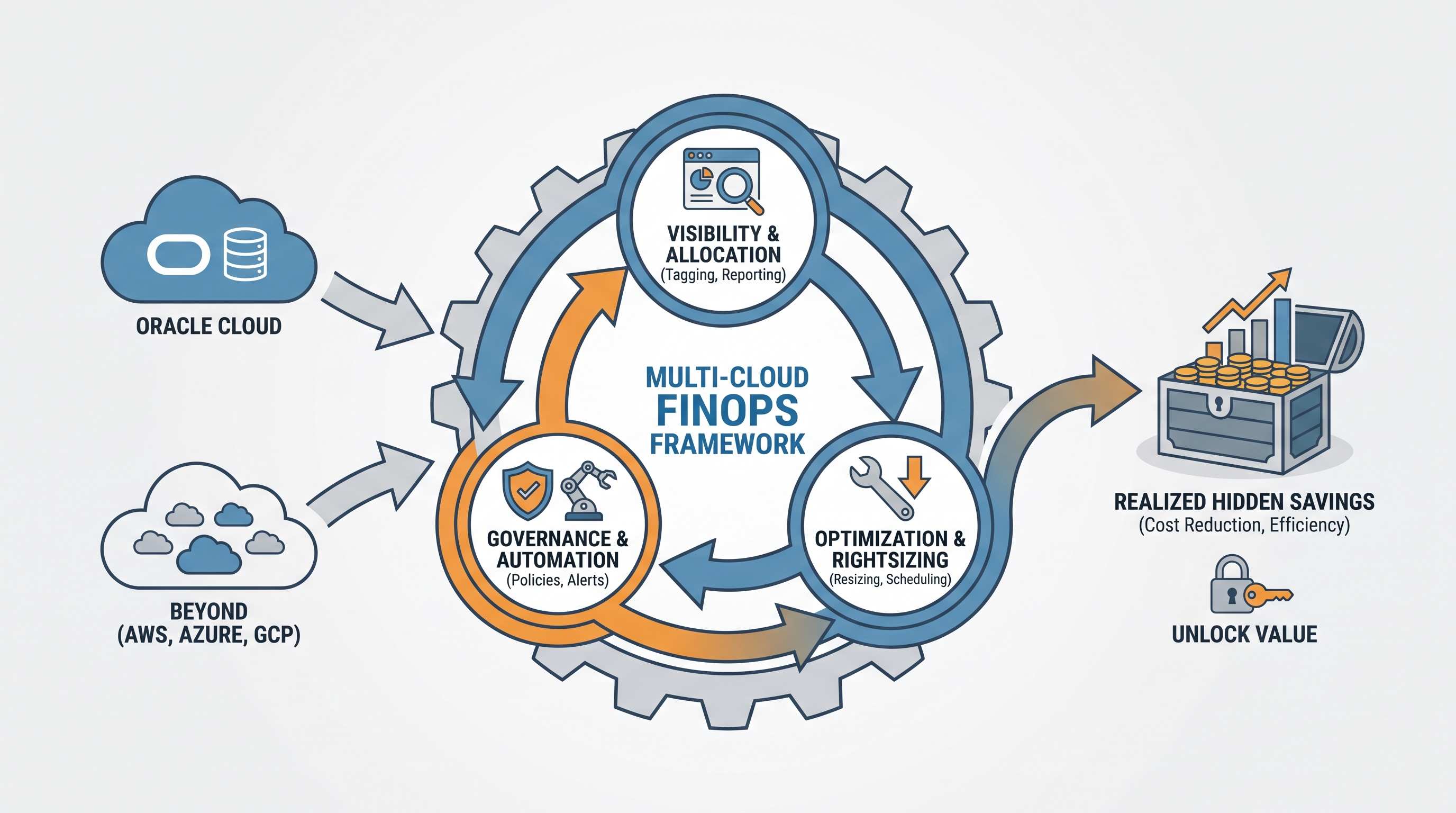
The Multi-Cloud Imperative and Its Cost Complexity
The modern enterprise landscape is unequivocally multi-cloud. Organizations are no longer content with a single vendor, driven by a strategic imperative for resilience, avoidance of vendor lock-in, and the need to leverage best-of-breed services from various providers. This often translates to a heterogeneous environment encompassing AWS, Azure, Google Cloud Platform (GCP), and increasingly, Oracle Cloud Infrastructure (OCI).
While the benefits of multi-cloud are compelling – enhanced disaster recovery capabilities, specialized services for AI/ML or high-performance computing, and competitive pricing – the operational complexities can quickly obscure these advantages. Hidden costs, resource sprawl, and fragmented visibility become prevalent challenges. When Oracle workloads, notorious for their stringent licensing and demanding performance requirements, are introduced into this multi-cloud mix, the complexity escalates exponentially. Managing these environments requires more than just reactive cost analysis; it demands a proactive, integrated FinOps framework that transcends individual cloud silos and embraces a holistic, enterprise-wide approach.
Understanding the Multi-Cloud FinOps Challenge
Effective FinOps in a multi-cloud setting is not simply about aggregating bills. It's about establishing a cultural practice that brings financial accountability to the variable spend model of cloud, enabling organizations to make data-driven decisions. The unique challenges in a multi-cloud context include:
Visibility Fragmentation: Each cloud provider offers its own billing and cost management tools (e.g., AWS Cost Explorer, Azure Cost Management, GCP Billing, OCI Cost Analysis). These tools, while powerful individually, lack a unified view, making cross-cloud analysis, forecasting, and anomaly detection a manual, error-prone endeavor. Different APIs, data schemas, and reporting frequencies exacerbate this fragmentation.
Resource Sprawl & Underutilization: Without a centralized governance mechanism, it's common to find orphaned resources (unattached storage volumes, idle compute instances), over-provisioned services, and redundant deployments across multiple clouds. Identifying and remediating these inefficiencies manually is nearly impossible at scale.
Complex Licensing & Contracts: This is particularly acute for Oracle workloads. Whether running Oracle databases on OCI, AWS RDS Custom, or Azure VMs, understanding the nuances of Universal Credit Agreements (UCAs), Bring Your Own License (BYOL) policies, and processor core factors is critical to avoiding costly compliance issues and optimizing spend. Different clouds have different models for supporting Oracle licenses, adding layers of complexity.
Governance & Policy Drift: Maintaining consistent tagging strategies, resource lifecycle policies, and security guardrails across disparate cloud environments is a monumental task. Inconsistent tagging leads to inaccurate cost allocation, while lax governance can result in both security vulnerabilities and uncontrolled expenditure.
Security-Cost Intersections: Cloud security is not just a technical concern; it has significant cost implications. Misconfigured security groups, unencrypted data stores, or non-compliant environments can lead to costly data breaches, regulatory fines, and increased operational overhead for remediation. Conversely, some security tools themselves can be expensive. A comprehensive FinOps strategy must consider security as an integral component, understanding that security posture directly impacts financial risk.
Phase 1: Inform – Gaining Granular Multi-Cloud Visibility
The foundational step of any successful FinOps framework is achieving complete, granular visibility into cloud spend and resource utilization. Without a single source of truth, optimization efforts are akin to shooting in the dark.
Centralized Data Ingestion and Normalization
The first technical hurdle is to ingest cost and usage data from all cloud providers into a unified platform. This involves:
AWS: Configuring Cost and Usage Reports (CUR) to be delivered to an S3 bucket, often processed via AWS Athena or Redshift Spectrum for querying.
Azure: Exporting cost details to an Azure Storage Account, typically in CSV format, which can then be ingested into Azure Data Lake Storage and analyzed with Azure Synapse Analytics.
GCP: Setting up BigQuery Export for billing data, allowing for real-time querying and integration with other GCP services.
OCI: Utilizing OCI Cost and Usage Reports (CUR) which can be published to an OCI Object Storage bucket.
Once ingested, this raw data must be normalized. Each cloud provider uses different terminology, units of measure, and categorization for services. A normalization layer maps these disparate data points to a common schema, making cross-cloud comparisons and aggregations possible. This layer is critical for accurate reporting and trend analysis.
Standardized Tagging Strategy and Enforcement
Tags are the bedrock of effective cost allocation and governance. A robust multi-cloud tagging strategy requires:
Mandatory Tags: Defining a set of mandatory tags (e.g.,
CostCenter,Project,Environment,Application,Owner) that must be applied to all resources across all clouds.Consistent Naming Conventions: Implementing clear, consistent naming conventions for resources to aid in identification and grouping.
Automated Tagging and Enforcement: Manual tagging is prone to errors and inconsistencies. Solutions like CloudAtler provide capabilities for automated tagging based on resource properties, deployment pipelines, or predefined rules. Furthermore, it enforces these policies, identifying untagged resources and flagging them for remediation or automatically applying default tags. This ensures data integrity for accurate chargeback and reporting.
Architectural Example: A common approach for multi-cloud cost data involves a central data lake. Raw CUR data from AWS, Azure, GCP, and OCI lands in separate zones within the data lake (e.g., S3 buckets, ADLS containers, GCS buckets). ETL processes then extract, transform, and load this data into a structured data warehouse layer (e.g., Snowflake, Databricks, or a cloud-native DWH like AWS Redshift/Azure Synapse/GCP BigQuery). This warehouse is where normalization and tagging enrichment occur, providing a unified dataset for analytics and reporting. CloudAtler's platform acts as an abstraction layer, ingesting these normalized datasets and presenting them through a unified dashboard, offering a single pane of glass for all cloud spend and security insights.
Resource Inventory & Dependency Mapping
Beyond cost data, a comprehensive inventory of all active resources and their interdependencies is crucial. This involves integrating with cloud provider APIs to discover all compute, storage, network, and database services. Understanding which applications rely on which resources, even across different cloud providers, helps prevent accidental deletion of critical components and facilitates intelligent rightsizing decisions.
Phase 2: Optimize – Driving Efficiency Across Heterogeneous Environments
With comprehensive visibility established, the next phase focuses on proactive optimization to reduce waste and maximize efficiency. This phase requires a deep understanding of each cloud provider's pricing models and service offerings.
Compute Optimization
Right-sizing: Analyzing CPU, memory, and network utilization metrics for EC2 instances, Azure VMs, GCE instances, and OCI Compute instances. Identifying over-provisioned resources and recommending smaller, more cost-effective instance types. This often involves historical data analysis to understand peak and average loads.
Elasticity & Auto-scaling: Implementing auto-scaling groups (AWS), VM Scale Sets (Azure), Managed Instance Groups (GCP), and Instance Pools (OCI) to ensure compute resources dynamically scale up during peak demand and scale down during off-peak periods, minimizing idle capacity.
Serverless Adoption: Where application architectures permit, migrating suitable workloads to serverless functions (AWS Lambda, Azure Functions, GCP Cloud Functions, OCI Functions) can dramatically reduce costs by only paying for actual execution time.
Scheduling: Automatically stopping non-production environments (development, testing, staging) outside of business hours using scheduled automation.
Storage Optimization
Lifecycle Policies: Implementing automated lifecycle management for object storage (S3 Intelligent-Tiering, Azure Blob Hot/Cool/Archive, GCP Cloud Storage classes, OCI Object Storage tiers) to move less frequently accessed data to cheaper storage classes.
Identifying Unattached Volumes: Regularly scanning for and deleting unattached block storage volumes (EBS volumes, Azure Disks, GCP Persistent Disks, OCI Block Volumes) that accrue costs without serving any active purpose.
Snapshot Management: Optimizing snapshot retention policies to avoid excessive storage costs for backups.
Network Optimization
Network egress costs can be a significant hidden expense, especially in multi-cloud architectures. Strategies include:
Minimizing Cross-Region/Cross-Cloud Traffic: Architecting applications to keep data transfer within the same region or cloud where possible.
Leveraging Private Connectivity: Utilizing AWS Direct Connect, Azure ExpressRoute, GCP Cloud Interconnect, and OCI FastConnect for predictable costs and improved performance for hybrid and multi-cloud scenarios.
Content Delivery Networks (CDNs): Using CDNs (e.g., CloudFront, Azure CDN, Cloud CDN) to cache content closer to users, reducing egress costs from primary cloud origins.
Commitment-Based Savings
Leveraging commitment-based discounts is a cornerstone of cloud cost optimization for predictable workloads. This includes:
Reserved Instances (RIs) / Savings Plans (AWS): Committing to a specific instance type or compute spend for 1 or 3 years.
Azure Reservations: Similar to RIs, offering significant discounts for committed usage.
Committed Use Discounts (CUDs) (GCP): Discounts for committing to a minimum level of resource usage (e.g., vCPUs, memory) over 1 or 3 years.
OCI Universal Credits & Reserved Capacity: OCI's flexible Universal Credits model allows for consumption across any OCI service, while Reserved Capacity offers discounts for committing to specific compute or database resources.
Strategy for Oracle Licensing: Optimizing Oracle licensing in a multi-cloud environment is particularly complex. For Oracle workloads, deciding between Bring Your Own License (BYOL) on IaaS instances (EC2, Azure VMs, OCI Compute) versus using included licenses with PaaS services (AWS RDS Oracle, Azure SQL Database for Oracle, OCI Autonomous Database) requires careful cost-benefit analysis. On OCI, Universal Credits offer flexibility, but understanding actual consumption against committed spend for dedicated Exadata or Autonomous Database resources is key. CloudAtler's commitment intelligence features provide recommendations for optimal commitment purchases across all clouds, including specific guidance on OCI resource utilization against UCA terms, ensuring you don't over-commit or under-utilize your reserved capacity.
Automated Remediation
Manual optimization is unsustainable at scale. Implementing automated remediation actions based on identified cost inefficiencies is crucial. This can involve:
Scripted Rightsizing: Automatically adjusting instance types based on predefined utilization thresholds.
Idle Resource Deletion: Automatically stopping or terminating resources identified as idle for a specified period (e.g., development environments left running overnight).
Policy Enforcement: Automatically applying tags, enforcing security group rules, or triggering alerts for non-compliant resources.
Architectural Example: Event-driven automation is highly effective. For instance, a CloudWatch Event (AWS), Azure Event Grid event, GCP Cloud Pub/Sub message, or OCI Event can be triggered when a resource's CPU utilization drops below a certain threshold for an extended period. This event can then invoke a serverless function (Lambda, Azure Function, Cloud Function, OCI Function) to either stop the instance, resize it, or send an alert for approval. CloudAtler integrates with these native automation capabilities, orchestrating cross-cloud remediation workflows and providing cost impact calculation for proposed changes before execution.
Phase 3: Operate – Embedding FinOps into Daily Operations
FinOps is an ongoing practice, not a one-time project. The "Operate" phase focuses on integrating financial accountability and continuous optimization into daily cloud operations, fostering a culture of cost awareness.
Budgeting & Forecasting
Multi-cloud budgeting requires a centralized approach to allocate spend, track consumption against budgets, and forecast future costs accurately. Key components include:
Dynamic Budget Allocation: Distributing cloud spend budgets across departments, projects, and environments, with the flexibility to adjust based on business priorities.
Predictive Forecasting: Utilizing historical data, growth projections, and seasonality to predict future cloud spend. CloudAtler's budget forecasting capabilities leverage AI to provide highly accurate predictions, enabling proactive adjustments.
Anomaly Detection & Alerting: Implementing real-time monitoring for sudden spikes in spend or deviations from forecasted budgets. Automated alerts notify relevant teams, allowing for rapid investigation and remediation. These budget control alerts are critical for preventing runaway costs.
Chargeback/Showback Mechanisms
To foster accountability, organizations must implement clear chargeback (billing departments for their cloud usage) or showback (reporting usage back to departments without direct billing) models. This requires robust tagging and granular cost allocation to accurately attribute spend to the correct business units or projects. CloudAtler facilitates this by providing detailed, customizable reports that break down costs by any defined tag or hierarchy.
Performance Management & Cost Impact
There's a direct correlation between application performance and cloud costs. Inefficient code, suboptimal database queries, or poorly configured infrastructure can lead to increased resource consumption and higher bills. A comprehensive FinOps framework integrates performance monitoring with cost analysis. CloudAtler's performance management features allow organizations to correlate performance bottlenecks with their financial impact, helping teams prioritize optimizations that deliver both performance improvements and cost savings.
Security-FinOps Synergy
Cloud security is not an optional extra; it's a fundamental requirement, and its implications on cost and operational efficiency cannot be overstated. Integrating security posture management with cost governance is essential:
Cost of Security Tools: Understanding the spend on WAFs, SIEMs, vulnerability scanners, and other security services across clouds.
Cost of Non-Compliance: Quantifying the potential financial impact of regulatory fines, data breaches, and reputational damage due to security lapses.
Security as a Cost Driver: Identifying security misconfigurations (e.g., public S3 buckets, open RDP ports, unencrypted databases) that not only pose a risk but can also indicate inefficient resource usage or potential data exfiltration costs.
Architectural Example: CloudAtler’s unified platform seamlessly integrates FinOps and security management. It can identify an unencrypted OCI Object Storage bucket, flag it as a security vulnerability (compliance risk), and simultaneously report its associated storage costs. This allows security and FinOps teams to collaborate on remediation, understanding both the security imperative and the financial implications. For instance, a CISO can use CloudAtler's CISO security solutions to prioritize vulnerabilities based on their potential financial impact and regulatory exposure, alongside their technical severity.
Phase 4: Innovate – Leveraging AI for Advanced FinOps
The sheer volume and velocity of multi-cloud data make manual analysis and optimization increasingly impractical. This is where AI and machine learning become transformative, enabling advanced capabilities that move beyond reactive reporting to proactive, intelligent automation.
Predictive Cost Modeling
AI algorithms can analyze vast datasets of historical cloud spend, resource utilization, and business metrics to build highly accurate predictive models. These models can forecast future cloud costs with greater precision than traditional methods, accounting for seasonality, growth trends, and even external factors. This allows finance and operations teams to plan budgets more effectively and identify potential overruns long before they occur.
Anomaly Detection with AI
While rule-based anomaly detection can catch obvious cost spikes, AI-powered systems excel at identifying subtle, complex patterns that indicate emerging cost inefficiencies or potential security threats. Machine learning models can learn normal consumption patterns and flag deviations that might signify misconfigurations, resource leakage, or even malicious activity across AWS, Azure, GCP, and OCI environments.
AI-driven Recommendation Engines
AI can move beyond identifying problems to suggesting optimal solutions. Recommendation engines can automatically propose rightsizing opportunities, optimal commitment purchases (e.g., RIs, Savings Plans, OCI Reserved Capacity), and even suggest architectural changes for greater efficiency. These recommendations are based on real-time data, historical performance, and cost models, providing actionable insights that would take human experts days or weeks to generate.
Automated Policy Enforcement with AI-powered Guardrails
The ultimate goal is to shift left on FinOps, embedding cost and security considerations directly into the development and deployment pipelines. AI-powered guardrails can automatically enforce policies, preventing the deployment of non-compliant or excessively costly resources. For example, an AI model could flag a proposed OCI Compute instance shape as over-provisioned for a specific workload type or block the deployment of an AWS S3 bucket without mandatory encryption, thereby preventing cost overruns and security risks before they materialize.
CloudAtler's Atler AI is specifically designed to unify and automate these processes across your multi-cloud estate. By ingesting and analyzing data from AWS, Azure, GCP, and OCI, Atler AI provides intelligent insights for cost optimization, security posture management, and operational efficiency, transforming raw data into actionable intelligence.
The Oracle Cloud Infrastructure (OCI) Nuance in Multi-Cloud FinOps
Integrating OCI into a multi-cloud FinOps framework presents distinct challenges and opportunities due to its unique architecture and pricing models. Many enterprises run mission-critical Oracle databases and applications, making OCI a vital component of their cloud strategy.
Unique OCI Cost Drivers
High-Performance Compute: OCI offers bare metal, Exadata Cloud Service, and high-performance VM shapes tailored for demanding Oracle workloads. While powerful, these come with specific cost implications. Optimizing their utilization, especially for Exadata, requires deep understanding of workload patterns.
Autonomous Database: Oracle Autonomous Database (ADB) provides self-driving, self-securing, and self-repairing capabilities. While it simplifies operations, monitoring its auto-scaling behavior and ensuring it's appropriately sized for peak vs. idle periods is crucial for cost control.
Network Egress: Similar to other clouds, OCI network egress can be a significant cost. Strategies for minimizing data transfer out of OCI, especially to other cloud providers or on-premises, must be carefully considered.
Block Volumes: OCI Block Volumes offer different performance tiers (Balanced, Higher Performance, Ultra High Performance). Selecting the appropriate tier based on I/O requirements, rather than defaulting to the highest, can yield substantial savings.
Licensing Optimization for Oracle Workloads
This is arguably the most critical aspect of OCI FinOps. Oracle's licensing terms, particularly for databases, are complex.
BYOL (Bring Your Own License) on OCI: For customers with existing Oracle licenses, BYOL on OCI Compute or Exadata Cloud Service can be highly cost-effective, but requires careful adherence to licensing rules.
Included Licenses with PaaS/SaaS: Services like Autonomous Database include licensing, simplifying management but requiring a different cost analysis.
Processor Core Factors: Understanding how Oracle counts processor cores for licensing on various virtualized and bare metal environments is paramount to avoid non-compliance and unexpected audit costs.
Hybrid Cloud Strategy: Many enterprises maintain a hybrid environment, with some Oracle workloads on-premises and others in OCI or other public clouds. A FinOps framework must account for existing on-premises investments and how they interact with cloud licensing. CloudAtler's support for hybrid and on-premises environments ensures a holistic view of IT spend.
Effective OCI FinOps means actively monitoring Oracle database usage, understanding CPU and memory consumption patterns, and aligning them with your licensing agreements. This often involves detailed analysis of AWR (Automatic Workload Repository) reports and OCI monitoring metrics to ensure optimal resource allocation.
Building a Multi-Cloud FinOps Team and Culture
Technology alone cannot deliver sustainable FinOps success. It requires a fundamental shift in organizational culture and cross-functional collaboration:
Cross-Functional Collaboration: FinOps bridges the gap between finance, engineering, operations, and security. Regular communication and shared goals are essential. Engineers need to understand the cost implications of their architectural decisions, while finance teams need to grasp the technical nuances of cloud spend.
Defining Roles and Responsibilities: Clearly define who is responsible for cost optimization, budgeting, forecasting, and security posture in each cloud and across the entire multi-cloud estate.
Continuous Education and Iteration: Cloud services and pricing models evolve rapidly. The FinOps team must continuously learn, adapt, and iterate on their strategies. Regular training for engineers on cost-aware architecture and for finance on cloud billing models is crucial.
Transparency and Accountability: Foster a culture where cloud costs and security posture are transparently communicated, and teams are empowered and held accountable for their cloud spend and security hygiene. CloudAtler promotes culture transparency by providing accessible, unified data to all stakeholders.
Conclusion: Unify Your Multi-Cloud for Unprecedented Savings and Security
The journey to unlocking hidden savings and fortifying security in a multi-cloud environment, particularly one incorporating Oracle workloads, is complex but highly rewarding. It demands a structured, proactive FinOps framework that moves beyond fragmented visibility to integrated, intelligent action. By embracing the Inform, Optimize, Operate, and Innovate phases, enterprises can transform their cloud expenditure from an unpredictable liability into a strategic asset.
The challenges of disparate billing, resource sprawl, complex licensing, and fragmented security are too great for manual processes or siloed tools. A unified approach, powered by AI and designed for the intricacies of AWS, Azure, GCP, and Oracle Cloud Infrastructure, is no longer a luxury but a necessity.
Don't let multi-cloud complexity obscure your path to financial efficiency and robust security. Unify your FinOps, cloud security, and automated operations with CloudAtler's AI-powered platform. Take control of your cloud spend, mitigate risks, and empower your teams with actionable intelligence across all your environments.
Discover how CloudAtler can transform your multi-cloud operations today.
All in One Place
Atler Pilot decodes your cloud spend story by bringing monitoring, automation, and intelligent insights together for faster and better cloud operations.