
The Complexity of AI Economics in 2026
We are living in an era where AI is deeply integrated into every SaaS product, enterprise workflow, and consumer application. Google Cloud’s Vertex AI provides a unified environment to build, deploy, and scale these AI models. Yet, beneath its sleek user interface lies a highly complex billing engine.
Unlike traditional web applications where costs are driven by steady state compute and predictable network egress, AI workloads are notoriously spiky. Training a foundation model might consume tens of thousands of dollars in a matter of days, followed by weeks of near-zero training spend. Conversely, inference costs can scale exponentially with user adoption. Without rigorous oversight, it is entirely possible to exhaust an annual cloud budget in a single quarter.
To navigate this landscape, engineering and finance leaders must shift their perspective from traditional infrastructure management to AI-specific FinOps. This is a core focus at CloudAtler, where our experts engineer customized cost governance frameworks designed specifically for massive parallel computing environments like Vertex AI.
Deconstructing Vertex AI Pricing
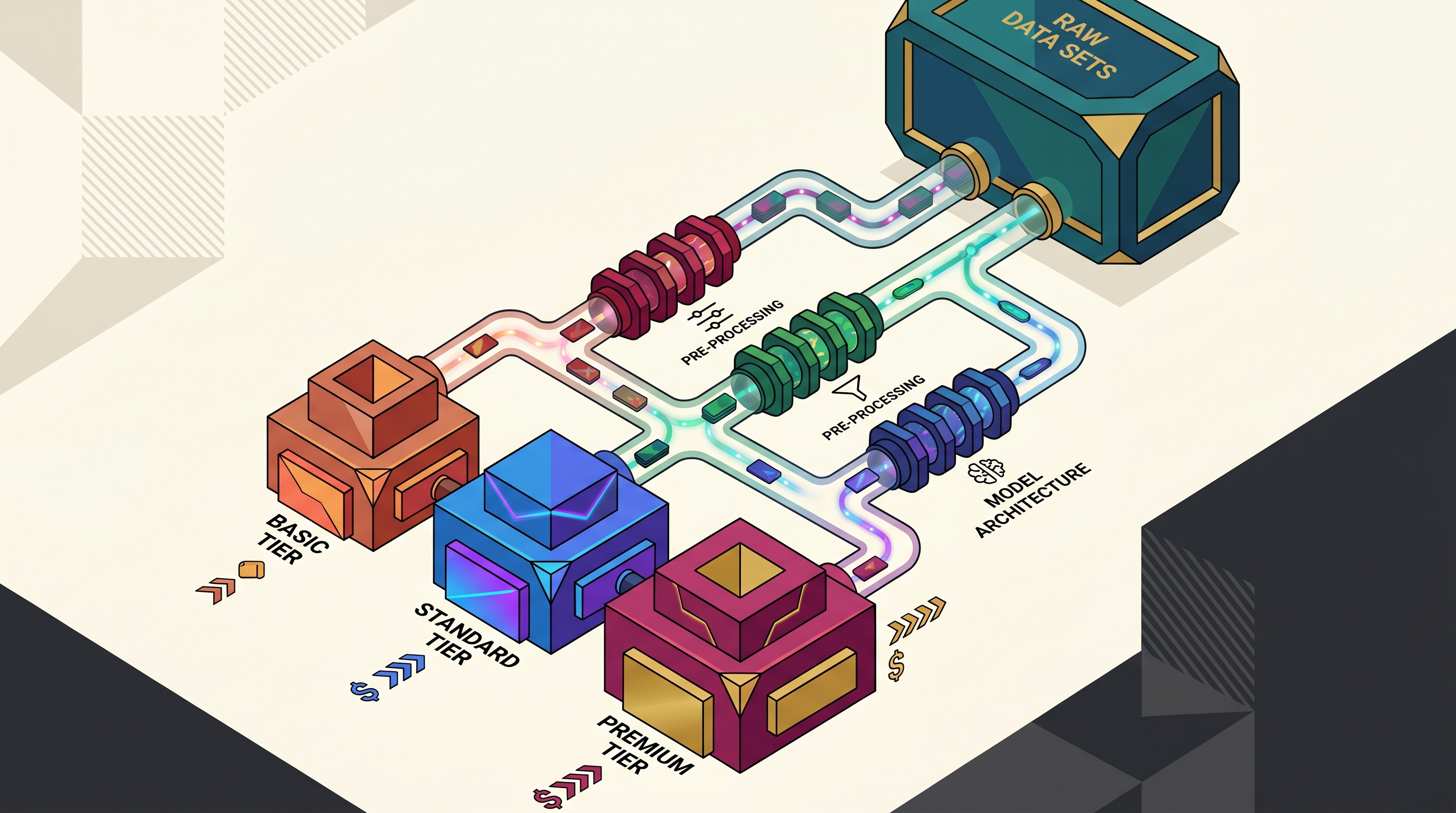
Vertex AI is not a single service; it is a sprawling ecosystem. Pricing is highly fragmented, categorized primarily by the phase of the machine learning lifecycle: Data Preparation, Model Training, and Model Deployment/Inference.
1. Model Training Costs: The Deep End of the Budget
Training custom machine learning models—especially deep neural networks or fine-tuning existing LLMs—is typically the most expensive phase of the AI lifecycle. Vertex AI charges for custom training based on the compute resources consumed, billed by the second (with a one-minute minimum).
The primary cost drivers here include:
Compute Engine Types: Selecting the right virtual machine family is crucial. While N1 or N2 standard machines are sufficient for tabular data or simple scikit-learn models, deep learning requires accelerators.
Accelerators (GPUs and TPUs): NVIDIA A100 and H100 GPUs, alongside Google’s proprietary TPUs (Tensor Processing Units), command a massive premium. For instance, utilizing a pod of TPUs can reduce training time from weeks to hours, but the hourly burn rate is immense.
Storage and Data I/O: Pulling petabytes of training data from Cloud Storage into Vertex AI training clusters incurs networking and storage reading costs, which are frequently underestimated by data scientists.
CloudAtler Tip: We frequently see organizations utilizing high-end GPUs for data preprocessing tasks before the actual training phase begins. CloudAtler implements pipeline separation, ensuring that CPU-intensive data wrangling runs on low-cost preemptible instances, reserving expensive GPU compute strictly for the neural network weight updates.
2. Vertex AI Feature Store and Data Management
The Vertex AI Feature Store acts as a centralized repository for organizing, storing, and serving ML features. Pricing here is divided into two distinct components: storage costs (billed per GB per month) and node costs (billed per hour based on the compute required to serve the features at low latency).
Online serving nodes must be carefully provisioned. Over-provisioning online nodes for batch-prediction workloads is a common architectural flaw that drastically inflates the monthly Vertex AI invoice.
3. Model Deployment and Inference (Prediction)
Once a model is trained, it must be deployed to an endpoint to serve predictions. Vertex AI offers both Online Prediction (for real-time, low-latency requests) and Batch Prediction (for asynchronous, large-scale processing).
Online predictions require dedicated compute resources to be active and listening for requests. You pay for the underlying VM and any attached accelerators per hour, regardless of whether traffic is flowing. In contrast, Batch Prediction spins up compute resources specifically for the duration of the job, then tears them down.
Proven Strategies for Managing Vertex AI Costs
With a firm understanding of the pricing components, organizations can begin implementing strategic optimizations. CloudAtler recommends the following best practices for controlling Vertex AI expenditure in 2026.
Leveraging Preemptible VMs for Training
One of the most immediate ways to slash custom training costs is by utilizing preemptible (Spot) instances. These are spare Google Cloud computing capacities offered at a massive discount—often up to 80% cheaper than on-demand instances.
However, Google can terminate these instances at any time. To utilize them effectively for AI training, your training scripts must be highly fault-tolerant, utilizing frequent checkpointing to save model state to Cloud Storage. If a node is preempted, Vertex AI can automatically restart the job from the last checkpoint. CloudAtler engineers specialize in rewriting legacy training scripts to be fully preemptible-compliant, unlocking enormous cost savings.
Optimizing Hardware Selection
The allure of the newest, most powerful NVIDIA GPU is strong, but it is rarely the most cost-effective choice. Many models do not require an H100 for inference; an older generation GPU (like an L4 or T4) or even a CPU may suffice, depending on latency requirements.
Furthermore, Google's TPUs often provide vastly superior price-to-performance ratios for TensorFlow and JAX workloads compared to standard GPUs. CloudAtler conducts exhaustive hardware benchmarking for our clients, ensuring that the selected hardware aligns perfectly with both latency SLAs and budget constraints.
Implementing Vertex AI Auto-scaling
For Online Prediction endpoints, static provisioning is a direct path to wasted capital. Traffic to AI models is rarely uniform; it peaks during business hours and drops to near zero at night.
Vertex AI supports robust auto-scaling configurations. By setting appropriate minimum and maximum replica counts, and defining scaling metrics (such as CPU utilization or concurrent requests), the endpoint can dynamically adjust to traffic. CloudAtler helps organizations fine-tune these auto-scaling parameters to prevent "cold start" latency spikes while minimizing idle compute costs.
The CloudAtler FinOps Advantage for AI
Managing cloud infrastructure costs is one thing; managing AI cloud costs requires an entirely new level of sophistication. Machine learning pipelines are inherently experimental, making cost forecasting incredibly difficult for traditional finance departments.
At CloudAtler, we bridge the gap between data science and finance. Our comprehensive AI FinOps methodology includes:
Automated Cost Guardrails: We implement strict budget alerting and quotas at the Vertex AI project level, ensuring that an accidental infinite loop in a hyperparameter tuning job doesn't result in a six-figure bill.
Experiment ROI Tracking: By utilizing custom labels and metadata tracking, CloudAtler enables organizations to calculate the exact cost of every ML experiment. This allows CTOs to evaluate the ROI of a model before it even reaches production.
Continuous Optimization: AI models experience drift and require retraining. CloudAtler monitors inference performance and drift metrics alongside cost data, triggering retraining pipelines only when statistically necessary, rather than on arbitrary, costly time schedules.
Conclusion: Innovating Responsibly
Vertex AI is a powerhouse that is accelerating the AI revolution, but its complexity necessitates mature financial governance. As models become larger and inference volumes scale globally in 2026, the organizations that succeed will be those that view cost optimization not as an afterthought, but as a core component of their machine learning lifecycle.
By understanding the nuances of training, storage, and prediction billing, and by implementing advanced strategies like spot instance utilization and dynamic auto-scaling, you can significantly reduce your Vertex AI overhead. But to truly master AI unit economics, you need a partner who understands the intricate dance between machine learning engineering and cloud finance. CloudAtler is dedicated to architecting highly efficient, cost-optimized AI environments, allowing your data scientists to focus on innovation while we protect your bottom line.
All in One Place
Atler Pilot decodes your cloud spend story by bringing monitoring, automation, and intelligent insights together for faster and better cloud operations.