
In the world of cloud computing, financial accountability is a shared responsibility. The FinOps model brings together finance, engineering, and business teams to manage cloud costs, where every team member makes trade-offs between speed, cost, and quality. A new, powerful methodology has emerged to make this collaboration tangible and effective: FinOps as Code (FaC). FaC is a strategic approach that applies software engineering principles to financial operations, transforming cloud financial management from a reactive reporting exercise into a proactive, programmable, and automated discipline.
The Core Principles of FinOps as Code
FinOps as Code is built on the same principles that make modern software development and DevOps so effective. By treating financial governance as code, organizations can achieve unprecedented levels of transparency and control.
Automation: FaC seeks to eliminate manual financial tracking and reporting. Instead of a person reviewing a bill at the end of the month, automated processes check costs before they are even incurred. This includes programmatic controls like automatically shutting down unused resources or scaling down during off-peak hours.
Reproducibility and Version Control: Just like infrastructure configurations, financial policies—such as budgets, tagging rules, or instance type restrictions—are defined in code and stored in a version control system like Git. This creates a clear, auditable history of all financial governance changes and ensures that policies are applied consistently across all environments.
Cross-Functional Collaboration: FaC breaks down the traditional silos between finance and engineering. When financial rules are expressed as code, they become a shared artifact that both technical and non-technical stakeholders can review, discuss, and contribute to. This fosters a culture of shared ownership over cloud spending.
The Technical Foundations: IaC and Policy as Code
FinOps as Code is not a standalone concept; it is built upon the foundations of Infrastructure as Code (IaC) and Policy as Code (PaC). The connection to IaC is direct: FaC extends the principles of IaC to financial management, using the same tools like Terraform, CloudFormation, and Pulumi to not only define resources but also model their costs.
The enforcement mechanism for FaC is "Governance-as-Code," the practice of defining and managing policies as executable code. This is where specialized policy engines come into play. Tools like Open Policy Agent (OPA) and HashiCorp Sentinel allow organizations to write rules that are automatically checked against IaC plans. These policies can express powerful financial constraints, such as:
"All provisioned resources must have a cost-center tag."
"No single deployment can increase the monthly bill by more than $500."
"The use of expensive GPU-enabled virtual machine types is blocked in all non-production environments."
How to Implement Financial Governance in Your CI/CD Pipeline
The most effective place to implement FinOps as Code is directly within the Continuous Integration/Continuous Deployment (CI/CD) pipeline, where infrastructure changes are proposed, reviewed, and deployed. This approach allows for governance to be applied at multiple stages.
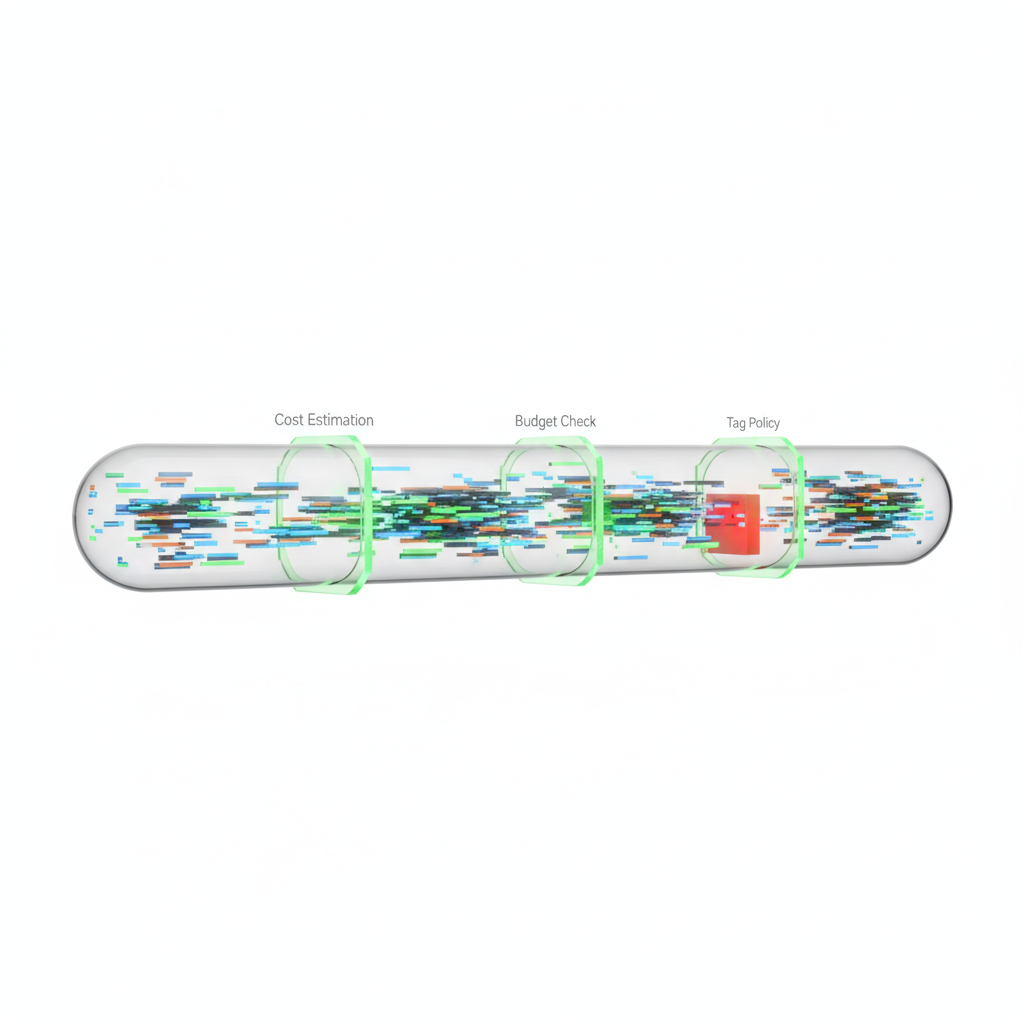
Pre-Deployment Validation: This is the most critical and impactful stage. When a developer opens a pull request with an infrastructure change, the CI pipeline triggers a series of automated checks. A cost estimation tool first analyzes the proposed change to determine its financial impact. Then, a policy engine like OPA or Sentinel evaluates this cost data against the predefined financial policies. If a policy is violated—for example, a required tag is missing or a budget threshold is exceeded—the pipeline fails. This "fail-fast" mechanism blocks the non-compliant change from ever being deployed, preventing cost overruns before they happen.
Runtime Monitoring: While pre-deployment checks are preventative, runtime monitoring is detective. Tools can be configured to continuously scan the live cloud environment to detect any "drift" from the established financial policies, alerting teams to manual changes or unexpected usage patterns that violate governance rules.
Automated Reporting: The data generated from both pre-deployment checks and runtime monitoring should be fed into dashboards and reporting systems. This provides real-time insights and predictive analytics about cloud spending, enabling teams to track trends and make data-driven decisions.
This evolution from simple cost visibility to automated governance is a significant leap in maturity for cloud financial management. It moves beyond just showing engineers a price tag and instead provides them with an automated safety net that prevents financially unhealthy infrastructure from being deployed. This shift from informing to empowering and guarding engineers is the essence of a modern, scalable FinOps practice.
Best Practices for Getting Started
Implementing a full FinOps as Code strategy can seem daunting, but it can be approached iteratively.
Start Small: Begin with a few high-impact, easy-to-understand policies. Enforcing a universal tagging strategy is an excellent starting point, as it provides the foundational data for all subsequent cost allocation and analysis.
Standardize and Modularize: Create reusable financial policy modules. For example, a single policy module could define the tagging requirements for all development environments. This reduces duplication and simplifies maintenance.
Establish Clear Ownership: Assign clear ownership for different policy domains. The security team might own policies related to network access, while the FinOps team owns policies related to cost thresholds and tagging. This decentralized model maintains accountability while empowering domain experts.
Conclusion
FinOps as Code represents the maturation of cloud financial management. It moves beyond spreadsheets and manual reviews, embedding financial intelligence and governance directly into the automated workflows that build and manage cloud infrastructure. By treating financial policies as code, organizations can create a scalable, transparent, and collaborative system for controlling cloud costs. This approach not only prevents budget surprises but also empowers engineering teams to innovate responsibly, making cost-awareness an integral part of their daily work.
All in One Place
Atler Pilot decodes your cloud spend story by bringing monitoring, automation, and intelligent insights together for faster and better cloud operations.