
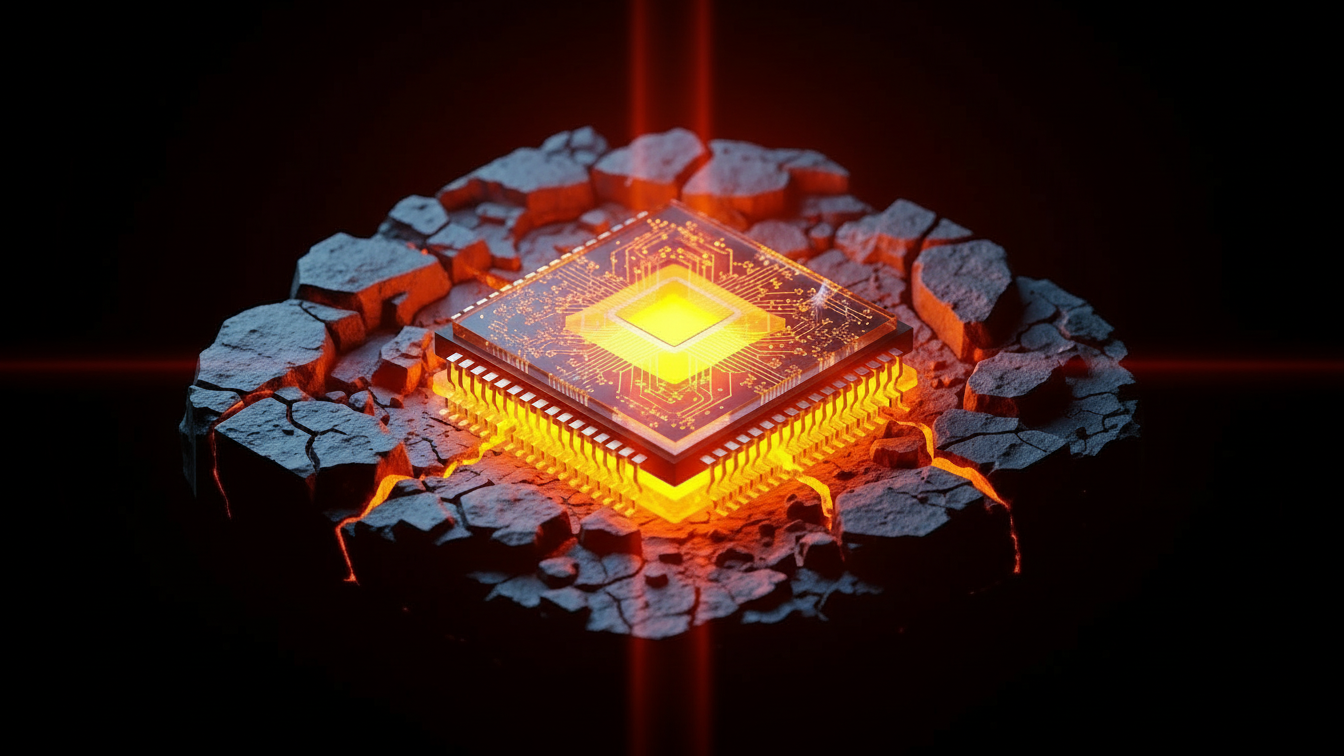
In 2024, Intel, AMD, and Microsoft started plastering the words "AI PC" on everything. They added a dedicated "Copilot Key" to keyboards.
But what actually makes a device an "AI Device"?
It's not the CPU. It's not the GPU. It's the NPU (Neural Processing Unit).
The "Memory Wall" Problem:
Marketing teams sell "TOPS" (Trillions of Operations Per Second).
"This chip has 45 TOPS!"
It doesn't matter.
LLMs are memory-bound, not compute-bound. A model like Llama-3-8B is 5GB in size. To generate one token, you have to move 5GB of weights from RAM to the Processor.
If your RAM speed is 50GB/s, you can only generate 10 tokens/second. It doesn't matter if your processor is infinitely fast; it is starving for data.
Part 1: The Silicon Contenders
1. The Apple M-Series (The Gold Standard)
Apple accidentally built the perfect AI chip years ago. The Unified Memory Architecture (UMA) is the killer feature.
In a PC, the CPU has RAM (DDR5) and the GPU has VRAM (GDDR6). To run a model on the GPU, you have to copy data across the PCIe bus (slow).
On a MacBook Pro (M3 Max), the CPU, GPU, and NPU all share the same massive pool of memory (up to 128GB) with 400GB/s bandwidth. You can load a 70B parameter model directly into RAM and run it instantly.
2. NVIDIA Jetson Orin (The Industrial King)
If you are building a robot, a drone, or a smart camera, you use Jetson.
Jetson Orin Nano ($299): 40 TOPS. Good for Vision AI (YOLO) and small LLMs (Phi-3).
Jetson AGX Orin ($1999): 275 TOPS. A datacenter server fits in the palm of your hand.
It runs the full Desktop CUDA stack. If it runs on a Server H100, it runs on a Jetson.
3. The "AI PC" (Intel Core Ultra / AMD Ryzen AI)
These chips now include a dedicated NPU tile.
The Goal: Offload background AI tasks (like Blur Background in Zoom, or Noise Cancellation) to the NPU to save battery, leaving the CPU free for Excel.
4. The Raspberry Pi 5 + Hailo-8
The Pi 5 CPU is too weak for real AI. But the new "AI Kit" ($70) adds a Hailo-8L accelerator via PCIe.
It gives you 13 TOPS. Enough to run object detection at 60 FPS for a security camera, but it struggles with GenAI.
Head-to-Head: Hardware Roundup
Device
Price
Memory
Bandwidth
Verdict
NVIDIA RTX 4090
$1,600
24GB VRAM
1,000 GB/s
The King. Unbeatable, but consumes 450 Watts.
MacBook Pro (M3 Max)
$3,500
128GB Unified
400 GB/s
Best for LLMs. Massive RAM lets you run 70B models.
Jetson Orin Nano
$299
8GB Shared
68 GB/s
Best for Robots. Low power, high durability.
Raspberry Pi 5 + Hailo
$150
8GB Shared
15 GB/s
Entry Level. Good for learning, bad for production.
Part 2: NPU vs GPU
Feature | GPU (Graphics Processing Unit) | NPU (Neural Processing Unit) |
Precision | Floating Point (FP32/FP16) | Integer (INT8/INT4) |
Architecture | Many Cores, High Frequency | Systolic Arrays (Matrix Multipliers) |
Efficiency | Power Hungry (100W+) | Power Sipping (10W) |
Flexibility | Programmable (CUDA/Shader) | Fixed Function (Matrix Math only) |
NPUs are incredibly efficient because they strip out all the logic needed for graphics rendering and just focus on Ax + b matrix math. But they require the model to be Quantized (compressed) to INT8.
Python
# -------------------------------------------------------------------------
# Compressing a Model for Edge NPU (Quantization)
# -------------------------------------------------------------------------
# We use ONNX Runtime to convert a 32-bit Float model to 8-bit Integer.
# This makes it 4x smaller and 10x faster on NPU.

import onnx
from onnxruntime.quantization import quantize_dynamic, QuantType

model_fp32 = 'mobilenet_v2.onnx'
model_int8 = 'mobilenet_v2.quant.onnx'

quantize_dynamic(
    model_input=model_fp32,
    model_output=model_int8,
    weight_type=QuantType.QUInt8  # Convert weights to Unsigned Int 8
)

print(f"Model compressed! Saved to {model_int8}")
Part 3: The Software Gap (The "Hell" of Deploying)
Hardware is easy. Software is hard.
If you write Python (PyTorch) code, it runs on NVIDIA GPUs easily. To make it run on an Intel NPU or a Qualcomm NPU, you enter the world of Compilers.
ONNX Runtime: The universal format. You export your model to
.onnxand it should run anywhere (Microsoft).OpenVINO: Intel's optimizer. It takes a model and performs "Graph Fusion" to make it run fast on Intel hardware.
TensorRT: NVIDIA's proprietary compiler. It's the fastest, but it only works on NVIDIA.
Part 4: Glossary
TOPS: Trillions of Operations Per Second. A dubious marketing metric.
UMA: Unified Memory Architecture. Apple's secret weapon.
Quantization: Reducing numbers from 16-bit decimals to 8-bit integers to save space/speed.
SoC: System on Chip. CPU + GPU + NPU + RAM all on one silicon die.
TDP: Thermal Design Power. How much heat the chip generates (Watts).
Deep Dive: The Thermal Wall
Why can't we put an H100 in a phone? Heat.
An H100 generates 700 Watts of heat. A phone can only dissipate 5 Watts before burning your hand.
This is why efficiency (TOPS per Watt) is more important than raw speed for Edge AI. If your chip is fast but hot, it will throttle (slow down) after 10 seconds.
Part 5: Expert Interview
Topic: Running AI in a Cornfield
Guest: Mike T., AgTech Start-up CTO.
Interviewer: Why Edge AI? Why not 5G to the Cloud?
Mike T: Have you ever been to a cornfield in Nebraska? There is no 5G. There is barely 2G. If our weed-zapping robot sees a weed, it needs to spray it in 100 milliseconds. It can't wait for a round-trip to AWS in Virginia. The decision MUST happen on the tractor.
Interviewer: What chip do you use?
Mike T: We use Jetson Orin AGX. It's expensive ($2k), but it's rugged. It survives vibration, dust, and 100F heat. Consumer GPUs fail in 2 weeks on a tractor.
Part 6: Future Tech (NPU + PIM)
Processing-in-Memory (PIM) is the holy grail. Instead of moving data to the CPU, we put the CPU inside the RAM stick.
Hypothesis: This could reduce energy consumption by 100x. Samsung is already prototyping HBM-PIM chips.
Part 7: Glossary (Extended)
FP16/INT8: Precision formats (Floating Point 16-bit vs Integer 8-bit).
SRAM: Extremely fast memory located directly on the processor die (Cache).
Bash
# Pro Tip: Use 'llama.cpp'
# If you want to run LLMs on a MacBook or standard Consumer PC, don't use PyTorch directly.
# Use llama.cpp. It is a C++ port of Llama optimized for Apple Silicon and AVX2.
# It runs 5x faster than Python.
Conclusion
In 2026, "Cloud Inference" will be considered legacy for personal AI. Your phone will run the Llama-5-7B model locally, knowing your schedule, your emails, and your secrets, without sending a single byte to a server.
The Battery Life Crisis:
Running a 7B model drains battery like running a AAA video game.
On an iPhone 15, running a local LLM can drain 1% battery per minute.
The Solution: "Sparse Mixture of Experts" (MoE). Instead of activating the entire massive brain for every word, we only activate the 10% of neurons relevant to the topic (e.g., only the "Coding" neurons fire when you ask about Python). This saves 90% power.
All in One Place
Atler Pilot decodes your cloud spend story by bringing monitoring, automation, and intelligent insights together for faster and better cloud operations.