
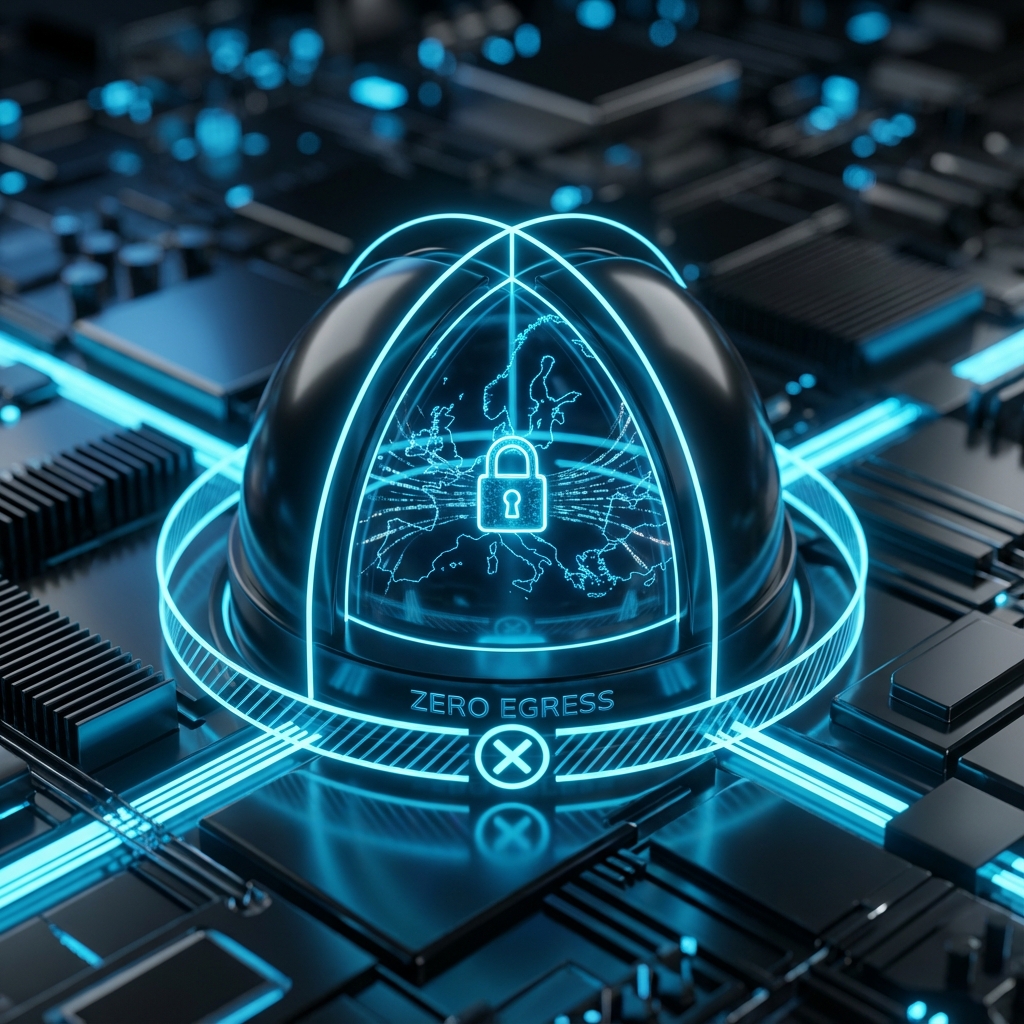
In the world of European AI compliance, "Trust" is good, but "Physics" is better. The biggest nightmare for a Privacy Officer is a "Chatty" Agent. Generative AI apps are naturally promiscuous with data; they want to call external APIs, fetch embeddings from OpenAI, and search the web (Bing/Google). Every single one of these outbound calls is a potential data leak.
If you process medical records (HDS) or banking data in the EU, the only way to be 100% safe is to implement a Zero-Egress Architecture.
Defining Zero-Egress
A Zero-Egress environment is a Virtual Private Cloud (VPC) that acts like a Roach Motel for data: Packets check in, but they don't check out.
Inbound Traffic: Allowed via strict Ingress Controllers (NGINX/Traefik) on port 443 with mTLS.
Outbound Traffic: Completely Blocked. No Internet Gateway (IGW). No NAT Gateway. If a server tries to ping
google.com, the packet dies instantly.
The 3 Pillars of Implementation
1. Local Model Hosting (No APIs) You cannot use OpenAI, Anthropic, or Cohere APIs. Period. Sending PII to an external API endpoint is, by definition, Egress. Solution: You must host open-weights models (Llama-3, Mistral, Mixtral) directly on your own GPU nodes inside the VPC. Use ultra-fast inference engines like vLLM or TGI (Text Generation Inference). The inference data typically travels over the internal VPC network, never touching the public internet.
2. "Dark" Mirrors for Dependencies The first time you try to build a Docker container in a Zero-Egress VPC, it will fail. commands like pip install pandas or apt-get update try to reach public repositories. Solution: You need internal mirrors.
PyPI Mirror: Run a local instance of Artifactory or DevPI.
Docker Registry: Host a private Harbor registry inside the VPC.
OS Updates: Maintain a local snapshot of the Ubuntu/Debian repositories. Updates enter the environment via a "Bastion Host" or "Data Diode" process where they are scanned for malware before being pushed to the internal mirrors.
3. PrivateLink for Cloud Services What if you need to access S3 or DynamoDB? These are usually public endpoints. Solution: Use VPC Endpoints (PrivateLink). This technology routes traffic to AWS/Azure services via the provider's private backbone network, bypassing the public internet entirely. Your application talks to a local IP address (e.g., 10.0.1.50) which maps to S3, ensuring the traffic never leaves the datacenter.
The "Air-Gapped" RAG Pipeline
Retrieval Augmented Generation (RAG) is tricky because it usually relies on external search.
# Typical RAG (Blocked)
User -> Agent -> Google Search -> LLM -> User

# Zero-Egress RAG (Allowed)
User -> Agent -> Internal Vector DB (Milvus) -> Local LLM (Llama-3) -> User
In this architecture:
Ingestion: Documents are uploaded securely to an internal S3 bucket.
Embedding: A local embedding model (e.g.,
bge-m3) running on CPU/GPU converts text to vectors.Storage: Vectors are stored in a self-hosted instance of Qdrant, Milvus, or Weaviate running on Kubernetes.
Conclusion
Managing a Zero-Egress environment increases DevOps overhead by roughly 30%. You lose the convenience of "just downloading a library." But for highly regulated industries, it is the ultimate shield. It proves—mathematically and architecturally—that your customer's data could not have leaked, because there was no door for it to walk out of.
All in One Place
Atler Pilot decodes your cloud spend story by bringing monitoring, automation, and intelligent insights together for faster and better cloud operations.