
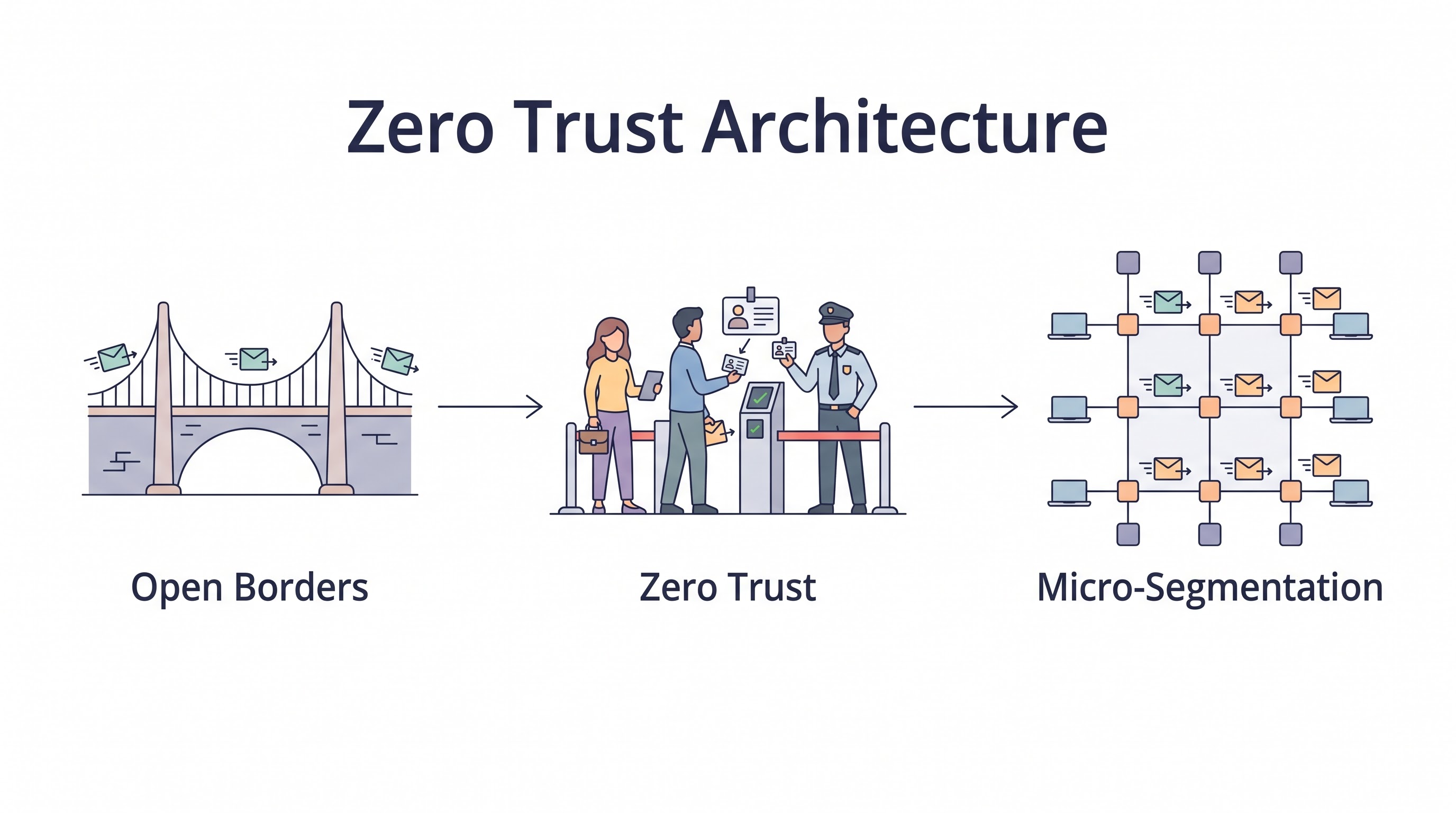
The Death of the Castle and Moat
For decades, enterprise security relied on a medieval concept: the castle and moat. Organizations built a strong perimeter firewall (the moat). Anyone outside was untrusted; anyone inside the corporate VPN (the castle) was implicitly trusted. Once you authenticated at the gate, you could roam the hallways freely.
The cloud destroyed the castle. Applications are now hosted on AWS, Azure, and SaaS providers. Employees work from coffee shops on personal devices. The network boundary has vanished. In a modern cloud environment, if an attacker compromises a low-level marketing server inside the "trusted" network, the implicit trust model allows them to pivot laterally, eventually compromising the core database.
The response to this reality is Zero Trust Architecture (ZTA). Unfortunately, "Zero Trust" has been heavily co-opted by security vendors as a buzzword to sell legacy VPNs. This guide strips away the marketing to explain the technical reality of implementing Zero Trust in a cloud-native architecture.
Defining Zero Trust (Without Marketing Buzzwords)
Zero Trust is not a product you can buy. It is a strategic security philosophy based on a single, uncompromising rule: Never trust, always verify.
In a Zero Trust architecture, there is no implicit trust granted based on network location. Just because a request originates from a corporate IP address or a server sitting inside your AWS VPC does not mean it is safe. Every user, every device, and every microservice must explicitly prove its identity and authorization for every single request it makes, continuously.
The Three Core Principles
The NIST framework (SP 800-207) formalizes Zero Trust around three operational principles:
Explicit Verification: Always authenticate and authorize based on all available data points, including user identity, location, device health, service or workload context, and data classification.
Least Privilege Access: Limit user and service access with Just-In-Time (JIT) and Just-Enough-Access (JEA) policies, granting only the absolute minimum permissions required to perform a task.
Assume Breach: Operate under the assumption that the network is already compromised. Minimize blast radius through segmentation, use end-to-end encryption, and use analytics to continuously hunt for anomalous behavior.
Pillar 1: Identity as the Perimeter
Because the network perimeter is gone, Identity and Access Management (IAM) becomes the new primary control plane.
Human Identity (Zero Trust Network Access - ZTNA)
Traditional VPNs grant broad network access. ZTNA replaces the VPN with an Identity-Aware Proxy (IAP). When a remote user attempts to access an internal application, they do not connect to the network. Instead, the IAP authenticates the user (via SSO and MFA), verifies the health of their device, and then brokers a secure, encrypted connection only to that specific application. The user remains completely blind to the rest of the network.
Machine Identity
In the cloud, servers and microservices vastly outnumber humans. Zero Trust requires that service-to-service communication is mutually authenticated. If "Microservice A" needs to talk to the "Database," it cannot rely on the fact that they are in the same private subnet. It must authenticate using a short-lived token or certificate. This is typically managed through a Service Mesh (like Istio), which handles mutual TLS (mTLS) automatically between containers.
Pillar 2: Micro-segmentation and Network Security
The "Assume Breach" principle dictates that we must contain an attacker who inevitably compromises a single asset.
Micro-segmentation replaces the concept of a large, flat trusted network with thousands of tiny, isolated secure zones. In AWS, this means heavily restricting Security Groups so that a web server can only communicate with its specific application server on a specific port, and explicitly denying all other outbound traffic. If the web server is compromised, the attacker cannot use it to scan the rest of the VPC or exfiltrate data to the internet.
Zero Trust networks operate on a "Default Deny" posture. Communication is impossible unless explicitly permitted by policy.
Pillar 3: Device and Contextual Trust
Authentication is not just about who is logging in, but what they are logging in from. A valid username and password (even with MFA) entered from an unpatched, malware-infected laptop in an unusual geographic location should not be trusted.
Zero Trust policy engines evaluate context in real-time. Integrating Mobile Device Management (MDM) or Endpoint Detection and Response (EDR) telemetry allows the access broker to dynamically deny access or demand step-up authentication if the requesting device fails compliance checks (e.g., "Deny access to the CRM if the laptop's hard drive is unencrypted").
A Practical Path to Zero Trust
You cannot implement Zero Trust over a weekend. It is a multi-year engineering effort. A pragmatic adoption roadmap includes:
Inventory Everything: You cannot protect what you don't know exists. Map all users, devices, applications, and data flows.
Implement Strong Identity: Roll out single sign-on (SSO) and strictly enforce hardware MFA for all users. Clean up stale cloud IAM permissions.
Replace VPNs with ZTNA: Begin transitioning remote access to high-value internal applications from legacy VPNs to Identity-Aware Proxies.
Micro-segment Critical Workloads: Start with your most sensitive data (the "crown jewels"). Lock down the network flows around those specific databases and application servers using strict Security Groups or network policies.
Deploy a Service Mesh: For advanced Kubernetes environments, implement a service mesh to enforce mTLS and zero trust networking between microservices.
Zero Trust is a Journey
Organizations must utilize comprehensive security platforms to continuously monitor their progress along the Zero Trust maturity curve. These platforms analyze IAM configurations, network routing, and device context to identify where implicit trust still exists in the architecture.
Key Takeaway
Zero Trust is a fundamental architectural shift from network-centric security to identity-centric security. It requires organizations to abandon the concept of a "trusted internal network" and instead verify every request based on strong identity, device health, and contextual policies. While complex to implement, it is the only viable defense against lateral movement in modern, highly distributed cloud environments.
All in One Place
Atler Pilot decodes your cloud spend story by bringing monitoring, automation, and intelligent insights together for faster and better cloud operations.