
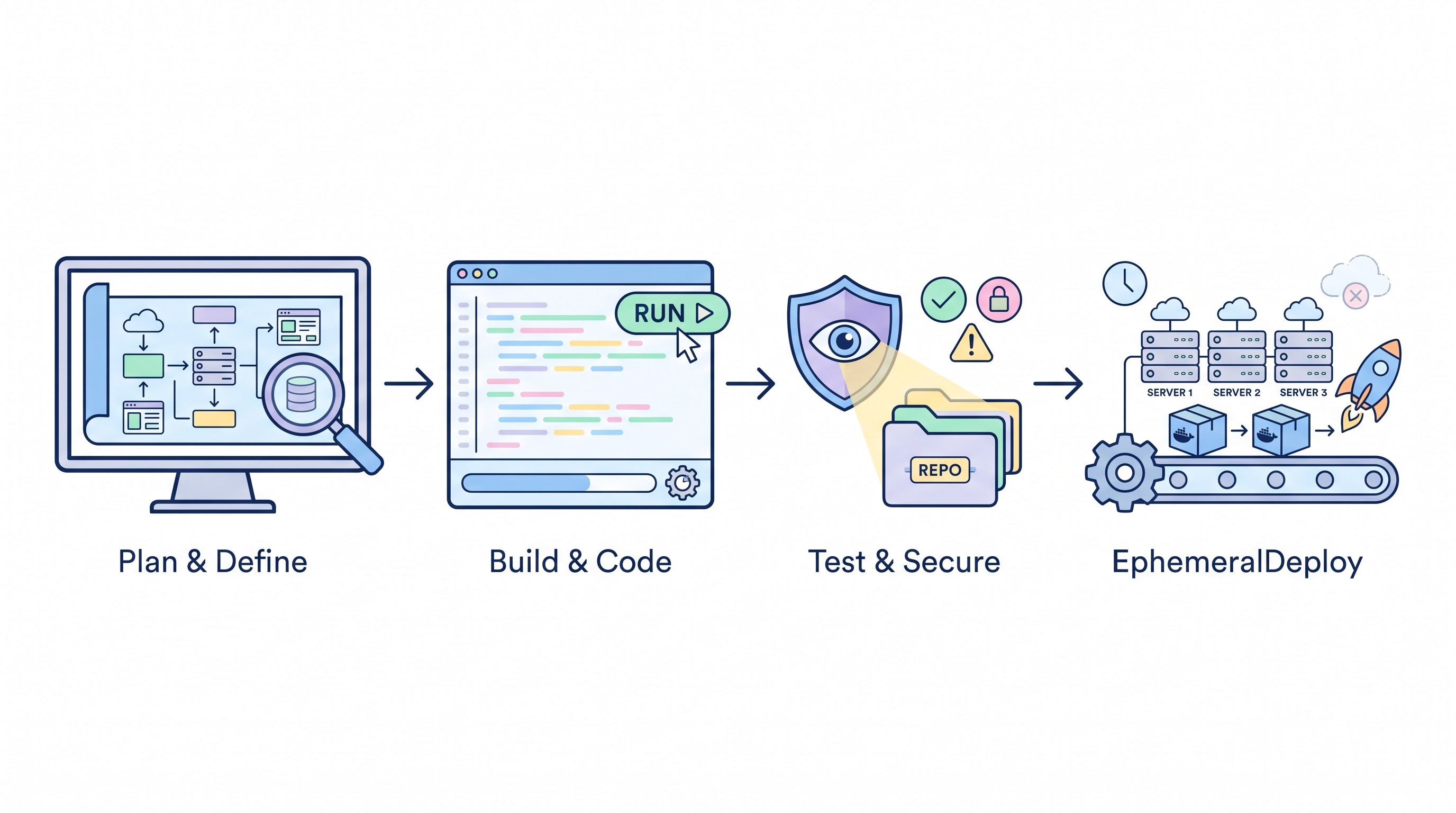
1. Executive Synthesis
In the drive toward absolute engineering velocity, enterprise CI/CD (Continuous Integration / Continuous Deployment) pipelines have devolved into an unmonitored financial black hole. By 2026, the cultural mandate to "automate everything" has resulted in CI/CD pipelines that consume staggering volumes of ephemeral compute and storage, entirely outside the purview of traditional FinOps dashboards. When a developer makes a minor typo correction on an Angular frontend application and commits the change, the pipeline often executes a full end-to-end suite—spinning up 50 large containers, rebuilding the entire Angular node_modules dependency tree from scratch, and pushing massive, redundant container images to a cloud registry.
This brute-force approach to DevOps is a structural failure in unit economics. While production workloads are heavily optimized via Auto Scaling Groups and Spot markets, the "factory floor" of software development is frequently left running on expensive, on-demand compute instances with zero caching strategies. Furthermore, the artifacts generated by these pipelines (Docker images, compiled binaries) are pushed to Amazon ECR or JFrog Artifactory and abandoned, accumulating petabytes of multi-cloud storage debt that generates massive monthly invoices for obsolete code.
To survive the financial weight of continuous delivery, FinOps and DevOps must converge. Enterprises must implement the Pipeline Execution Arbitrage (PEA) Framework. This framework requires treating CI/CD pipelines as Tier-1 production workloads subject to strict financial governance. It mandates the deployment of Remote Build Execution (RBE) and aggressive semantic caching to mathematically guarantee that the enterprise never pays to compile the same line of code twice.
Furthermore, the architecture must decouple the CI/CD orchestration control plane (e.g., GitHub Actions SaaS) from the execution data plane. By routing pipeline execution specifically to self-hosted runners deployed dynamically on heavily discounted public cloud Spot instances via Karpenter, organizations can slash their CI/CD compute COGS by up to 75%. This playbook establishes the rigid mathematical thresholds required to govern developer velocity, ensuring that the cost of shipping code does not cannibalize the profitability of the product itself.
2. Market Gap & Search Intent Failure Analysis
Enterprise research regarding "CI/CD Cost Optimization" is severely polluted by vendor-centric tutorials focused purely on workflow syntax. Search queries yield generic advice such as "use smaller base images" or "run jobs in parallel to save time." This advice completely ignores the financial mechanics of distributed build systems and artifact lifecycle management.
The structural market gap is the total failure to calculate the Compute vs. Cache Break-Even. DevOps engineers are encouraged to implement parallelization to speed up build times. However, if a pipeline spins up 20 parallel instances to run testing, but lacks a remote build cache, the enterprise pays for 20 independent instances to concurrently download the exact same 2GB NPM or Maven dependencies across the NAT Gateway. Analysts fail to model this overlapping egress and compute waste. Furthermore, industry playbooks ignore the financial compounding of Container Registry bloat. They do not provide the equations required to calculate the exact financial liability of keeping a 3-year-old unused Docker image in active S3 storage. This playbook destroys these blind spots by providing the exact mathematical models required to price and optimize the software delivery lifecycle.
3. Core Strategic Framework
The enterprise must implement the Pipeline Execution Arbitrage (PEA) Framework. This framework enforces financial routing for pipeline execution, balancing developer wait-time against infrastructure COGS.
Implementation Protocol:
Pipeline Execution Profiling: Instrument all CI/CD pipelines to output duration, exact CPU/RAM utilization, and cache-hit ratios to the central FinOps observability platform.
Execute Execution Plane Arbitrage: Abandon expensive SaaS-hosted runners (e.g., GitHub-hosted runners billed by the minute). Deploy a fleet of self-hosted, ephemeral runners orchestrated by Karpenter on Kubernetes, heavily biased toward Spot instances and Graviton (ARM) architectures.
Deploy Remote Build Caching: Integrate tools like Bazel, Nx, or Turborepo to utilize a centralized, remote cache (e.g., Redis or S3). The pipeline must mathematically evaluate the AST (Abstract Syntax Tree) of the commit; if a module has not changed, the build step is skipped and the cached artifact is pulled.
Execution Decision Matrix:
If PR (Pull Request) is marked Draft, strictly block the execution of expensive E2E (End-to-End) browser testing. Route only fast, localized unit tests to the Spot runners.
If Remote Cache Hit Ratio
$< 50\%$, pause pipeline optimization and force the engineering team to refactor the monolithic repository into properly decoupled modules to isolate build targets.If a container image in the registry lacks a deployment signature within the trailing 90 days, an automated lifecycle policy must instantly transition it to Glacier Deep Archive, dropping the storage cost by 95%.
4. Financial Modeling Layer (MANDATORY)
Governing DevOps velocity requires strict mathematical modeling to prevent runaway ephemeral cloud spend.
Core Equations
1. Fully Burdened Pipeline Run Cost ($C_{pipeline}$):
Calculates the exact infrastructure cost of executing a single CI/CD pipeline from commit to deployment.
$$C_{pipeline} = \sum_{i=1}^{n} \left( \left( \frac{T_{job\_sec\_i}}{3600} \right) \times P_{compute\_hr} \right) + (V_{egress\_GB} \times P_{egress}) + (V_{artifact\_GB} \times P_{storage\_monthly})$$Where:
$T_{job\_sec\_i}$= Duration of the specific CI/CD job in seconds.$P_{compute\_hr}$= The hourly rate of the runner instance (SaaS rate vs self-hosted Spot rate).$V_{egress\_GB}$= Data transferred out (e.g., pulling dependencies or pushing images across AZs).$V_{artifact\_GB}$= Size of the generated artifact stored in the registry.
2. Remote Build Cache Arbitrage ($M_{build\_cache}$):
Determines the financial savings generated by bypassing redundant compilation via a remote cache.
$$M_{build\_cache} = \left( T_{compilation\_avoided\_hrs} \times P_{compute\_hr} \right) - \left( C_{cache\_storage\_monthly} + C_{cache\_network\_transit} \right)$$Where:
$T_{compilation\_avoided\_hrs}$= Total compute hours saved by serving cached artifacts.
3. Artifact Storage Liability ($L_{artifact}$):
Quantifies the compounding financial waste of storing obsolete build artifacts in hot cloud storage.
$$L_{artifact} = \sum_{d=1}^{days} \left( V_{obsolete\_images\_GB} \times P_{hot\_storage\_daily} \right)$$A) Sensitivity Analysis Table
This table models the monthly compute cost for a mid-sized engineering organization executing 100,000 CI/CD pipeline minutes per month, comparing the SaaS-hosted runner model against the Self-Hosted PEA architecture.
Runner Architecture | No Build Caching (100k mins) | Partial Caching (60k mins) | Aggressive Caching (30k mins) | FinOps Recommendation |
SaaS Hosted Linux ($0.008/min) | $800 / month | $480 / month | $240 / month | Viable for very small teams |
SaaS Hosted macOS ($0.080/min) | $8,000 / month | $4,800 / month | $2,400 / month | Extremely toxic COGS |
Self-Hosted K8s Spot ($0.001/min) | $100 / month | $60 / month | $30 / month | Mandatory Enterprise Standard |
Decision Threshold: Utilizing SaaS-hosted runners for specialized environments (like macOS for iOS builds) without aggressive caching destroys engineering budgets. The enterprise must migrate all standard Linux/Docker builds to self-hosted Kubernetes Spot runners to secure a 90% reduction in raw execution costs.
B) Break-Even Formula
The Remote Cache Inversion Point ($T_{cache\_be}$) calculates the exact pipeline execution time where the cost of downloading a cached artifact over the network equals the cost of simply recompiling the code from scratch on the local runner CPU.
$$T_{cache\_be} = \frac{V_{artifact\_GB} \times \left( \frac{1}{Bandwidth_{GB/s}} \right) \times P_{compute\_hr\_sec}}{P_{compute\_hr\_sec}}$$Simplified: If the network is so slow that downloading a 5GB cached artifact takes 2 minutes, but compiling the code from scratch takes 1 minute, the remote cache is financially and temporally destructive. The cache must sit in the same Availability Zone (AZ) as the runners.
C) Probability-Weighted Risk Table
Quantifying the operational risks of unoptimized DevOps infrastructure.
Scenario | Probability | Financial Impact | Weighted Exposure |
Infinite Build Loop (Webhook Recursion) | 8.0% / yr | $15,000 (Compute burn) | $1,200 per year |
NAT Gateway Egress Bloat (NPM/Maven pulls) | 45.0% / mo | $8,000 (Network transit tax) | $3,600 per month |
Spot Node Preemption (Build Failure) | 20.0% / job | $5 (Wasted partial build) | $1.00 per job |
Registry Storage Runaway (No TTLs) | 85.0% / yr | $25,000 (Compounding storage) | $21,250 per year |
D) Cost-per-Unit Model
The central metric for DevOps infrastructure is the Cost Per Successful Deployment ($CPSD$):
$$CPSD = \frac{Total\_CICD\_Monthly\_Spend\_(Compute + Storage + SaaS)}{Total\_Successful\_Deployments\_to\_Production}$$Threshold: If $CPSD > \$15.00$ per production deployment, the pipeline is structurally bloated with redundant testing or failing builds. Engineering must implement "Shift-Left" localized testing (e.g., pre-commit hooks) to prevent expensive cloud executions for trivial syntax errors.
5. Operational Architecture Integration
Self-Hosted Ephemeral Runners via Karpenter:
To execute the PEA framework, enterprises must decouple their pipeline definitions (e.g., .github/workflows) from the execution environment. Architecture must deploy an Autoscaling Runner Controller (ARC) inside an EKS cluster. When a developer merges a pull request, the SaaS control plane sends a webhook to the EKS cluster. Karpenter intercepts the pending pod request and provisions a highly discounted AWS Spot Instance (e.g., c7g.2xlarge utilizing Graviton processors). The build executes, pushes the artifact, and the pod terminates. Karpenter immediately scales the node back to zero, ensuring the enterprise pays exactly for the execution seconds and absolutely nothing for idle runner capacity.
Remote Build Caching Topology:
An Angular Single Page Application (SPA) might take 15 minutes to execute ng build --prod due to massive Ahead-of-Time (AOT) compilation and tree-shaking. If a developer only alters a single CSS file, running the full build is financial waste. By integrating tools like Nx (for Angular/monorepos) with a centralized S3 bucket or Redis cluster, the architecture hashes the AST of the codebase. The pipeline checks the remote cache; finding that the core TypeScript logic is unchanged, it downloads the cached chunks in 12 seconds instead of waiting 15 minutes for compilation. This mathematically enforces the $M_{build\_cache}$ savings across the entire engineering floor.
Egress Defense via Local Mirrors (VPC Endpoints):
A hidden FinOps disaster in CI/CD is the NAT Gateway egress tax. If a pipeline spins up 5,000 ephemeral containers a day, and each container runs npm install, pulling 500MB of packages from the public internet, the enterprise pays a massive AWS NAT Gateway processing fee for every megabyte. Architecture must deploy VPC Endpoints (PrivateLink) and local pull-through caches (e.g., a localized Nexus or Artifactory mirror inside the private subnet). The ephemeral runners pull dependencies locally across the high-speed, zero-cost internal network, completely circumventing the hyperscaler egress tax.
6. Failure Scenarios
Scenario 1: The "Nightly Build" ECR Bloat
Breakdown: An engineering team configures a nightly CI/CD pipeline to build the master branch of a monolithic application, tagging the resulting 3GB Docker image with a timestamp and pushing it to Amazon Elastic Container Registry (ECR). They never configure an image lifecycle policy. Over three years, they push 1,095 images.
Financial Exposure: 1,095 images × 3GB = 3.2 Terabytes of completely useless, obsolete code sitting in expensive standard ECR storage, costing thousands of dollars annually for zero business value.
Governance Prevention Layer: Mandatory Registry TTLs. Infrastructure-as-Code (IaC) governance must physically block the creation of any container registry that lacks an active lifecycle policy. The policy must algorithmically delete any untagged image older than 14 days, and transition any nightly tagged image older than 30 days directly to the system recycle bin.
Scenario 2: The SaaS Runner CPU Trap
Breakdown: A DevOps team defaults to utilizing the basic 2-vCPU hosted runners provided by their CI/CD SaaS vendor because they are "easy to set up." The massive Java application takes 45 minutes to compile on the underpowered 2-vCPU runner. The developers complain about wait times, so the team pays an exorbitant premium for the SaaS vendor's 16-vCPU "Large" runners.
Financial Exposure: The enterprise is trapped paying a 400% markup on compute cycles to a SaaS vendor acting as a middleman for basic hyperscaler infrastructure.
Governance Prevention Layer: Execution Plane Repatriation. The FinOps team mandates the PEA architecture. All intensive compilation jobs are forcibly routed to the self-hosted Kubernetes cluster, where a 16-vCPU Spot instance can be acquired for 1/10th the price of the SaaS vendor's markup, radically reducing the Fully Burdened Pipeline Run Cost (
$C_{pipeline}$).
Scenario 3: The End-to-End (E2E) Thrashing Loop
Breakdown: A pipeline is configured to run a massive Cypress E2E testing suite containing 5,000 browser tests on every single commit to a feature branch. The suite takes 2 hours and requires spinning up 10 database containers. A developer makes 15 commits in one day trying to fix a styling issue.
Financial Exposure: 30 hours of heavy compute execution burned to validate a minor CSS change, stalling the CI/CD queue for other developers and spiking the daily AWS bill.
Governance Prevention Layer: Stage-Gated Arbitrage. Pipelines must be intelligently gated. Commits to feature branches are mathematically restricted to running unit tests and localized linting. Expensive, infrastructure-heavy E2E suites are physically blocked from executing until the Pull Request is approved by a peer and labeled Ready for Merge.
7. Board-Level Translation Layer
EBITDA Delta Modeling: CI/CD compute is a pure operational expense that scales linearly with developer headcount and commit frequency. By transitioning from SaaS-hosted runners to Spot-driven self-hosted clusters, the enterprise immediately recovers 60-80% of pipeline COGS. For a large engineering organization, this translates to hundreds of thousands of dollars flowing directly to EBITDA without slowing down product delivery.
Gross Margin Defense: While pipeline costs are typically categorized under R&D rather than direct COGS, bloated DevOps infrastructure artificially inflates the cost of engineering, reducing the capital available for revenue-generating feature development. The PEA framework ensures that developer velocity does not result in a proportionate explosion of cloud waste.
Capital Allocation Signal: A rising Cost Per Successful Deployment (
$CPSD$) metric indicates severe operational inefficiency in the software factory. It signals to the board that engineering leadership must pause feature development and allocate capital toward addressing technical debt, fixing flaky tests, and implementing remote build caching to restore pipeline efficiency.Risk-Adjusted ROI Formula:
$$ROI_{cicd\_finops} = \frac{\text{Eliminated SaaS Runner Premiums} + \text{Reduced Egress and Storage Bloat}}{\text{Engineering Hours to Build Karpenter EKS Cluster} + C_{cache\_infra}}$$
8. Data Visualization Suggestions
Pipeline Cost Comparison Graph: A dual-bar chart showing the monthly cost of 100,000 pipeline minutes. The left bar is high and red (SaaS Hosted Runners @ $0.008/min); the right bar is low and green (Self-Hosted Spot Runners @ $0.001/min), visualizing the massive arbitrage opportunity.
Remote Cache Hit Ratio Pie Chart: A dashboard element showing the percentage of pipeline steps skipped via build caching vs steps fully executed, driving the FinOps discussion on code modularity.
Artifact Storage Lifecycle Waterfall: A visual showing total container registry storage dropping dramatically as a 30-day lifecycle policy purges obsolete nightly builds and untagged images, translating directly into dollar savings.
Egress Architecture Topology: A network diagram contrasting the expensive path (Runners pulling NPM packages across an AWS NAT Gateway) versus the optimized path (Runners pulling from a local VPC Endpoint mirror), highlighting the eliminated transit tax.
Cost Per Successful Deployment (
$CPSD$) Trend Line: A time-series graph tracking the$CPSD$over a quarter. Sharp spikes clearly correlate with specific, unoptimized architectural changes in the deployment pipeline.
9. Why Analyst-Style Summaries Fail at Financial Precision
When DevOps analysts proclaim that "Enterprises must adopt continuous integration and testing on every commit to maximize developer velocity and code quality," they are providing a cultural directive while ignoring the unit economics of the cloud.
This narrative fails because it treats compute as an infinite, free resource. If an Enterprise Architect follows this advice blindly, they will configure the pipeline to run a 45-minute E2E test suite on every single typo fix. The analyst's summary does not calculate the Fully Burdened Pipeline Run Cost ($C_{pipeline}$) or the Artifact Storage Liability ($L_{artifact}$). It assumes that "automation" inherently means "efficiency."
Equation-backed modeling destroys this assumption. By calculating the exact $CPSD$, the FinOps team proves that executing massive test suites on un-cached, on-demand SaaS runners for trivial code changes is financially destructive. It forces the engineering team to adopt the Pipeline Execution Arbitrage (PEA) framework—proving mathematically that true DevOps maturity is not just automating the build, but executing that build on the most aggressively discounted, heavily cached infrastructure available.
10. Strategic Conclusion
The CI/CD pipeline is the industrial factory floor of the modern software enterprise. However, unlike physical factories which are relentlessly optimized for unit cost and supply chain efficiency, CI/CD pipelines are frequently allowed to operate with zero financial oversight. As developer velocity increases, the compounding cost of ephemeral compute, redundant compilation, and obsolete artifact storage creates a massive, hidden drain on corporate resources.
To govern this velocity, infrastructure leadership must implement the Pipeline Execution Arbitrage (PEA) Framework. The mandate is clear: the orchestration of the pipeline (the SaaS control plane) must be decoupled from the execution of the pipeline (the data plane). Enterprises must repatriate their build execution onto self-hosted Kubernetes clusters, utilizing Spot instances and Karpenter to drive the raw compute cost as close to zero as physics allows.
Furthermore, DevOps teams must treat network egress and compilation time as hostile variables. By deploying localized dependency mirrors and integrating remote build caching systems, the enterprise mathematically guarantees that it never pays to download or compile the same module twice. CI/CD is a Tier-1 production workload. By applying strict FinOps principles to the software delivery lifecycle, organizations ensure that the speed of innovation never compromises the profitability of the business.
11. Implementation Readiness Checklist
Calculate the Baseline
$CPSD$: Aggregate total monthly CI/CD compute, storage, and SaaS costs, and divide by total production deployments to establish your Cost Per Successful Deployment baseline.Repatriate Build Execution: Transition away from default SaaS-hosted runners (e.g., GitHub-hosted Linux/macOS). Deploy Actions Runner Controller (ARC) or GitLab Runner operators inside your own VPC.
Implement Karpenter + Spot for Runners: Configure your self-hosted runner Kubernetes cluster to exclusively utilize Karpenter to dynamically provision heavily discounted Spot instances, falling back to On-Demand only upon immediate preemption.
Deploy Remote Build Caching: Integrate Nx, Turborepo, or Bazel with a centralized S3/Redis cache to mathematically eliminate redundant compilation for unchanged code modules across parallel PRs.
Enforce Registry Lifecycle Policies: Audit Amazon ECR, JFrog, or Docker Hub. Implement strict, automated deletion policies for any untagged image or automated build artifact older than 30 days.
Block NAT Gateway CI/CD Egress: Deploy internal pull-through caches or VPC Endpoints for major package registries (NPM, Maven, PyPI, Docker Hub) to eliminate the hyperscaler egress tax on ephemeral runners.
Implement Stage-Gated E2E Testing: Reconfigure CI/CD yaml files to physically block heavy end-to-end browser testing suites from running on every commit. Require a Ready for Merge manual label to trigger expensive test execution.
Audit Base Image Sizes: Force the DevOps team to transition all build and deployment containers to minimal distributions (e.g., Alpine Linux or distroless images) to reduce cold-start network transfer times and registry bloat.
Standardize on Graviton (ARM): Where application architecture permits, configure self-hosted runners to execute on ARM-based instances to instantly capture a 20% price-performance FinOps advantage over x86.
Establish the FinOps Developer Dashboard: Integrate pipeline cost metrics back into the developer portal (e.g., Backstage), exposing the specific dollar cost of a PR build directly to the engineer who triggered it.
Stop guessing where your Kubernetes budget is going. Schedule a demo here to explore Kubernetes cost monitoring with Cloud Atler.