
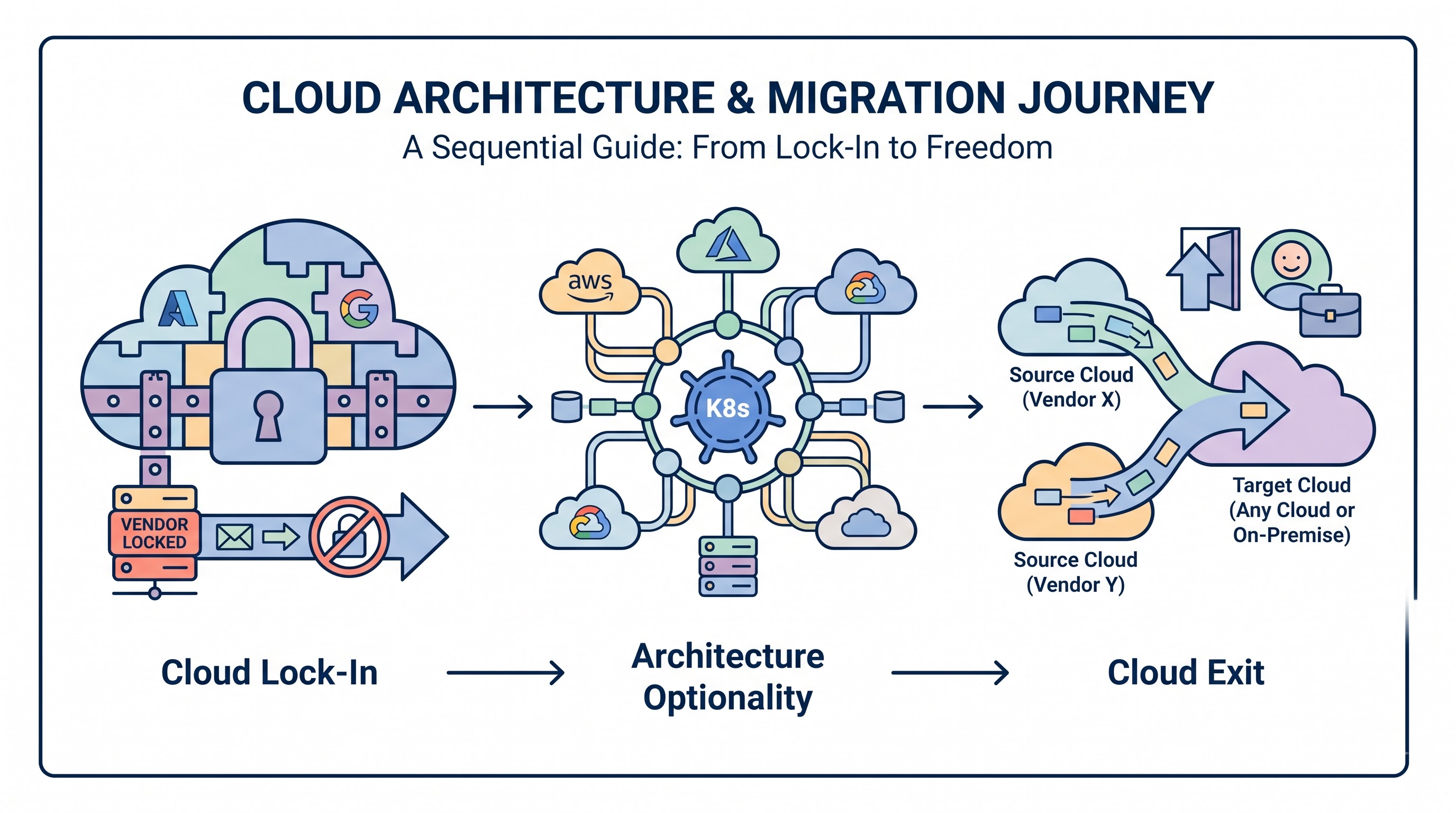
1. Executive Synthesis
In the 2026 enterprise landscape, the concept of "Vendor Lock-In" has evolved from a theoretical engineering debate into a quantifiable, board-level financial liability. For years, hyperscalers (AWS, Azure, GCP) incentivized enterprises to adopt deep, proprietary managed services (e.g., AWS Lambda, DynamoDB, Google BigQuery) by offering massive initial development velocity. However, as enterprise scale increases, the monopolistic pricing power of these proprietary services inflicts severe margin compression.
When a hyperscaler realizes an enterprise cannot technically or financially leave their ecosystem—because the cost of rewriting 5,000 proprietary serverless functions and paying the network egress tax on 50 Petabytes of data would bankrupt the IT budget—the enterprise loses all leverage during Enterprise Discount Program (EDP) negotiations.
To restore negotiation parity and defend corporate optionality, organizations must implement the Strategic Cloud Optionality Protocol (SCOP). SCOP does not mandate the deployment of active-active multi-cloud architectures (which frequently double operational costs and create catastrophic complexity). Instead, SCOP treats Cloud Optionality as a financial derivative—an insurance policy that the enterprise pays a slight premium to maintain.
This requires architecting a "Ready-to-Exit" perimeter. Workloads are strictly bound to open-source, containerized standards (Kubernetes). Proprietary data stores (DynamoDB/CosmosDB) are rejected in favor of managed open-source engines (PostgreSQL/Cassandra) that can be easily replicated across cloud boundaries. By calculating the exact Absolute Cloud Extraction Cost () and proving to the hyperscaler that the enterprise has the literal, mathematically viable capability to migrate its top 5 workloads to a competitor in under 90 days, the CIO regains absolute financial leverage, securing maximum discounts and neutralizing predatory pricing.
2. Market Gap & Search Intent Failure Analysis
Enterprise research regarding "Cloud Exit Strategy" or "Multi-Cloud Architecture" is dominated by binary, unpragmatic narratives. Analysts either promote total hyperscaler lock-in ("Go all-in on AWS to maximize discounts and developer speed") or mandate complex agnostic abstraction layers ("Build everything on OpenShift and Terraform so it runs anywhere").
The market gap is the total failure to model the Optionality Premium ROI. Analysts do not calculate the financial cost of abstaining from a highly efficient proprietary service (like AWS SQS) to run a self-managed, generic equivalent (Apache Kafka). Maintaining optionality costs money in engineering time and infrastructure overhead. If an enterprise spends $500,000 a year maintaining an agnostic Kafka cluster just to avoid a $50,000/year lock-in risk with SQS, they have executed a catastrophic financial strategy. This playbook fills that gap by providing the exact mathematical boundaries required to justify abstraction, ensuring the enterprise only pays for optionality where the extraction risk poses an existential financial threat.
3. Core Strategic Framework
The enterprise must operationalize the Strategic Cloud Optionality Protocol (SCOP). This framework balances the speed of managed services against the financial necessity of maintaining a credible threat of migration.
Implementation Protocol:
Workload Portability Profiling: Categorize all enterprise workloads into Commodity (Stateless web servers, batch processing) and Gravity (Massive databases, proprietary ML pipelines).
Execute the Optionality Premium Test: Calculate the cost difference between utilizing a proprietary hyperscaler service (e.g., AWS Kinesis) versus deploying its open-source equivalent (e.g., Apache Kafka on K8s).
Architect the Exit Pathway: Mandate that all net-new Commodity workloads are built strictly on OCI-compliant containers orchestrated by Kubernetes, avoiding proprietary serverless runtimes.
Execution Decision Matrix:
If the Absolute Cloud Extraction Cost (
$C_{extract}$) for a specific workload exceeds 20% of its annual operating budget, mandate an immediate architectural refactor to open standards.If a proprietary managed service offers a
$> 50\%$cost-to-performance advantage over its open-source equivalent (e.g., DynamoDB for hyper-scale key-value lookups), accept the lock-in, but mathematically quarantine the service behind a generic API abstraction layer.If EDP renewal negotiations approach, actively run a "Disaster Recovery / Cloud Exit" drill, spinning up the top 3 workloads in a secondary cloud to empirically prove the viability of the exit threat to the vendor account team.
4. Financial Modeling Layer (MANDATORY)
Defending corporate leverage requires explicit mathematical models to price lock-in and optionality.
Core Equations
1. Absolute Cloud Extraction Cost ($C_{extract}$):
Calculates the exact, fully burdened cost to abandon a primary cloud provider and migrate a workload to a competitor.
$$C_{extract} = (V_{data\_GB} \times P_{cloud\_egress\_tax}) + (H_{eng\_refactor} \times R_{eng\_hr}) + C_{dual\_run\_overlap}$$Where:
$V_{data\_GB}$= Total volume of stateful data that must be physically moved.$P_{cloud\_egress\_tax}$= The hyperscaler's outbound data transfer fee (e.g., $0.08/GB).$H_{eng\_refactor}$= Engineering hours required to rewrite code tied to proprietary APIs (e.g., rewriting AWS Lambda code to run in standard Docker containers).$C_{dual\_run\_overlap}$= The cost of running both cloud environments simultaneously during the migration window.
2. The Optionality Premium ($P_{optionality}$):
Quantifies the financial cost of maintaining an agnostic, portable architecture versus surrendering to vendor-managed services.
$$P_{optionality} = C_{agnostic\_infra\_monthly} - C_{proprietary\_managed\_service\_monthly}$$Where:
$C_{agnostic\_infra\_monthly}$= Cost of running K8s/Kafka/Postgres (including dedicated SRE labor).$C_{proprietary\_managed\_service\_monthly}$= Cost of running the hyperscaler equivalent (e.g., Lambda/Kinesis/DynamoDB).
3. Vendor Lock-In Leverage Factor ($L_{vendor}$):
Calculates the financial leverage the hyperscaler holds over the enterprise, indicating how much they can raise prices before migration becomes economically viable.
$$L_{vendor} = \frac{C_{extract}}{Total\_Annual\_Cloud\_Spend}$$A) Sensitivity Analysis Table
This table models the 3-Year TCO of building a massive event-driven SaaS application, comparing the financial impact of absolute lock-in versus maintaining architectural optionality.
Architecture Choice | Ops Premium (Poptionality) | Extraction Cost (Cextract) | Leverage Factor (Lvendor) | Strategic Risk Posture |
Pure Proprietary (Lambda + DynamoDB) | $0 (Cheapest upfront) | $2.5M (Egress + Rewrite) | 85% (Total Capture) | Extremely Vulnerable to Price Hikes |
Abstracted OSS (K8s + Kafka + Postgres) | $350k ( labor + Ops) | $200k (Data egress only) | 12% (Highly Portable) | Maximum Negotiation Leverage |
Hybrid (K8s + DynamoDB abstracted) | $100k (Minor overhead) | $800k (Data rewrite) | 35% (Balanced) | Mathematically Optimal |
Decision Threshold: If the Vendor Lock-In Leverage Factor ($L_{vendor}$) exceeds 40%, the hyperscaler practically owns the enterprise's gross margins. The enterprise must accept a higher Optionality Premium ($P_{optionality}$) to refactor architecture and drive the leverage factor down below 20%.
B) Break-Even Formula
The Abstraction ROI Break-Even ($V_{abstraction\_be}$) calculates the percentage of EDP discount an enterprise must win in contract negotiations to financially justify the engineering cost of maintaining an agnostic cloud architecture.
$$V_{abstraction\_be} = \left( \frac{P_{optionality\_annual} + CapEx_{abstraction\_engineering}}{Total\_Annual\_Cloud\_Spend} \right) \times 100$$Numerical Example: Maintaining a portable Kubernetes architecture instead of using cheap proprietary serverless costs an extra $200,000/year. The abstraction engineering cost $100,000. Total annual cloud spend is $5,000,000. $V_{abstraction\_be} = (\$300,000 / \$5,000,000) \times 100 = 6.0\%$. By proving they can exit the cloud, the CIO negotiates a 12% EDP discount instead of a 4% discount (an 8% gain). The 8% discount ($400,000) exceeds the 6% cost of optionality. The agnostic architecture mathematically pays for itself.
C) Probability-Weighted Risk Table
Quantifying the financial risks of cloud lock-in and multi-cloud operations.
Scenario | Probability | Financial Impact | Weighted Exposure |
Predatory Pricing / Reduced EDP Discount | 60.0% / 3-yr | $800,000 (Lost savings) | $480,000 per cycle |
Proprietary Service Deprecation (Forced rewrite) | 15.0% / yr | $250,000 (Eng refactoring) | $37,500 per year |
Active-Active Multi-Cloud Sync Failure | 35.0% / yr | $120,000 (Downtime/Data loss) | $42,000 per year |
Unbudgeted Cloud Egress (Extracting locked data) | 20.0% / proj | $85,000 (Network transit tax) | $17,000 per project |
D) Cost-per-Unit Model
The central metric for Cloud Strategy is the Cost Per Portable Compute Unit ($CPPCU$):
$$CPPCU = \frac{Total\_Agnostic\_Infra\_Spend\_(K8s + OSS\_Databases)}{Total\_vCPU\_Hours\_Actually\_Consumed}$$Threshold: If $CPPCU$ exceeds the proprietary equivalent (e.g., AWS Fargate or Lambda) by more than 25%, the enterprise is over-paying for optionality. Engineering must optimize the Kubernetes clusters (via Karpenter) or selectively accept lock-in for non-critical workloads to restore unit economics.
5. Operational Architecture Integration
The Kubernetes Portability Layer:
The foundation of the SCOP framework is containerization. Code must never be deployed directly to proprietary runtimes (like AWS Lambda or Azure Functions) if the workload represents core business logic. All stateless compute must be packaged into OCI-compliant containers and orchestrated by Kubernetes (EKS, AKS, or GKE). Because the Kubernetes API is identical across all hyperscalers, the extraction cost ($C_{extract}$) for compute logic drops to near zero. A CI/CD pipeline simply points the deployment manifest to a new cluster in a different cloud, and the stateless workload is migrated in seconds.
Database Engine Standardization:
Data gravity is the ultimate lock-in mechanism. Relying heavily on proprietary databases (like AWS DynamoDB or Google Spanner) creates catastrophic extraction costs, as migrating off them requires rewriting the entire data access layer of the application. The architecture must mandate standard, open-source database engines (PostgreSQL, MySQL, Redis, Cassandra). While the enterprise can use the managed versions of these engines (e.g., Amazon RDS for PostgreSQL), the underlying wire protocol remains open. This guarantees that if a cloud exit is triggered, the data can be migrated via standard logical replication (e.g., pglogical) to an equivalent managed service in a competing cloud with zero application code changes.
The Hexagonal Architecture (API Abstraction):
When a proprietary service offers an unignorable cost-to-performance advantage (e.g., utilizing AWS SQS for massive queuing instead of running a heavy Kafka cluster), the enterprise must utilize Hexagonal Architecture (Ports and Adapters). The core application logic must never directly call the AWS SDK. Instead, it calls an internal, generic interface (QueueService.sendMessage()). The specific AWS SQS logic is isolated in a thin adapter layer. If the enterprise exits AWS, engineering only has to rewrite the thin adapter to point to Azure Service Bus, insulating 99% of the codebase from the extraction refactor cost.
6. Failure Scenarios
Scenario 1: The Active-Active Financial Hemorrhage
Breakdown: An enterprise attempts to avoid lock-in by running an active-active multi-cloud architecture, deploying their SaaS platform simultaneously across AWS and GCP. They replicate the 500 TB production database continuously across the public internet between the two clouds to maintain parity.
Financial Exposure: The constant cross-cloud replication generates $45,000 a month in hyperscaler network egress fees. Furthermore, the engineering team spends 40% of their time managing complex cross-cloud networking and split-brain resolution, costing $1M annually in wasted SRE labor.
Governance Prevention Layer: Exit-Ready vs Active-Active Distinction. True multi-cloud (running active workloads in multiple clouds simultaneously) is mathematically disastrous for all but the top 0.1% of global financial institutions. The SCOP framework dictates an "Active-Passive Exit-Ready" posture. You run 100% in Cloud A to maximize volume discounts, but maintain Terraform scripts and open standards that allow migration to Cloud B in 30 days if required.
Scenario 2: The Egress Extraction Trap
Breakdown: A company decides to migrate its 10 Petabyte data lake from AWS to Azure because Azure offered a massive upfront credit. The CIO signs the contract without calculating the Absolute Cloud Extraction Cost (
$C_{extract}$).Financial Exposure: Extracting 10 PB of data out of AWS S3 across the public internet incurs an egress tax of $0.08/GB, generating a catastrophic $800,000 network bill from AWS just to leave the platform. The extraction tax instantly obliterates the financial value of the Azure credit.
Governance Prevention Layer: Pre-Migration PNI Arbitration. Before executing any massive data extraction, the FinOps team must lease a massive Private Network Interconnect (PNI) (e.g., 100Gbps Megaport connection) specifically for the migration window. This routes the data through the discounted Direct Connect / ExpressRoute peering locations, collapsing the egress tax by 70% and saving hundreds of thousands of dollars during the exit.
Scenario 3: The "Serverless First" Code Base Trap
Breakdown: An engineering organization adopts a strict "Serverless First" mandate, writing thousands of tightly coupled AWS Lambda functions integrated directly with AWS EventBridge, SQS, and DynamoDB. Three years later, AWS raises prices and refuses to offer a competitive EDP discount.
Financial Exposure: The CIO threatens to leave AWS, but the AWS account team knows the enterprise's Leverage Factor (
$L_{vendor}$) is nearly 100%. Rewriting the proprietary serverless codebase to run elsewhere would take 18 months and $5M in engineering labor. The CIO is forced to sign the unfavorable contract.Governance Prevention Layer: FinOps Architectural Review Board. No critical business application can be deployed using proprietary serverless runtimes without a signed waiver acknowledging the
$C_{extract}$liability. All core intellectual property must execute within portable Docker containers, guaranteeing the CIO maintains a credible threat of exit.
7. Board-Level Translation Layer
EBITDA Delta Modeling: Cloud lock-in is a silent tax on future EBITDA. Hyperscalers calculate the extraction cost of their clients; if a client cannot leave, they receive inferior discount tiers. By investing in the Optionality Premium (
$P_{optionality}$) (e.g., containerization), the CIO mathematically weaponizes the enterprise's architecture. Presenting a credible exit threat forces the hyperscaler to increase EDP discounts by 5% to 15%, directly driving millions of dollars back into corporate EBITDA.Gross Margin Defense: Operating an agnostic architecture ensures that the enterprise is never subjected to arbitrary, non-negotiable price hikes on proprietary managed services. If a specific cloud provider increases the cost of their managed Kubernetes control plane, the enterprise simply migrates the stateless workloads to a competitor, permanently defending the infrastructure COGS margin.
Capital Allocation Signal: The board must view the engineering cost of maintaining open-source, agnostic infrastructure not as "IT overhead," but as a highly strategic insurance premium. The CFO must allocate capital to Kubernetes and open-database R&D to ensure the enterprise retains sovereign control over its most critical operational assets.
Risk-Adjusted ROI Formula:
$$ROI_{optionality} = \frac{\text{Negotiated EDP Discount Increase} \times Total\_Cloud\_Spend}{P_{optionality\_premium} + C_{extraction\_drills}}$$
8. Data Visualization Suggestions
Vendor Lock-In Leverage Factor (
$L_{vendor}$) Gauge: A dashboard gauge showing the current lock-in percentage. Green ($<20\%$) indicates high optionality; Red ($>60\%$) warns the board that the hyperscaler holds absolute pricing leverage over the enterprise.Absolute Cloud Extraction Cost (
$C_{extract}$) Waterfall: A breakdown of what it would cost to leave the primary cloud today. The chart visually highlights the massive spike generated by the Data Egress Tax and the Engineering Refactor (Rewrite) costs.Optionality Premium vs Discount Yield Bar Chart: A side-by-side comparison proving ROI. The left bar shows the $250k cost of maintaining an agnostic architecture. The right bar shows the $1M in negotiated EDP savings achieved because the enterprise could credibly threaten to walk away.
Hexagonal Architecture / API Abstraction Diagram: A technical visualization showing a solid core of "Business Logic" surrounded by thin, swappable adapter rings (e.g., "AWS SQS Adapter", "GCP PubSub Adapter"), demonstrating how easily a service can be swapped without rewriting the core.
Data Extraction Network Topology: A map showing the catastrophic cost of extracting 10 PB over the public internet (red line) versus the optimized, low-cost extraction route utilizing a temporary leased Megaport Private Interconnect (green line).
9. Why Analyst-Style Summaries Fail at Financial Precision
When technology analysts publish guidance stating, "Enterprises should adopt a multi-cloud strategy to avoid vendor lock-in and leverage best-of-breed services," they are issuing a catastrophic financial directive disguised as risk management.
This narrative fails because it ignores the compounding cost of complexity. If a CIO follows this advice and attempts to run AWS and GCP simultaneously, they must hire two distinct teams of certified engineers, secure two distinct network perimeters, and split their cloud spend, thereby failing to hit the volume discount tiers (EDP) of either provider. The analyst's summary does not calculate the Optionality Premium ($P_{optionality}$).
Equation-backed modeling using the Strategic Cloud Optionality Protocol (SCOP) completely destroys the multi-cloud myth. It mathematically proves that true leverage comes from being capable of moving, not from actually running in two places at once. By calculating the Vendor Lock-In Leverage Factor ($L_{vendor}$) and aggressively minimizing the Absolute Cloud Extraction Cost ($C_{extract}$) through containerization and open database standards, the enterprise secures the exact same pricing leverage as a multi-cloud architecture, but without destroying its operational budget. You do not negotiate with hyperscalers using multi-cloud philosophy; you negotiate using quantified, immediate extraction capability.
10. Strategic Conclusion
In the 2026 hyperscaler oligopoly, vendor lock-in is no longer merely a technical inconvenience; it is a critical vulnerability that dictates corporate valuation. If an enterprise architectures its entire business logic upon the proprietary, immovable managed services of a single cloud provider, it surrenders its financial sovereignty. When the contract renewal arrives, the hyperscaler's pricing algorithm will extract the maximum possible margin, knowing precisely that the enterprise cannot afford to leave.
To break this dynamic, infrastructure leaders must execute the Strategic Cloud Optionality Protocol (SCOP). The goal is not to execute a cloud exit, but to weaponize the mathematics of optionality. By strictly mandating OCI-compliant containers, open-source database wire protocols, and API abstraction layers, the enterprise systematically drives its Absolute Cloud Extraction Cost ($C_{extract}$) down to a highly manageable figure.
This architecture requires discipline. Engineers will always gravitate toward the immediate ease of proprietary serverless tools, and maintaining an agnostic Kubernetes environment incurs an Optionality Premium. However, the C-suite must recognize that this premium is the ultimate insurance policy. When a CIO can empirically prove to a cloud vendor that their entire stateless compute layer and relational data tier can be extracted and migrated to a competitor in under 60 days, the power dynamic instantly inverts. The enterprise secures the steepest possible volume discounts, permanently defending its operating margins and securing absolute control over its digital future.
11. Implementation Readiness Checklist
Calculate the Baseline
$C_{extract}$: Audit the top 3 revenue-generating applications. Calculate the exact dollar cost (Egress + Engineering Rewrite) required to migrate them to a competing cloud provider today.Mandate Kubernetes for Stateless Compute: Establish an absolute IaC governance policy: all net-new stateless business logic must be deployed as standard Docker containers on K8s (EKS/AKS/GKE), banning proprietary serverless runtimes for core functions.
Standardize Open Database Protocols: Restrict primary stateful storage to managed open-source engines (e.g., Amazon RDS for PostgreSQL, ElastiCache for Redis). Ban the use of proprietary NoSQL (DynamoDB/CosmosDB) unless mathematically justified by extreme scale.
Implement Hexagonal API Adapters: Force development teams to wrap any utilized proprietary service (like AWS SQS or EventBridge) in a generic internal interface, isolating the vendor-specific SDK code to a single, easily replaceable adapter file.
Execute a "Fire Drill" Migration: Select a Tier-2 workload. Without warning, order the engineering team to deploy it to a secondary cloud provider using the existing Terraform scripts. Measure the time and friction required to prove extraction viability.
Consolidate Spend for EDP Leverage: Reject active-active multi-cloud deployments. Route 95% of enterprise spend to a single primary cloud to maximize the volume discount tier, while using the 5% secondary cloud purely to maintain operational extraction readiness.
Pre-Plan PNI Extraction Routes: Map out the exact physical colocation facilities where you would deploy Megaport or Equinix virtual routers to execute a low-cost, private fiber data extraction if a cloud exit is triggered.
Evaluate Portability ROI (
$V_{abstraction\_be}$): Before approving the budget to build an agnostic abstraction layer (e.g., self-managing Kafka instead of using Kinesis), mathematically prove that the projected EDP discount savings exceed the SRE labor cost.Audit Data Gravity Weekly: Monitor the growth rate of data stored in proprietary formats (e.g., Snowflake native storage, BigQuery). Aggressively mandate the transition of historical data to Open Table Formats (Iceberg) on standard S3 to preserve data liquidity.
Weaponize
$C_{extract}$in Negotiations: Deliver the quantified extraction timeline and cost model directly to the hyperscaler account executives during contract renewals, empirically proving that the enterprise is willing and able to execute a migration if discount tiers are not met.
Stop guessing where your Kubernetes budget is going. Schedule a demo here to explore Kubernetes cost monitoring with Cloud Atler.