
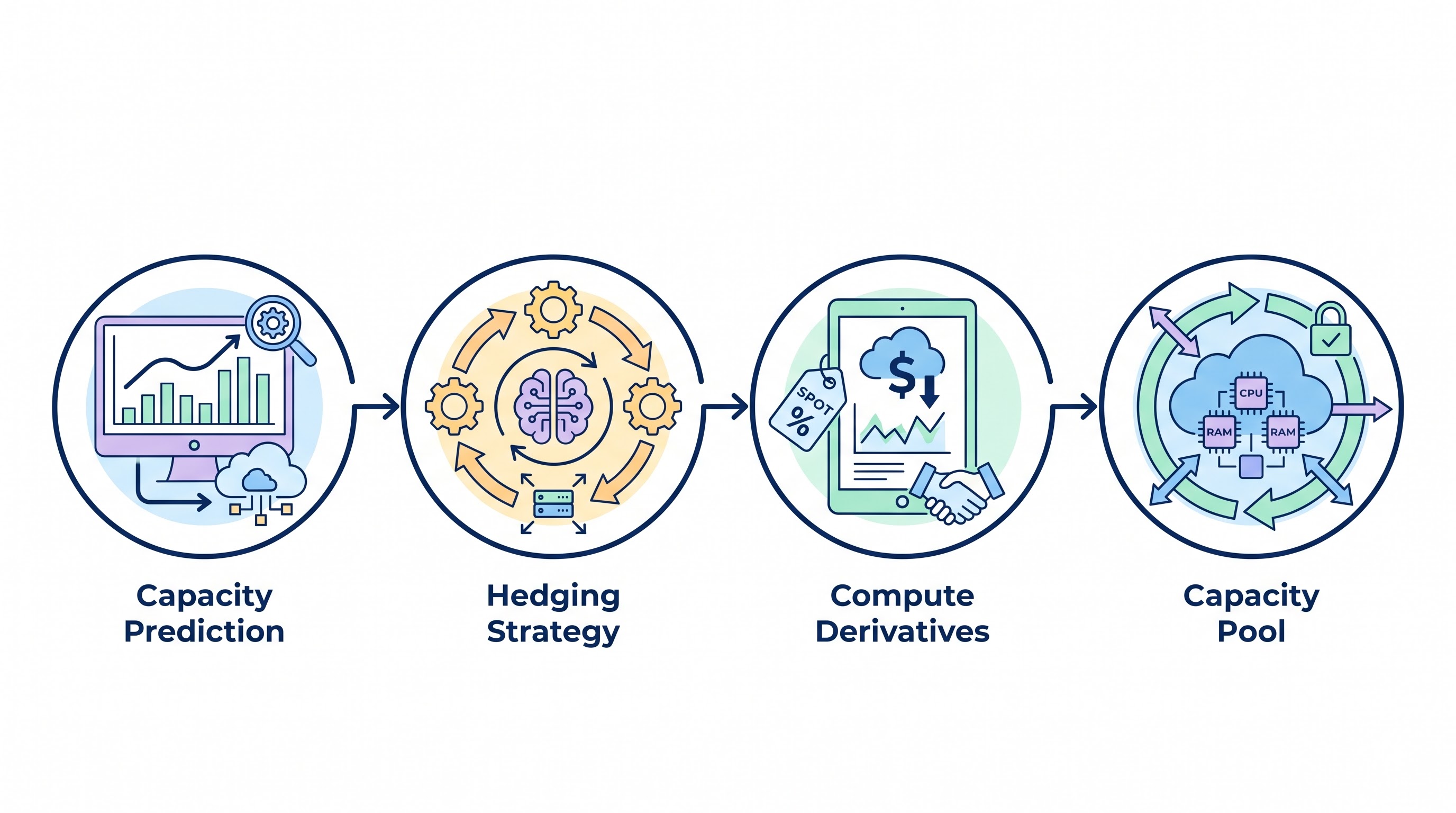
1. Executive Synthesis
In 2026, cloud compute is no longer merely an IT infrastructure service; it has fully matured into a highly volatile global commodity, exhibiting the same pricing dynamics as crude oil, wheat, or electrical power. The explosive demand for AI inference (GPU capacity) and the massive decentralization of multi-cloud architectures have created severe regional supply shocks. Hyperscaler list prices remain superficially stable, but the underlying spot markets—where true enterprise margin optimization occurs—are subjected to extreme, algorithmic price swings based on real-time global supply and demand.
Traditional FinOps strategies, which rely exclusively on 3-year static Reserved Instances (RIs) or Savings Plans (SPs) blended with unhedged Spot market consumption, are structurally inadequate for this new commodity era. A static 3-year RI is highly illiquid; it locks millions of dollars of corporate CapEx into specific silicon architectures that rapidly become obsolete. Conversely, operating massive elastic workloads on unhedged Spot instances exposes the enterprise to catastrophic "Preemption Cascades"—where a sudden spike in regional compute demand (e.g., a massive LLM training run by a competitor) wipes out the enterprise's Spot fleet and forces a fallback to On-Demand pricing, destroying the monthly infrastructure budget in hours.
To survive and exploit this commodity market, the CFO and FinOps leadership must integrate Wall Street financial engineering into cloud operations. Enterprises must implement the Compute Capacity Hedging Framework (CCHF).
The CCHF dictates that cloud compute must be aggressively hedged utilizing financial derivatives, forward contracts, and multi-cloud liquidity pools. Organizations must calculate their exact Net Spot Exposure (NSE) and purchase compute futures or options to lock in maximum pricing thresholds. If GPU spot prices in us-east-1 skyrocket, a properly hedged enterprise exercises its forward contract or routes compute to decentralized exchanges (e.g., Akash) via automated Kubernetes schedulers. This playbook establishes the mathematical models required to treat cloud infrastructure as a tradable financial asset, allowing the enterprise to guarantee compute availability and isolate gross margins from global silicon volatility.
2. Market Gap & Search Intent Failure Analysis
Enterprise research regarding "Cloud Cost Hedging" or "Spot Market Optimization" generally fails by treating cloud purchasing as a software configuration problem rather than a financial market problem. Search queries yield generic advice: "Use Spot Fleet auto-scaling groups" or "diversify your instance types to avoid interruptions."
This advice ignores the macroeconomic reality of systemic supply shocks. If a global GPU shortage occurs, diversifying from an a100 to an h100 Spot instance is useless because the entire market segment scales in price simultaneously. The market gap is the total lack of Derivative Modeling and Arbitrage Pricing Theory applied to FinOps. Analysts do not provide the formulas to calculate the Black-Scholes equivalent for an AWS compute option. They fail to explain how to utilize decentralized compute marketplaces to construct synthetic straddles that guarantee execution costs. This playbook corrects this failure, providing the advanced financial equations necessary to price risk, calculate optimal hedge ratios, and deploy compute capital with the sophistication of a commodity trading desk.
3. Core Strategic Framework
The enterprise must operationalize the Compute Capacity Hedging Framework (CCHF). This framework shifts the FinOps discipline from retrospective billing analysis to proactive risk management and commodity trading.
Implementation Protocol:
Commodity Exposure Profiling: Continuously audit the enterprise infrastructure to calculate the Net Spot Exposure (NSE)—the exact percentage of daily revenue that relies on volatile, non-reserved compute instances.
Execute the Hedging Matrix: Based on the NSE and the historical volatility (
$\sigma$) of the target instance class, procure financial derivatives (forward contracts with alternative providers or hyperscaler capacity blocks) to cap the maximum hourly rate.Deploy the Liquidity Router: Integrate Kubernetes clusters with a programmatic bidding engine that scans hyperscaler APIs, Tier-2 GPU clouds (CoreWeave, Lambda), and decentralized compute exchanges in real-time, executing workloads on the venue with the lowest clearing price.
Execution Decision Matrix:
If Spot Market Price spikes above the Strike Price of the Forward Contract (
$P_{strike}$), execute the hedge and lock the fleet to the contracted rate.If Spot Market Price drops
$> 40\%$below historical baselines, aggressively scale up latent batch processing (e.g., AI model backtesting, data rendering) to exploit the transient compute surplus.If a workload has a strictly bound completion deadline (e.g., end-of-day financial reconciliation), block Spot market routing entirely unless covered by a 100% capacity-guaranteed option contract to prevent SLA default.
4. Financial Modeling Layer (MANDATORY)
To trade compute like a commodity, FinOps must employ strict financial models to quantify risk and define hedging parameters.
Core Equations
1. Net Spot Exposure ($NSE_{cloud}$):
Calculates the total financial liability exposed to real-time market volatility over a specific budgeting period.
$$NSE_{cloud} = \sum_{i=1}^{n} \left( V_{spot\_hrs\_i} \times \sigma_{price\_volatility\_i} \right) \times P_{on-demand\_fallback}$$Where:
$V_{spot\_hrs}$= Total expected hours the workload will run on Spot/Preemptible nodes.$\sigma_{price\_volatility}$= The historical standard deviation of the spot price for that specific instance family in the target region.$P_{on-demand\_fallback}$= The maximum price the enterprise will pay if Spot capacity reaches zero and the workload fails over to On-Demand.
2. Optimal Hedge Ratio ($H_{optimal}$):
Determines the exact percentage of the $NSE_{cloud}$ that must be covered by forward contracts or reserved blocks to minimize portfolio variance.
$$H_{optimal} = \rho \times \left( \frac{\sigma_{spot\_market}}{\sigma_{forward\_contract}} \right)$$Where:
$\rho$= The correlation coefficient between the public cloud spot price and the price of the alternative decentralized compute market.$\sigma_{spot\_market}$= Volatility of the primary cloud spot market.$\sigma_{forward\_contract}$= Volatility (or fixed premium) of the hedging instrument.
3. Hedged Arbitrage Yield ($Y_{hedge}$):
Calculates the net financial return of implementing a hedging strategy during a period of high compute volatility.
$$Y_{hedge} = \left( P_{average\_spot\_spike} - P_{strike\_price} \right) \times V_{compute\_hrs} - C_{option\_premium}$$Where:
$P_{average\_spot\_spike}$= The actual market price of compute during the supply shock.$P_{strike\_price}$= The locked-in maximum price of the forward contract.$C_{option\_premium}$= The upfront cost paid to secure the capacity block or derivative contract.
A) Sensitivity Analysis Table
This table models the financial impact of a 72-hour global GPU supply shock (where Spot instances are preempted and On-Demand prices surge) on a massive AI training run requiring 50,000 GPU hours.
Hedging Strategy | Market Calm (Spot @ $1.50) | Moderate Shock (Spot @ $4.00) | Severe Shock (On-Demand Fallback @ $8.00) | Financial Outcome |
Unhedged (100% Spot) | $75,000 | $200,000 | $400,000 (Budget Destroyed) | Massive Volatility Risk |
Static RI (100% Reserved) | $250,000 | $250,000 | $250,000 | Safe, but wastes $175k in calm |
Optimal Hedge (60% Spot, 40% Fwd Contract @ $2.00) | $125,000 | $170,000 | $210,000 (Margin Defended) | Maximum Financial Efficiency |
Decision Threshold: Relying on 100% Unhedged Spot exposes the enterprise to a $400,000 catastrophic liability during a severe shock. Utilizing an Optimal Hedge caps the maximum downside exposure at $210,000 while allowing the enterprise to capture cheap compute during market calm.
B) Break-Even Formula
The Compute Option Premium Break-Even ($OP_{be}$) determines the maximum upfront premium a FinOps team should pay to reserve future compute capacity without taking physical delivery immediately.
$$OP_{be} = \left( P_{projected\_on-demand} - P_{contract\_strike} \right) \times Probability_{supply\_shock}$$Numerical Example: An enterprise wants to guarantee access to 1,000 H100 GPUs next quarter. Projected On-Demand rate is $10/hr. The contract strike price is $6/hr (Savings of $4/hr). The statistical probability of a massive GPU shortage next quarter is 30% (0.30). $OP_{be} = (\$10 - \$6) \times 0.30 = \$1.20$. The enterprise should pay a maximum upfront premium of $1.20 per projected hour to secure this option. If the broker demands $2.00/hr for the reservation premium, it is mathematically negative expected value; reject the contract.
C) Probability-Weighted Risk Table
Quantifying the operational risks of treating compute as a financial commodity.
Scenario | Probability | Financial Impact | Weighted Exposure |
Counterparty Default (Tier-2 Cloud Fails to Deliver) | 5.0% / yr | $150,000 (SLA/Fallback cost) | $7,500 per year |
Over-Hedging (Locked into high fixed rates during surplus) | 35.0% / yr | $60,000 (Opportunity loss) | $21,000 per year |
Spot Preemption Cascade (Zero Capacity Available) | 18.0% / yr | $250,000 (Downtime/Lost Rev) | $45,000 per year |
API Bidding Latency (Missed Arbitrage Window) | 40.0% / mo | $5,000 (Paying higher spread) | $2,000 per month |
D) Cost-per-Unit Model
The central metric for Commodity FinOps is the Volatility-Adjusted Compute Hour (VACH):
$$VACH = \frac{Total\_Compute\_Spend + Hedging\_Premiums\_Paid - Hedging\_Payouts}{Total\_vCPU\_Hours\_Consumed}$$Threshold: If $VACH$ tracks higher than the standard On-Demand rate for a full quarter, the FinOps trading desk is over-hedging and losing money on option premiums. The Optimal Hedge Ratio ($H_{optimal}$) must be dynamically lowered.
5. Operational Architecture Integration
The Automated Compute Trading Desk (Kube-Bidding Engines):
To operationalize the CCHF, human FinOps analysts cannot manually execute cloud routing. The architecture must deploy automated bidding engines integrated deeply with the Kubernetes scheduler. When a massive batch job is queued, the Bidding Engine scans the real-time API pricing of AWS Spot, Azure Spot, and decentralized compute marketplaces (e.g., Akash Network or Golem). It calculates the $Y_{hedge}$ and submits a programmatic bid. If a decentralized marketplace offers the required TFLOPS at 60% below the AWS Spot price, the scheduler instantly provisions the decentralized nodes, deploys the container payloads, executes the job, and tears down the infrastructure, clearing the financial transaction in crypto or fiat instantly.
Compute Forward Contracts & Capacity Blocks:
To secure the $H_{optimal}$ (Optimal Hedge Ratio), enterprises must utilize advanced hyperscaler and broker mechanics. This involves purchasing AWS EC2 Capacity Blocks for ML or entering into bilateral forward contracts with Tier-2 GPU clouds (e.g., CoreWeave). The enterprise pays an upfront premium ($C_{option\_premium}$) to guarantee that exactly 500 GPUs will be available for a specific 14-day window three months in the future at a locked-in strike price ($P_{strike}$). This architecture physically prevents the "Spot Preemption Cascade" and guarantees the execution timeline for mission-critical AI training runs.
Multi-Cloud Liquidity Routing (Abstracted Storage):
Arbitrage routing fails instantly if data gravity prevents the compute from shifting venues. To trade compute dynamically across hyperscalers, the architecture must implement abstracted, highly liquid storage layers (e.g., Alluxio or global edge caching). When the Bidding Engine wins a compute contract on Azure to exploit a transient price crash, the Azure nodes must be able to instantly mount and read the training data residing in AWS S3 without incurring a massive latency or egress penalty. True compute arbitrage requires absolute data liquidity.
6. Failure Scenarios
Scenario 1: The Liquidity Trap (Counterparty Risk)
Breakdown: A FinOps team successfully purchases a massive forward contract for cheap GPU compute on a decentralized, unproven Tier-3 cloud marketplace. When the execution date arrives, the Tier-3 provider suffers a massive data center outage and defaults on the physical delivery of the compute.
Financial Exposure: The enterprise loses the
$C_{option\_premium}$, fails to execute a critical AI model training run, and is forced to buy hyperscaler On-Demand compute at the absolute peak of the market, resulting in a $300,000 budget blowout.Governance Prevention Layer: Counterparty Risk Assessment. All forward contracts and compute derivatives must be governed by strict counterparty limits. The FinOps trading desk is mathematically prohibited from allocating more than 15% of the
$NSE_{cloud}$to un-rated or decentralized compute exchanges, ensuring that a default does not bankrupt the execution pipeline.
Scenario 2: The Over-Hedged CapEx Anchor
Breakdown: Terrified by a recent GPU supply shock, the CFO mandates locking in 90% of all projected compute through 3-year Reserved Instances and heavy forward contracts at current market peak prices. Six months later, a new generation of highly efficient silicon is released, crashing the spot market price of the reserved hardware by 60%.
Financial Exposure: The enterprise is contractually obligated to pay premium rates for obsolete hardware, bleeding $50,000 a month in opportunity cost while competitors utilize the new, cheaper silicon.
Governance Prevention Layer: Dynamic Hedge Ratio Limits. The architecture strictly bounds the
$H_{optimal}$formula. No single cloud region or instance family is permitted to be hedged$> 60\%$beyond a 6-month time horizon. The enterprise must purposefully maintain a minimum level of Spot market exposure to capitalize on downward price volatility and hardware refresh cycles.
Scenario 3: The API Thrashing Arbitrage Loss
Breakdown: The Kube-Bidding Engine is configured to hunt for the absolute lowest Spot price globally. It detects a 5% price drop in ap-northeast-1 (Tokyo) and violently migrates a 1,000-node batch processing job from us-east-1 to Tokyo.
Financial Exposure: The 5% compute savings generates $500. However, moving the 50TB dataset across the Pacific Ocean generates $4,000 in network egress fees and adds 12 hours of network latency, resulting in a net loss of $3,500.
Governance Prevention Layer: Data-Gravity Constrained Bidding. The Bidding Engine algorithm must be hardcoded to deduct the fully burdened egress cost and latency penalty from the expected arbitrage yield before submitting a bid. If Net Arbitrage Yield
$\le 0$, the spatial migration is strictly blocked.
7. Board-Level Translation Layer
EBITDA Delta Modeling: Cloud compute is the modern factory floor. By treating compute as a volatile commodity and executing the CCHF, the FinOps team smooths out the massive peaks and valleys of infrastructure COGS. This active hedging guarantees that sudden hyperscaler supply shocks do not cause unanticipated margin compression, delivering a predictable, optimized EBITDA profile to the board and shareholders.
Gross Margin Defense: For AI-centric SaaS platforms, the cost of GPU inference is highly volatile. If the platform sells subscriptions at a fixed monthly rate, but underlying Spot prices triple due to a market shortage, the product's gross margin instantly inverts negative. Purchasing compute derivatives and forward contracts acts as absolute insurance, locking in the COGS required to maintain the 80% software margin mandate.
Capital Allocation Signal: Building a "Compute Trading Desk" signals a profound maturation of the IT organization. It demonstrates to the board that infrastructure leadership has evolved beyond reactive ticket-taking and is actively leveraging corporate capital to exploit global cloud market inefficiencies, generating alpha through operational financial engineering.
Risk-Adjusted ROI Formula:
$$ROI_{compute\_futures} = \frac{\text{Avoided On-Demand Fallback Costs} + \text{Arbitrage Profits}}{\text{Derivative Premiums Paid} + \text{Cost of Bidding Engine Automation}}$$
8. Data Visualization Suggestions
Compute Option Payoff Diagram: A classic financial "hockey stick" payoff chart. The X-axis is the Market Spot Price; the Y-axis is Profit/Loss. It visually demonstrates how buying a Compute Call Option caps the enterprise's maximum hourly rate during a supply shock.
Net Spot Exposure (
$NSE$) Dashboard: A real-time gauge displaying the millions of dollars of enterprise revenue currently dependent on unhedged, volatile spot market compute, triggering alerts when the exposure breaches corporate risk tolerance.Kube-Bidding Execution Matrix: A heatmap showing multiple global cloud regions and tier-2 providers. Regions flash green when the bidding engine executes a successful arbitrage trade below the moving average, and red when prices are too high.
Hedging Strategy Waterfall: A chart showing Total Potential Liability ($400k) stepping down to actual liability ($210k) through the strategic application of 3-year RIs, Capacity Blocks, and dynamic Spot market routing.
Volatility-Adjusted Compute Hour (
$VACH$) Trendline: A time-series graph tracking the$VACH$metric. A stable, flat line amidst a highly jagged, volatile background market price proves the operational success of the CCHF hedging strategy.
9. Why Analyst-Style Summaries Fail at Financial Precision
When technology analysts publish guidance stating, "Organizations must adopt a multi-cloud strategy to avoid vendor lock-in and optimize pricing," they are dispensing a superficial platitude that fundamentally fails to grasp the financial mechanics of commodity markets.
This narrative fails because it assumes that merely having accounts on AWS and Azure automatically yields financial optimization. It does not. An Enterprise Architect following this advice will simply deploy unhedged Auto Scaling Groups across two clouds, resulting in duplicated administrative overhead and zero protection against a systemic, cross-cloud silicon shortage. Analyst summaries do not calculate the Optimal Hedge Ratio ($H_{optimal}$) or the Option Premium Break-Even ($OP_{be}$).
Equation-backed modeling using the Compute Capacity Hedging Framework (CCHF) destroys this naive view. It mathematically proves that multi-cloud is not an architectural goal; it is a financial liquidity requirement. By quantifying the exact Net Spot Exposure ($NSE_{cloud}$) and forcing the purchase of forward contracts to cap volatility, FinOps leaders transform cloud procurement into a rigorous risk-management discipline. You cannot optimize global infrastructure with qualitative advice; you must trade it, hedge it, and route it utilizing absolute mathematical certainty.
10. Strategic Conclusion
By 2026, the enterprise cloud is no longer a static utility; it is a hyper-volatile, globally traded commodity market driven by the insatiable demand for artificial intelligence and massive parallel compute. Relying on traditional procurement methods—signing static 3-year enterprise agreements or blindly throwing workloads onto the Spot market and hoping for the best—constitutes a failure of fiduciary duty.
To dominate this landscape, enterprises must execute the Compute Capacity Hedging Framework (CCHF). Infrastructure leadership, working directly with the Office of the CFO, must build capabilities analogous to a commodity trading desk. By meticulously calculating Net Spot Exposure ($NSE_{cloud}$), organizations can accurately identify their financial vulnerability to silicon supply shocks.
Armed with this data, the enterprise must aggressively deploy capital to purchase compute futures, capacity blocks, and forward contracts, capping their maximum hourly rate while retaining the agility to exploit transient market crashes via decentralized compute exchanges. Through the deployment of automated Kube-Bidding engines and highly liquid, abstracted data layers, the organization transitions from being a passive consumer of cloud infrastructure to an active, predatory participant in the global compute market. Treating cloud capacity as a financial derivative is the ultimate evolution of FinOps, mathematically guaranteeing operational resilience and relentlessly defending corporate gross margins.
11. Implementation Readiness Checklist
Calculate Baseline
$NSE_{cloud}$: Audit the trailing 90 days of cloud telemetry to calculate the exact dollar value of production workloads running on unhedged, volatile Spot/Preemptible instances.Establish the FinOps Trading Desk: Form a dedicated cross-functional unit combining a Cloud Architect, a Data Scientist, and a Financial Risk Analyst to actively manage the CCHF portfolio.
Define Counterparty Risk Limits: Draft formal corporate governance policies restricting the maximum percentage of compute budget that can be legally allocated to Tier-2 or decentralized compute exchanges to prevent default cascades.
Procure Hyperscaler Capacity Blocks: Engage directly with AWS/Azure/GCP account teams to negotiate and purchase ML Capacity Blocks (forward contracts) to guarantee GPU availability for the next major training run.
Deploy Automated Bidding Engines: Install programmatic Kubernetes schedulers (e.g., customized Kueue or Keda operators) configured to query real-time multi-cloud Spot APIs before provisioning batch jobs.
Execute the
$OP_{be}$Formula on Renewals: Before signing any new cloud commitment, force the FinOps team to run the Option Premium Break-Even math to ensure the enterprise is not overpaying for the insurance of guaranteed capacity.Decouple Storage for Liquidity: Architect data pipelines using caching layers (Alluxio, Redis) to abstract data gravity, enabling the Bidding Engine to instantly shift compute execution between cloud providers without massive egress delays.
Set Dynamic Hedge Ratios (
$H_{optimal}$): Configure automated alerts that recalculate the optimal hedge ratio weekly based on the rolling 30-day standard deviation ($\sigma$) of global GPU spot prices.Pilot a Decentralized Compute Trade: Run a low-risk, stateless QA testing workload on a decentralized marketplace (e.g., Akash) to validate the bidding API integration, latency profiles, and crypto/fiat clearing mechanics.
Sunset Static Procurement: Formally ban the practice of purchasing 100% fixed, 3-year Reserved Instances for anything other than absolute, unyielding baseline databases, forcing all elastic compute into the active hedging portfolio.
Stop guessing where your Kubernetes budget is going. Schedule a demo here to explore Kubernetes cost monitoring with Cloud Atler.