
1. Executive Synthesis
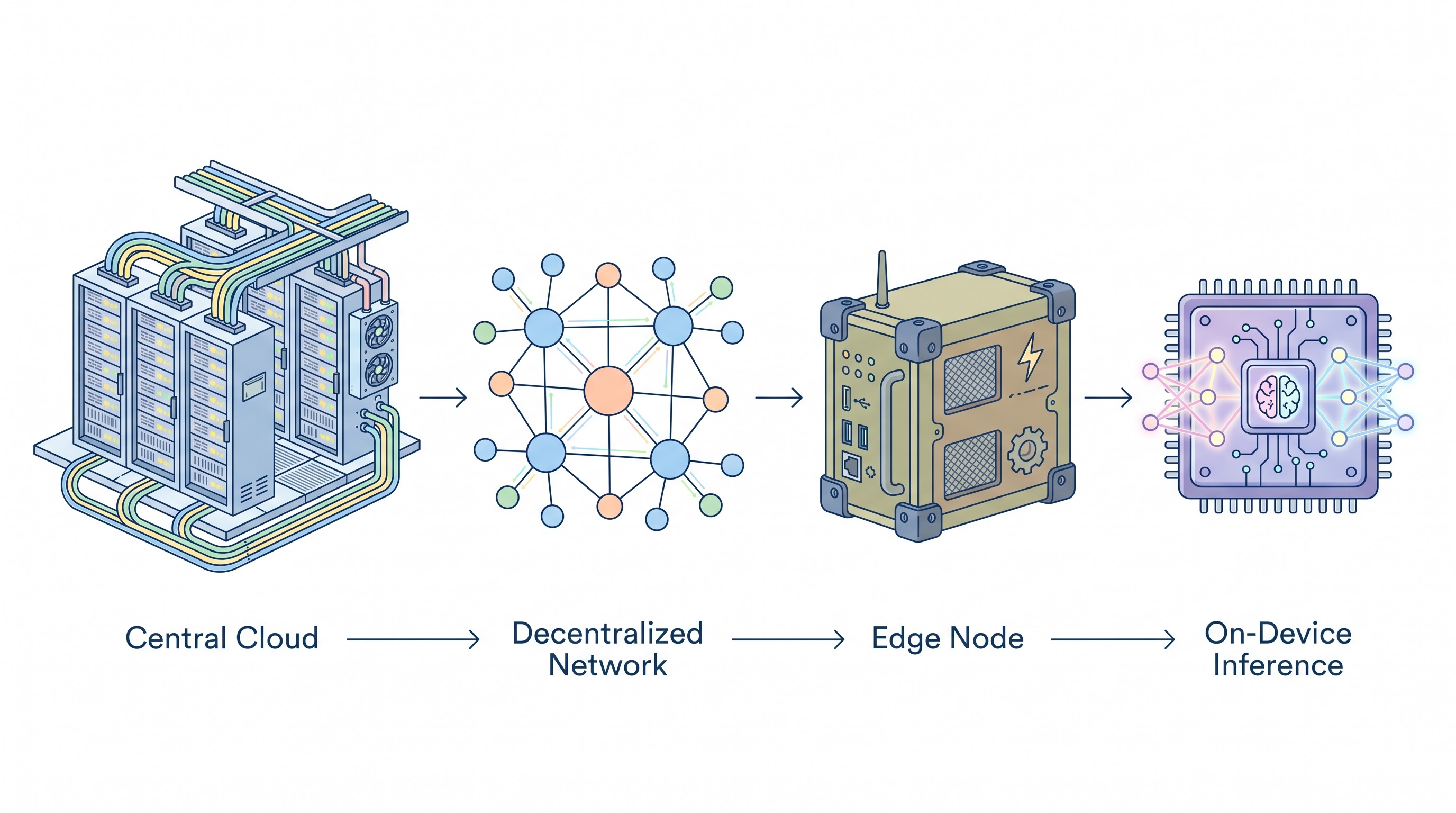
The rapid decentralization of artificial intelligence from monolithic public cloud regions to edge locations—spanning retail micro-datacenters, industrial IoT gateways, autonomous vehicle fleets, and on-device Neural Processing Units (NPUs)—has fundamentally altered the topography of enterprise compute economics. By 2026, relying exclusively on centralized hyperscaler regions (e.g., us-east-1 or eu-west-1) for high-frequency AI inference creates a catastrophic double-penalty: severe network latency degradation and unscalable data ingress/egress bandwidth bills.
However, moving AI inference to the edge introduces the "Decentralized Complexity Tax." Unlike centralized cloud environments where multi-tenant infrastructure absorbs hardware failures and capacity fluctuations, edge environments require capitalizing hardware acquisition, managing distributed power and cooling constraints, deploying OTA (Over-The-Air) container updates over constrained cellular networks, and managing physical security risks. Attempting to deploy Edge AI without a mathematically rigorous Total Cost of Ownership (TCO) model results in immediate margin collapse driven by localized operational overhead and stranded hardware capacity.
This playbook introduces the Edge Token Arbitrage (ETA) Model. The ETA model establishes a dynamic financial translation engine that continuously evaluates the fully burdened cost of generating an AI inference at the physical edge versus hauling raw sensor telemetry back to a centralized cloud region. By quantifying the exact threshold where localized hardware amortization and power draw become cheaper than cloud bandwidth egress and central GPU tokens, enterprise architects can build self-regulating hybrid inference pipelines.
To achieve long-term sustainability, infrastructure leaders must implement containerized edge orchestration (e.g., K3s, Wasm runtimes) paired with hardware-agnostic compilation layers (e.g., ONNX, TVM). This approach allows micro-datacenters and edge devices to operate as fluid, price-aware compute nodes within the global enterprise finops data lakehouse, permanently insulating product gross margins from the escalating costs of centralized cloud compute.
2. Market Gap & Search Intent Failure Analysis
Current enterprise research regarding "Edge AI TCO" suffers from a profound "Silicon Vacuum." Search queries for edge computing economic models consistently return high-level, narrative whitepapers published by hardware OEMs or telecommunications providers. These reports promote the benefits of low latency while presenting naive cost models that compare the raw purchase price of an edge gateway against public cloud On-Demand GPU instance hours over a three-year period.
This approach fails to model the Physical Lifecycle Friction Factor. Standard industry literature ignores the cost of physical site access (truck rolls), thermal throttling performance degradation, localized energy tariff volatility, and the bandwidth penalties incurred when deploying OTA model updates to thousands of remote nodes. Furthermore, standard FinOps guides fail to provide the mathematical formulas required to evaluate WebAssembly (Wasm) lightweight runtimes against traditional Docker containers on resource-constrained edge hardware. This playbook bridges that gap by establishing hard quantitative equations that incorporate hardware depreciation, localized energy consumption, network backhaul penalties, and physical maintenance overhead.
3. Core Strategic Framework
To govern edge AI deployments, enterprises must execute the Edge Token Arbitrage (ETA) Model. This framework establishes the operational boundaries for when compute must be executed on localized edge hardware versus when it should be offloaded to centralized cloud regions or regional micro-datacenters.
Implementation Protocol:
Physical Site & Silicon Profiling: Audit every edge node location to determine localized power costs ($/kWh), available backhaul bandwidth, and the empirical Model Flops Utilization (MFU) of the local NPU/GPU accelerator.
Telemetry Ingestion: Stream edge node health, power draw, and local inference execution logs into the centralized FinOps database via lightweight, batched MQTT or gRPC protocols.
Execute ETA Calculation: Calculate the
$C_{edge\_token}$and compare it continuously against the$C_{cloud\_token}$plus network transport penalties.Decision Matrix:
If
$C_{edge\_token} < C_{cloud\_token}$AND Latency SLA$< 20\text{ms}$, execute inference strictly on localized edge hardware (On-Device/Micro-DC).If local NPU thermal limits exceed 85°C OR local power grid rates spike into peak tariff zones, dynamically spill inference execution to the nearest regional cloud edge zone (e.g., AWS Wavelength).
If the workload requires raw parameters
$> 70\text{B}$that exceed local VRAM, execute local feature extraction and route compressed embeddings to the central cloud for deep processing.
4. Financial Modeling Layer (MANDATORY)
The financial mechanics of Edge AI require modeling both capitalized hardware assets and distributed operational costs.
Core Equations
1. Fully Burdened Edge Token Cost ($C_{edge\_token}$):
Calculates the true cost per 1 million inference tokens generated on distributed edge infrastructure.
$$C_{edge\_token} = \frac{\left( \frac{CapEx_{node} + CapEx_{install}}{D_{months}} \right) + OpEx_{power} + OpEx_{backhaul} + OpEx_{maint\_alloc}}{\left( Throughput_{tokens/hr} \times 730 \times U_{node} \right) / 1,000,000}$$Where:
$CapEx_{node}$= Purchase price of the edge silicon, enclosure, and networking hardware.$CapEx_{install}$= Capitalized cost of physical site installation and provisioning.$D_{months}$= Depreciation window (strictly 36 months for edge hardware).$OpEx_{power}$= Monthly electrical cost based on local kWh rates and thermal cooling load.$OpEx_{backhaul}$= Monthly fixed/cellular connectivity cost allocated to the node.$OpEx_{maint\_alloc}$= Amortized cost of physical maintenance (truck rolls) per node.$U_{node}$= Average continuous utilization percentage of the edge node.
2. Bandwidth-Latency Egress Arbitrage ($M_{blea}$):
Determines the net financial savings of executing inference locally versus streaming raw sensor telemetry (e.g., 4K video feeds) to the central public cloud.
$$M_{blea} = \left( V_{raw\_data\_GB} \times P_{cloud\_ingress/egress} + P_{cloud\_gpu\_hr} \times T_{hrs} \right) - \left( C_{edge\_token} \times Volume_{tokens} \right)$$3. Edge Hardware Obsolescence Penalty ($P_{edge\_obs}$):
Quantifies the financial loss incurred when specialized edge silicon becomes incapable of running newer model architectures before the end of its 36-month depreciation schedule.
$$P_{edge\_obs} = \left( \frac{D_{remaining\_months}}{36} \right) \times CapEx_{node} \times \left( 1 - Accuracy_{legacy\_model\_ratio} \right)$$A) Sensitivity Analysis Table
This table models the monthly TCO and EBITDA impact per 1,000 edge nodes across different continuous node utilization tiers and network backhaul environments.
Variable (Node Utilization) | Low Backhaul Cost ($0.01/GB) | Med Backhaul Cost ($0.08/GB) | Cellular/Satellite ($0.50/GB) | Financial TCO Winner |
Low Util (10%) | -$12,000 (Cloud Wins) | -$5,000 (Cloud Wins) | +$45,000 (Edge Wins) | Cellular favors Edge |
Med Util (50%) | +$18,000 (Edge Wins) | +$62,000 (Edge Wins) | +$210,000 (Edge Wins) | Edge Highly Accretive |
High Util (85%) | +$85,000 (Edge Wins) | +$145,000 (Edge Wins) | +$480,000 (Edge Wins) | Edge Transformative |
Decision Threshold: When network backhaul costs exceed $0.05/GB, local Edge AI deployment is financially mandatory for workloads operating at >20% continuous utilization.
B) Break-Even Formula
The Node Utilization Inversion Point ($U_{edge\_be}$) defines the exact percentage of monthly utilization an edge node must sustain to be cheaper than streaming data to a central cloud GPU instance.
$$U_{edge\_be} = \frac{\left( \frac{CapEx_{node}}{36} \right) + OpEx_{fixed\_site}}{730 \times \left( P_{cloud\_gpu\_equivalent\_hr} + (V_{raw\_gb\_hr} \times P_{bandwidth\_gb}) - OpEx_{power\_hr} \right)} \times 100$$Numerical Example: An edge gateway costs $3,600 (amortized to $100/mo). Fixed site costs are $20/mo. Cloud GPU equivalent plus bandwidth savings equals $0.50/hr. Local power is $0.05/hr. The break-even utilization is $(\$120) / (730 \times \$0.45) \times 100 = 36.5\%$. The edge gateway must run local inference >36.5% of the month to be economically superior to the cloud.
C) Probability-Weighted Risk Table
Quantifying the operational risks inherent in distributed edge AI deployments.
Scenario | Probability | Financial Impact | Weighted Exposure |
Physical Maintenance Requirement (Truck Roll) | 12.0% / year | $1,200 per site visit | $144.00 per node/yr |
Thermal Throttling Performance Drop | 25.0% / summer | $350 (SLA degradation) | $87.50 per node/yr |
Corrupted OTA Firmware Flash | 3.5% / update | $850 (Recovery & downtime) | $29.75 per update |
Edge Node Physical Tampering / Theft | 1.5% / year | $4,000 (Asset replacement) | $60.00 per node/yr |
D) Cost-per-Unit Model
The core unit metric for Edge AI is the Cost Per Edge Inference (CPEI):
$$CPEI = \frac{C_{edge\_token} \times Average\_Tokens\_Per\_Inference}{1,000,000}$$Threshold: If $CPEI > \$0.002$ for standard vision or classification models, the edge runtime is unoptimized. Engineering must execute model quantization (FP16 to INT8 or INT4) or transition the container runtime from Docker to WebAssembly.
5. Operational Architecture Integration
Kubernetes at the Edge (K3s / MicroK8s):
Deploying heavy, full-footprint Kubernetes distributions to resource-constrained edge gateways is an architectural failure that burns memory and power. Edge nodes must run stripped-down, CNCF-certified distributions like K3s or MicroK8s. The control plane resides centrally or within a regional micro-datacenter, while the edge hardware acts strictly as an agent worker node. Container images are stripped of legacy OS utilities, utilizing minimal scratch bases to reduce image sizes to $<50\text{MB}$, ensuring rapid OTA deployment across low-bandwidth cellular channels.
WebAssembly (Wasm) Runtime Acceleration:
For sub-watt, highly constrained edge environments (e.g., IoT gateways), container runtimes like Docker introduce unacceptable memory overhead. Architecture must leverage WebAssembly runtimes (e.g., WasmEdge or Wasmer) compiled directly to target the local NPU. Wasm modules boot in microseconds, consume less than 1% of the RAM of a standard Linux container, and allow AI inference code to execute at near-native speeds while maintaining strict sandboxed memory security.
OTA Model Update Governance & Delta Sync:
Updating a 7B parameter LLM or a complex vision model across 5,000 remote nodes over LTE/5G can generate an catastrophic backhaul bill. Edge architecture must utilize binary delta updates (e.g., OSTree or Courgette). Rather than pushing a complete 14GB container image, the central CI/CD pipeline computes the binary delta between Model v1.1 and v1.2, pushing only the 200MB parameter weight delta file. The localized edge agent reconstructs the new model binary locally before swapping the production execution pointer.
6. Failure Scenarios
Scenario 1: The OTA Bandwidth Shock
Breakdown: An engineering team deploys a fleet of 2,000 computer vision edge devices connected via 4G LTE cellular subscriptions. To fix an accuracy issue, they trigger an automated CI/CD pipeline that pushes an uncompressed 8GB Docker image containing a new PyTorch model to all devices simultaneously.
Financial Exposure: 2,000 nodes × 8GB = 16,000 GB of cellular data. At a overage rate of $10/GB, the pipeline generates an unexpected $160,000 cellular bill in 4 hours.
Governance Prevention Layer: Network Aware Deployment Policies. The CI/CD deployment engine must query the local node's connection type. OTA updates
$>500\text{MB}$are strictly blocked over cellular interfaces and scheduled only when the node signals an active Wi-Fi/Fiber backhaul or via verified binary delta synchronization.
Scenario 2: The Thermal Throttling Death Spiral
Breakdown: Edge gateways are deployed inside unconditioned industrial enclosures. During summer months, ambient temperatures inside the enclosure hit 55°C. The local NPU/GPU dynamically throttles its clock speed by 70% to prevent hardware destruction. Local inference latency spikes from 15ms to 250ms, causing real-time safety systems to fail.
Financial Exposure: $500,000+ in production line stoppage penalties and contract SLA violations.
Governance Prevention Layer: Thermal-Aware Workload Shedding. The localized telemetry agent continuously monitors the NPU die temperature. If the temperature exceeds 75°C, the node enters a "Shedding State," automatically executing local model quantization (falling back to a lightweight INT4 model) or shedding 50% of the non-critical inference frames to a cloud edge zone before thermal throttling occurs.
Scenario 3: The Truck Roll Cascade
Breakdown: An enterprise deploys custom Linux kernels to 1,000 remote retail micro-datacenters. A misconfigured network driver update causes the edge nodes to lose their default gateway route upon reboot. The nodes become completely unmanageable out-of-band.
Financial Exposure: 1,000 sites require physical technician visits (truck rolls) at an average cost of $600 per visit, resulting in a direct $600,000 OpEx loss.
Governance Prevention Layer: Immutable OS with Automated A/B Fallback. Edge hardware must run an immutable operating system (e.g., Fedora CoreOS or Ubuntu Core) utilizing dual boot partitions (A/B). During an update, the node flashes Partition B and attempts a reboot. If the node fails to ping the central control plane within 180 seconds, the hardware watchdog automatically triggers a hardware reset back to Partition A, restoring connectivity without physical human intervention.
7. Board-Level Translation Layer
EBITDA Delta Modeling: Deploying the ETA framework for high-throughput AI features transitions variable, hyperscaling cloud egress and GPU costs into fixed, predictable CapEx investments. For an enterprise handling massive vision telemetry, moving inference to the edge eliminates millions in cloud data transfer fees, directly expanding operational EBITDA margins.
Gross Margin Defense: For IoT and Hardware-enabled SaaS providers, embedding efficient Edge AI capabilities defends unit margins by pushing compute execution onto the client's localized hardware or on-premises power grid, effectively transferring the COGS of inference off the SaaS provider's balance sheet.
Capital Allocation Signal: Investing in Edge AI requires evaluating physical asset depreciation against cloud agility. The board must view edge hardware capital expenditure through the lens of long-term unit cost suppression, requiring a minimum 3.0x return on invested capital (ROIC) derived from avoided cloud egress fees.
Risk-Adjusted ROI Formula:
$$ROI_{edge} = \frac{\left( \text{Avoided Cloud Egress} + \text{Avoided Cloud GPU Costs} \right) - \left( OpEx_{power} + OpEx_{backhaul} + OpEx_{maint} \right)}{CapEx_{hardware\_total} \times \left( 1 + WACC \right)}$$
8. Data Visualization Suggestions
ETA Model Inference Decision Matrix: A decision flow chart plotting Latency SLA (Y-axis) against Network Backhaul Cost (X-axis), visually partitioning regions into "On-Device NPU," "Local Micro-DC," "Regional Cloud Edge," and "Central Cloud Region."
Edge Node TCO Component Breakdown: A stacked bar chart comparing the TCO of a Cloud-Only approach versus an Edge-Only approach over 36 months, detailing Silicon CapEx, Power OpEx, Backhaul Costs, and Cloud Egress.
Thermal Throttling Performance Decay Curve: A dual-axis time series chart mapping ambient enclosure temperature against NPU Clock Speed (GHz) and Inference Latency (ms), showing the exact point where thermal limits trigger SLA failures.
Binary Delta OTA Synchronization Topology: A visual diagram contrasting a standard 8GB container push against a 200MB binary weight delta sync, highlighting data consumption savings across cellular networks.
Wasm vs Container Footprint Comparison: A side-by-side bar chart showing Memory Footprint (MB), Boot Time (ms), and Idle Power Draw (Watts) between a standard Docker container and a WebAssembly runtime.
9. Why Analyst-Style Summaries Fail at Financial Precision
Generic analyst reports frequently declare that "Edge computing reduces cloud costs by bringing processing closer to the data source." This statement is a narrative oversimplification that frequently leads to financial failure.
Narrative summaries treat edge hardware as self-sustaining entities that require zero operational maintenance. They fail to calculate the $C_{edge\_token}$ equation, completely ignoring the localized power tariffs, thermal cooling overhead, and the massive financial risk of out-of-band network failures. If an enterprise blindly follows analyst advice and deploys thousands of edge devices without automated A/B fallback kernels or binary delta sync pipelines, the resulting maintenance truck rolls and cellular overage fees will completely obliterate any theoretical cloud compute savings. Precision modeling demands that we evaluate edge infrastructure through strict corporate finance mechanisms, quantifying hardware depreciation velocity, localized power costs, and physical risk factors before deploying a single node to the field.
10. Strategic Conclusion
The decentralization of artificial intelligence to the physical edge represents a fundamental transformation in enterprise infrastructure architecture. The historical model of streaming raw sensor telemetry across global networks to centralized hyperscaler data centers is no longer sustainable from a latency or financial perspective. High-frequency AI inference requires localized execution.
However, capturing the economic advantages of Edge AI requires avoiding the traps of distributed operational complexity. Infrastructure leaders cannot treat edge nodes as miniature public cloud instances. Deploying Edge AI successfully demands strict adherence to the Edge Token Arbitrage (ETA) Model. Enterprises must implement lightweight, resilient architectures—utilizing K3s, WebAssembly runtimes, immutable operating systems, and binary delta OTA synchronization—to keep operational management overhead near zero.
Every edge hardware deployment must be mathematically gated. By continually weighing the fully burdened cost of edge token generation against centralized cloud egress and compute tariffs, FinOps and architecture teams can construct dynamic, self-healing inference networks. By pushing compute to the edge while maintaining central financial governance, the enterprise secures low-latency execution, reduces regulatory exposure, and permanently insulates its operational gross margins.
11. Implementation Readiness Checklist
Execute Edge Telemetry Audits: Instrument all remote edge nodes to log real-time power draw (Watts), ambient temperature, backhaul bandwidth consumption, and local model inference latency.
Define Localized Energy Tariffs: Build a dynamic lookup table within the FinOps database mapping every physical edge location to its local utility kWh power rate and peak tariff schedules.
Implement Immutable OS Structures: Transition all edge hardware to immutable operating system builds (e.g., Ubuntu Core, CoreOS) featuring dual-partition (A/B) automated rollback watchdogs.
Deploy K3s / Wasm Runtimes: Standardize edge container orchestration on K3s, and evaluate WebAssembly (WasmEdge) for high-frequency, sub-watt sensor inference microservices.
Implement Binary Delta OTA Pipelines: Configure the edge CI/CD deployment engine to generate and push binary weight deltas rather than full container image rebuilds for model updates.
Block Cellular Container Pushes: Establish automated network-aware policies within the container registry that physically block OTA updates
$>500\text{MB}$over cellular backhaul interfaces.Code Thermal-Aware Model Quantization: Program localized inference engines to automatically swap to quantized INT4/INT8 model parameter weights when die temperatures exceed 75°C.
Integrate Edge Metrics into FOCUS: Map edge node CapEx depreciation schedules and localized power/backhaul OpEx into the centralized FOCUS 1.2 data lakehouse for unified global cost reporting.
Automate Out-of-Band Management: Ensure every physical micro-datacenter or critical edge cluster is equipped with hardware-level out-of-band management capabilities to minimize physical truck rolls.
Establish the ETA Decision Engine: Expose an API gateway that continuously queries local node health and cloud egress rates to dynamically route inference requests between local hardware and cloud edge zones.
Stop guessing where your Kubernetes budget is going. Schedule a demo here to explore Kubernetes cost monitoring with Cloud Atler.