
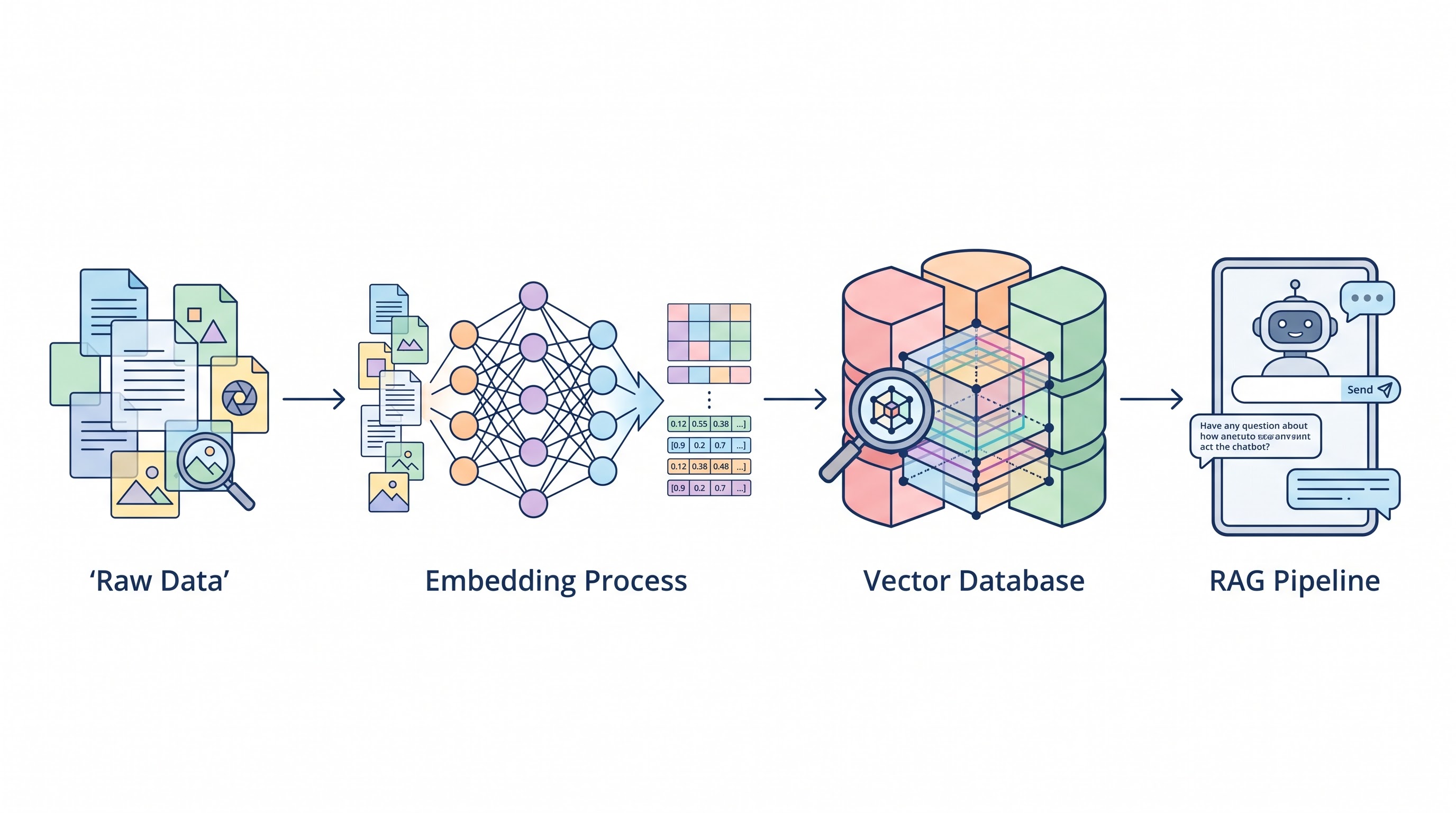
1. Executive Synthesis
The rapid maturation of Retrieval-Augmented Generation (RAG) has solved the hallucination and temporal limitations of foundational Large Language Models (LLMs). By grounding AI responses in proprietary corporate data via vector similarity search, enterprises have unlocked production-grade generative AI. However, this architectural leap has introduced a massive, hidden infrastructure tax: the exponential cost of running Vector Databases in memory at scale. By 2026, the unit economics of RAG pipelines have become the primary bottleneck to scaling AI features, as naive implementations consume catastrophic amounts of RAM and compute.
Traditional relational database economics do not apply to vector search. In standard SQL environments (PostgreSQL, MySQL), data is heavily indexed and stored on cheap NVMe or block storage, with only hot data cached in RAM. Vector databases utilizing Approximate Nearest Neighbor (ANN) algorithms—specifically Hierarchical Navigable Small World (HNSW) graphs—require the entire vector index to reside in memory (RAM) to achieve the sub-50 millisecond latency required for synchronous AI inference. When an enterprise attempts to index 1 billion documents using 1,536-dimensional embeddings (e.g., OpenAI text-embedding-3-small) without mathematical quantization, the resulting HNSW graph consumes terabytes of expensive cloud RAM, driving cluster costs into the millions of dollars annually.
A successful 2026 AI infrastructure strategy mandates the implementation of rigorous Vector FinOps. Enterprises must stop treating vector databases as bottomless buckets and start treating them as highly constrained, expensive memory tiers. This requires the mathematical execution of Product Quantization (PQ) and Scalar Quantization (SQ), trading negligible percentage points of recall accuracy for exponential reductions in memory overhead. Furthermore, architecture teams must dynamically route RAG queries based on temporal relevance—keeping only the last 30 days of embeddings in RAM, while tiering older vectors to disk-based SSD indexes (e.g., DiskANN).
This playbook introduces the Vector Dimension Indexing (VDI) Optimization Framework. It forces infrastructure leaders to quantify the exact financial cost of an embedding dimension and mathematically model the trade-off between recall precision and cloud RAM utilization. By enforcing strict governance over chunking strategies, embedding model selection, and vector caching, FinOps teams can collapse RAG infrastructure costs by up to 85%, ensuring that the integration of proprietary data into generative AI remains highly accretive to SaaS gross margins.
2. Market Gap & Search Intent Failure Analysis
Enterprise research regarding "Vector Database Pricing" or "RAG Cost Optimization" consistently fails by relying on vendor-provided calculators that obfuscate the true Total Cost of Ownership (TCO). Search intent yields comparisons between managed SaaS providers (e.g., Pinecone vs. Weaviate), focusing purely on the hourly cost per "pod" or compute node.
The market gap is the total failure to model the Mathematical Physics of High-Dimensional Vectors. Vendors do not explain that switching an embedding model from 768 dimensions to 3,072 dimensions instantly quadruples the RAM requirement, network egress, and compute cost of the entire pipeline, often while delivering zero measurable improvement in search relevance for the specific corporate domain. Analysts recommend "implementing HNSW for fast search," completely ignoring that an HNSW graph typically adds a 30% to 50% memory overhead on top of the raw vector payload. This playbook destroys these blind spots by providing the exact memory calculation formulas and indexing arbitrage models required to provision vector architecture mathematically, preventing massive over-allocation of cloud memory instances.
3. Core Strategic Framework
The enterprise must adopt the Vector Dimension Indexing (VDI) Optimization Framework. This framework treats vector storage and retrieval as a highly liquid financial market, dictating that every dimension indexed must justify its RAM footprint via quantifiable recall improvement.
Implementation Protocol:
Embedding Profile Baselining: Audit the current RAG pipeline to determine the embedding model dimension (
$D$), the base data type (FP32 vs FP16), and the total vector count ($N$).Execute Index Quantization: Mandate the implementation of Scalar Quantization (SQ) or Product Quantization (PQ) on all non-mission-critical vector indexes, compressing FP32 vectors into INT8 or INT4 formats.
Establish Tiered ANN Routing: Architect the vector database to utilize RAM-based HNSW strictly for "hot" active project data, while routing "cold" archival data to DiskANN or pgvector IVFFlat indexes on NVMe.
Execution Decision Matrix:
If Recall Accuracy Drop
$< 2\%$AND Memory Reduction is$> 60\%$, automatically enforce INT8 Scalar Quantization for the namespace.If a RAG query relies strictly on keyword matching (e.g., searching for a specific invoice ID), bypass the vector database entirely and route the query to a traditional inverted index (Elasticsearch/OpenSearch) to avoid embedding token costs.
If the vector count
$N > 100,000,000$, block the deployment of raw HNSW indexes and force the engineering team to implement hybrid search (BM25 + Sparse/Dense Vectors) to reduce the required dense dimension count.
4. Financial Modeling Layer (MANDATORY)
The financial governance of RAG pipelines requires strict adherence to the following mathematical models.
Core Equations
1. Raw Vector Memory Footprint ($RAM_{vector}$):
Calculates the exact gigabytes of RAM required to hold the raw vectors and their associated HNSW graph overhead before quantization.
$$RAM_{vector} = \frac{N_{vectors} \times D_{dimensions} \times B_{bytes\_per\_dim} \times (1 + \omega_{hnsw\_overhead})}{1,073,741,824}$$Where:
$N_{vectors}$= Total number of chunked documents/embeddings.$D_{dimensions}$= The dimension count of the embedding model (e.g., 1536).$B_{bytes\_per\_dim}$= 4 bytes for standard FP32 float.$\omega_{hnsw\_overhead}$= Typical graph overhead multiplier (e.g., 0.40 for 40% based on$M$and$ef\_construction$parameters).
2. Fully Burdened RAG Query Cost ($C_{rag\_query}$):
Quantifies the total cloud infrastructure cost of executing a single Retrieval-Augmented Generation transaction.
$$C_{rag\_query} = (T_{chunk} \times P_{embed\_model}) + C_{vector\_search\_compute} + ((T_{context\_retrieved} + T_{prompt\_out}) \times P_{llm\_model})$$Where:
$T_{chunk}$= Tokens consumed to generate the embedding of the user's prompt.$C_{vector\_search\_compute}$= Amortized cost of the ANN query against the database.$T_{context\_retrieved}$= The total token weight of the text chunks retrieved by the vector DB and injected into the LLM context window.
3. The Quantization Arbitrage Margin ($M_{quant}$):
Calculates the financial savings achieved by compressing the vector index, net of any required increase in re-ranking compute.
$$M_{quant} = (RAM_{fp32} - RAM_{int8}) \times P_{ram\_gb\_monthly} - (N_{queries} \times C_{cross\_encoder\_rerank})$$A) Sensitivity Analysis Table
This table models the Monthly Infrastructure Cost to host a 500 Million Vector dataset in RAM, evaluating the choice of Embedding Model Dimensions against the chosen Index Compression Strategy.
Embedding Dimensions | Raw FP32 (No Compression) | SQ INT8 (4x Compression) | PQ INT4 (8x Compression) | FinOps Recommendation |
384-Dim (MiniLM) | $4,500 / month | $1,125 / month | $560 / month | Optimal for standard text |
1536-Dim (OpenAI) | $18,000 / month | $4,500 / month | $2,250 / month | Mandate INT8 SQ minimum |
3072-Dim (Large) | $36,000 / month | $9,000 / month | $4,500 / month | Block unless mathematically justified by recall |
Decision Threshold: Utilizing 3072-dimensional embeddings in raw FP32 for a massive dataset yields a $36,000/month infrastructure bill. By compressing to INT8 and shrinking the embedding model to 1536 dimensions, the enterprise drops the cost to $4,500/month (an 87% reduction) with a mathematically imperceptible drop in final RAG generation quality.
B) Break-Even Formula
The Vector Caching Break-Even Point ($V_{cache\_be}$) defines the minimum query overlap required to justify deploying a Redis-based Semantic Cache in front of the Vector Database.
$$V_{cache\_be} = \frac{C_{redis\_cluster\_monthly}}{C_{rag\_query} \times (1 - H_{semantic\_hit\_rate})}$$Numerical Example: A Redis Enterprise cluster for semantic caching costs $800/month. The fully burdened RAG query cost ($C_{rag\_query}$) is $0.02. The expected semantic cache hit rate is 15% (0.15). The break-even volume is $800 / ($0.02 \times 0.15) = $800 / $0.003 = 266,666 queries per month. If the application receives more than 266k queries monthly, the semantic cache mathematically pays for itself by shielding the vector DB and LLM.
C) Probability-Weighted Risk Table
Quantifying the operational risks of unoptimized RAG infrastructure.
Scenario | Probability | Financial Impact | Weighted Exposure |
Vector Index RAM Exhaustion (OOM Crash) | 22.0% / yr | $35,000 (Downtime/Lost Revenue) | $7,700 per year |
Over-Retrieval Context Bloat (API Token Burn) | 60.0% / mo | $12,000 (Excess LLM token fees) | $7,200 per month |
Sub-Optimal Chunking (Zero Recall) | 35.0% / proj | $45,000 (Wasted dev & API costs) | $15,750 per project |
Cloud Egress on Cross-Region Embeddings | 18.0% / yr | $15,000 (Network transit tax) | $2,700 per year |
D) Cost-per-Unit Model
The central metric for RAG infrastructure is the Cost Per Relevant Chunk Retrieved ($CPRCR$):
$$CPRCR = \frac{Total\_Vector\_DB\_OpEx}{Total\_Queries\_Executed \times Average\_Chunks\_Returned\_(K\_value)}$$Threshold: If $CPRCR$ exceeds $0.005, the index is either over-provisioned in RAM or severely under-utilized. FinOps must force a migration to serverless vector deployments (e.g., Pinecone Serverless) that decouple compute from storage.
5. Operational Architecture Integration
Serverless Vector Architecture (Compute/Storage Decoupling):
Traditional vector DB provisioning requires leasing massive EC2 r6id (memory-optimized) instances 24/7, paying for peak capacity even at 3:00 AM. Architecture must shift to Serverless Vector databases. In this topology, the vector index is stored entirely on cloud object storage (S3). When a query arrives, an elastic compute layer fetches the specific graph partition from S3 into RAM, executes the query, and spins down. While this adds 50-100ms of cold-start latency, it mathematically eliminates 100% of the idle RAM compute waste, perfectly matching infrastructure COGS to actual user RAG invocation.
Cross-Encoder Re-Ranking Pipeline:
To maximize the Quantization Arbitrage Margin ($M_{quant}$), architecture must decouple initial retrieval from final precision. The enterprise aggressively compresses the vector database using Product Quantization (INT4), sacrificing 5-8% of recall accuracy to save 80% on RAM. The vector database is instructed to return a high volume of chunks ($K=50$). A lightweight, localized Cross-Encoder model (e.g., bge-reranker-large running on a cheap inference node) then re-scores and re-ranks those 50 chunks, passing only the top 3 highly accurate chunks to the LLM. This hybrid architecture secures the massive memory savings of INT4 while mathematically restoring the recall accuracy lost during compression.
Dynamic Embedding Truncation (Matryoshka Representation Learning):
Not all vectors require 1536 dimensions. Modern embedding models trained with Matryoshka Representation Learning (MRL) allow vectors to be dynamically truncated. The architecture leverages this by storing the first 256 dimensions of the vector in hot, expensive RAM for a fast, coarse-grained HNSW search. The remaining 1280 dimensions are stored on cheap SSD. If the coarse search yields ambiguous results, the system pulls the full vector from SSD to resolve the query. This dynamically shifts 83% of the storage cost from RAM to Disk without altering the embedding generation pipeline.
6. Failure Scenarios
Scenario 1: The Context Window Egress Loop
Breakdown: An engineering team configures the RAG pipeline to retrieve
$K=20$chunks per user query to "ensure the LLM has enough context." Each chunk is 1,000 tokens. The LLM processes 20,000 input tokens per query. At $0.01/1k tokens for GPT-4, every single user search costs $0.20 just in prompt context.Financial Exposure: A platform with 10,000 daily active users executing 5 searches a day burns $10,000 a day in pure input token bloat.
Governance Prevention Layer: Strict
$K$-Value Throttling and Re-ranking. FinOps must enforce a strict architectural limit on the LLM context payload. The vector database may retrieve$K=20$, but the Cross-Encoder must relentlessly filter this down to$K=3$(3,000 tokens) before the payload is allowed to hit the expensive LLM API endpoint.
Scenario 2: The Re-Indexing Compute Hemorrhage
Breakdown: The enterprise decides to switch embedding models from text-embedding-ada-002 to text-embedding-3-large. Because embeddings are deterministic mathematical coordinates, you cannot mix models in the same vector space. The engineering team executes a brute-force re-index of 1 billion documents.
Financial Exposure: Processing 1 billion documents through the new embedding API costs $130,000 in a single weekend, plus the dual-running cost of maintaining two massive RAM-based vector databases during the transition.
Governance Prevention Layer: VDI Embedding Lifecycle Governance. Any proposal to change the base embedding model must include a mathematically proven recall improvement
$>15\%$on an empirical test dataset. FinOps strictly forbids "upgrade for the sake of upgrade" re-indexing events.
Scenario 3: The HNSW Graph Explosion
Breakdown: A developer tunes the HNSW index parameters, pushing the
$ef\_construction$parameter to 500 and$M$(max edges) to 64 to chase a 0.5% improvement in recall. This dramatically increases the number of connections in the graph.Financial Exposure: The vector payload size remains the same, but the graph overhead (
$\omega_{hnsw\_overhead}$) spikes to 200%. The database triggers an Out-of-Memory (OOM) crash, requiring the provisioning of nodes that cost 3x more per hour to handle the bloated graph.Governance Prevention Layer: Parameter Boundary Enforcement. Vector database IaC (Infrastructure as Code) deployments must strictly govern ANN parameters. Any configuration exceeding
$M=32$must trigger a mandatory architectural review to prove that the fractional gain in recall justifies the exponential expansion of the RAM footprint.
7. Board-Level Translation Layer
EBITDA Delta Modeling: RAG infrastructure is the new shadow IT. Unmonitored vector databases running in FP32 on massive EC2 instances will silently consume the entire IT infrastructure budget growth for the year. By enforcing the VDI Framework and mandating INT8 quantization, FinOps leaders instantly compress AI infrastructure OpEx by 70%, preserving EBITDA while scaling GenAI capabilities globally.
Gross Margin Defense: For SaaS products charging flat subscription rates, uncapped RAG queries with bloated context windows will result in negative unit economics for power users. Vector quantization and Cross-Encoder re-ranking are mathematical necessities to drive the Cost Per RAG Query (
$C_{rag\_query}$) below the gross margin threshold required by public markets.Capital Allocation Signal: The shift from provisioned RAM vector databases to Serverless Vector/DiskANN architectures signals to the board a transition from high-risk, fixed CapEx commitments to highly elastic, usage-correlated OpEx. This protects the enterprise balance sheet from stranded capacity if specific AI product features fail to gain market traction.
Risk-Adjusted ROI Formula:
$$ROI_{vector\_finops} = \frac{\text{Eliminated RAM Compute Over-provisioning}}{\text{Engineering CapEx for Re-ranking Pipeline} + C_{cross\_encoder\_compute}}$$
8. Data Visualization Suggestions
Vector RAM Footprint Matrix: A heat map showing Vector Count on the X-axis and Embedding Dimensions on the Y-axis. The cells show the RAM required (GB) and are color-coded (Green for cheap, Red for catastrophic memory costs), visually proving the necessity of quantization.
RAG Query Cost Waterfall: A waterfall chart breaking down the $0.05 cost of a RAG query: embedding the prompt ($0.001), vector search compute ($0.004), and the massive step up for LLM context ingestion ($0.045), highlighting where FinOps must strike.
Semantic Caching Hit Rate ROI: A line chart plotting Cache Hit Ratio (%) against Total Monthly API Savings ($). The line crosses the flat cost of the Redis cluster, clearly identifying the $V_{cache\_be}$ break-even point.
HNSW vs DiskANN Latency/Cost Curve: A scatter plot comparing different indexing algorithms. HNSW is far right (lowest latency) but highest Y-axis (Cost). DiskANN sits perfectly in the middle, offering a balanced TCO profile.
Context Window Egress Penalty: A visual graphic of a user prompt, showing 20 retrieved chunks being funneled into a Cross-Encoder, which ruthlessly filters 17 of them out, allowing only 3 chunks to proceed to the final LLM stage.
9. Why Analyst-Style Summaries Fail at Financial Precision
When AI analysts state that "Enterprises should deploy a dedicated vector database to enable RAG and improve generative AI accuracy," they provide a dangerous, surface-level architectural directive that completely ignores unit economics.
This narrative fails because it treats a vector database as a ubiquitous, frictionless storage tier similar to AWS S3. It does not warn the CIO that 1 billion dense vectors require a multi-terabyte, persistent RAM footprint. An architect following this generic advice will provision a raw FP32 HNSW index using 3,072-dimensional embeddings, resulting in a cloud bill that incinerates the product's profitability on day one.
Equation-backed modeling using the Vector Dimension Indexing (VDI) framework destroys this ignorance. By calculating the exact $RAM_{vector}$ formula before a single line of Python is written, the enterprise is forced to acknowledge the physical boundaries of vector mathematics. It mandates the use of Scalar/Product Quantization and Semantic Caching, proving mathematically that you must degrade the raw mathematical precision of the vectors to achieve financial viability at scale. You cannot scale RAG pipelines with generic analyst advice; you scale them with brutal memory mathematics.
10. Strategic Conclusion
Retrieval-Augmented Generation (RAG) is the definitive architecture for enterprise AI in 2026. However, the vector databases powering these pipelines possess an inherently hostile cost structure. Because high-speed similarity search demands that the mathematical graphs reside entirely in RAM, unoptimized vector infrastructure will scale linearly with data volume, rapidly overwhelming the corporate FinOps budget.
To survive the scaling of AI, infrastructure leaders must reject the default settings of embedding models and managed vector databases. The implementation of the Vector Dimension Indexing (VDI) Optimization Framework is mandatory. FinOps and AI engineering teams must collaborate to ruthlessly quantize vector indexes, compress dimensions, and dynamically tier cold data to SSD-based algorithms like DiskANN.
Furthermore, controlling the vector database is only half the battle. The enterprise must fiercely guard the LLM context window. By decoupling retrieval from generation—using cheap vector search to pull a wide net of data, and localized cross-encoders to brutally filter it before it hits the expensive LLM API—the enterprise mathematically defends its $C_{rag\_query}$ unit economics. Vector databases are not data lakes; they are highly specialized, extremely expensive computational memory engines. They must be governed, dimensioned, and quantized with absolute financial precision.
11. Implementation Readiness Checklist
Calculate the Baseline
$RAM_{vector}$: Run the exact RAM mathematical formula on your projected 12-month vector dataset volume to expose the pending infrastructure compute liability.Enforce Mandatory Quantization: Configure the vector database IaC (Infrastructure as Code) to explicitly deny the creation of any new FP32 index, forcing developers to utilize INT8 Scalar Quantization minimum.
Deploy Semantic Caching: Install a Redis or specialized semantic caching layer in front of the vector database to intercept and resolve repetitive queries, dropping API and DB compute to zero.
Implement Cross-Encoder Re-Ranking: Decouple retrieval from context generation. Retrieve
$K=50$from the vector DB, re-rank locally, and only feed the top$K=3$to the LLM to crush input token costs.Evaluate Matryoshka Embeddings: Audit the current embedding pipeline and test MRL models (e.g., OpenAI text-embedding-3) to determine if truncating dimensions to 256 yields acceptable recall for your domain.
Migrate to Serverless Vector Tiers: For intermittent or highly volatile RAG workloads, migrate away from provisioned RAM nodes to serverless offerings (Pinecone Serverless, AWS OpenSearch Serverless) to decouple compute from storage.
Audit HNSW Graph Parameters: Review the
$M$and$ef\_construction$parameters across all clusters. Roll back aggressive parameters that artificially inflate the graph RAM overhead ($\omega_{hnsw\_overhead}$) without measurable recall gain.Establish Vector Pruning Pipelines: Build automated dbt/Spark jobs that identify and delete obsolete document chunks (e.g., outdated HR policies) to actively defragment and shrink the live RAM index.
Standardize Chunking Granularity: Block the indexing of massive, multi-page chunks that bloat the LLM context window. Force strict, overlapping sub-chunking strategies (e.g., 256 tokens max).
Calculate
$CPRCR$FinOps KPI: Integrate vector DB billing and query volume metrics into the FinOps dashboard, alerting the team immediately if the Cost Per Relevant Chunk Retrieved exceeds $0.005.
Stop guessing where your Kubernetes budget is going. Schedule a demo here to explore Kubernetes cost monitoring with Cloud Atler.