
1. Executive Synthesis
By 2026, the concept of "GreenOps" has violently evolved from a voluntary corporate social responsibility initiative into a highly regulated, mathematically rigid financial discipline. The implementation of the European Union’s Corporate Sustainability Reporting Directive (CSRD) and the United States SEC climate disclosure rules mandate that enterprises report their Scope 3 cloud infrastructure emissions with the same auditable precision as their GAAP financial statements. Cloud carbon is no longer a public relations metric; it is a direct financial liability subject to escalating carbon taxation models and internal transfer pricing.
Treating carbon accounting as a separate silo from FinOps is an architectural failure. The hyperscaler "carbon footprint dashboards" are fundamentally inadequate for 2026 enterprise operations. They rely on location-based averages, delay data by 30 to 90 days, and fail to distinguish between base-load grid carbon and marginal emissions. An enterprise cannot manage a real-time regulatory tax liability using a 90-day delayed CSV export. To defend gross margins and EBITDA, carbon telemetry must be deeply fused into the FinOps Open Cost and Usage Specification (FOCUS) data pipeline, creating a unified metric: the Carbon-Adjusted Unit Cost.
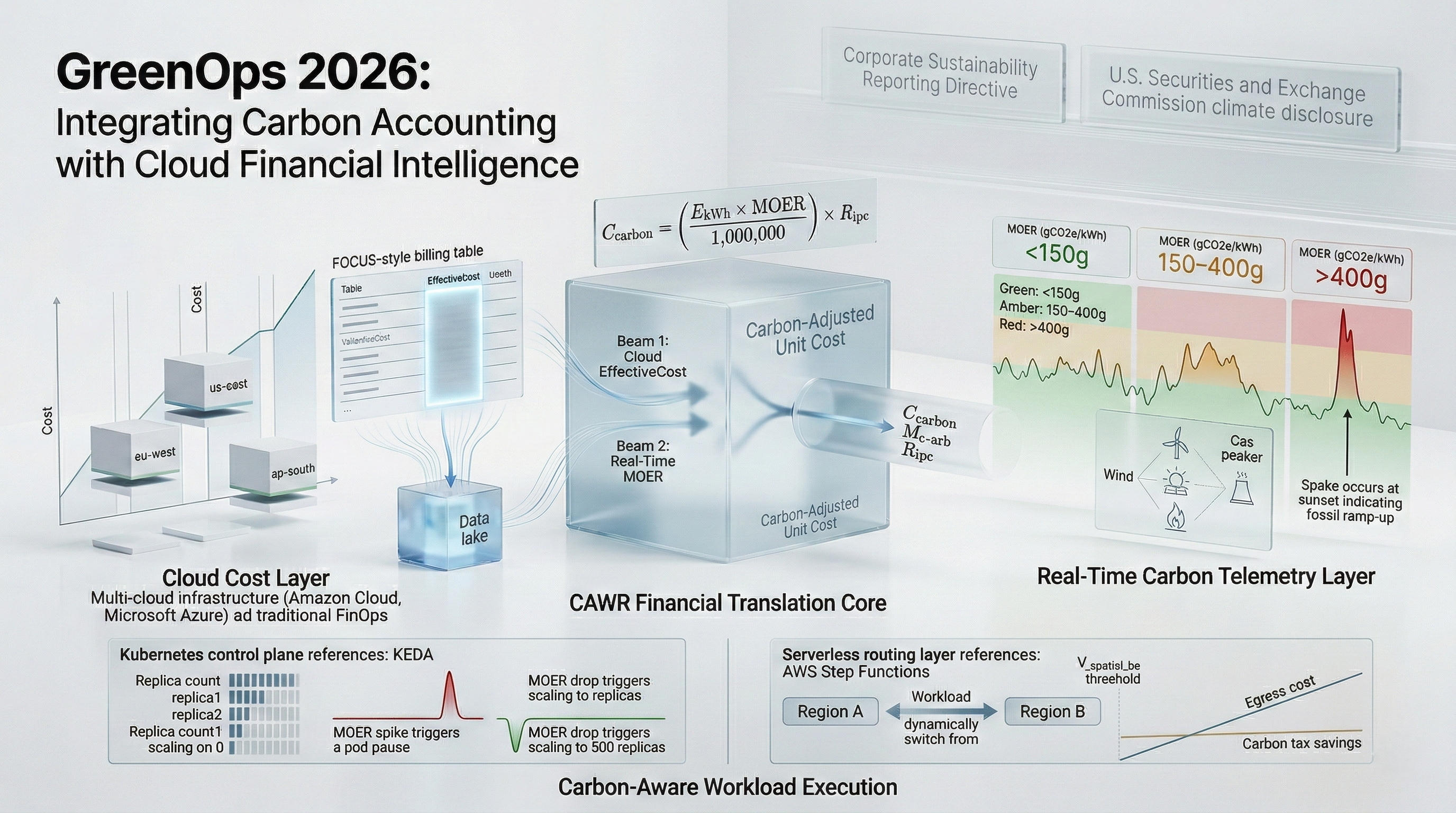
This playbook establishes the blueprint for transitioning from passive carbon reporting to autonomous, carbon-aware infrastructure execution. Enterprises must adopt the concept of the Internal Price of Carbon (IPC)—a hard, financial tax applied dynamically to engineering budgets based on the carbon intensity of their chosen compute regions. By integrating real-time grid telemetry (via APIs like WattTime or ElectricityMaps) into Kubernetes schedulers, infrastructure architects can execute temporal and spatial workload shifting. Massive, latency-tolerant AI training runs must be programmatically paused when the local power grid switches to coal-fired peaker plants, and automatically resumed when renewable wind generation spikes.
This level of operational maturity requires rigorous mathematical governance. The enterprise must calculate the exact break-even point where the cost of network egress to move a workload to a "greener" cloud region exceeds the financial penalty of the carbon tax. By weaponizing GreenOps through the Carbon-Adjusted Workload Routing (CAWR) Framework, FinOps leaders can simultaneously slash regulatory tax exposure, achieve aggressive ESG mandates, and enforce algorithmic discipline across the entire multi-cloud ecosystem.
2. Market Gap & Search Intent Failure Analysis
Enterprise research surrounding "Cloud GreenOps strategy" is overwhelmingly dominated by superficial ESG consultant narratives. Search results yield advice such as "select regions with high renewable energy matching" or "right-size instances to save power." This guidance is mathematically bankrupt because it ignores the actual physics and financial mechanics of global energy grids.
The market gap lies in the failure to model the Marginal Operating Emissions Rate (MOER) versus the average emissions rate. Analysts advise moving workloads to regions claiming "100% renewable energy." However, in 2026, those claims are often based on annualized Power Purchase Agreements (PPAs), not real-time physics. If an enterprise spins up a massive 1,000-GPU training cluster at 8:00 PM in a "renewable" region when solar generation drops, the local utility must spin up a natural gas peaker plant specifically to handle that marginal load. The enterprise is directly responsible for a massive carbon spike, which CSRD auditors will detect and tax. This playbook eliminates this blind spot by providing the exact mathematical models required to calculate true carbon liability based on real-time grid intensity, shifting GreenOps from a marketing exercise to a quantifiable arbitrage strategy.
3. Core Strategic Framework
The enterprise must implement the Carbon-Adjusted Workload Routing (CAWR) Framework. This framework treats carbon emissions as a highly volatile pricing vector, establishing automated mechanisms to route workloads based on the combined optimization of cloud compute rates and the Internal Price of Carbon (IPC).
Implementation Protocol:
FOCUS Data Pipeline Enrichment: Instrument the dbt transformations within the FinOps data lake to multiply the hyperscaler's estimated kWh consumption per resource by the real-time grid intensity API data, generating a
Carbon_CO2e_Gramscolumn alongsideEffectiveCost.Establish the IPC ($R_{ipc}$): The CFO sets a mandatory Internal Price of Carbon (e.g., $100 per Metric Ton). This is hard-billed to engineering unit budgets.
Temporal Shifting Profiling: Identify non-time-sensitive workloads (e.g., CI/CD batch testing, BI data pipeline rendering, AI model checkpoint generation) and tag them with
Carbon-SLA: Flexible.Execution Decision Matrix:
If Grid MOER $> 400\text{g CO2e/kWh}$ AND Workload is
Flexible, KEDA automatically scales the pod count to zero until the MOER drops below the target threshold.If $C_{carbon\_liability} > (M_{compute\_savings} - P_{egress})$, block spatial migration. The cost to move the data destroys the carbon tax savings.
If Workload is
Tier-0(Real-time serving), ignore carbon intensity and route strictly based on latency and spot compute pricing.
4. Financial Modeling Layer (MANDATORY)
To enforce GreenOps, the enterprise must utilize strict financial mathematics to quantify the invisible cost of carbon.
Core Equations
1. Cost of Carbon Liability ($C_{carbon}$):
Calculates the exact financial penalty imposed on a workload based on its real-time energy consumption and the corporate/regulatory carbon tax rate.
$$C_{carbon} = \left( \frac{E_{kWh} \times MOER_{g/kWh}}{1,000,000} \right) \times R_{ipc}$$
Where:
$E_{kWh}$ = Total energy consumed by the workload (Compute + Storage + Networking).
$MOER_{g/kWh}$ = Marginal Operating Emissions Rate from real-time grid telemetry.
$R_{ipc}$ = Internal Price of Carbon or regulatory tax rate per Metric Ton (MT).
2. Carbon-Adjusted Arbitrage Margin ($M_{c-arb}$):
Determines the true profitability of moving a workload to a different cloud region, explicitly factoring in the carbon penalty differential alongside compute and egress costs.
$$M_{c-arb} = (P_{compute\_origin} + C_{carbon\_origin}) - (P_{compute\_target} + C_{carbon\_target} + P_{egress\_penalty})$$
Where:
$P_{compute}$ = Hourly compute cost in respective regions.
$P_{egress\_penalty}$ = Data transfer out cost to move the workload state.
3. The Green Premium Threshold ($T_{green}$):
Calculates the maximum acceptable compute premium an enterprise should pay to utilize a greener cloud region before it becomes financially destructive.
$$T_{green} = \frac{(MOER_{origin} - MOER_{target})}{1,000,000} \times E_{kWh} \times R_{ipc}$$
A) Sensitivity Analysis Table
This table models the financial impact on EBITDA of running a 1,000-node continuous AI inference cluster over a year, mapping the Grid Carbon Intensity against the escalting Internal Price of Carbon ($R_{ipc}$).
Variable (Grid MOER) | Low Tax ($40/MT) | CSRD Base ($90/MT) | Aggressive ESG ($150/MT) | Strategic Action |
Wind/Hydro (50g/kWh) | -$12,000 Penalty | -$27,000 Penalty | -$45,000 Penalty | Maintain placement |
Mixed Grid (350g/kWh) | -$84,000 Penalty | -$189,000 Penalty | -$315,000 Penalty | Optimize Karpenter bin-packing |
Coal/Gas Peaker (750g/kWh) | -$180,000 Penalty | -$405,000 Penalty | -$675,000 Penalty | Mandatory automated evacuation |
Decision Threshold: If the $R_{ipc}$ is set to CSRD compliance levels ($90/MT), running continuous workloads in regions like ap-southeast-1 or eu-central-1 (during low wind) imposes a six-figure tax liability. Automated spatial shifting is mathematically required.
B) Break-Even Formula
The Spatial Carbon Break-Even Volume ($V_{spatial\_be}$) calculates the exact amount of data a workload can egress to a greener region before the network costs obliterate the carbon tax savings.
$$V_{spatial\_be} = \frac{T_{hrs\_run} \times E_{kWh/hr} \times \left( \frac{MOER_{origin} - MOER_{target}}{1,000,000} \right) \times R_{ipc}}{Rate_{egress\_per\_GB}}$$
Numerical Example: A 100-hour job uses 500 kWh/hr. Origin MOER is 600g. Target MOER is 100g. The carbon saved is 25 MT. At $100/MT, you save $2,500 in carbon tax. If egress costs $0.08/GB, your Break-Even Volume is 31,250 GB (31.25 TB). If the job requires moving 40 TB, the migration destroys your EBITDA. Do not move it.
C) Probability-Weighted Risk Table
Quantifying the financial exposure of ignoring advanced GreenOps architecture.
Scenario | Probability | Financial Impact | Weighted Exposure |
CSRD Audit Failure (Fines & Rework) | 25.0% | $450,000 (Consulting/Penalties) | $112,500 per year |
False Greenwashing Accusation (PR Hit) | 10.0% | $2,000,000 (Brand/Stock impact) | $200,000 per event |
Data Gravity Trap (Egressing for Green) | 40.0% | $35,000 (Network bill shock) | $14,000 per month |
Premature Spot Termination (Due to KEDA) | 15.0% | $8,000 (Lost compute cycles) | $1,200 per event |
D) Cost-per-Unit Model
The central metric is the Cost Per Metric Ton of CO2e Avoided ($CPMA$):
$$CPMA = \frac{C_{greenops\_tooling} + (P_{compute\_target\_premium} \times T_{hrs})}{Total\_MT\_CO2e\_Avoided}$$
Threshold: If $CPMA$ exceeds the corporate $R_{ipc}$ (e.g., spending $120 to avoid a ton of carbon when the tax is $90), the GreenOps automation is financially destructive. FinOps must immediately disable the CAWR spatial routing and default to pure financial arbitrage.
5. Operational Architecture Integration
KEDA Carbon-Aware Autoscaling (Kubernetes):
The execution of the CAWR framework relies on Kubernetes Event-driven Autoscaling (KEDA) integrated with real-time grid APIs. Traditional autoscaling triggers on CPU or Queue length. Carbon-aware architecture introduces a CarbonIntensity scaler. For a large Kafka stream processing batch job, KEDA queries the WattTime API. If the marginal emissions rate in us-east-1 spikes above the acceptable threshold because solar generation drops at sunset, KEDA gracefully scales the consumer deployment down to 0 replicas, effectively pausing the work. When the API signals that grid intensity has dropped (e.g., nuclear base load kicks in at 2:00 AM), KEDA scales the deployment back to 500 replicas, processing the backlog utilizing physically clean energy without human intervention.
Data Lakehouse Carbon Enrichment (Snowflake/FOCUS):
Hyperscaler CURs do not natively include real-time CO2e data at the resource level. The FinOps data architecture must construct a dedicated dbt pipeline. This pipeline ingests the normalized FOCUS 1.2 billing data, extracts the instance type and region, estimates the underlying server power draw (using models from the Cloud Carbon Footprint OSS project), and multiplies it by the historical MOER for that exact hour. This synthesized table allows the CFO to generate a daily dashboard showing Carbon-Adjusted EBITDA down to the specific engineering namespace.
Serverless Carbon Execution (AWS Step Functions / Lambda):
For event-driven architectures, spatial shifting is executed via serverless routing. When an asynchronous S3 object trigger initiates an AI inference job, an AWS Step Function acts as the orchestrator. The first state queries the grid intensity of us-west-2 (Oregon - Hydro) versus us-east-2 (Ohio - Mixed). If Oregon has a lower $M_{c-arb}$ profile, the Step Function dynamically routes the S3 object URL to a Lambda function deployed in us-west-2. Because serverless compute requires zero node provisioning time, the workload surfs the global grid for the absolute lowest carbon/cost intersection in milliseconds.
6. Failure Scenarios
Scenario 1: The Egress Carbon Trap
Breakdown: An automated GreenOps script detects that the
eu-north-1(Stockholm) region is running on 100% wind power, whileeu-central-1(Frankfurt) is burning coal. The script violently re-routes a massive distributed database cluster to Stockholm.Financial Exposure: The script failed to calculate $V_{spatial\_be}$. The act of replicating 100 TB of data across the inter-region backbone generates a $20,000 network bill. Furthermore, the networking equipment transferring that data consumes electricity, generating more carbon emissions than the compute arbitrage saved.
Governance Prevention Layer: Egress-Locked Routing. The CAWR decision matrix must integrate with the infrastructure state file. Any automated spatial shifting must be strictly locked to stateless workloads (e.g., web frontends, ephemeral AI inference). Stateful workloads containing $> 5\text{GB}$ of persistent volume are cryptographically banned from spatial carbon shifting.
Scenario 2: Spot Preemption Cascade
Breakdown: To optimize both cost and carbon, an AI training workload is configured to only run on Spot instances when the grid MOER is below 200g/kWh. A heatwave strikes the region; air conditioning spikes demand, and grid intensity surges. The KEDA carbon scaler aggressively terminates the pods. The checkpointing architecture was misconfigured, losing 12 hours of training progress.
Financial Exposure: $15,000 in wasted GPU compute that produced zero mathematical output, destroying the project's Effective Token Yield (ETY).
Governance Prevention Layer: Temporal Backoff and Fault Tolerance Verification. Carbon-aware scaling must never supersede fault tolerance. KEDA scaling policies must be tied to a Prometheus metric verifying that a successful model checkpoint has been committed to S3 within the last 5 minutes before allowing a carbon-driven pod termination.
Scenario 3: Phantom Location-Based Reporting
Breakdown: To pass a CSRD audit, the enterprise relies exclusively on the cloud provider's default carbon dashboard, which utilizes location-based annual averages. The auditor demands hour-by-hour marginal emissions data to prove that the company’s AI training runs are not triggering fossil-fuel peaker plants. The enterprise cannot produce the data.
Financial Exposure: $100,000+ in regulatory fines, forced restatement of ESG reports, and exclusion from ESG-indexed mutual funds, impacting corporate valuation.
Governance Prevention Layer: Mandatory Market-Based / Marginal Telemetry. FinOps must mandate the abandonment of location-based average reporting. All carbon calculations must mathematically bind the specific hour of compute consumption to the specific hour of grid telemetry via the enriched FOCUS data lake.
7. Board-Level Translation Layer
EBITDA Delta Modeling: By internalizing the $R_{ipc}$ and deploying CAWR, the enterprise avoids massive future carbon tax payouts. If a company consumes 100,000 MWh annually, optimizing workload timing to reduce marginal emissions by just 20% eliminates $2M in regulatory carbon taxation (assuming a $100/MT IPC), directly defending EBITDA from non-operational regulatory drag.
Gross Margin Defense: As SaaS customers face their own Scope 3 emissions reporting, they will demand low-carbon vendors. A SaaS platform that can cryptographically prove its features operate on low-MOER compute will possess a massive competitive advantage, enabling premium pricing tiers ("Zero-Carbon AI Inference") that expand gross margins.
Capital Allocation Signal: Institutional investors heavily utilize ESG indices. Failing to implement programmatic carbon accounting signals severe operational immaturity to the board and limits access to capital. Treating carbon as a quantifiable FinOps metric unlocks access to green bonds and favorable financing rates.
Risk-Adjusted ROI Formula:
$$ROI_{greenops} = \frac{\text{Carbon Taxes Avoided} + \text{Cloud Compute Savings}}{\text{API Telemetry Costs} + C_{engineering\_integration}}$$
8. Data Visualization Suggestions
Diagram showing the Kubernetes control plane querying WattTime APIs, dynamically scaling deployment replicas based on the fluctuating grid carbon intensity line.
A heat map where the X-axis is "Cloud Region" and the Y-axis is "Time of Day." Squares are colored green (Execute Workload) or red (Pause Workload) based on the combined score of Spot Pricing + Real-Time MOER.
A dual-axis chart showing the cost of network egress rising linearly as data volume increases, intersecting with the flat line of carbon tax savings, visually representing the $V_{spatial\_be}$ threshold.
A time-series line chart comparing a flat, misleading "Average Emissions" line against a highly volatile "Marginal Emissions" line, proving the necessity of temporal workload shifting.
A data architecture diagram showing standard billing exports flowing into dbt, merging with a real-time ESG telemetry database, and outputting a mathematically rigid "Carbon-Adjusted Unit Cost" to the FinOps dashboard.
9. Why Analyst-Style Summaries Fail at Financial Precision
When sustainability analysts declare that "Enterprises should migrate their cloud workloads to regions powered by 100% renewable energy to achieve net-zero," they are demonstrating a dangerous misunderstanding of cloud architecture and grid physics.
This narrative fails because it ignores Data Gravity and the physics of the Marginal Operating Emissions Rate. An analyst summary cannot calculate the $V_{spatial\_be}$. If an Enterprise Architect follows this narrative advice and mandates the migration of a 5 PB data warehouse from Ohio to Sweden solely for "green energy," they will trigger millions of dollars in network egress fees and destroy application latency, creating an extinction-level financial event for the IT budget.
Equation-backed modeling, utilizing the CAWR framework, completely replaces performative ESG strategies with strict operational arbitrage. By calculating the exact Carbon-Adjusted Arbitrage Margin ($M_{c-arb}$), FinOps leaders explicitly bound the cost of sustainability. You do not save the planet by bankrupting the engineering department; you reduce carbon by mathematically weaponizing Kubernetes to execute workloads precisely when and where the physics of the grid make it financially optimal to do so.
10. Strategic Conclusion
GreenOps in 2026 is no longer a peripheral ESG initiative; it is a core pillar of the FinOps discipline. The weaponization of carbon reporting mandates by regulatory bodies across the EU and US has transformed greenhouse gas emissions into a hard financial liability. Treating carbon as an afterthought to be summarized in an annual PDF report guarantees catastrophic regulatory fines and severe EBITDA compression.
To survive and out-compete in this landscape, enterprises must internalize the cost of carbon. By establishing a rigid Internal Price of Carbon (IPC), FinOps leaders translate an abstract environmental concept into a concrete unit cost that engineering teams understand and optimize against. This requires profound architectural shifts. The hyperscaler-provided dashboards are insufficient; enterprises must build enriched FOCUS data pipelines that merge real-time grid marginal emissions with hourly compute billing.
The ultimate objective is autonomous execution. Through the Carbon-Adjusted Workload Routing (CAWR) Framework, enterprises can leverage KEDA and serverless architectures to mathematically surf the global energy grid. By temporally pausing massive AI workloads during fossil-fuel spikes and seamlessly shifting stateless compute to regions flush with excess wind or solar, organizations dramatically slash their carbon tax liabilities. However, this must always be governed by strict network egress mathematics. GreenOps must be executed not with ideological fervor, but with algorithmic, equation-backed precision.
11. Implementation Readiness Checklist
Define the IPC ($R_{ipc}$): Collaborate directly with the CFO to establish a mandatory Internal Price of Carbon (e.g., $90/MT) to use as the mathematical baseline for all CAWR routing decisions.
Integrate Grid Telemetry APIs: Procure and integrate real-time API access (WattTime, ElectricityMaps) to stream Marginal Operating Emissions Rates (MOER) directly into the FinOps data lakehouse.
Enrich the FOCUS Data Pipeline: Write dbt models that multiply cloud resource power draw estimates by real-time MOER to append a quantified
Carbon_Tax_Liabilitycolumn to daily billing reports.Identify Flexible Workloads: Audit the enterprise application portfolio to isolate massive, latency-tolerant batch jobs (e.g., AI training, data rendering) that are candidates for temporal shifting.
Deploy KEDA Carbon Scalers: Install Kubernetes Event-driven Autoscaling in non-production clusters and configure the carbon-intensity triggers to test automated workload pausing.
Calculate Spatial Break-Evens: Pre-calculate the $V_{spatial\_be}$ limits for your top 10 most expensive applications to strictly mathematically block any "green migration" that causes egress bankruptcy.
Sunset Location-Based Reporting: Discontinue the use of annual, average-based hyperscaler carbon dashboards for internal decision-making, shifting entirely to real-time marginal emissions modeling.
Automate Carbon Chargebacks: Update the internal IT chargeback reports to explicitly line-item the IPC carbon tax against individual engineering team budgets, forcing behavioral optimization.
Implement Spot/Carbon Synergy: Configure Karpenter to prioritize Spot instances in regions specifically when grid MOER is low, combining maximum financial discount with minimum carbon liability.
Execute Fault-Tolerance Drills: Force-test the temporal shifting architecture by artificially simulating a carbon spike during peak load, verifying that the system cleanly checkpoints data before terminating compute nodes.
Stop guessing where your Kubernetes budget is going. Schedule a demo here to explore Kubernetes cost monitoring with Cloud Atler.