
1. Executive Synthesis
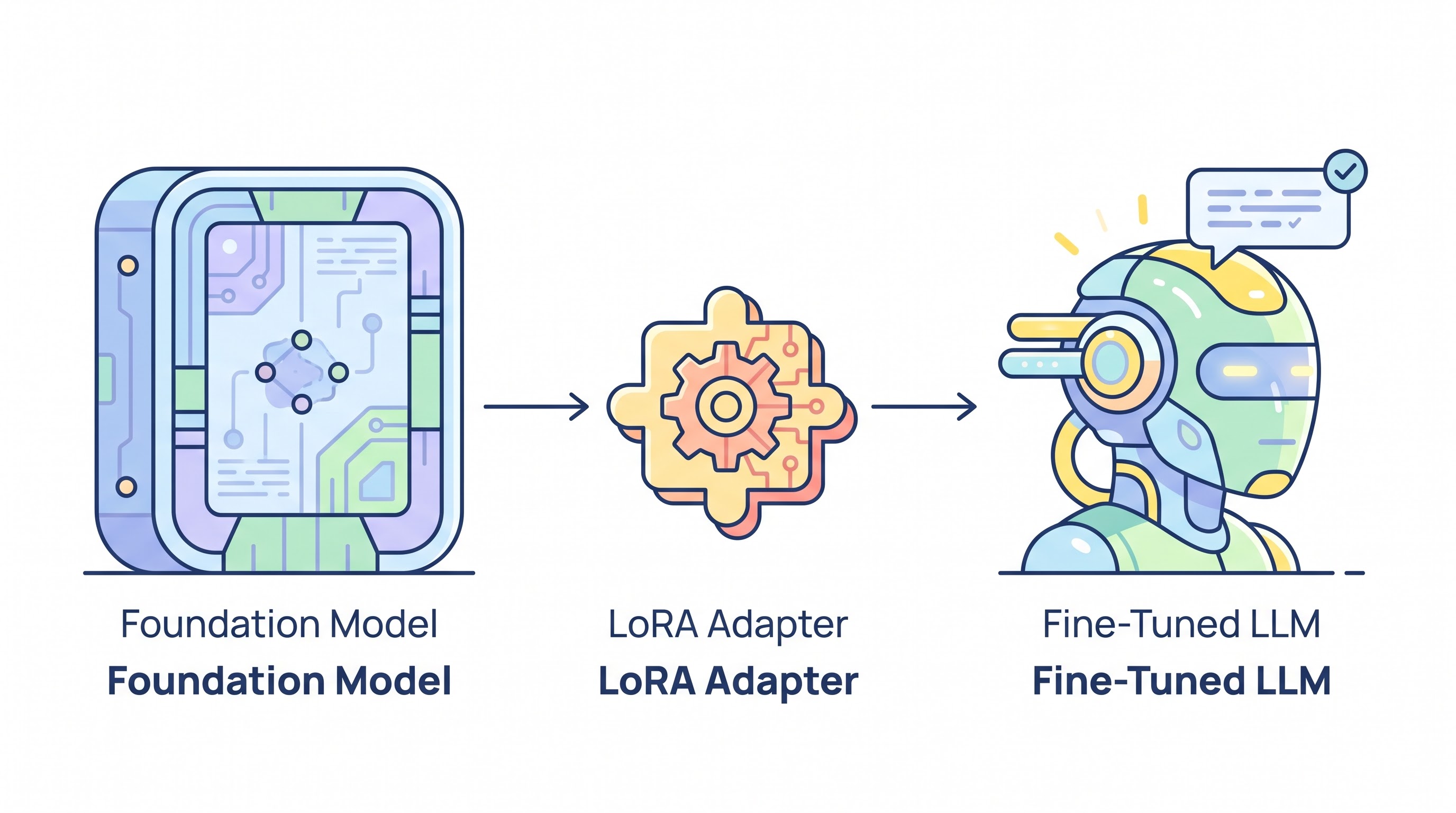
In the early stages of generative AI adoption, enterprises faced a binary choice for domain-specific intelligence: utilize Retrieval-Augmented Generation (RAG) to inject context into off-the-shelf models, or spend millions of dollars in compute CapEx to fully pre-train or continuously train a custom foundational model. By 2026, Parameter-Efficient Fine-Tuning (PEFT)—specifically Low-Rank Adaptation (LoRA) and Quantized LoRA (QLoRA)—has completely upended this paradigm. LoRA allows enterprises to fine-tune massive open-weights models (like Llama 3 70B or Mixtral) on domain-specific data by freezing the original weights and updating only a tiny, localized matrix of parameters.
This breakthrough collapsed the CapEx of fine-tuning an LLM from millions of dollars down to mere hundreds of dollars, executable on a single cloud GPU in a few hours. Consequently, enterprise engineering teams have abandoned restraint, initiating a "Fine-Tuning Sprawl." Business units are generating hundreds of unique, hyper-specialized LoRA adapters for every distinct task: one adapter for summarizing legal contracts, another for generating Python code, and a third for drafting customer support emails.
While the training cost of LoRA is negligible, this sprawl introduces a catastrophic hidden FinOps liability in Inference Serving (OpEx). When an enterprise attempts to host 50 different LoRA adapters in production, traditional infrastructure demands deploying 50 distinct GPU endpoints. Even if each adapter is only queried a few times an hour, the enterprise is forced to pay for 50 idle GPUs (e.g., AWS g5.12xlarge), generating millions of dollars in wasted, continuous infrastructure spend.
To survive the financial weight of custom AI, enterprises must deploy the Parameter-Efficient Serving Arbitrage (PESA) Framework. This playbook establishes the architectural requirement for Dynamic Multi-LoRA Serving utilizing engines like vLLM or LoRAX. The PESA framework mathematically dictates how to multiplex dozens of distinct fine-tuned adapters onto a single, heavily utilized GPU cluster. It provides the strict VRAM (Video RAM) calculations required to govern adapter swapping latency and batching efficiency, ensuring that the enterprise can maintain thousands of hyper-specialized AI models while defending its gross margins through ruthless compute consolidation.
2. Market Gap & Search Intent Failure Analysis
Enterprise research regarding "LLM Fine-Tuning Costs" focuses almost entirely on the Training phase. Search results yield calculators demonstrating how cheap it is to run QLoRA on a single NVIDIA A100 for 12 hours. The marketing narrative claims, "Fine-tune your own 70B model for under $50!"
The market gap is the catastrophic omission of the Inference Lifecycle Burden. Analysts fail to warn CTOs that while training the custom model costs $50, hosting that model in highly available, low-latency production costs $6,000 per month per endpoint. If a company generates 20 custom models based on generic advice, they unknowingly commit to $1.4M in annual OpEx. Standard playbooks do not provide the dynamic routing equations required to load and unload lightweight LoRA weights dynamically into a base model's VRAM during runtime. This playbook eliminates this massive blind spot, shifting the FinOps focus from the trivial training CapEx to the continuous, margin-destroying inference OpEx.
3. Core Strategic Framework
The enterprise must implement the Parameter-Efficient Serving Arbitrage (PESA) Framework. This framework treats GPU VRAM as highly constrained, expensive real estate, strictly governing how many custom models can be served concurrently without destroying unit economics.
Implementation Protocol:
Adapter Profiling: Measure the exact VRAM footprint (in Megabytes) of the trained LoRA adapter weights, typically governed by the chosen Rank (
$r$) and Alpha ($\alpha$) hyper-parameters.Deploy Multi-LoRA Serving Infrastructure: Abandon traditional, single-model deployment pipelines (e.g., standard SageMaker endpoints). Deploy advanced inference engines (like vLLM with LoRA support or LoRAX) on Kubernetes clusters backed by Spot GPUs.
Execute Dynamic Routing: Load the massive, frozen foundational base model (e.g., Llama 3 8B) into GPU VRAM once. Store the 50 distinct LoRA adapters in cheap S3 object storage. When an API request arrives, dynamically pull the specific 100MB LoRA adapter into VRAM, execute the inference against the base model, and evict the adapter if inactive.
Execution Decision Matrix:
If requested LoRA adapter requires
$> 500\text{ms}$to load from CPU RAM to GPU VRAM and violates the latency SLA, force the adapter to remain "pinned" in VRAM and charge the holding cost to the specific business unit's P&L.If a specific fine-tuned model receives
$< 100$invocations per day, it is mathematically blocked from having dedicated GPU capacity. It MUST be routed through the dynamic Multi-LoRA multiplexer.If the continuous inference cost (
$CPFTI$) of the fine-tuned model exceeds the cost of achieving the same result via prompt engineering on a frontier API (GPT-4), sunset the custom model and revert to API usage.
4. Financial Modeling Layer (MANDATORY)
To prevent fine-tuning sprawl from bankrupting the AI budget, FinOps teams must model the exact VRAM mathematics and inference costs.
Core Equations
1. LoRA VRAM Footprint Penalty ($RAM_{lora}$):
Calculates the exact GPU memory (in Bytes) required to hold a specific custom adapter in active memory, based on its rank and the number of layers targeted in the base model.
$$RAM_{lora} = \sum_{l=1}^{layers} \left( 2 \times r \times (d_{in} + d_{out}) \right) \times B_{bytes\_per\_param}$$Where:
$r$= The rank of the LoRA matrices (typically 8, 16, or 64).$d_{in}$/$d_{out}$= The input/output dimensions of the targeted attention matrices.$B_{bytes\_per\_param}$= Bytes per parameter (e.g., 2 bytes for FP16/BF16).
2. Multi-LoRA Consolidation Yield ($Y_{multi\_lora}$):
Determines the financial savings generated by serving multiple fine-tuned models from a single GPU cluster versus dedicating separate endpoints to each model.
$$Y_{multi\_lora} = \left( N_{distinct\_models} \times P_{dedicated\_gpu\_endpoint\_monthly} \right) - \left( C_{shared\_gpu\_cluster} + (V_{adapter\_swaps} \times P_{latency\_penalty}) \right)$$Where:
$N_{distinct\_models}$= Total number of unique LoRA fine-tunes deployed.$V_{adapter\_swaps}$= Frequency of hot-swapping adapters in and out of active VRAM.$P_{latency\_penalty}$= The quantified business cost of adding 100-300ms of latency during an adapter swap.
3. Fine-Tuning Break-Even Threshold ($FT_{be}$):
Calculates the minimum daily inference volume required for a custom, self-hosted fine-tuned model to become financially cheaper than using a generic, highly-prompted premium API model (like Claude 3.5 Sonnet).
$$FT_{be} = \frac{C_{gpu\_hosting\_monthly} + CapEx_{training}}{30 \times \left( (T_{prompt} + T_{completion}) \times P_{premium\_api\_token\_rate} \right)}$$A) Sensitivity Analysis Table
This table models the Monthly Infrastructure Cost of serving 20 distinct custom models in production, comparing deployment architectures based on continuous GPU utilization.
Serving Architecture | Compute Footprint Required | Monthly Infrastructure Cost | FinOps Recommendation |
Dedicated Endpoints (Legacy) | 20 isolated A10G GPUs | $18,000 / month | Financially Catastrophic Sprawl |
Multi-LoRA (Low Traffic) | 1 shared A10G GPU | $900 / month | Optimal for highly diverse, intermittent tasks |
Multi-LoRA (High Traffic) | 4 shared A10G GPUs (Scale-out) | $3,600 / month | Maximum Margin Defense (80% Savings) |
Decision Threshold: Dedicating a 24/7 cloud GPU endpoint to a single fine-tuned model that executes sporadically is an absolute failure of FinOps governance. By utilizing Multi-LoRA serving frameworks (like LoRAX), the enterprise consolidates 20 endpoints down to a single $900/month GPU, securing an immediate 95% reduction in TCO.
B) Break-Even Formula
The Adapter Swap Latency Limit ($L_{swap\_max}$) defines the maximum allowable time required to inject a custom adapter into the base model's active VRAM before the application SLA is violated, forcing the enterprise to pay for a dedicated, pinned GPU endpoint.
$$L_{swap\_max} = SLA_{total\_response\_time} - \left( T_{network\_transit} + (T_{tokens\_out} \times T_{time\_per\_token\_generation}) \right)$$Numerical Example: An AI autocompletion SaaS has a strict SLA of 1,000ms. Network transit takes 100ms. Generating 20 tokens at 25ms/token takes 500ms. The total unavoidable latency is 600ms. $L_{swap\_max} = 1000\text{ms} - 600\text{ms} = 400\text{ms}$. If downloading the 200MB LoRA weights from S3 and injecting them into the GPU VRAM takes 600ms, the SLA fails. The enterprise is mathematically forced to cache the adapter in active VRAM or pay for a dedicated endpoint.
C) Probability-Weighted Risk Table
Quantifying the operational risks of fine-tuned model deployment.
Scenario | Probability | Financial Impact | Weighted Exposure |
VRAM OOM Crash (Too many adapters pinned) | 25.0% / mo | $12,000 (Downtime/Lost Revenue) | $3,000 per month |
Catastrophic Forgetting (Bad training data) | 40.0% / proj | $5,000 (Wasted CapEx & GPU time) | $2,000 per project |
Continuous Adapter Swapping (PCIe bottleneck) | 15.0% / mo | $3,500 (SLA degradation/Churn) | $525 per month |
Unmonitored Endpoint Sprawl (Zombie APIs) | 70.0% / yr | $35,000 (Wasted idle GPU hours) | $24,500 per year |
D) Cost-per-Unit Model
The central metric for Fine-Tuned AI Operations is the Cost Per Fine-Tuned Inference ($CPFTI$):
$$CPFTI = \frac{Total\_GPU\_Inference\_OpEx_{monthly} + (CapEx_{training\_gpu} / 12)}{Total\_Successful\_Inferences_{monthly}}$$Threshold: If the $CPFTI$ of a custom model exceeds the cost of executing a highly engineered prompt against OpenAI's API, the custom model is structurally inefficient. The FinOps team must mandate either higher batching consolidation or sunset the model.
5. Operational Architecture Integration
Dynamic Multi-LoRA Multiplexing (vLLM / LoRAX):
To execute the PESA framework, the architecture must transition from static to dynamic model serving. The enterprise provisions a shared Kubernetes cluster running vLLM or Hugging Face LoRAX on heavily discounted Spot GPUs. The base model (e.g., Llama 3 8B, requiring ~16GB of VRAM in FP16) is loaded once. The remaining 8GB of VRAM on a 24GB GPU is designated as the "Adapter Cache." When user requests hit the API, the HTTP payload specifies which adapter is required (lora_id: "legal_contract_v2"). The inference engine dynamically pages the 100MB adapter weights from host CPU RAM into the GPU VRAM via the PCIe bus, executes the inference, and seamlessly pages in the next requested adapter. This enables a single GPU to serve 50 distinct product features concurrently, destroying the legacy "one endpoint per model" financial trap.
Continuous Batching with Heterogeneous Adapters:
Traditional inference engines cannot batch requests that require different model weights; they process them sequentially, destroying GPU utilization. Modern Multi-LoRA engines (like LoRAX) support heterogeneous continuous batching. Architecture must ensure that a request for the "Coding Agent" adapter and a request for the "Email Agent" adapter can be processed in the exact same forward pass through the base model, applying the specific LoRA weight deltas only at the targeted attention layers. This mathematically maximizes GPU SM (Streaming Multiprocessor) utilization and drastically lowers the $CPFTI$.
Automated LoRA Hyper-Parameter Governance (Rank & Alpha constraints):
Data scientists frequently tune LoRA with unnecessarily high Ranks ($r=64$ or $r=128$) believing it guarantees higher accuracy. However, per the $RAM_{lora}$ equation, doubling the Rank doubles the VRAM footprint. If adapters are too large, they cannot be dynamically swapped without causing PCIe bus bottlenecks and latency spikes, breaking the $L_{swap\_max}$ threshold. The FinOps CI/CD pipeline must enforce strict hyper-parameter governance: any LoRA training job requesting $r > 16$ must be explicitly mathematically justified by a $>5\%$ accuracy improvement on a test holdout set.
6. Failure Scenarios
Scenario 1: The "Endpoint per Developer" Sprawl
Breakdown: An enterprise allows its machine learning developers to deploy their fine-tuned experiments directly to AWS SageMaker Real-Time Endpoints. Developers create 30 custom LoRA models for various internal hacks and microservices. They leave the endpoints running 24/7 on ml.g5.2xlarge instances.
Financial Exposure: 30 endpoints ×
$900/month = $27,000 per month in continuous GPU burn for internal tools that are queried less than 10 times a day.Governance Prevention Layer: Mandatory Serverless/Multiplexed Routing. FinOps policies physically block IAM permissions for deploying dedicated GPU endpoints in non-production environments. All internal or experimental fine-tunes must be routed exclusively to a centralized, shared Multi-LoRA cluster, isolating the financial risk to a single, governed resource pool.
Scenario 2: The PCIe Bus Bottleneck (Adapter Thrashing)
Breakdown: The architecture team successfully deploys a Multi-LoRA engine on a single GPU. However, they allow the data science team to deploy 10 massive LoRA adapters (
$r=128$, heavily bloated). The API is hit simultaneously by 10 different users requesting the 10 different models. The engine attempts to hot-swap gigabytes of weights across the PCIe bus simultaneously.Financial Exposure: The PCIe bus saturates. Inference latency spikes from 200ms to 4,500ms. The application times out, the load balancer assumes the node is dead, and autoscaling spins up 5 more GPUs to handle the "traffic," triggering an unbudgeted scale-out event.
Governance Prevention Layer: VRAM Cache Limits and Request Queuing. The orchestration layer must mathematically track the active
$RAM_{lora}$resident in VRAM. The system must enforce request queuing: it physically prevents swapping in a new adapter until the current batch clears, intentionally introducing slight, controlled queue latency to prevent catastrophic PCIe saturation and uncontrolled Auto-Scaling.
Scenario 3: The "Full Fine-Tune" CapEx Disaster
Breakdown: Unaware of PEFT and LoRA capabilities, a business unit secures $150,000 in budget to "fine-tune" a custom Llama 70B model. They execute a full-parameter fine-tune, updating all 70 billion weights.
Financial Exposure: They burn the entire $150,000 CapEx on a multi-node A100 training cluster. The resulting model is a distinct 140GB file. It cannot be dynamically swapped or multiplexed. To serve it in production requires an isolated cluster of 4x A100 GPUs (to handle the VRAM requirements), locking the enterprise into $30,000/month in dedicated inference OpEx.
Governance Prevention Layer: Full-Parameter FinOps Ban. Any proposal to execute a full-parameter fine-tune on an LLM
$>7B$parameters is strictly banned by the FinOps Architecture board. Teams are mathematically required to utilize QLoRA (Quantized LoRA) to achieve$>95\%$of the accuracy for$<1\%$of the training and serving cost.
7. Board-Level Translation Layer
EBITDA Delta Modeling: Custom AI is critical for differentiation, but legacy deployment models (dedicated endpoints) turn AI into an EBITDA-destroying liability. By adopting the PESA Framework and multiplexing models, the FinOps team allows the enterprise to scale its AI product features infinitely (creating 1,000 distinct custom models) without scaling its infrastructure COGS. This severs the linear relationship between AI feature deployment and cloud spend, defending operational margins.
Gross Margin Defense: If a SaaS product relies on specific fine-tuned models for each individual enterprise tenant (e.g., training a unique LoRA adapter on "Customer A's" proprietary data), traditional hosting is financially impossible. Multi-LoRA serving enables true multi-tenant AI. A $900 GPU can serve 50 unique customer models dynamically, keeping the Cost Per Fine-Tuned Inference ($CPFTI$) fractions of a cent, fiercely defending the SaaS gross margin percentage.
Capital Allocation Signal: A rising
$CPFTI$metric indicates that the enterprise is building custom models that are not generating sufficient utilization. It signals to the board that capital must be redirected away from continuous fine-tuning operations and toward foundational prompt-engineering and RAG architectures, which carry lower fixed overhead.Risk-Adjusted ROI Formula:
$$ROI_{peft\_finops} = \frac{\text{Eliminated Dedicated GPU Endpoints} \times P_{monthly\_gpu}}{\text{Engineering CapEx to Implement LoRAX/vLLM}}$$
8. Data Visualization Suggestions
Multi-LoRA Consolidation Yield (
$Y_{multi\_lora}$) Bar Chart: A side-by-side comparison. Left bar (Red): "Dedicated Endpoints" showing $18k/month. Right bar (Green): "PESA Multiplexing" showing $900/month. The visual delta immediately proves the value of the architectural shift.VRAM Footprint Allocation Diagram: A stacked bar chart representing a single 24GB GPU. The bottom block is the Base Model (16GB). The top block (8GB) is broken into small, distinct slices representing multiple 100MB LoRA adapters actively loaded and hot-swapping in active memory.
Adapter Swap Latency Curve: A line chart mapping LoRA Rank (
$r$) on the X-axis against PCIe Transfer Latency (ms) on the Y-axis. The line curves upward, hitting a horizontal red threshold line ($L_{swap\_max}$), proving exactly why Rank hyper-parameters must be strictly governed.Fine-Tuning vs Premium API Break-Even Matrix: A scatter plot mapping Inference Volume against Total Cost. The steep line represents OpenAI API costs. The flatter line (starting higher due to training CapEx) represents the custom LoRA model. The intersection point dictates the financial pivot.
PCIe Bus Saturation Circuit Breaker: A flow diagram showing HTTP requests carrying different lora_id tags. A traffic controller assesses active VRAM, queues conflicting requests, and dynamically batches similar requests into the GPU to prevent thrashing.
9. Why Analyst-Style Summaries Fail at Financial Precision
When AI analysts state that "Parameter-Efficient Fine-Tuning (PEFT) has democratized AI by making it incredibly cheap for enterprises to train custom models," they are telling a dangerous half-truth that focuses exclusively on the CapEx of training.
This narrative fails because it completely ignores Day 2 Operations and the physics of continuous inference serving. An Enterprise Architect following this generic advice will cheer the $50 training bill, allow their developers to generate 100 custom models, and subsequently incinerate the corporate FinOps budget by deploying those 100 models to dedicated, isolated SageMaker endpoints at a cost of thousands of dollars a day. Analysts do not calculate the Multi-LoRA Consolidation Yield ($Y_{multi\_lora}$).
Equation-backed modeling using the Parameter-Efficient Serving Arbitrage (PESA) framework destroys this blind spot. By calculating the exact LoRA VRAM Footprint Penalty ($RAM_{lora}$) and enforcing dynamic hot-swapping, FinOps leaders prove that the true cost of custom AI is entirely dictated by how you manage GPU memory during active inference. You cannot manage enterprise AI by celebrating cheap training; you manage it by ruthlessly consolidating, multiplexing, and mathematically governing the active VRAM of your production serving clusters.
10. Strategic Conclusion
The advent of LoRA and QLoRA is arguably the most significant architectural breakthrough in applied AI, enabling enterprises to imbue open-source foundational models with hyper-specific, proprietary domain intelligence at near-zero training cost. However, this accessibility has created a massive, unmonitored vector for cloud waste: Fine-Tuning Sprawl.
To safely scale custom AI in 2026, infrastructure leadership must aggressively pivot their FinOps strategy from managing training costs to managing inference serving topologies. The mandate is absolute: the enterprise must deploy the Parameter-Efficient Serving Arbitrage (PESA) Framework. Dedicating an isolated, 24/7 cloud GPU endpoint to a single fine-tuned model is a mathematical failure that destroys product unit economics and SaaS gross margins.
Enterprises must implement dynamic Multi-LoRA serving frameworks. By loading a massive base model once, and dynamically paging lightweight custom adapters in and out of GPU VRAM via the PCIe bus, a single heavily discounted Spot GPU can serve the intelligence of 50 different distinct models. This requires strict CI/CD governance over hyper-parameters, enforcing low-rank matrices to prevent PCIe bottlenecking and SLA latency failures. By treating GPU VRAM as a highly constrained, multi-tenant marketplace, FinOps teams ensure that the enterprise can deploy unlimited specialized AI capabilities while maintaining absolute, unyielding control over operational infrastructure costs.
11. Implementation Readiness Checklist
Ban Full-Parameter Fine-Tuning: Establish strict IaC governance blocking the provisioning of multi-node training clusters for any LLM update that does not utilize PEFT/LoRA architectures without C-level sign-off.
Calculate the Baseline
$CPFTI$: Audit all currently deployed custom models. Calculate their true Cost Per Fine-Tuned Inference by dividing their dedicated GPU monthly cost by their actual invocation volume.Deploy Multi-LoRA Serving Engines: Transition away from static deployment platforms. Provision Kubernetes clusters running vLLM, Hugging Face TGI, or LoRAX optimized for continuous, heterogeneous batching.
Enforce LoRA Rank Limits (
$r \le 16$): Configure the ML training CI/CD pipeline to automatically reject any LoRA adapter build that exceeds Rank 16 unless explicitly mathematically justified by a massive recall requirement.Calculate the
$L_{swap\_max}$Threshold: Work with product managers to define the maximum allowable latency for AI features, providing the architecture team with the strict millisecond limit for dynamic adapter loading over the PCIe bus.Store Adapters in Object Storage: Decouple adapter weights from the container image. Store the 100MB LoRA weights in cheap S3/GCS buckets and pull them dynamically into the inference engine at runtime to ensure stateless node scaling.
Identify Zombie Endpoints: Scan AWS SageMaker or Azure ML for custom model endpoints that have received
$< 100$requests in the last 7 days. Immediately tear them down and migrate the weights to the multiplexed cluster.Automate Spot Instance Fallback: Configure the Multi-LoRA serving cluster to run exclusively on Spot GPUs (e.g., g5 or L4 instances). Because the nodes are stateless and pull adapters from S3, preemption carries zero data loss risk.
Execute the
$FT_{be}$Break-Even Math: Before approving a new fine-tuning project, force the engineering team to prove that the expected inference volume makes the custom model mathematically cheaper than simply prompt-engineering GPT-4 or Claude.Implement VRAM Over-Subscription Circuit Breakers: Configure the inference router to mathematically monitor the active
$RAM_{lora}$in the GPU. If memory exceeds 90%, physically queue incoming requests to prevent catastrophic Out-Of-Memory (OOM) node crashes.
Stop guessing where your Kubernetes budget is going. Schedule a demo here to explore Kubernetes cost monitoring with Cloud Atler.