
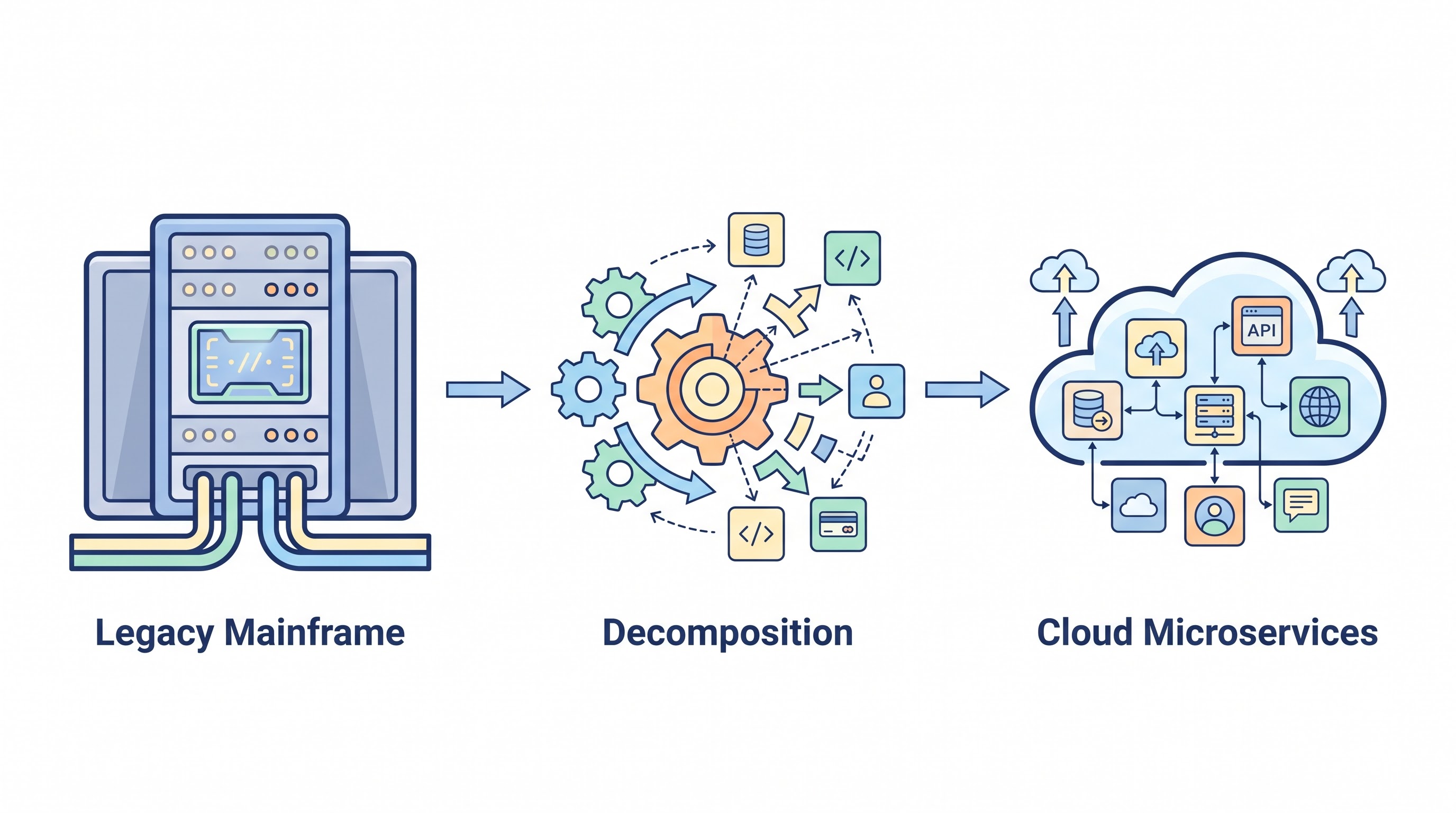
1. Executive Synthesis
In 2026, the final frontier of enterprise digital transformation is the decommissioning of the legacy mainframe. For decades, global financial institutions, insurance conglomerates, and logistics giants have relied on IBM Z-Series mainframes running COBOL/CICS to process massive, highly synchronous transactional workloads. The operational reliability of the mainframe is unmatched, but its financial trajectory is a slow-motion catastrophe. Escalating MIPS (Millions of Instructions Per Second) licensing costs, dwindling pools of aging COBOL talent, and the inability to natively integrate with agile AI/ML data pipelines have forced the C-suite to mandate Mainframe-to-Cloud migrations.
However, moving a core-banking ledger from an IBM z16 to an AWS Kubernetes cluster is not a standard IT project; it is the most financially perilous architectural maneuver an enterprise can execute. Hyperscaler migration calculators present a utopian ROI model, highlighting the cheap cost of cloud compute compared to IBM licensing. What these calculators deliberately obscure is the Dual-Run Burn Rate.
A mainframe migration cannot occur overnight. The enterprise must execute the Strangler Fig pattern—slowly decoupling microservices and routing traffic to the cloud while keeping the mainframe running as the absolute source of truth. This phase often lasts 3 to 5 years. During this window, the enterprise pays for the entirety of the on-premises mainframe (licenses, power, cooling, specialized staff) plus the rapidly escalating cost of the new cloud infrastructure, plus the massive network egress and Change Data Capture (CDC) compute required to keep the two disparate environments synchronized in real-time.
To survive this transition without bankrupting the IT operating budget, enterprises must deploy the Mainframe Extraction Arbitrage (MEA) Model. The MEA model treats mainframe modernization as a hostile financial extraction. It provides the strict mathematical thresholds required to govern the dual-run phase, dictates the precise routing of Read vs. Write queries to minimize MIPS consumption, and calculates the exact point where the Stranded Mainframe Penalty forces the absolute shutdown of the legacy iron. This playbook establishes the financial physics required to execute a mainframe extraction without triggering a catastrophic, multi-year OpEx hemorrhage.
2. Market Gap & Search Intent Failure Analysis
Enterprise research targeting "Mainframe to Cloud Migration Cost" is monopolized by systems integrators (SIs) and hyperscalers selling migration tools. Search intent yields high-level narratives about automated COBOL-to-Java refactoring engines and the agility of microservices.
The structural market gap is the total failure to quantify the Data Synchronization Tax and the Emulator Liability. Analysts advise enterprises to "lift and shift" mainframe workloads using x86 emulators (e.g., Micro Focus) as a quick first step. They completely ignore the FinOps reality that emulating a highly specialized mainframe instruction set on generalized cloud x86 CPUs requires massive, expensive compute clusters, frequently resulting in cloud bills that equal or exceed the original mainframe MIPS cost. Furthermore, standard playbooks ignore the financial physics of maintaining two-phase commit consistency between a DB2 mainframe database and an Aurora Postgres cloud database. This playbook fills that gap by mathematically modeling the dual-run phase and explicitly defining the financial penalties of emulation versus true microservice refactoring.
3. Core Strategic Framework
The enterprise must operationalize the Mainframe Extraction Arbitrage (MEA) Model. This framework establishes rigid financial and architectural timelines for the migration, ensuring that cloud spend does not scale until legacy MIPS consumption definitively drops.
Implementation Protocol:
MIPS Consumption Profiling: Audit the mainframe workload to identify exactly which transactions drive the peak MIPS usage (usually complex batch jobs and read-heavy reporting).
Execute the Offload Arbitrage (Read/Batch first): Deploy a Change Data Capture (CDC) pipeline to replicate the DB2 data to a cloud relational database. Reroute all read-heavy reporting queries and analytical batch jobs to the cloud. This instantly drops peak MIPS consumption, capturing immediate software licensing savings.
Deploy the Strangler Fig Router: Implement a highly intelligent API Gateway. As specific COBOL transactions are refactored into cloud-native microservices, the gateway routes specific request types to the cloud, allowing the mainframe to slowly wither.
Execution Decision Matrix:
If an automated COBOL-to-Java translation tool generates code that requires
$> 3x$the expected cloud compute to meet the legacy latency SLA, immediately halt the automated translation and mandate manual microservice refactoring.If the Dual-Run Burn Rate (
$R_{dual\_run}$) persists for$> 36\text{ months}$without a definitive mainframe shutdown date, the migration has failed. FinOps must force a freeze on new cloud development and execute a ruthless consolidation plan.If CDC synchronization lag exceeds
$500\text{ms}$and threatens transaction consistency, physically upgrade the private interconnect (e.g., Direct Connect) rather than attempting to solve the issue with expensive, complex cloud-side caching compute.
4. Financial Modeling Layer (MANDATORY)
Executing a mainframe extraction requires precise financial mathematics to prevent the dual-run phase from destroying corporate EBITDA.
Core Equations
1. The Dual-Run Burn Rate ($R_{dual\_run}$):
Calculates the exact monthly financial penalty incurred while operating both the legacy mainframe and the new cloud environment simultaneously during the migration window.
$$R_{dual\_run} = \left( C_{mainframe\_fixed\_opex} + C_{mips\_licensing} \right) + C_{cloud\_infrastructure} + C_{cdc\_sync\_compute} + C_{migration\_labor}$$Where:
$C_{mainframe\_fixed\_opex}$= The inflexible baseline costs of the mainframe (power, cooling, base hardware lease).$C_{mips\_licensing}$= The variable software licensing cost based on CPU consumption.$C_{cdc\_sync\_compute}$= The heavy compute and network cost of running Kafka/Qlik to replicate DB2 to Postgres in real-time.
2. Mainframe Extraction Arbitrage ($M_{extraction}$):
Determines the true, long-term financial yield of the migration, explicitly subtracting the accumulated dual-run penalty from the projected cloud savings.
$$M_{extraction} = \sum_{y=1}^{10} \left( C_{legacy\_annual} - C_{cloud\_annual} \right) - \sum_{m=1}^{months} \left( R_{dual\_run\_m} \right) - CapEx_{migration\_project}$$3. Stranded Mainframe Penalty ($P_{stranded\_mf}$):
Quantifies the financial waste when the enterprise successfully migrates 90% of the workloads to the cloud, but the remaining 10% prevents the physical decommissioning of the mainframe hardware.
$$P_{stranded\_mf} = C_{mainframe\_fixed\_opex} - \left( \frac{C_{mainframe\_fixed\_opex}}{10} \right)$$(If you run 10% of the workload, you still pay 100% of the fixed facility, cooling, and maintenance contract costs, rendering the remaining workloads extraordinarily expensive).
A) Sensitivity Analysis Table
This table models the 5-Year Net Cash Flow of a $20M/year Mainframe Migration project based on the duration of the Dual-Run transition phase.
Migration Timeline Strategy | 5-Year Cloud Savings | Accumulated Dual-Run Penalty | Net 5-Year Financial Impact | FinOps Conclusion |
Rapid Cutover (18 Months) | +$40,000,000 | -$15,000,000 | +$25,000,000 | Highly Accretive & Optimal |
Standard Phased (36 Months) | +$40,000,000 | -$30,000,000 | +$10,000,000 | Acceptable, requires strict governance |
Failed Strangler (60+ Months) | +$40,000,000 | -$55,000,000 | -$15,000,000 | Margin Destruction (The Dual-Run Trap) |
Decision Threshold: If the migration timeline extends beyond 36 months, the compounding cost of maintaining the legacy iron while paying hyperscaler invoices obliterates the business case. The CIO must set hard, mathematically binding decommissioning dates for the legacy hardware.
B) Break-Even Formula
The Microservice Translation Yield ($Y_{translation}$) calculates the maximum amount of cloud compute an enterprise can provision for a refactored microservice before it becomes more expensive than the legacy MIPS it replaced.
$$Y_{translation\_be} = \frac{MIPS_{offloaded} \times P_{mips\_rate\_monthly}}{N_{k8s\_pods} \times P_{pod\_compute\_monthly} + C_{managed\_database\_monthly}}$$Numerical Example: Moving the "Account Inquiry" batch job off the mainframe saves 100 MIPS per month. At $3,000 per MIPS, the enterprise saves $300,000/month in IBM licensing. The new Java microservice runs on EKS with an Aurora database. The break-even threshold for the cloud infrastructure is exactly $300,000. If poorly written Java code requires massive EC2 instances and unoptimized database reads costing $350,000/month to meet the SLA, the translation yields a negative ROI. The code must be mathematically constrained to fit within the offloaded MIPS budget.
C) Probability-Weighted Risk Table
Quantifying the operational and financial risks of legacy extraction.
Scenario | Probability | Financial Impact | Weighted Exposure |
CDC Synchronization Failure (Data divergence) | 18.0% / yr | $800,000 (Reconciliation labor) | $144,000 per year |
Stranded Mainframe (10% workload remains) | 60.0% / proj | $5,000,000 (Wasted fixed OpEx) | $3,000,000 per project |
Cloud Emulation CPU Bloat (Lift & Shift fail) | 40.0% / proj | $1,500,000 (Cloud compute overruns) | $600,000 per project |
COBOL SME Attrition (Knowledge loss) | 85.0% / 3-yr | $1,200,000 (Emergency SI rates) | $1,020,000 per cycle |
D) Cost-per-Unit Model
The central metric for Mainframe Modernization is the Cost Per Extracted Transaction ($CPET$):
$$CPET = \frac{Total\_Migration\_CapEx + R_{dual\_run\_accumulated}}{Total\_Transactions\_Successfully\_Routed\_to\_Cloud}$$Threshold: If $CPET$ exceeds the projected lifetime value of the transaction, the extraction strategy is flawed. FinOps must mandate a shift from expensive automated code-translation tools to deliberate, domain-driven microservice rewrites to ensure the resulting cloud architecture is highly efficient.
5. Operational Architecture Integration
The Change Data Capture (CDC) Synchronization Engine:
The fundamental architectural requirement for a phased mainframe migration is the CDC engine. The cloud and the mainframe must operate in perfect harmony during the multi-year dual-run phase. Architecture must deploy a robust replication tool (e.g., Qlik Replicate or IBM InfoSphere) reading the DB2 transaction logs on the mainframe. This data is streamed via a dedicated, high-bandwidth Direct Connect into a cloud-native event bus (e.g., Amazon MSK or Confluent Kafka), which applies the state changes to the cloud relational database (Aurora/Cloud SQL) in sub-second latency. This architecture decouples reads from writes, allowing the enterprise to instantly route massive, expensive read-only reporting workloads to the cloud, capturing immediate MIPS savings to fund the rest of the migration.
Strangler Fig API Routing Layer:
To execute the migration without a catastrophic "Big Bang" cutover, architecture must implement the Strangler Fig pattern. A highly resilient API Gateway is placed in front of all client applications. Initially, the Gateway routes 100% of traffic to the legacy mainframe APIs via z/OS Connect. As the engineering team successfully refactors the Payment_Processing COBOL module into a cloud-native Go/Java microservice, the API Gateway configuration is updated. It dynamically routes all /api/payments requests to the Kubernetes cluster, while continuing to route /api/accounts to the mainframe. This allows surgical, mathematically verifiable offloading of specific workloads.
Avoiding the x86 Emulator Trap:
Many hyperscalers offer "Mainframe Modernization" runtimes that essentially emulate a mainframe environment on cloud x86 servers. While this accelerates the migration timeline (avoiding the need to rewrite COBOL), it is a profound FinOps trap. Emulating specialized legacy instructions on generalized cloud CPUs is computationally devastating. A workload that ran efficiently on a mainframe will frequently require massive, highly expensive cloud instance families to achieve the same throughput. Architecture should strictly limit emulation to low-priority workloads with impending end-of-life dates, mandating true domain-driven microservice refactoring for core intellectual property to secure long-term cloud unit economics.
6. Failure Scenarios
Scenario 1: The Infinite Dual-Run Margin Crush
Breakdown: An enterprise successfully migrates 95% of its retail banking workloads to the cloud over 3 years. However, a single, highly complex COBOL batch job tied to an ancient regulatory requirement proves too difficult to refactor. The engineering team leaves it on the mainframe, intending to fix it "later."
Financial Exposure: The Stranded Mainframe Penalty (
$P_{stranded\_mf}$) triggers. The enterprise continues to pay the multi-million dollar annual facility, cooling, hardware lease, and baseline IBM licensing costs just to run one batch job. The anticipated $10M annual savings of shutting down the mainframe never materialize, devastating the project's ROI.Governance Prevention Layer: Hard Decommissioning Deadlines. The MEA framework dictates that the Board of Directors must sign a legally binding decommissioning date for the physical mainframe hardware before the migration project is funded. The engineering team is mathematically forced to refactor or sunset the final 5% of workloads, preventing the permanent establishment of a hybrid architectural nightmare.
Scenario 2: The Latency-Driven Emulation Revert
Breakdown: An insurance company utilizes an automated translation tool to convert 2 million lines of COBOL into Java, deploying the result onto AWS ECS. The legacy mainframe processed claims in 40 milliseconds. The new cloud architecture, burdened by unoptimized Java garbage collection, complex ORM queries, and network hops, takes 450 milliseconds.
Financial Exposure:SRE
Governance Prevention Layer: Microservice Translation Yield (
$Y_{translation}$) Gates. Code translation is not modernization. FinOps must enforce a strict CI/CD performance gate: any refactored microservice must mathematically demonstrate that it can meet the legacy latency SLA utilizing a compute footprint that costs less than the offloaded MIPS value before it is permitted to route production traffic.
Scenario 3: The Split-Brain Data Corruption
Breakdown: During the dual-run phase, a network failure on the Direct Connect severs the CDC replication pipeline. The cloud database and the mainframe database fall out of sync. The Strangler Fig API gateway continues to route writes to the cloud and reads to the mainframe.
Financial Exposure: Customers view incorrect account balances and execute transactions against stale data. The enterprise incurs massive regulatory fines, SLA payouts, and requires a $2M emergency engagement with database forensics experts to manually reconcile and merge the split-brain transaction ledgers.
Governance Prevention Layer: Synchronous Circuit Breakers. The API routing layer must be deeply integrated with the CDC telemetry. If the replication lag exceeds an absolute threshold (e.g., 2,000ms), the API Gateway must trigger a FinOps circuit breaker, instantly failing over 100% of traffic back to the mainframe (the source of truth) until synchronization is restored and verified, physically preventing data corruption.
7. Board-Level Translation Layer
EBITDA Delta Modeling: Mainframe migrations represent a massive transition from fixed, depreciating CapEx to elastic OpEx. While the ultimate end-state yields a 40-60% reduction in IT operating costs (driving massive EBITDA expansion), the 3-year migration window will artificially depress EBITDA due to the Dual-Run Burn Rate. The CFO must explicitly model this "J-Curve" for the board and investors, clearly isolating the temporary migration penalty from the core operational margins to protect corporate valuation during the transition.
Gross Margin Defense: Legacy MIPS licensing models penalize business growth—if transaction volume doubles, the licensing cost skyrockets. By extracting core banking or logistics ledgers into cloud-native microservices backed by open-source databases (PostgreSQL), the enterprise fundamentally alters its unit economics. Revenue growth is decoupled from punitive legacy licensing, permanently defending the gross margin at scale.
Capital Allocation Signal: The decision to fund a mainframe migration is a signal that the enterprise is mitigating an existential risk: the exhaustion of the COBOL talent pool. The board must view the CapEx of the migration project as a mandatory survival investment, protecting the core intellectual property of the firm from becoming unmaintainable and un-securable within the next decade.
Risk-Adjusted ROI Formula:
$$ROI_{mainframe\_exit} = \frac{\text{10-Year Avoided MIPS Costs} + \text{Increased Feature Velocity Revenue}}{CapEx_{migration} + R_{dual\_run\_accumulated} + P_{stranded\_mf}}$$
8. Data Visualization Suggestions
The Dual-Run "J-Curve" Waterfall: A multi-year line chart showing Net Cash Flow. The line dips deeply negative during Years 1-3 (representing the
$R_{dual\_run}$and Migration CapEx), hits the "Mainframe Shutdown" inflection point, and rockets steeply upward into massive positive ROI for Years 4-10.MIPS Offload vs Cloud Spend Matrix: A dual-axis chart. The red line (MIPS Consumption) slopes downward as workloads are strangled. The blue line (Cloud Spend) slopes upward. The area between the lines visually represents the captured Mainframe Extraction Arbitrage (
$M_{extraction}$).Strangler Fig Routing Topology: A dynamic network diagram showing an API Gateway acting as a traffic cop. At
$T=0$, 100% of traffic flows down to a monolithic Mainframe block. At$T=12$, traffic splits dynamically to localized Kubernetes pods (cloud) and the shrinking Mainframe block.Stranded Capital Risk Gauge: A dashboard dial showing "Percentage of Workloads Remaining on Mainframe." If the dial sits at 5% but the enterprise is still paying 100% of the facility and base hardware costs, the dial flashes red, signaling the
$P_{stranded\_mf}$penalty.Microservice Translation Yield Bar Chart: A side-by-side comparison for a specific transaction module. Left bar: $50,000 monthly MIPS cost. Right bar: $12,000 AWS EKS compute cost. The $38,000 delta visually proves the success of the architectural refactor.
9. Why Analyst-Style Summaries Fail at Financial Precision
When digital transformation analysts declare, "Enterprises must aggressively migrate legacy mainframes to the cloud using automated translation tools to unlock agility and reduce costs," they are providing a dangerous, unquantified narrative that frequently results in career-ending project failures.
This narrative fails because it completely ignores the financial physics of the transition state. An analyst report does not calculate the Dual-Run Burn Rate (). If a CIO follows this advice and embarks on a massive 5-year automated migration without strict financial boundaries, the accumulated cost of paying for both environments simultaneously will obliterate the IT budget.
Equation-backed modeling using the Mainframe Extraction Arbitrage (MEA) framework destroys this ignorance. By calculating the exact Stranded Mainframe Penalty ($P_{stranded\_mf}$), FinOps leaders force the engineering team to recognize that "mostly migrated" is a financial disaster; the migration is only profitable upon absolute physical decommission of the hardware. Furthermore, by evaluating the Microservice Translation Yield ($Y_{translation}$), the enterprise mathematically protects itself from the trap of cloud emulation bloat. You cannot dismantle a 40-year-old mission-critical mainframe with qualitative optimism; you must dismantle it with ruthless, equation-backed financial extraction.
10. Strategic Conclusion
The migration of legacy mainframe workloads to the public cloud is the most complex, high-risk financial and architectural maneuver an enterprise will ever execute. It is the ultimate test of corporate engineering capability and FinOps discipline. While the endpoint of a fully cloud-native, microservice-driven architecture offers unparalleled agility and massive cost reductions, the journey is fraught with margin-destroying traps.
To survive the extraction, enterprise leadership must mandate the Mainframe Extraction Arbitrage (MEA) Model. The organization must treat the migration as a surgical, financially routed operation. The Strangler Fig pattern must be deployed alongside robust Change Data Capture (CDC) pipelines to ensure that workloads are decoupled and moved sequentially, instantly capturing MIPS licensing savings to fund the next phase of the migration.
Crucially, FinOps leaders must violently defend against the Stranded Capital Trap. A mainframe migration is not successful when the code runs in the cloud; it is successful when the power to the physical IBM hardware is permanently severed. The Dual-Run phase must be strictly time-boxed, and the architecture must reject lazy x86 emulation in favor of true, highly optimized microservice refactoring. By managing the extraction with mathematical precision, the enterprise successfully defuses its greatest technical debt bomb, securing infinite scalability and absolute control over its unit economics for the modern digital era.
11. Implementation Readiness Checklist
Calculate the
$R_{dual\_run}$Liability: Run the exact financial math on your current mainframe fixed costs and projected cloud scaling costs to determine the absolute maximum number of months the enterprise can afford to operate both environments simultaneously.Identify Read-Only Offload Targets: Audit MIPS consumption to identify heavy analytical reporting and batch read jobs. Deploy CDC pipelines to replicate DB2 data to the cloud, offloading these reads immediately to secure instant licensing ROI.
Establish Hard Decommissioning Dates: Secure C-level and Board sign-off on a legally binding physical shutdown date for the legacy mainframe hardware to prevent the organization from accepting a permanent, hybrid "Stranded Capital" state.
Deploy Strangler Fig API Gateways: Implement an intelligent, robust API routing layer in front of all client applications to enable dynamic, zero-downtime traffic shaping between legacy COBOL systems and new cloud microservices.
Provision High-Bandwidth Direct Connects: Procure and install redundant, low-latency private network interconnects (AWS Direct Connect, Azure ExpressRoute) to handle the massive, continuous CDC replication traffic without incurring public internet egress taxes or latency spikes.
Enforce the
$Y_{translation\_be}$Gate: Configure the CI/CD pipeline to automatically profile the compute footprint of newly translated Java/Go microservices, blocking production deployment if the cloud infrastructure cost exceeds the offloaded MIPS value.Implement CDC Replication Circuit Breakers: Deploy automated health checks on the data synchronization pipeline. If replication lag exceeds safety thresholds, the system must automatically fail all routing back to the mainframe to prevent split-brain data corruption.
Reject Broad x86 Emulation: Institute architectural governance that strictly limits the use of "Lift and Shift" mainframe emulators on cloud VMs to low-priority, soon-to-be-sunset applications, mandating true refactoring for core IP.
Standardize on Open-Source Databases: Ensure all migrated relational data lands in managed open-source engines (e.g., Aurora PostgreSQL) rather than proprietary cloud NoSQL, guaranteeing long-term data portability and avoiding secondary vendor lock-in.
Track the
$CPET$FinOps KPI:centralized dashboard
Stop guessing where your Kubernetes budget is going. Schedule a demo here to explore Kubernetes cost monitoring with Cloud Atler.