
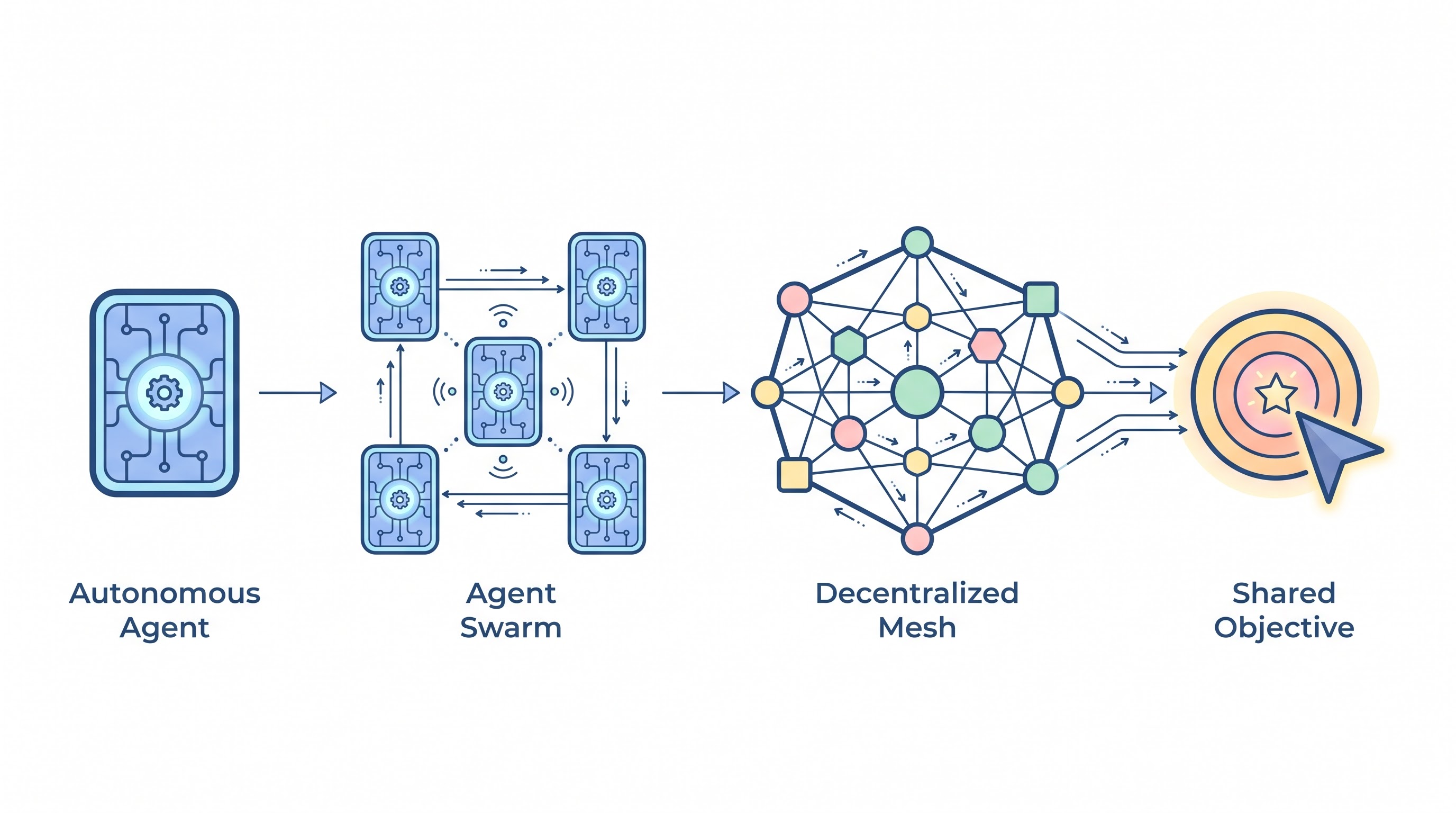
1. Executive Synthesis
The deployment of single-agent AI systems (e.g., standard chatbots or basic RAG implementations) has rapidly given way to Multi-Agent Swarms. By 2026, enterprise architectures utilize frameworks like AutoGen or LangGraph to deploy specialized autonomous agents—a "Researcher" agent, a "Coder" agent, a "QA" agent, and a "Manager" agent—that collaborate, debate, and iteratively execute complex tasks without human intervention. While this architecture unlocks profound operational velocity, it introduces a terrifying new FinOps vector: Exponential Intra-Agent Token Bloat.
In a multi-agent swarm, AI models converse with each other. Every time the "Coder" agent sends a message to the "QA" agent, the entire conversation history (the context window) is re-transmitted to the LLM API. If the QA agent finds a bug and sends it back to the Coder, the context window grows. A simple request to "Write and test a Python script for data extraction" can trigger a 40-message debate loop between agents. Because hyperscaler APIs charge per input token, this compounding context window can turn a theoretical $0.05 task into a $15.00 API burn in a matter of minutes.
To prevent the financial collapse of autonomous initiatives, enterprises must deploy the Swarm Coordination Arbitrage (SCA) Model. This framework treats intra-agent communication as a highly taxed network topology. It mandates that swarm orchestration cannot rely exclusively on frontier, premium models (e.g., GPT-4 or Claude Opus) for all agents.
The SCA model establishes strict hierarchical routing. Highly capable, expensive models are reserved strictly for the "Manager" or "Planner" nodes, while the repetitive, verbose intra-agent debates and sub-tasks are forcibly routed to virtually free, internally hosted Small Language Models (SLMs). Furthermore, the architecture must implement aggressive Context Window Pruning—summarizing or truncating agent conversation histories before passing them to the next node. By executing this playbook, FinOps and AI leaders can mathematically guarantee that the cost of an autonomous swarm remains fundamentally cheaper than the human labor it replaces.
2. Market Gap & Search Intent Failure Analysis
Enterprise research regarding "Multi-Agent AI" or "CrewAI / AutoGen implementation" is heavily focused on theoretical capabilities and prompt engineering. Developer tutorials show how easy it is to spin up a 5-agent swarm to write a blog post or scrape a website, entirely ignoring the billing API dashboard.
The market gap is the total lack of Intra-Agent Cost Modeling. Analysts focus on the cost of the user's prompt, completely missing the fact that the swarm's internal dialogue multiplies that cost exponentially. They fail to warn architects about "Infinite Debate Loops," where two agents disagree on a code implementation and iterate 100 times, maxing out the 128k context window on every API call. Standard playbooks do not provide the equations required to calculate the human-to-swarm break-even point, leading enterprises to automate tasks where the API cost vastly exceeds the hourly rate of a junior employee. This playbook provides the definitive mathematical models to constrain, monitor, and cost-optimize autonomous swarms.
3. Core Strategic Framework
The enterprise must implement the Swarm Coordination Arbitrage (SCA) Model. This framework establishes rigid topological and financial rules for how AI agents are permitted to interact, decoupling the swarm's intelligence from premium API dependency.
Implementation Protocol:
Agent Topology Baselining: Map the directed graph of the agent swarm. Identify the Planner/Manager nodes, the Worker nodes, and the Validation/QA nodes.
Execute Model Arbitrage: Downgrade the LLM engine for all Worker and Validation nodes to highly quantized, self-hosted SLMs (e.g., Llama 3 8B or Mistral 7B) running on spot GPUs. Restrict premium API usage exclusively to the Planner node.
Implement Context Pruning: Deploy an intermediate orchestration script that intercepts messages between agents. Instead of passing the entire raw conversation history, the script uses a cheap SLM to compress the history into a dense summary before passing it to the next agent.
Execution Decision Matrix:
If Agent A and Agent B iterate more than
$Max\_Debate = 5$times without reaching a <TERMINATE> state, instantly suspend the swarm and route the task to a Human-in-the-Loop (HITL) for resolution.If the calculated
$C_{swarm\_task}$exceeds $1.50, block execution and force the engineering team to refactor the prompt instructions to be more deterministic (reducing required iterations).If an agent's specific sub-task is deterministic (e.g., executing a SQL query), physically block the agent from utilizing an LLM to generate the code; force the use of traditional programmatic APIs (Tool Calling) to bypass token costs entirely.
4. Financial Modeling Layer (MANDATORY)
Controlling a multi-agent swarm requires modeling the compounding mathematics of input tokens.
Core Equations
1. Fully Burdened Swarm Task Cost ($C_{swarm\_task}$):
Calculates the exact API cost of a multi-agent execution, accounting for the compounding context window across $I$ iterations.
$$C_{swarm\_task} = \sum_{i=1}^{I} \left( (T_{base\_prompt} + (i \times T_{message\_delta})) \times P_{input\_token} + T_{output\_i} \times P_{output\_token} \right)$$Where:
$I$= Number of iterative conversational turns between agents.$T_{base\_prompt}$= Token count of the initial system prompt and tools.$T_{message\_delta}$= Average tokens added to the context history per conversational turn.$P_{input\_token}$/$P_{output\_token}$= Price per token of the selected LLM.
2. Swarm Coordination Overhead ($O_{swarm}$):
Quantifies the financial inefficiency of the multi-agent architecture—the percentage of the bill spent purely on agents talking to each other rather than generating the final output.
$$O_{swarm} = \left( \frac{C_{intra\_agent\_messages}}{C_{swarm\_task}} \right) \times 100$$Where:
$C_{intra\_agent\_messages}$= The cost of the tokens representing the conversation history passed between agents, excluding the final output tokens.
3. Return on Autonomous Execution ($R_{swarm\_roi}$):
Determines if deploying the AI swarm is financially superior to utilizing human labor for the same task.
$$R_{swarm\_roi} = \frac{(H_{task\_hrs} \times R_{human\_hourly\_rate}) - C_{swarm\_task}}{C_{swarm\_task} + C_{swarm\_infra\_compute}}$$A) Sensitivity Analysis Table
This table models the total cost of completing a software QA task requiring 15 conversational turns (iterations) between a "Coder" and a "Reviewer" agent, comparing different model routing strategies.
Swarm Routing Strategy | Input Token Accumulation (15 turns) | Total API Cost per Task | Swarm Overhead (Oswarm) | FinOps Conclusion |
Pure Premium (GPT-4 / Opus) | ~120,000 tokens (Compounding) | $2.85 | 85% (Paying for history) | Financially Toxic |
Hybrid (Premium Manager + SLM Workers) | ~120,000 tokens | $0.65 | 70% | Acceptable for complex dev |
Hybrid + Context Pruning | ~25,000 tokens (Summarized) | $0.15 | 30% | Highly Optimized |
Decision Threshold: Utilizing premium frontier models for all nodes in an iterative multi-agent swarm guarantees an $O_{swarm}$ $> 80\%$. You are paying massive API premiums just to have LLMs read their own prior text. Hybrid routing with context pruning is a mathematical necessity.
B) Break-Even Formula
The Human-in-the-Loop Disengagement Break-Even ($HIL_{be}$) calculates the maximum number of multi-agent iterations a swarm is allowed to execute before it becomes mathematically cheaper to page a human engineer to finish the task.
$$HIL_{be\_iterations} = \frac{(T_{human\_resolve\_hrs} \times R_{human\_rate}) - T_{base\_prompt} \times P_{input}}{T_{message\_delta} \times P_{input} + T_{output} \times P_{output}}$$Numerical Example: A junior engineer costs $40/hr and takes 0.25 hours ($10) to fix a specific bug. The swarm starts debugging. The base prompt costs $0.50. Each iteration adds $0.25 in compounding input/output token costs. Break-Even Iterations = ($10.00 - $0.50) / $0.25 = 38 iterations. If the swarm iterates 39 times without fixing the bug, it is mathematically more expensive than the human. The framework must enforce a hard cut-off at 35 iterations.
C) Probability-Weighted Risk Table
Quantifying the operational risks of autonomous multi-agent systems.
Scenario | Probability | Financial Impact | Weighted Exposure |
Infinite Debate Loop (Token Burn) | 25.0% / wk | $2,500 (Runaway API charges) | $625 per week |
Context Window Overflow (Task Failure) | 15.0% / task | $50 (Wasted tokens/restart) | $7.50 per task |
Tool Execution Malfunction (Rogue API Call) | 5.0% / mo | $10,000 (Corrupted DB/Egress) | $500 per month |
Hallucinated Sub-task Creation | 30.0% / task | $15 (Unnecessary iterations) | $4.50 per task |
D) Cost-per-Unit Model
The central metric for autonomous operations is the Cost Per Successful Task Resolution ($CPSTR$):
$$CPSTR = \frac{Total\_Swarm\_API\_Cost + C_{swarm\_infra}}{Total\_Tasks\_Completed\_Without\_Human\_Intervention}$$Threshold: If $CPSTR$ exceeds 30% of the equivalent human labor cost, the swarm is suffering from catastrophic iteration bloat. FinOps must mandate a complete refactor of the system prompts to enforce determinism.
5. Operational Architecture Integration
Hierarchical Model Routing (SLM Worker Tiers):
The architecture of a multi-agent system must physically enforce the SCA model. Do not deploy flat swarms where every agent uses the same LLM client. Architecture must configure the orchestrator (e.g., AutoGen GroupChat) to utilize a specific dictionary of model endpoints. The Manager_Agent is assigned the gpt-4o API key to leverage high-level reasoning for task decomposition. The Coder_Agent and Reviewer_Agent are assigned to an internal vLLM Kubernetes endpoint running Llama-3-8B-Instruct. This topology allows the heavy, iterative lifting (writing and checking syntax) to execute on heavily depreciated, fixed-cost hardware, eliminating the per-token variable API cost for the most verbose part of the swarm.
Context Pruning & State Compression:
To defeat the $C_{swarm\_task}$ compounding math, the orchestrator cannot pass the raw JSON conversation array between agents indefinitely. Architecture must insert a "Compressor Node." After every 3 iterations, the Compressor Node (running on a fast, cheap model) takes the 8,000-token conversation history, extracts the current code state and the unresolved bug, and outputs a 500-token summary. This 500-token summary replaces the 8,000-token history for Iteration 4. This mathematically flatlines the compounding input token curve, converting exponential cost growth into a highly manageable, linear step-function.
Tool Execution Sandboxing (Egress Defense):
Agents possess "Tools" (functions they can execute, like running Python code or querying a database). If a multi-agent swarm enters a hallucination loop, it might execute a database query tool 10,000 times a minute. The architecture must place the swarm execution environment inside a strictly governed sandbox (e.g., gVisor or an isolated Docker container with dropped network capabilities). The sandbox egress firewall must implement a token-bucket rate limiter: if an agent attempts more than 10 external API/DB calls per minute, the sandbox physically drops the packets and returns a hard error to the agent, forcing it to stop the loop.
6. Failure Scenarios
Scenario 1: The Infinite Debate Loop
Breakdown: A "Writer" agent generates a marketing email. A "Compliance" agent reviews it and flags a sentence. The Writer agent rewrites the sentence, but introduces a new error. The Compliance agent flags it again. The system prompt lacks a strict <TERMINATE> condition or conflict resolution protocol. The agents debate the sentence 400 times over 6 hours.
Financial Exposure: Because the conversation history grows with every reply, Iteration 400 submits a 100,000-token payload. A single bug costs $450 in OpenAI API fees overnight.
Governance Prevention Layer: Hard Iteration Caps. The swarm orchestrator must be configured with max_consecutive_auto_reply = 10. If the agents cannot resolve the task in 10 turns, the system automatically halts, dumps the state log, and routes the ticket to a human queue.
Scenario 2: The Egress-Driven Hallucination
Breakdown: An agent is tasked with writing a Python script to scrape a competitor's website. The agent hallucinates the pagination logic and writes an infinite while loop. The agent then utilizes its "Execute Code" tool to run the script. The script runs indefinitely in the cloud, consuming massive CPU and generating terabytes of network egress.
Financial Exposure: $5,000+ in cloud compute and egress costs generated by a single hallucinated script executing in an unmonitored environment.
Governance Prevention Layer: Sandboxed Execution with Timeouts. Agents must never execute code directly on the host machine. All tool execution must occur in heavily restricted, ephemeral containers (e.g., AWS Fargate or Docker) configured with a hard timeout = 60s and strict CPU/Memory cgroups limits.
Scenario 3: Premium Model Misallocation
Breakdown: Engineering deploys a swarm to categorize and route 50,000 customer support emails daily. They assign Anthropic Claude-3.5-Sonnet to all agents in the swarm (Categorizer, Sentiment Analyzer, Router).
Financial Exposure: The swarm executes perfectly, but the API cost averages $0.15 per email. Processing 50,000 emails costs $7,500/day ($2.7M/year), destroying the SaaS platform's profitability.
Governance Prevention Layer: FinOps Model Arbitrage Enforcement. FinOps must mandate that high-volume, simple deterministic tasks (like categorization or sentiment analysis) are mathematically banned from utilizing frontier models. The architecture team is forced to swap the Worker agents to a fine-tuned, self-hosted Mistral-7B, dropping the daily cost from $7,500 to the $40/day cost of a single GPU instance.
7. Board-Level Translation Layer
EBITDA Delta Modeling: Multi-agent swarms represent massive operational leverage, replacing human hours with API seconds. However, unconstrained swarms act as a volatile financial liability. By implementing the SCA model (Iteration Caps and Context Pruning), an enterprise can capture the EBITDA expansion of autonomous labor while mathematically guaranteeing that the API cost per task (
$CPSTR$) never exceeds 10% of the equivalent human cost.Gross Margin Defense: If a platform offers "Autonomous Agents" to its SaaS users, allowing users to trigger unbounded swarm executions will obliterate multi-tenant gross margins. The enterprise must enforce the Human-in-the-Loop Break-Even (
$HIL_{be}$) natively in the product, pausing the swarm and prompting the user for input when API costs cross the profitability threshold.Capital Allocation Signal: A rising Swarm Coordination Overhead (
$O_{swarm}$) metric indicates that the enterprise is paying API providers massive margins just for context window transmission. This signals to the board that capital must be aggressively redirected toward building internal Small Language Model (SLM) hosting capabilities to run the swarm's internal dialogue at a fixed, depreciable cost.Risk-Adjusted ROI Formula:
$$ROI_{swarm\_finops} = \frac{\text{Eliminated API Bloat from Infinite Loops}}{\text{Cost of SLM Hosting} + \text{Engineering Cost of Orchestration}}$$
8. Data Visualization Suggestions
Exponential Context Window Growth Chart: A line graph demonstrating the cost of a multi-agent task over 20 iterations. The "Unpruned" line curves sharply upward exponentially. The "Pruned" line looks like a shallow staircase, proving the financial necessity of context compression.
SCA Hierarchical Routing Topology: A network diagram showing a "Manager" node colored Gold (Premium API) distributing sub-tasks to three "Worker" nodes colored Blue (Self-Hosted SLMs), visually reinforcing the model arbitrage strategy.
Swarm Task Cost vs. Human Labor Bar Chart: A comparison chart showing the
$CPSTR$of an unoptimized swarm ($15.00), an optimized swarm ($0.45), and the equivalent human labor cost ($12.00), explicitly defining the arbitrage margin.Agent Debate FinOps Circuit Breaker Logic: A flow chart showing agents iterating. A counter increments (1, 2, 3...). When it hits
$Max\_Debate = 5$, a red "Circuit Breaker Triggered" icon flashes, and the arrow routes to a "Human Review" queue.Swarm Coordination Overhead (
$O_{swarm}$) Pie Chart: A pie chart breaking down the API cost of a task. The slice representing "Generating Final Output" vs the slice representing "Agents reading each other's chat history," highlighting operational inefficiency.
9. Why Analyst-Style Summaries Fail at Financial Precision
When AI analysts declare that "Multi-agent systems will revolutionize enterprise productivity by allowing AI to collaborate and solve complex problems autonomously," they are selling a vision while completely ignoring the underlying billing mechanics.
This narrative fails because it assumes that AI agents communicate for free. If an Enterprise Architect follows this vision and deploys a LangChain swarm using GPT-4 without configuring iteration limits, the agents will cheerfully debate the syntax of a Python script until the API quota is exhausted. Analyst summaries do not calculate the Swarm Coordination Overhead ($O_{swarm}$).
Equation-backed modeling using the Swarm Coordination Arbitrage (SCA) framework destroys this financial blindness. By calculating the exact Human-in-the-Loop Break-Even ($HIL_{be}$), FinOps leaders establish a rigid mathematical boundary on autonomy. It proves that allowing AI to endlessly iterate is not "advanced reasoning"—it is a catastrophic financial failure. You cannot scale autonomous AI by letting agents talk indefinitely; you scale it by ruthlessly pruning their context windows, forcing them onto cheap SLMs, and mathematically capping their conversational turns.
10. Strategic Conclusion
Multi-agent swarms represent the transition from generative AI to agentic AI—moving from systems that write text to systems that execute workflows. However, this architectural leap fundamentally breaks traditional per-token FinOps modeling. Because agents must constantly read the output of their peers to collaborate, the context window—and therefore the financial cost—grows exponentially with every single iteration.
To prevent autonomous initiatives from destroying cloud budgets, enterprise leadership must impose strict, algorithmic governance via the Swarm Coordination Arbitrage (SCA) Model. Swarms must be architected hierarchically. The enterprise cannot afford to pay frontier model API premiums for basic intra-agent dialogue; those tasks must be routed to self-hosted, fixed-cost Small Language Models (SLMs).
Furthermore, the orchestration layer must be fiercely defensive. Context windows must be dynamically summarized and pruned to flatten the exponential cost curve. Hard iteration caps must be enforced to physically prevent infinite debate loops. Tool execution must be sandboxed and rate-limited. By embedding these mathematical and architectural constraints deeply into the swarm's orchestration framework, FinOps leaders can safely unlock the massive operational leverage of autonomous AI, guaranteeing that the swarm remains ruthlessly efficient and inherently profitable.
11. Implementation Readiness Checklist
Enforce Hard Iteration Caps: Configure the swarm orchestrator (AutoGen, CrewAI) to enforce a strict max_turns or max_consecutive_auto_reply limit (e.g., 5-10) before requiring a human-in-the-loop override.
Deploy SLM Worker Nodes: Provision a cluster of Spot GPUs running vLLM and deploy highly quantized open-source models (Llama 3 8B) to serve as the default LLM engine for all non-planner agents.
Implement Context Pruning Scripts: Write an interceptor function in the orchestration layer that utilizes a cheap LLM to summarize conversation histories
$>4,000$tokens before passing the payload to the next agent.Sandbox Tool Execution: Deploy secure, ephemeral container environments (e.g., gVisor, Firecracker) for all agent tool execution to prevent hallucinated code from destroying local state or generating cloud egress.
Calculate the
$HIL_{be}$Threshold: Run the mathematics to define the exact number of iterations where your specific swarm becomes more expensive than human labor, and hardcode that limit into the product.Tag Swarm API Telemetry: Require the swarm orchestrator to inject metadata headers into all LLM API calls, specifically tagging Agent_Role, Task_ID, and Iteration_Count for granular FinOps tracking.
Monitor
$O_{swarm}$Real-Time: Create a dashboard that continuously tracks Swarm Coordination Overhead. If the overhead exceeds 60% of the API cost, trigger an alert to prompt engineering to refactor the agent instructions.Ban Deterministic LLM Usage: Audit agent tool sets. If an agent needs to retrieve data from a SQL database, force it to use standard API tool calling; strictly forbid agents from attempting to write dynamic SQL via LLM inference if a deterministic API exists.
Enforce Egress Rate Limiting: Apply strict egress network policies on the agent execution sandbox, physically dropping packets if an agent enters a hallucinated loop of web scraping or API polling.
Test Infinite Loop Circuit Breakers: Conduct chaos engineering by deliberately injecting an unresolvable contradiction into a swarm prompt, verifying that the
$Max\_Debate$circuit breaker successfully halts the system before API costs spike.
Stop guessing where your Kubernetes budget is going. Schedule a demo here to explore Kubernetes cost monitoring with Cloud Atler.