
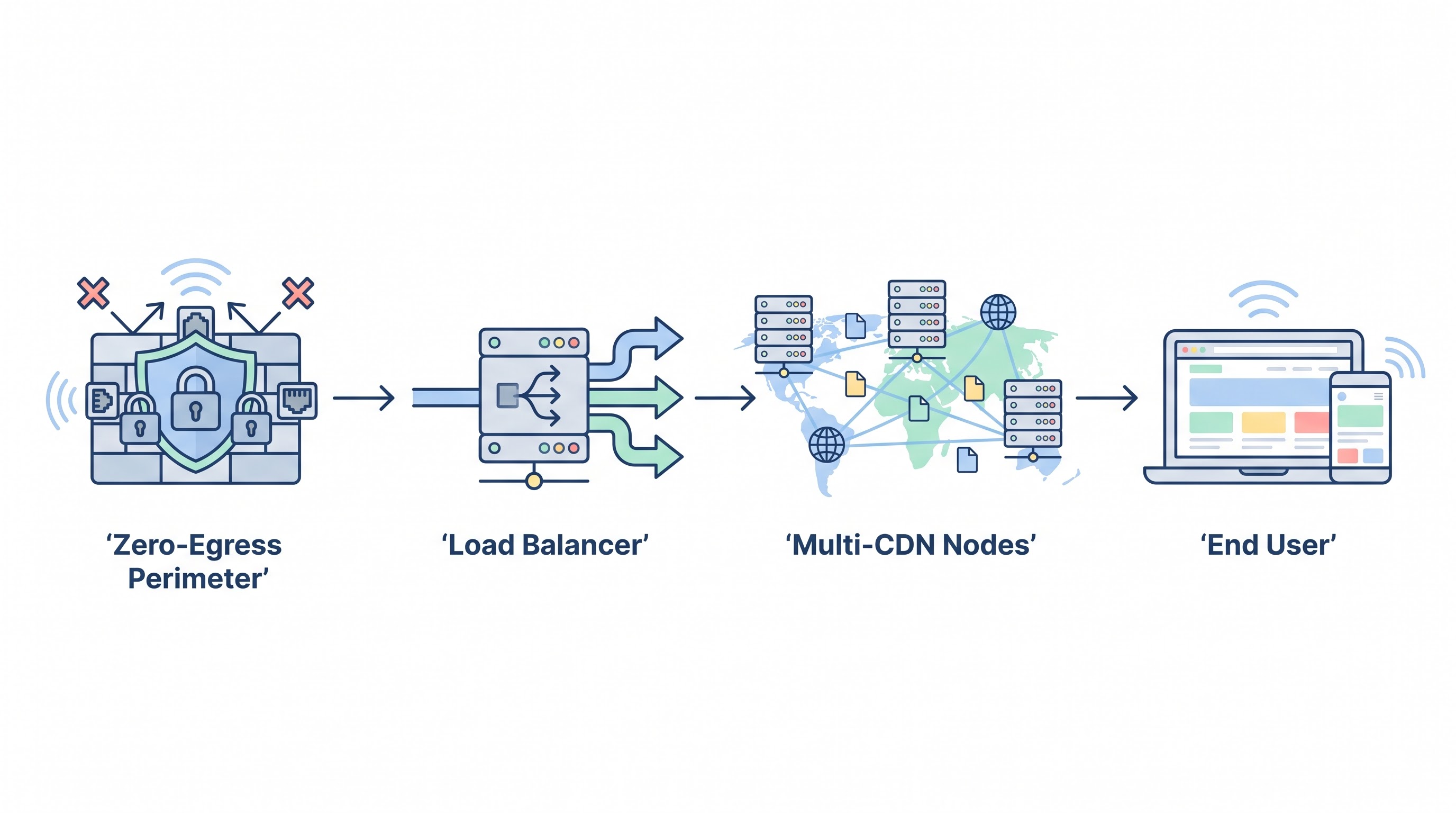
1. Executive Synthesis
In the 2026 enterprise cloud ecosystem, compute and storage costs have become heavily commoditized and aggressively discounted. Hyperscalers (AWS, Azure, GCP) no longer derive their primary monopolistic leverage from virtual machines; their absolute lock-in mechanism is the Data Transfer Out (Egress) fee. Charging upwards of $0.05 to $0.09 per Gigabyte for data traversing the open internet, cloud providers impose an artificial margin penalty that defies the physical cost of global fiber transit by magnitudes.
As enterprises scale generative AI architectures—streaming massive multi-modal embeddings, 4K video datasets, and heavy inference payloads—this egress tax transitions from a nuisance line item into an existential threat to SaaS gross margins. Architecting a multi-cloud environment without a mathematically rigorous plan to subvert network egress is equivalent to building a massive factory with only one highly tolled road leading out of it.
To neutralize this threat, enterprises must transition to a Zero-Egress Perimeter Strategy. This is not a literal reduction of data to zero; it is the architectural implementation of the Dynamic Egress Arbitrage Routing (DEAR) Framework. The DEAR framework utilizes intelligent Edge Compute platforms (e.g., Cloudflare Workers, Fastly Compute) and Private Network Interconnects (PNIs) to mathematically circumvent hyperscaler public internet transit fees.
By leveraging heavily discounted peering arrangements (such as the Bandwidth Alliance) and executing aggressive, edge-based semantic caching, FinOps leaders can collapse egress bills by 70% to 90%. This playbook establishes the advanced network architecture and financial mechanics required to decouple from hyperscaler transit monopolies, forcing cloud providers to compete purely on compute efficiency while shifting global data transport to high-performance, low-cost multi-CDN arbitrage engines.
2. Market Gap & Search Intent Failure Analysis
Enterprise research addressing "Cloud Egress Costs" consistently fails due to a pervasive, simplistic reliance on default CDN configurations. Search intent yields basic advice: "Put a CDN like CloudFront in front of your S3 buckets." This guidance is fundamentally flawed for a 2026 multi-cloud enterprise for two reasons. First, using a hyperscaler's native CDN (e.g., AWS CloudFront) often just shifts the high margin from the compute bill to the CDN bill; it does not achieve true market arbitrage. Second, it assumes all egress is cacheable static web traffic, ignoring the reality of dynamic AI API payloads and continuous inter-region data replication.
The structural market gap is the absence of Multi-CDN Arbitrage and BGP-Aware Traffic Shaping models. Analysts fail to explain the mathematics of caching penalties. If a CDN is misconfigured with a low Cache Hit Ratio (CHR), the enterprise pays twice: once for the hyperscaler egress to feed the cache, and again for the CDN egress to the user. Standard playbooks do not provide the dynamic routing equations required to route traffic programmatically based on real-time bandwidth commits and peering discounts. This playbook provides the financial modeling to execute dynamic, protocol-level egress evasion.
3. Core Strategic Framework
The enterprise must implement the Dynamic Egress Arbitrage Routing (DEAR) Framework. This framework treats network transit as a highly liquid commodity, utilizing intelligent edge routing to dynamically shift data transfer pathways to the cheapest available exit node based on real-time peering mathematics.
Implementation Protocol:
Egress Baselining: Audit the cloud network architecture to categorize all egress traffic into three tiers: Cacheable Static (Web/Media), Dynamic API (AI Inference/SaaS payloads), and Inter-Region/Inter-Cloud Replication.
Deploy the Edge Arbitrage Engine: Implement programmable edge runtimes (e.g., Cloudflare Workers or Fastly VCL) as the global ingress/egress proxy, decoupling the end-user from the origin hyperscaler.
Execute Private Peering (PNI): For sustained Inter-Cloud traffic
$>5\text{Gbps}$, physically bypass the internet by deploying Software-Defined Interconnects (e.g., Megaport, Equinix Fabric) to route traffic over private fiber, dropping hyperscaler egress fees to a fraction of a penny per GB.Decision Matrix:
If payload is Static AND Origin is AWS S3: Route via Cloudflare/Fastly to capture Bandwidth Alliance peering discounts (slashing AWS egress by up to 80%).
If payload is Dynamic API (Uncacheable): Evaluate the Edge Arbitrage Margin (
$M_{edge\_arb}$). If routing through the CDN adds latency without saving egress cost, route via Direct Server Return (DSR) or BGP Anycast optimization.If Cache Hit Ratio (CHR) drops
$< 75\%$, trigger an automated FinOps alert. The origin is suffering a "Cache Stampede" and paying double transit fees; force engineering to extend TTLs (Time to Live) immediately.
4. Financial Modeling Layer (MANDATORY)
Defending gross margins against hyperscaler transit taxes requires executing the following network financial models.
Core Equations
1. Fully Burdened Egress Cost ($C_{egress\_total}$):
Calculates the exact monthly cost of delivering data to end-users through a layered CDN architecture.
$$C_{egress\_total} = \left( V_{total\_GB} \times CHR \times P_{cdn\_egress} \right) + \left( V_{total\_GB} \times (1 - CHR) \times (P_{cloud\_egress} + P_{cdn\_egress}) \right)$$Where:
$V_{total\_GB}$= Total data volume delivered to end-users.$CHR$= Cache Hit Ratio (percentage of requests served directly from the CDN edge).$P_{cdn\_egress}$= Negotiated cost per GB delivered by the third-party CDN.$P_{cloud\_egress}$= Hyperscaler cost per GB for data leaving the origin to feed the CDN.
2. Multi-CDN Arbitrage Margin ($M_{cdn\_arb}$):
Determines the financial viability of dynamically routing a specific traffic profile to an alternate CDN or Private Interconnect based on volume commit tiers.
$$M_{cdn\_arb} = \left( P_{current\_route\_GB} \times V_{projected\_GB} \right) - \left( P_{alternate\_route\_GB} \times V_{projected\_GB} + C_{routing\_compute} \right)$$Where:
$C_{routing\_compute}$= The edge compute cost (e.g., Worker invocations) required to inspect and dynamically route the packet.
3. Cache Miss Financial Penalty ($P_{cache\_miss}$):
Quantifies the exact dollar penalty incurred for every percentage point drop in the Cache Hit Ratio, exposing the cost of poor cache engineering.
$$P_{cache\_miss} = \frac{V_{total\_GB}}{100} \times P_{cloud\_egress}$$A) Sensitivity Analysis Table
This table models the monthly data transfer bill for a platform delivering 10 Petabytes (10,000,000 GB) of data, comparing architectural setups and Cache Hit Ratios (CHR).
Variable (Architecture & CHR) | Raw Hyperscaler (No CDN) | Managed Native CDN (CloudFront/MediaCDN) | Edge Arbitrage (Cloudflare + B.A. Peering) | FinOps Outcome |
Poor Cache (40% CHR) | $800,000 | $650,000 (Paying double on 60%) | $350,000 (Peering discount saves bill) | Requires engineering fix |
Avg Cache (75% CHR) | $800,000 | $300,000 | $120,000 | Highly optimized |
Perfect Cache (98% CHR) | $800,000 | $120,000 | $40,000 (Maximum Margin Defense) | Architectural Perfection |
Decision Threshold: Utilizing raw hyperscaler egress for public data delivery is financially negligent. The enterprise MUST maintain a CHR $> 80\%$ and leverage third-party peering alliances to collapse the blended per-GB rate below $0.01.
B) Break-Even Formula
The Private Network Interconnect (PNI) Break-Even Point ($V_{pni\_be}$) calculates the exact terabytes per month required to justify leasing private fiber ports (e.g., AWS Direct Connect / Megaport) to bypass the public internet egress tax.
$$V_{pni\_be} = \frac{C_{port\_lease\_monthly} + C_{cross\_connect\_monthly}}{P_{public\_cloud\_egress\_rate} - P_{pni\_cloud\_egress\_rate}}$$Numerical Example: Leasing a 10Gbps Megaport connection and cross-connects costs $3,500/month. Public AWS internet egress is $0.08/GB. PNI egress (Direct Connect routing) is $0.02/GB. The savings per GB is $0.06. Break-Even is $3,500 / $0.06 = 58,333 GB (~58 TB). If your inter-cloud or hybrid traffic exceeds 58 TB per month, you are losing money by not deploying private fiber.
C) Probability-Weighted Risk Table
Quantifying the operational risks of aggressive egress evasion tactics.
Scenario | Probability | Financial Impact | Weighted Exposure |
Cache Stampede (Origin Overload) | 15.0% / year | $45,000 (Egress spike & downtime) | $6,750 per year |
BGP Route Hijacking (Misdirected traffic) | 2.5% / year | $150,000 (Latency/Data loss) | $3,750 per year |
Stale Cache / Invalidation Failure | 20.0% / year | $10,000 (Customer support/SLA) | $2,000 per year |
Multi-CDN Failover Routing Loop | 5.0% / year | $80,000 (Infinite transit billing) | $4,000 per year |
D) Cost-per-Unit Model
The central FinOps networking metric is the Blended Cost Per Delivered Gigabyte ($CPDG$):
$$CPDG = \frac{Total\_Monthly\_Network\_Spend\_(Cloud + CDN + PNI + Routing)}{Total\_Gigabytes\_Delivered\_to\_End\_User}$$Threshold: If $CPDG > \$0.03$ globally, the architecture is leaking margin to the hyperscalers. The FinOps team must mandate a comprehensive routing audit and force engineering to implement aggressive Edge API caching.
5. Operational Architecture Integration
Programmable Edge Arbitrage (Cloudflare Workers / Fastly VCL):
To execute the DEAR framework, traffic routing cannot be hardcoded in DNS. Architecture must deploy intelligent edge compute proxies. When a user requests a massive AI model weight file or 4K video, the Edge Worker intercepts the request. The Worker executes lightweight logic (costing fractions of a millisecond): It checks the current traffic commit levels across multiple CDNs and evaluates the geographic origin of the user. If delivering the file from AWS us-east-1 directly triggers an $0.08/GB charge, but routing the request through an active Bandwidth Alliance peering link drops the AWS charge to $0.00, the Worker dynamically rewrites the origin header to force the data through the highly discounted transit path.
Private Interconnects (Megaport / Equinix Fabric) for Inter-Cloud Egress:
A critical failure in multi-cloud architecture is moving data between AWS and Azure over the public internet, paying massive egress taxes on both sides. The Zero-Egress Perimeter demands Software-Defined Cloud Interconnects (SDCI). By deploying a virtual router on Megaport, traffic leaving an AWS VPC utilizes an AWS Direct Connect, flows across Megaport's private backbone, and enters Azure via ExpressRoute. This physical architecture mathematically converts the public internet egress tax ($0.08/GB) into a highly discounted private peering rate (often $<\$0.02\text{/GB}$), permanently restructuring the unit economics of multi-cloud data gravity.
AI API Semantic Caching at the Edge:
Generative AI APIs generate massive egress costs because the JSON payloads containing thousands of embedding vectors are heavy and entirely dynamic (uncacheable by standard CDNs). Architecture must move semantic caching to the Edge. Using Edge KV stores (e.g., Cloudflare KV or Fastly Edge Dictionaries), the edge proxy hashes the incoming user prompt. If the prompt is semantically identical to a previous request, the Edge runtime serves the heavy embedding payload directly to the user. This drops the origin hyperscaler egress from megabytes to exactly zero bytes.
6. Failure Scenarios
Scenario 1: The Multi-CDN Infinite Routing Loop
Breakdown: An enterprise configures two CDNs (Akamai and Cloudflare) for high-availability active-active failover. A misconfiguration in the origin DNS headers causes Akamai to treat Cloudflare as the origin, and Cloudflare to treat Akamai as the origin. When a user requests a file, the request bounces between the two CDNs infinitely at 100Gbps.
Financial Exposure: Millions of gigabytes of transit billed by both CDN providers within hours, resulting in a $100,000+ catastrophic billing event and total site outage.
Governance Prevention Layer: Loop Detection & Hop Limiters. Programmable edge routers must inject specific cryptographic tracing headers (e.g., X-CDN-Trace-Count). If any edge node detects a trace count
$> 2$, it must instantly drop the connection and return an HTTP 508 (Loop Detected) to mathematically sever the infinite billing cycle.
Scenario 2: The Egress Black Swan (Cache Stampede)
Breakdown: A SaaS platform pushes a faulty code update that accidentally alters the URL parameters of 10 million static image assets. The CDN views these as entirely new files (Cache Miss). Instantly, 10 million requests bypass the CDN and slam the AWS S3 origin.
Financial Exposure: The hyperscaler absorbs the massive traffic spike, serving terabytes of data directly to the internet at peak On-Demand egress rates, causing a $50,000 unbudgeted spike in 24 hours.
Governance Prevention Layer: Request Collapsing and FinOps Alerts. The CDN architecture must implement strict "Request Collapsing" (or Origin Shielding). When 1,000 identical cache-miss requests hit the edge simultaneously, the CDN must hold 999 connections and send exactly one request to the origin, mathematically limiting the egress blast radius.
Scenario 3: The "Free Egress" Illusion
Breakdown: An enterprise utilizes a minor cloud provider that advertises "Free Egress." The engineering team routes all global video streaming through this single provider. However, the provider lacks the global fiber backbone of tier-1 ISPs. During peak hours, transit congestion causes massive packet loss, dropping streaming bitrates and causing massive application latency.
Financial Exposure: While the cloud bill is zero, the application becomes unusable, causing a 20% spike in customer churn and destroying millions in MRR.
Governance Prevention Layer: Performance-Gated Arbitrage. The DEAR framework explicitly forbids routing decisions based solely on cost. The Edge Arbitrage engine must run continuous synthetic latency tests (Real User Monitoring - RUM). If the cheapest transit path exhibits
$> 50\text{ms}$of latency or packet loss, the algorithm must automatically fail over to a premium transit route, prioritizing revenue protection over transit savings.
7. Board-Level Translation Layer
EBITDA Delta Modeling: Hyperscaler egress fees are a 100% margin tax with zero operational value. By architecting a Zero-Egress perimeter, an enterprise delivering 10 Petabytes a month can compress its network bill from $800,000 down to $80,000. This $720,000 monthly savings flows entirely and immediately to EBITDA, demonstrating profound architectural mastery to the board.
Gross Margin Defense: As SaaS applications become more data-intensive (e.g., streaming RAG AI responses or high-fidelity telemetry), network transit becomes a dominant component of COGS. Establishing robust Multi-CDN peering arrangements permanently suppresses this cost vector, insulating gross margins from the exponential data growth of the 2026 internet.
Capital Allocation Signal: Leasing physical Private Network Interconnects (PNIs) requires fixed monthly OpEx commitments. The CFO must view this not as an infrastructure expense, but as a high-yield financial hedge against hyperscaler data gravity lock-in, mathematically ensuring that the enterprise retains the freedom to migrate workloads to cheaper compute clouds without paying extortionate extraction taxes.
Risk-Adjusted ROI Formula:
$$ROI_{egress} = \frac{\text{Eliminated Hyperscaler Egress Spend}}{\text{CDN Commit Contracts} + \text{PNI Port Leases} + \text{Edge Compute Costs}}$$
8. Data Visualization Suggestions
Dynamic Egress Arbitrage Routing (DEAR) Flowchart: A diagram showing user traffic hitting an Edge Proxy, which queries a real-time pricing matrix, and physically steers traffic left (to a PNI) or right (to a peered CDN) based on the absolute lowest transit cost per packet.
Fully Burdened Egress Cost Waterfall: A waterfall chart taking a theoretical $100,000 raw AWS egress bill and showing the sequential cost deductions provided by the Cache Hit Ratio, Bandwidth Alliance peering, and PNI offloading, resulting in a $12,000 final blended bill.
Cache Miss Financial Penalty Graph: A line chart plotting Cache Hit Ratio (%) on the X-axis and Total Monthly Cost ($) on the Y-axis. The curve is exponential—showing that dropping from 99% to 90% cache efficiency costs significantly more than dropping from 60% to 50%.
PNI Break-Even Matrix: A scatter plot mapping Inter-Cloud Data Volume against PNI Cost. A thick break-even line divides the chart into "Public Internet Optimized" (bottom left) and "Private Fiber Required" (top right).
Multi-CDN Traffic Distribution Map: A global dashboard mapping where edge traffic is being routed in real-time, color-coded by the CDN provider winning the algorithmic cost/performance bid for that specific geographic region.
9. Why Analyst-Style Summaries Fail at Financial Precision
When analysts advise enterprises to "Implement a Content Delivery Network to improve application performance and reduce cloud data transfer costs," they are dispensing introductory networking advice disguised as financial strategy.
This narrative fails because it treats CDNs as a magic bullet while ignoring the financial mechanics of cache engineering and peering alliances. If an architect follows this advice and deploys a CDN without configuring strict Cache-Control headers or Origin Shields, the Cache Hit Ratio drops, and the enterprise pays double: they pay the hyperscaler egress to feed the CDN, and the CDN egress to feed the user.
Equation-backed modeling, specifically the calculation of the Fully Burdened Egress Cost ($C_{egress\_total}$) and the Cache Miss Financial Penalty ($P_{cache\_miss}$), eliminates this operational blindness. It mathematically proves that egress optimization requires continuous, programmable traffic shaping at the edge. By running the Private Network Interconnect Break-Even ($V_{pni\_be}$) equation, FinOps leaders can precisely identify the exact day their cloud data volume justifies bypassing the public internet entirely. You cannot defeat hyperscaler transit monopolies with generic CDN deployments; you defeat them with ruthless, mathematically executed network arbitrage.
10. Strategic Conclusion
The 2026 public cloud model is a trap designed around data gravity: ingress is free, compute is cheap, and egress is financially devastating. As long as an enterprise relies on the public internet routing of their primary cloud provider to deliver data to users or other clouds, they are actively bleeding gross margin and surrendering architectural leverage.
The mandate for 2026 is the creation of the Zero-Egress Perimeter. This requires adopting the Dynamic Egress Arbitrage Routing (DEAR) Framework. Enterprises must strip the routing and transit authority away from the hyperscalers and push it to highly intelligent, programmable Edge Compute layers and Private Network Interconnects.
By mastering these FinOps network mechanics, organizations transform egress from a monopolistic tax into a highly competitive, liquid market. Enforcing mathematical Cache Hit Ratios, leveraging Bandwidth Alliance peering discounts, and dynamically routing inter-cloud traffic over leased private fiber fundamentally alters the unit economics of the enterprise. The Zero-Egress architecture mathematically guarantees that the enterprise can scale massive, data-intensive AI and SaaS applications globally without enriching the hyperscalers for the privilege of accessing its own data.
11. Implementation Readiness Checklist
Calculate Baseline
$CPDG$: Run a comprehensive audit of all cloud and CDN invoices to calculate the exact Blended Cost Per Delivered Gigabyte globally to establish the optimization baseline.Implement Edge Arbitrage Proxies: Decouple from hyperscaler native CDNs (like CloudFront) and deploy programmable edge proxies (Cloudflare Workers, Fastly VCL) to enable intelligent, multi-provider traffic steering.
Enforce Origin Shielding: Configure strict request collapsing (Origin Shield) at the CDN layer to mathematically protect the hyperscaler origin from absorbing catastrophic egress spikes during cache invalidation events.
Execute PNI Break-Even Analysis (
$V_{pni\_be}$): Query cloud network logs to measure exact inter-region and inter-cloud traffic volumes. If volumes exceed the break-even point, initiate procurement for Megaport or Equinix virtual routers.Leverage Peering Alliances: Audit all CDN routing paths to ensure static assets stored in AWS S3 or GCP Storage are explicitly routed through Bandwidth Alliance partners to capture massive egress discounts.
Deploy Edge Semantic Caching for AI: Re-architect AI inference pipelines to utilize edge-based KV stores, caching massive JSON payload embeddings locally to drop origin hyperscaler egress to zero for repetitive queries.
Set FinOps CHR Circuit Breakers: Configure automated alerting that instantly pages the Network Engineering on-call if the global Cache Hit Ratio drops below 85% for more than 15 consecutive minutes.
Inject Infinite-Loop Tracing Headers: Hardcode cryptographic trace-count headers into all multi-CDN routing logic to physically prevent infinite routing loops from generating unbounded transit bills.
Standardize Cache-Control Headers: Implement strict CI/CD linting rules that fail any deployment where web assets lack explicit, long-lived Cache-Control: max-age HTTP response headers.
Perform Synthetic Egress Drills: Run quarterly chaos engineering drills by intentionally invalidating a massive cache sector, verifying that the Origin Shield holds and the egress FinOps circuit breakers trigger appropriately.
Stop guessing where your Kubernetes budget is going. Schedule a demo here to explore Kubernetes cost monitoring with Cloud Atler.