
1. Executive Synthesis
For the past decade, enterprise data warehousing has been dominated by a tightly coupled architecture. Platforms like Snowflake, Redshift, and BigQuery revolutionized analytics by integrating proprietary storage layers directly with their massive compute engines. While this delivered exceptional performance, it created an inescapable financial lock-in. Once an enterprise loaded 50 Petabytes of data into a proprietary warehouse format, the vendor held absolute pricing leverage. If the vendor increased compute prices, the enterprise was forced to pay the premium, as migrating 50 PB out of the ecosystem incurred catastrophic data egress and transformation costs.
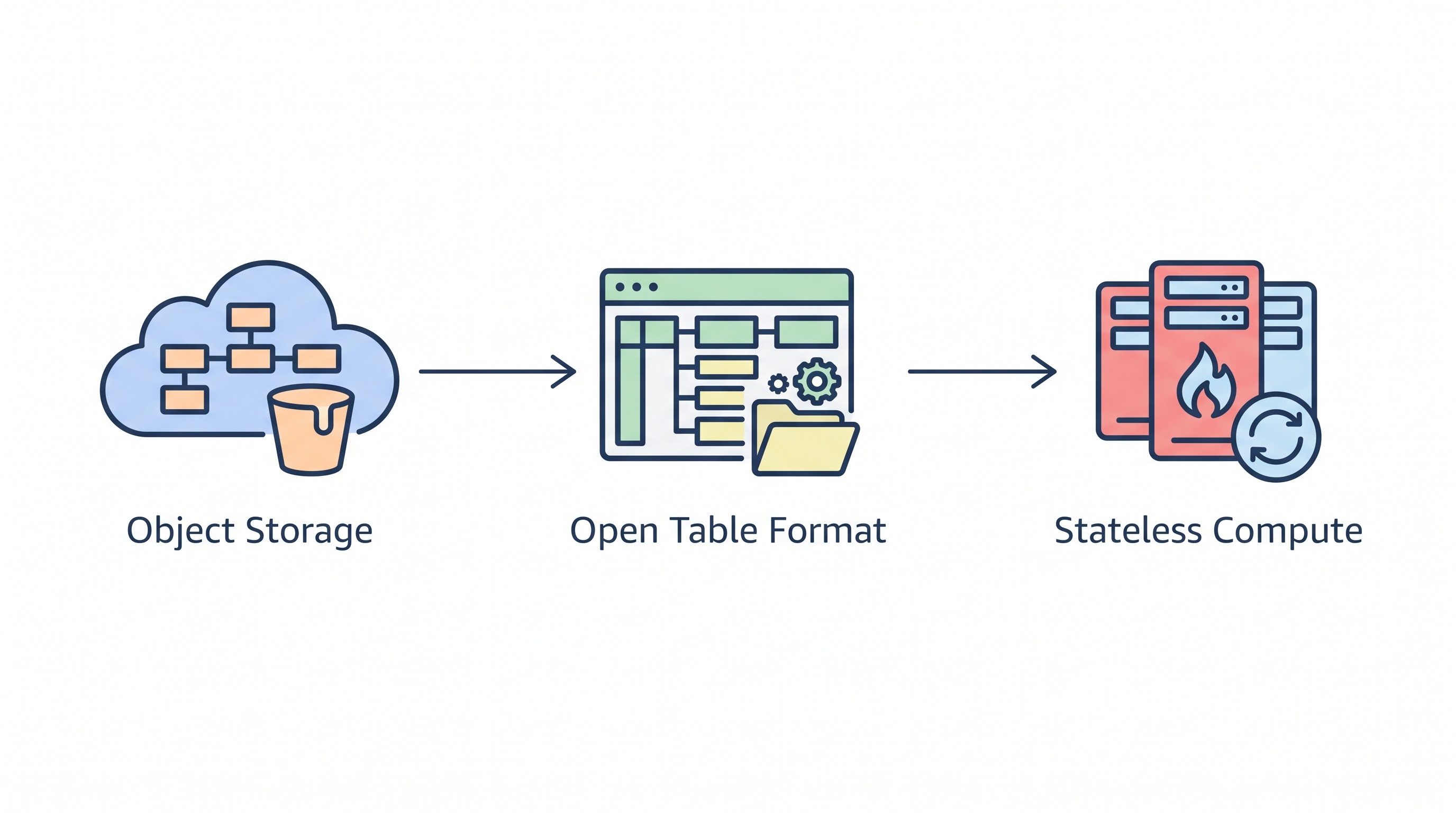
By 2026, the data architecture paradigm has violently fractured, shifting toward Open Table Formats (OTFs) primarily dominated by Apache Iceberg and Delta Lake. This transition physically and financially decouples data storage from query compute. In this architecture, the enterprise stores its 50 PB of data in standard, open-source Parquet files residing in ultra-cheap AWS S3 or GCP Cloud Storage. The OTF acts as a metadata layer, providing ACID transactions and time-travel capabilities directly on top of the object store.
The financial implication of this decoupling is profound. It enables the Storage-Compute Decoupling Arbitrage (SCDA) Framework. Because the data is stored in an open format on commodity cloud storage, the enterprise can dynamically route compute queries to the cheapest available engine. A complex financial model can be queried via Trino running on highly discounted Kubernetes Spot instances, while a high-priority CEO dashboard can query the exact same underlying S3 files using Snowflake’s engine, without moving or copying a single byte of data.
However, Open Table Formats introduce a severe, hidden FinOps liability: The Compaction Compute Tax. Because data lakes ingest data continuously (streaming pipelines), they generate millions of tiny Parquet files. If left unmanaged, querying these millions of small files destroys query performance and generates massive API request fees (e.g., S3 GET charges). To maintain performance, the enterprise must run continuous background compute jobs to compact (merge) these small files and optimize the Z-order indexes. If not mathematically governed, the compute cost of running these background maintenance jobs rapidly eclipses the savings generated by abandoning the proprietary data warehouse. This playbook provides the rigorous financial models required to balance query performance against compaction compute COGS, ensuring that the transition to an Open Data Lakehouse remains highly accretive to EBITDA.
2. Market Gap & Search Intent Failure Analysis
Enterprise research regarding "Apache Iceberg vs Snowflake cost" is heavily polluted by open-source maximalism. Technology blogs and vendor marketing present a utopian narrative: "Move your data to Iceberg, use S3 for storage, and slash your data warehouse bill by 80%."
This narrative is a mathematical illusion that fails to account for the Total Cost of Ownership (TCO) of decentralized data management. The market gap is the total failure to model the Metadata Operations Burden. Analysts calculate the savings of storing data in S3 ($23/TB) versus Snowflake storage ($40/TB), but completely ignore the continuous Apache Spark or Flink compute jobs required to manage Iceberg snapshots, clean up orphaned files (vacuuming), and rewrite data for efficient skipping.
If a data engineering team implements Iceberg without FinOps governance, they will schedule blind compaction jobs that run hourly across the entire 50 PB lake. The resulting EC2 compute burn and S3 PUT/GET API request charges will completely obliterate the initial storage savings. Furthermore, standard playbooks do not provide the dynamic routing equations required to actively arbitrage queries between different compute engines. This playbook fills that gap by providing the strict equations necessary to model the true cost of OTF maintenance and execute intelligent, cost-aware query routing.
3. Core Strategic Framework
The enterprise must implement the Storage-Compute Decoupling Arbitrage (SCDA) Framework. This framework enforces financial discipline over the Open Data Lakehouse, treating query routing and table maintenance as highly constrained economic variables.
Implementation Protocol:
Data Gravity Anchoring: Migrate all massive, historical analytical datasets (e.g., event logs, telemetry, historical transactions) out of proprietary warehouses and into Apache Iceberg formats residing in the primary cloud region's native object storage (S3/GCS).
Compute Engine Bidding: Deploy a semantic routing layer (e.g., heavily utilizing Trino or Starburst) that sits above the data. When a query is submitted, the routing layer evaluates the query complexity and required SLA, dynamically sending it to the cheapest capable engine.
Execute the Compaction Equation: Profile the ingestion rate of every Iceberg table to calculate the exact mathematical threshold where the cost of querying unoptimized files exceeds the compute cost of running a compaction job.
Decision Matrix:
If a query has an SLA
$> 10\text{ minutes}$(batch reporting), route strictly to Trino running on ephemeral Kubernetes Spot nodes.If an Iceberg table receives
$< 100$queries per day, immediately suspend all automated hourly compaction jobs. Schedule maintenance strictly on a weekly basis to eliminate wasted compute.If S3 GET/LIST API charges for a specific bucket exceed 15% of the total storage cost, the table is suffering from severe "Small File Bloat." Trigger an immediate, aggressive compaction job and rewrite the ingestion pipeline to increase batch sizes.
4. Financial Modeling Layer (MANDATORY)
Governing the economics of an Open Data Lakehouse requires strict algorithmic execution to balance compute, storage, and API costs.
Core Equations
1. Fully Burdened Open Table Maintenance Cost ($C_{otf\_maint}$):
Calculates the hidden background cost of managing an Iceberg/Delta table over a billing period.
$$C_{otf\_maint} = \sum \left( (T_{compaction\_hrs} \times P_{spark\_compute}) + (N_{api\_calls} \times P_{api\_rate}) + (V_{orphan\_gb} \times P_{storage}) \right)$$Where:
$T_{compaction\_hrs}$= Total compute hours burned running OPTIMIZE or VACUUM commands.$P_{spark\_compute}$= Hourly rate of the data engineering compute cluster.$N_{api\_calls}$= Volume of cloud object storage PUT/GET/LIST requests generated by the table metadata.$V_{orphan\_gb}$= Volume of historical data snapshots retained for time-travel queries.
2. Storage-Compute Decoupling Arbitrage Margin ($M_{scda}$):
Determines the true financial savings of operating an OTF architecture compared to a legacy proprietary warehouse, explicitly factoring in the new maintenance burden.
$$M_{scda} = (C_{legacy\_storage} + C_{legacy\_compute}) - \left( C_{s3\_storage} + C_{multi\_engine\_compute} + C_{otf\_maint} + C_{engineering\_ops} \right)$$Where:
$C_{multi\_engine\_compute}$= The blended cost of querying the data via cheaper engines like Trino.$C_{engineering\_ops}$= The capitalized labor cost of the Data Engineers required to build and monitor the custom compaction pipelines.
3. Compaction Break-Even Threshold ($T_{compact\_be}$):
Calculates the exact moment when the compute cost of running a background file compaction job is mathematically justified by the resulting reduction in query compute costs.
$$T_{compact\_be} = \frac{C_{compaction\_job\_run}}{(C_{query\_unoptimized} - C_{query\_optimized}) \times F_{query\_frequency\_daily}}$$A) Sensitivity Analysis Table
This table models the Monthly TCO of a 5 Petabyte active data lake under different Apache Iceberg maintenance strategies, isolating the impact of compaction frequency and snapshot retention.
Maintenance Strategy | Query Compute Cost (Monthly) | Background Maint. Cost (Cotf_maint) | Total Financial Output |
No Compaction (Small File Bloat) | $120,000 (Scans are agonizingly slow) | $5,000 (Pure storage) | $125,000 (High latency, high cost) |
Hyper-Aggressive (Hourly Opt) | $45,000 (Lightning fast queries) | $85,000 (Massive Spark burn) | $130,000 (Destroying EBITDA) |
Math-Governed ( | $50,000 (Highly efficient) | $15,000 (Nightly Spot compute) | $65,000 (Maximum Margin Defense) |
Decision Threshold: Utilizing hyper-aggressive maintenance schedules to guarantee sub-second query times on an open data lake frequently costs more than the queries themselves. Compaction MUST be governed by the $T_{compact\_be}$ equation, utilizing Spot instances for all background optimization.
B) Break-Even Formula
The Proprietary Migration Break-Even ($V_{migration\_be}$) calculates the exact data volume (in Terabytes) where the cost savings of migrating from a proprietary warehouse to S3/Iceberg eclipses the engineering capital expenditure required to execute the migration.
$$V_{migration\_be} = \frac{CapEx_{data\_engineering\_migration}}{12 \times \left( (P_{proprietary\_storage\_TB} - P_{s3\_storage\_TB}) + (P_{proprietary\_query\_TB} - P_{trino\_query\_TB}) \right)}$$Numerical Example: A proprietary data warehouse charges $40/TB for storage and $5/TB scanned for queries. S3 costs $23/TB, and querying via Trino costs $1/TB scanned. The savings per TB per month is $17 (Storage) + $4 (Compute) = $21/TB. The engineering project to migrate pipelines to Iceberg costs $250,000. $V_{migration\_be} = \$250,000 / (12 \times \$21) = \$250,000 / \$252 = 992\text{ TB}$. If the enterprise has less than 1 Petabyte of data, the migration takes over a year to break even; stay in the proprietary warehouse. If the enterprise has 10 Petabytes, the migration pays for itself in 5 weeks.
C) Probability-Weighted Risk Table
Quantifying the operational risks of decentralized open table formats.
Scenario | Probability | Financial Impact | Weighted Exposure |
Orphaned Snapshot Bloat (No Vacuuming) | 65.0% / yr | $40,000 (Wasted S3 storage) | $26,000 per year |
S3 API GET Request Storm | 30.0% / mo | $12,000 (Metadata parsing overload) | $3,600 per month |
Engine Capability Mismatch (Failed Query) | 25.0% / wk | $500 (Wasted compute cycle) | $125 per week |
Cross-Cloud Egress via External Query | 10.0% / mo | $35,000 (Network transit tax) | $3,500 per month |
D) Cost-per-Unit Model
The central metric for Open Lakehouse operations is the Cost Per Normalized Terabyte Scanned ($CPNTS$):
$$CPNTS = \frac{Total\_Query\_Compute\_Spend + C_{otf\_maint}}{Total\_Terabytes\_Successfully\_Processed\_by\_Engine}$$Threshold: If $CPNTS > \$4.00$, the underlying Iceberg tables are severely unoptimized. FinOps must immediately force data engineering to implement Z-order indexing on the most frequently filtered columns to enforce aggressive data skipping at the Parquet block level.
5. Operational Architecture Integration
The Compute Arbitrage Router (Trino/Starburst on Kubernetes):
To capture the SCDA margin, the architecture must separate the query submission layer from the execution layer. End-users and BI tools do not connect directly to Snowflake or AWS Athena. They connect to an abstracted SQL routing layer (e.g., Trino deployed on an EKS cluster). The FinOps team configures Trino with strict resource groups and cost-based routing rules. If a data scientist submits a massive exploratory GROUP BY query spanning 5 years of telemetry, the router intercepts it, evaluates the Iceberg manifest files to estimate data volume, and routes the execution entirely to internal Trino worker nodes running on heavily discounted AWS Spot instances. This mechanically prevents expensive, proprietary compute engines from burning credits on low-priority batch analytics.
Spot-Driven Automated Compaction Pipelines:
Background maintenance ($C_{otf\_maint}$) must never execute on On-Demand or proprietary compute. Architecture must construct a dedicated, decoupled Apache Spark or Ray cluster utilized strictly for Iceberg table optimization (Compaction, Sorting, and Vacuuming). This cluster is configured to run exclusively on deep-discount Spot instances (or GCP Preemptible VMs) during off-peak hours (e.g., 2:00 AM to 5:00 AM). Because compaction jobs are inherently idempotent—if a Spot node is preempted, the table is unharmed and the job simply restarts—this is the mathematically perfect workload for volatile compute markets, crushing the maintenance tax by 70%.
AWS Glue / Centralized Hive Metastore Governance:
An open data architecture requires a highly resilient, centralized catalog to prevent metadata corruption and track table state across multiple compute engines. Utilizing a managed catalog like AWS Glue provides a serverless control plane that enforces schema evolution and tracks the location of Iceberg manifest files. FinOps architecture must monitor the API calls made to the Glue Catalog; a sudden spike in catalog requests indicates that an unoptimized engine is attempting to scan millions of small files, serving as an early-warning FinOps circuit breaker before the S3 GET charges destroy the monthly budget.
6. Failure Scenarios
Scenario 1: The "Time-Travel" Storage Hemorrhage
Breakdown: Apache Iceberg provides "time travel," allowing users to query the state of a table as it existed days or months ago. To enable this, Iceberg does not delete old data files when records are updated; it simply creates a new snapshot. A data engineering team sets up a streaming pipeline that updates a massive table every 5 minutes but forgets to configure a VACUUM process to expire old snapshots.
Financial Exposure: Within 6 months, a 50 TB table balloons to 2 Petabytes of retained historical snapshots stored in standard S3. The enterprise pays $45,000 a month in pure storage bloat for data that is mathematically obsolete and never queried.
Governance Prevention Layer: Mandatory Expiration Policies. IaC governance must explicitly deny the creation of any Open Table Format asset that does not include an automated expire_snapshots procedure set to a maximum retention of 7 days (or the legally required minimum), aggressively physically deleting orphaned Parquet files from cloud storage.
Scenario 2: The S3 API LIST/GET Storm
Breakdown: A raw ingest pipeline dumps 10 million 5KB JSON files into an S3 bucket daily. The engineering team points an Iceberg table directly at this raw ingest layer without running a compaction job. A BI tool executes a standard SELECT count(*) query. The compute engine must execute an S3 GET request for all 10 million individual files just to read the metadata footers.
Financial Exposure: S3 GET requests cost $0.0004 per 1,000 requests. 10 million requests cost $4.00 per query execution. If the BI dashboard refreshes every 15 minutes, a single dashboard generates $11,500 a month purely in background API request taxes, vastly exceeding the actual compute cost of the query.
Governance Prevention Layer: File Size Thresholding. FinOps must monitor the ratio of API costs to Storage costs. If API costs exceed 5%, it triggers an automated architectural block. The ingestion pipeline must be rewritten to buffer incoming data in memory or Kafka, flushing to S3 only when file sizes exceed an optimal 128MB to 256MB target block size, neutralizing the API tax.
Scenario 3: The Cross-Cloud Data Egress Trap
Breakdown: The enterprise stores its massive Iceberg data lake in AWS S3 (us-east-1). A rogue data science team decides they prefer the ML tooling natively available in Google Cloud (GCP) BigQuery. Because BigQuery supports querying external Iceberg tables, the team points BigQuery directly at the AWS S3 buckets and runs massive training queries.
Financial Exposure: Every query run in GCP pulls terabytes of data across the public internet from AWS. AWS charges $0.09/GB for Data Transfer Out. A 100 TB query generates an immediate $9,000 network egress bill on the AWS side, while the GCP compute bill is only $500.
Governance Prevention Layer: Cross-Cloud IAM Denial. S3 bucket policies must be strictly locked down to deny any GetObject request originating from IP spaces outside the corporate AWS VPCs or authorized Private Network Interconnects (PNIs). If cross-cloud querying is mathematically required, it must traverse a leased Megaport private circuit to bypass the public egress tax.
7. Board-Level Translation Layer
EBITDA Delta Modeling: Proprietary data warehouses lock enterprises into escalating compute costs that directly attack operating margins. Transitioning to Open Table Formats via the SCDA framework destroys this monopoly, introducing competitive bidding between compute engines. For an enterprise spending $10M annually on analytics, decoupling storage from compute and utilizing spot-driven Trino engines recovers $3M to $5M directly into EBITDA, fundamentally restructuring the unit economics of corporate intelligence.
Gross Margin Defense: As SaaS platforms transition to offering embedded analytics and AI features, the underlying data architecture must be relentlessly cheap to query. If customer-facing analytics are powered by proprietary warehouses billing by the credit, power users will generate negative gross margins. Architecting an Iceberg data lake guarantees that COGS for data retrieval remains strictly tied to commodity S3 storage and highly elastic Kubernetes compute, defending the SaaS margin floor.
Capital Allocation Signal: A massive reduction in the Proprietary Migration Break-Even (
$V_{migration\_be}$) timeline signals to the board that data sovereignty has been achieved. The enterprise is no longer held hostage by vendor pricing models and possesses the ultimate architectural liquidity: the ability to fire a compute vendor on Friday and route all queries to a new vendor on Monday without migrating a single byte of physical storage.Risk-Adjusted ROI Formula:
$$ROI_{open\_data} = \frac{\text{Eliminated Proprietary Compute \& Storage Premiums}}{\text{CapEx of Migration} + C_{otf\_maint} + C_{engineering\_ops}}$$
8. Data Visualization Suggestions
Storage-Compute Decoupling Arbitrage (SCDA) Waterfall: A chart showing the baseline $100k cost of a proprietary warehouse, stepping down drastically as storage moves to S3 (-$30k), query execution moves to Spot Trino (-$40k), and stepping slightly back up for the Compaction Tax (+$10k), netting massive total savings.
Compaction Break-Even (
$T_{compact\_be}$) Intersection Graph: A dual-line chart plotting "Query Frequency" on the X-axis against "Total Cost" on the Y-axis. The line for "Uncompacted Queries" is steep; the line for "Compacted Queries + Maintenance Cost" starts higher (fixed cost) but has a shallow slope. The intersection proves exactly when compaction becomes profitable.The Small File S3 API Tax Heatmap: A visual representation of S3 buckets where color intensity corresponds to the ratio of API GET charges vs physical storage charges. Glowing red buckets instantly highlight rogue ingestion pipelines suffering from severe small-file bloat.
Multi-Engine Routing Topology: A system diagram showing end-users connecting to a centralized SQL Router (Trino), which dynamically directs fast, complex queries to Snowflake, and massive, slow batch queries to ephemeral K8s Spot clusters, all querying the exact same underlying Iceberg S3 bucket.
Orphaned Snapshot Lifecycle Decay: A line graph demonstrating the total Petabytes of storage dropping off a cliff on Day 7, visually representing the automated VACUUM and snapshot expiration policies purging obsolete time-travel data to defend the budget.
9. Why Analyst-Style Summaries Fail at Financial Precision
When data analysts proclaim, "Enterprises should modernize their data stack by migrating to open table formats like Apache Iceberg to prevent vendor lock-in and reduce storage costs," they are providing architectural philosophy devoid of operational physics.
This narrative fails because it assumes that Open Source inherently equates to lower Total Cost of Ownership (TCO). If a FinOps leader follows this narrative and simply points an open-source engine at raw Parquet files in S3 without implementing rigorous maintenance pipelines, the resulting S3 API request storm and agonizing query latencies will completely paralyze the business. Analysts do not calculate the Fully Burdened Open Table Maintenance Cost ($C_{otf\_maint}$).
Equation-backed modeling destroys the illusion of "free" data infrastructure. By calculating the Compaction Break-Even Threshold ($T_{compact\_be}$), the enterprise recognizes that an open data lake requires constant, active financial management. It mathematically proves that you must spend compute dollars (on compaction) to save compute dollars (on queries). You cannot build a modern data stack on philosophical vendor avoidance; you must build it on aggressive, continuous, and highly automated financial arbitrage.
10. Strategic Conclusion
The era of the monolithic, proprietary enterprise data warehouse is collapsing. The architectural transition to Open Table Formats (Apache Iceberg, Delta Lake) represents the final decoupling of compute and storage, delivering ultimate data sovereignty to the enterprise. By utilizing commodity object storage and enforcing open metadata standards, organizations permanently destroy the monopolistic pricing leverage of hyperscale data platforms.
However, capturing this financial leverage requires confronting a harsh operational reality: the enterprise must internalize the database administration tasks that the proprietary vendors previously abstracted. Open Table Formats are not magic; they are highly volatile architectures that generate millions of small files, unoptimized indexes, and massive orphaned snapshots if left ungoverned.
To guarantee the success of this transition, infrastructure leaders must implement the Storage-Compute Decoupling Arbitrage (SCDA) Framework. FinOps must violently regulate the background maintenance jobs. Compaction, Z-ordering, and Vacuuming must be mathematically bound by the Break-Even equations, and their execution must be relentlessly forced onto highly discounted, ephemeral Spot markets.
Furthermore, the enterprise must deploy intelligent semantic routing layers to continuously bid out query execution to the cheapest capable compute engine. By treating the open data lakehouse not as a passive repository, but as a dynamic financial marketplace where compute and storage are aggressively traded and optimized, the enterprise secures permanent agility and ruthless EBITDA expansion.
11. Implementation Readiness Checklist
Calculate the Migration Break-Even (
$V_{migration\_be}$): Run the exact financial math comparing your proprietary warehouse costs against S3+Trino estimates to mathematically validate that your data volume justifies the CapEx of an Iceberg migration.Deploy an Abstracted Routing Layer: Implement Trino, Starburst, or a similar SQL proxy to intercept all enterprise queries, severing the direct connection between BI tools and expensive proprietary execution engines.
Automate Spot-Driven Maintenance: Build a dedicated, isolated Kubernetes/Spark cluster utilizing 100% Spot instances scheduled to run all Iceberg OPTIMIZE and VACUUM jobs exclusively during off-peak hours.
Enforce Snapshot Expiration Limits: Code IaC governance policies that physically block the deployment of any OTF table that lacks a hardcoded expire_snapshots configuration (e.g., maximum 7 days retention).
Monitor the S3 API Tax Ratio: Configure billing alerts in the FinOps dashboard to trigger if the S3 PUT/GET API charges for the data lake bucket exceed 10% of the raw storage charges, indicating small-file bloat.
Implement Z-Order Indexing: Analyze QUERY_HISTORY to identify the most frequently filtered columns (e.g., tenant_id, timestamp) and force the background optimization jobs to physically Z-order the Parquet files based on those exact columns to maximize data skipping.
Block Cross-Cloud Egress Paths: Apply strict VPC Endpoint policies to the S3 data lake buckets, mathematically ensuring that no external compute engine can execute queries that would trigger public internet egress tariffs.
Execute the
$T_{compact\_be}$Formula: Require data engineers to prove that scheduling an hourly compaction job will save more in downstream query compute costs than it burns in Spark EC2 hours.Standardize on the AWS Glue / Hive Metastore: Ensure all compute engines (Trino, Flink, Spark, Snowflake External Tables) read from a single, centralized metadata catalog to prevent split-brain table corruption.
Shadow-Bill Proprietary Usage: During the transition, implement internal chargebacks that explicitly highlight the cost premium business units pay when they choose to route queries to legacy proprietary engines instead of the open routing layer.
Stop guessing where your Kubernetes budget is going. Schedule a demo here to explore Kubernetes cost monitoring with Cloud Atler.