
1. Executive Synthesis
By 2026, the enterprise data monetization landscape has encountered a severe regulatory barricade. The global proliferation of stringent data localization laws, combined with the rigorous enforcement of the EU AI Act and advanced cross-border data transfer restrictions, has fundamentally broken traditional plaintext AI training and inference pipelines. Enterprises possessing high-value, highly sensitive datasets (e.g., genomic sequences, real-time banking transaction ledgers, cross-institutional healthcare records) are legally prohibited from pooling this data into centralized, plaintext cloud data lakes for machine learning analysis. The inability to safely compute on multi-party, highly regulated datasets creates a catastrophic opportunity cost, trapping billions of dollars in latent algorithmic value behind rigid compliance firewalls.
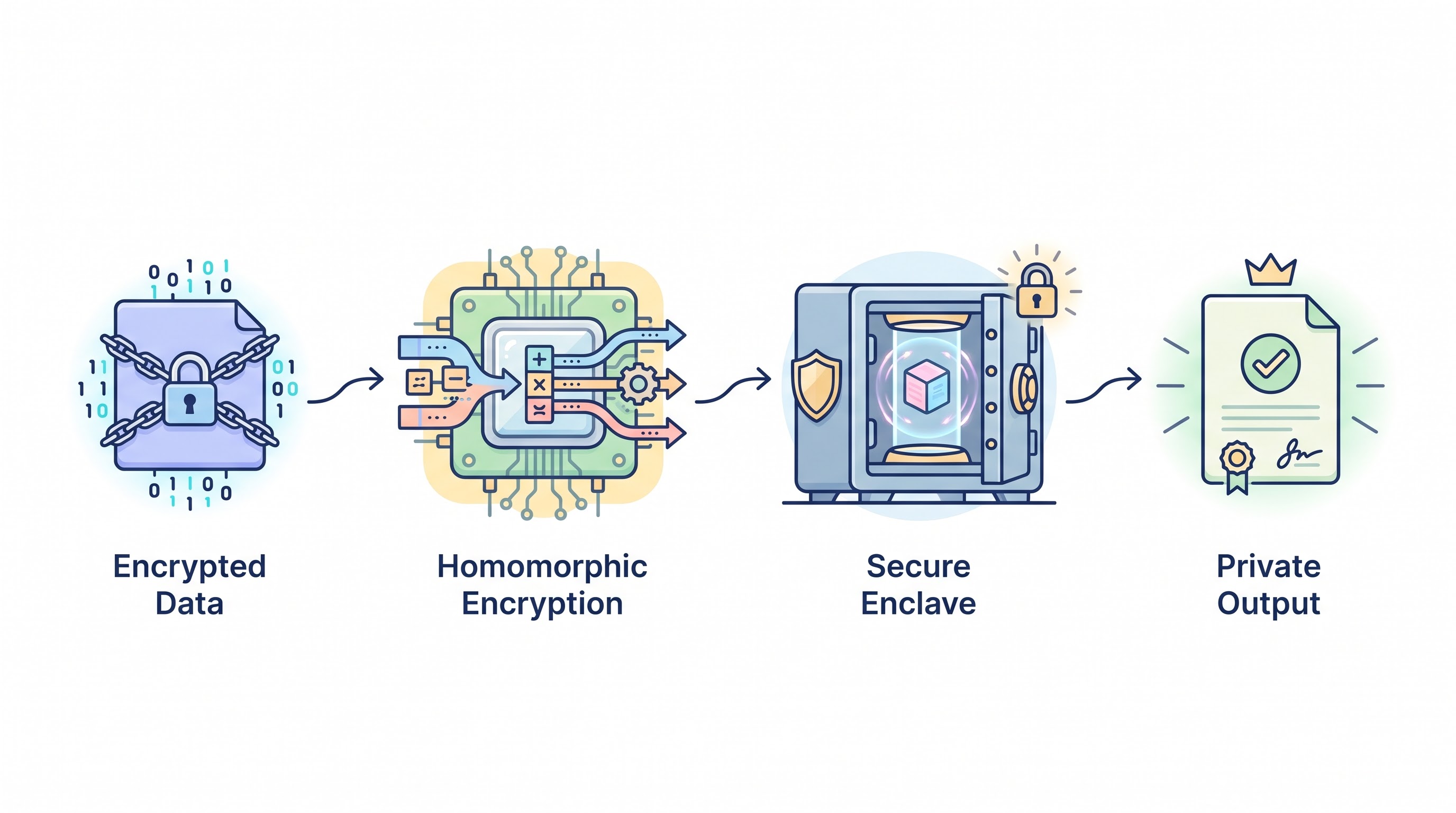
To bypass this regulatory deadlock, enterprises are aggressively pivoting toward Privacy-Preserving Machine Learning (PPML). The 2026 infrastructure market presents two primary architectures to achieve this: hardware-based Trusted Execution Environments (TEEs), colloquially known as Secure Enclaves, and software-based Fully Homomorphic Encryption (FHE). While both paradigms allow an enterprise to execute mathematical functions on data that remains encrypted during compute, their underlying unit economics and infrastructure requirements are diametrically opposed. Treating these two technologies as interchangeable security features is a profound financial miscalculation that routinely destroys project gross margins.
Secure Enclaves (like AWS Nitro or Azure Confidential VMs) rely on physical silicon isolation. They inject a relatively low compute overhead (typically 15% to 25% ) but require absolute trust in the hyperscaler's hardware supply chain and microcode patching cadence, leaving residual vectors for side-channel attacks (e.g., Spectre/Meltdown variants). Conversely, Fully Homomorphic Encryption represents the holy grail of cryptographic computation, relying on advanced lattice-based mathematics to process ciphertext directly with zero hardware trust required. However, the "FHE Tax" is staggering. Unoptimized FHE pipelines introduce a compute penalty ranging from 1,000x to 10,000x, transforming a sub-second, fraction-of-a-cent classical inference request into a multi-minute, highly expensive HPC operation.
A mature FinOps strategy in 2026 demands the implementation of the Cryptographic Compute Arbitrage (CCA) Framework. This framework forces infrastructure leaders to quantify the exact financial penalty of cryptographic computation and mathematically weigh it against the expected commercial yield of the previously inaccessible data. By profiling the depth of the polynomial approximations required for the AI model and calculating the exact hardware acceleration (e.g., utilizing custom FHE ASICs or GPU acceleration like cuFHE), FinOps teams can establish a rigid break-even threshold. This playbook provides the specific equations required to govern PPML, ensuring that the cost of cryptographic privacy never exceeds the commercial value of the underlying algorithmic output, thereby defending gross margins in highly regulated markets.
2. Market Gap & Search Intent Failure Analysis
Enterprise research targeting "Confidential AI pricing" or "FHE vs Secure Enclaves" is saturated with theoretical academic papers and vendor marketing that obfuscates the operational reality of cloud billing. Search queries return cryptography whitepapers detailing the noise-growth mechanics of the TFHE scheme, or hyperscaler blogs claiming that "Confidential VMs offer seamless security for zero application refactoring."
The market gap lies in the total absence of applied cloud unit economics. Academic papers ignore the fact that leasing a fleet of p5.48xlarge GPU instances to accelerate FHE bootstrapping costs $98 per hour per node. Hyperscaler blogs ignore the profound architectural friction of rewriting CI/CD pipelines to build isolated Enclave Image Files (EIFs) and the massive operational cost of establishing decentralized key ceremonies. Analysts fail to provide the mathematical formulas required to calculate the exact Cost Per Encrypted Inference ($CPEI$). Without these models, engineering teams default to deploying deep neural networks on FHE, instantly incinerating cloud budgets when the compute complexity scales exponentially with circuit depth. This playbook bridges that gap, converting theoretical cryptographic overhead into hard financial ledgers and actionable routing logic.
3. Core Strategic Framework
The enterprise must operationalize the Cryptographic Compute Arbitrage (CCA) Framework. This framework dictates that the selection of privacy-preserving infrastructure is strictly governed by the algorithmic circuit depth, the latency SLA, and the mathematical monetization value of the dataset.
Implementation Protocol:
Model Depth Profiling: Audit the proposed AI workload. Translate the neural network into an equivalent Boolean or arithmetic circuit. Calculate the multiplicative depth (the number of consecutive multiplications), which directly drives FHE noise growth and bootstrapping compute costs.
Infrastructure Baselining: Benchmark the exact inference execution time and compute cost of the model across three tiers: Plaintext (Baseline), Secure Enclave (Hardware TEE), and FHE (Software Lattice).
Monetization Yield Calculation: Quantify the net-new revenue or risk-reduction value generated by unlocking the regulated data.
Execution Decision Matrix:
If Multiplicative Depth is shallow (e.g., XGBoost, simple linear regression) AND regulatory posture strictly prohibits hardware trust, route execution to FHE accelerated by GPUs.
If Multiplicative Depth is deep (e.g., 70B parameter LLM inference) AND latency SLA is
$< 500\text{ms}$, FHE is mathematically banned. Execution must route exclusively to Confidential VMs (TEEs) backed by external FIPS 140-3 HSMs.If the calculated
$CPEI$for either PPML architecture exceeds the expected revenue per transaction ($Yield_{txn}$), the project is immediately suspended. The enterprise must abandon the AI feature and accept the data silo.
4. Financial Modeling Layer (MANDATORY)
To prevent cryptographic computation from destroying SaaS margins, FinOps leaders must govern deployments using precise mathematical constraints.
Core Equations
1. Fully Burdened FHE Inference Cost ($C_{fhe\_txn}$):
Calculates the exact cloud compute cost to execute a single inference utilizing Fully Homomorphic Encryption, explicitly accounting for the bootstrapping overhead.
$$C_{fhe\_txn} = \left( \frac{T_{base\_ms} \times M_{fhe\_penalty} \times (1 + R_{bootstrapping\_freq})}{3,600,000} \right) \times P_{hpc\_compute\_hr}$$Where:
$T_{base\_ms}$= Milliseconds required for a plaintext inference.$M_{fhe\_penalty}$= The native compute multiplier for FHE operations (historically$10^3$to$10^4$, heavily dependent on compiler optimization).$R_{bootstrapping\_freq}$= The frequency of bootstrapping operations required to reset cryptographic noise, driven entirely by circuit depth.$P_{hpc\_compute\_hr}$= The hourly cost of the specialized hardware (GPUs/FPGAs) required to accelerate polynomial ring multiplications.
2. Cryptographic Arbitrage Margin ($M_{crypto\_arb}$):
Determines the financial viability of utilizing hardware Secure Enclaves versus software FHE for a specific multi-party computation.
$$M_{crypto\_arb} = (C_{fhe\_txn} \times V_{txn\_vol}) - \left( (C_{tee\_txn} \times V_{txn\_vol}) + CapEx_{hsm\_key\_brokerage} + P_{side\_channel\_risk\_exposure} \right)$$Where:
$C_{tee\_txn}$= The per-transaction cost inside a Trusted Execution Environment (typically 1.2x the plaintext cost).$CapEx_{hsm\_key\_brokerage}$= Capital cost of deploying decentralized external key management to guarantee enclave isolation.$P_{side\_channel\_risk\_exposure}$= Quantified financial exposure of a microcode vulnerability compromising the hardware enclave.
3. Data Monetization Break-Even ($Yield_{be}$):
Calculates the absolute minimum revenue that must be extracted from the newly accessible regulated data to justify the structural premium of PPML infrastructure.
$$Yield_{be} = \frac{(C_{ppml\_txn} - C_{plaintext\_txn}) \times V_{annual\_txns} + C_{engineering\_crypto\_refactor}}{V_{annual\_txns}}$$A) Sensitivity Analysis Table
This table models the Monthly Infrastructure Cost of processing 10 Million API requests for a logistic regression model trained on highly sensitive cross-border banking data, comparing architectural pathways.
Architecture Choice | Compute Premium Multiplier | Monthly Infrastructure Cost | Board-Level Risk Posture |
Plaintext (Non-Compliant) | 1.0x (Baseline) | $4,000 | Extreme Legal/CSRD Risk (Unviable) |
AWS Nitro Enclaves (TEE) | 1.25x (Memory/CPU drag) | $5,000 + $2k Key Brokerage | Acceptable, relies on Amazon hardware trust |
CPU-Based FHE (OpenFHE) | 2,500x (Math overhead) | $10,000,000 | Financially Catastrophic (Bankrupts project) |
GPU-Accelerated FHE | 150x (cuFHE optimized) | $600,000 | Highly secure, requires massive revenue yield |
Decision Threshold: Utilizing CPU-bound FHE for high-volume synchronous inference is a guaranteed margin destruction event. FHE must be strictly accelerated via GPUs/FPGAs, and even then, the project requires a $Yield_{be}$ that is at least 150x higher than traditional SaaS API endpoints. If the data does not justify a $600k monthly premium, force the architecture to Secure Enclaves.
B) Break-Even Formula
The Cryptographic Circuit Depth Threshold ($Depth_{max}$) defines the maximum algorithmic complexity an enterprise can deploy to FHE before the cost of noise-reduction bootstrapping exceeds the cloud budget constraint.
$$Depth_{max} = \frac{Budget_{max\_txn\_cost} \times 3,600,000}{T_{gate\_operation\_ms} \times P_{compute\_hr} \times C_{bootstrap\_penalty\_factor}}$$Numerical Example: A business unit is willing to pay a maximum of $0.50 per encrypted inference transaction. The GPU compute node costs $15.00/hr. A single homomorphic gate operation takes 5ms. The bootstrapping penalty factor is 10. $Depth_{max} = (\$0.50 \times 3,600,000) / (5 \times \$15 \times 10) = 1,800,000 / 750 = 2,400\text{ sequential operations}$. If the proposed neural network requires a depth of 5,000 sequential multiplications, it violates the financial limit and will cost $>\$1.00$ per inference. The data science team must aggressively prune the model to a depth of $<2,400$ before FinOps approves deployment.
C) Probability-Weighted Risk Table
Quantifying the financial exposure of deploying privacy-preserving infrastructure.
Scenario | Probability | Financial Impact | Weighted Exposure |
TEE Side-Channel Attack (Hardware breach) | 4.0% / yr | $15,000,000 (Reg fines/Brand) | $600,000 per year |
FHE Compute Runaway (Unoptimized loops) | 45.0% / mo | $120,000 (Cloud GPU burn) | $54,000 per month |
Key Ceremony Synchronization Failure | 15.0% / yr | $45,000 (System downtime) | $6,750 per year |
Unquantized Model FHE Deployment | 60.0% / proj | $250,000 (Wasted engineering) | $150,000 per project |
D) Cost-per-Unit Model
The central metric for Confidential AI is the Cost Per Encrypted Inference (CPEI):
$$CPEI = \frac{Total\_Confidential\_Compute\_Spend + Key\_Management\_OpEx}{Total\_Successful\_Zero-Knowledge\_Inferences}$$Threshold: If $CPEI$ exceeds the direct revenue generated by the API call, the architecture is financially toxic. The engineering team must transition from synchronous FHE API calls to asynchronous, batch-processed FHE over Spot instances to collapse the compute premium.
5. Operational Architecture Integration
GPU-Accelerated Fully Homomorphic Encryption (cuFHE / Zama):
Attempting to execute FHE on standard CPU architectures (e.g., AWS m6i) is mathematically equivalent to mining Bitcoin on a laptop; the unit economics are disastrous. Operational architecture requires specialized acceleration. Enterprises must deploy FHE compilers (like Zama's Concrete or OpenFHE) strictly targeting multi-GPU clusters (e.g., p5 or g5 instances) utilizing specialized libraries like NVIDIA cuFHE. Because FHE relies heavily on Fast Fourier Transforms (FFTs) for polynomial ring multiplication, GPUs can execute these operations with massive parallelism. This architectural mandate physically drops the $M_{fhe\_penalty}$ from 10,000x down to 100x-150x, moving FHE from a theoretical novelty to a commercially viable (albeit expensive) batch processing tool.
Decentralized Key Brokerage for Trusted Execution Environments (TEEs):
If the CCA matrix dictates the use of Secure Enclaves (e.g., Azure Confidential VMs utilizing AMD SEV-SNP), the enterprise cannot rely on the cloud provider's native Key Management Service (KMS). If the hyperscaler controls both the physical hardware and the decryption keys, digital sovereignty is compromised, and the enterprise remains exposed to government subpoenas against the cloud provider. Architecture must inject an External Key Management (EKM) broker. The Confidential VM boots, generates a cryptographic attestation of its hardware state, and sends this attestation to an external, physically isolated FIPS 140-3 HSM owned by the enterprise. Only if the attestation perfectly matches the expected cryptographic hash does the external HSM release the decryption keys directly into the enclave's isolated memory space.
Model Quantization and FHE Pruning:
FHE does not natively support floating-point arithmetic (FP32); it computes on encrypted integers. Therefore, architecture teams cannot simply "lift and shift" standard PyTorch models into an FHE environment. The FinOps pipeline must enforce a strict CI/CD gate: all models destined for FHE must undergo aggressive Post-Training Quantization (PTQ) or Quantization-Aware Training (QAT), reducing parameters to INT8 or INT4. Furthermore, developers must replace complex activation functions (like ReLU or Sigmoid) with low-degree polynomial approximations. If a CI/CD pipeline detects a model exceeding the $Depth_{max}$ threshold, it automatically rejects the build to prevent runaway GPU billing.
6. Failure Scenarios
Scenario 1: The FHE "Lift and Shift" GPU Hemorrhage
Breakdown: A healthcare startup secures a contract to provide diagnostic AI on encrypted patient records. Without optimizing the model, the engineering team uses an FHE compiler to translate a massive ResNet-50 vision model directly into an encrypted circuit. They deploy it to an AWS p4d.24xlarge GPU cluster.
Financial Exposure: The depth of ResNet-50 requires continuous, massive cryptographic bootstrapping. A single inference takes 14 minutes and burns $8.00 in raw GPU compute. The startup's contract pays $1.50 per diagnostic. They lose $6.50 on every API call, draining their venture capital runway in 60 days.
Governance Prevention Layer: FinOps Algorithmic Auditing. No FHE workload is permitted to enter production without a mathematically certified
$CPEI$profile. Models must be rewritten specifically for FHE (e.g., using specialized low-depth architectures like CryptoNets) to ensure the inference execution time strictly respects the$Yield_{be}$threshold.
Scenario 2: The Nitro Enclave Egress Trap
Breakdown: An enterprise utilizes AWS Nitro Enclaves to securely process PII. Nitro Enclaves intentionally lack persistent storage and interactive network access to guarantee isolation. To process a 10 TB dataset, the primary EC2 instance continually fetches chunks from S3, passes them over the local vsock to the Enclave, retrieves the result, and pushes it back to S3.
Financial Exposure: The architectural overhead of continuously shuffling 10 TB of data through the narrow vsock interface causes massive CPU wait times on the expensive primary EC2 instance. The processing job takes 4x longer than expected, resulting in $30,000 of wasted EC2 uptime.
Governance Prevention Layer: Localized Data Topologies. Architecture must dimension the primary EC2 instance to hold the entire encrypted dataset on local NVMe instance store volumes before initiating the Enclave processing loop. This eliminates network latency and vsock bottlenecking, compressing the compute window and slashing the TCO.
Scenario 3: The Fake Confidentiality SLA Breach
Breakdown: A company markets a "Zero-Knowledge" SaaS application using Azure Confidential VMs. However, the engineering team configures the application to log raw crash dumps and unencrypted application telemetry directly to a centralized Datadog agent running outside the enclave to aid in debugging.
Financial Exposure: The telemetry stream leaks plaintext PII. A regulatory audit discovers the breach. The enterprise is hit with a $10M GDPR fine for deceptive marketing and failing to maintain data localization requirements, instantly destroying enterprise value.
Governance Prevention Layer: Cryptographic Egress Firewalls. Confidential enclaves must be governed by strict network policies that mathematically block any outbound connection that is not cryptographically signed and encrypted with a designated egress key. Debugging agents must be strictly banned from accessing enclave memory space.
7. Board-Level Translation Layer
EBITDA Delta Modeling: Privacy-Preserving Machine Learning is fundamentally a revenue-expansion strategy, unlocking highly regulated data (e.g., banking, healthcare) for multi-party monetization. By strictly enforcing the CCA framework, the C-suite guarantees that the massive infrastructure premiums associated with FHE and TEEs (which directly attack gross margins) are entirely offset by the net-new EBITDA generated from the unlocked data pools.
Gross Margin Defense: If a platform blindly integrates FHE without GPU optimization and polynomial pruning, the compute COGS will spike exponentially, destroying unit economics. The board must mandate that FinOps explicitly tracks the Cost Per Encrypted Inference (
$CPEI$) and halts any feature where$CPEI > Yield_{be}$, protecting the company from selling features at a structural loss.Capital Allocation Signal: The decision to invest in FHE vs TEEs is a risk-hedging mechanism. Investing heavily in TEEs implies acceptance of hardware supply-chain risk. Investing in FHE indicates zero-trust paranoia. The board must allocate capital based on the regulatory environment: if operating in ultra-strict sovereign defense sectors, the high CapEx of GPU-accelerated FHE is a mandatory cost of doing business.
Risk-Adjusted ROI Formula:
$$ROI_{confidential\_ai} = \frac{\text{Net Revenue from Regulated Data Monetization} - (C_{fhe\_txn} \times V_{txn})}{\text{CapEx of GPU Infrastructure} + \text{Cost of Cryptographic Refactoring}}$$
8. Data Visualization Suggestions
Cryptographic Arbitrage Margin Matrix: A 2D scatter plot where X-axis is Algorithmic Circuit Depth and Y-axis is Commercial Yield per Transaction. The chart is divided into three distinct zones: "Plaintext (Non-Regulated)", "Hardware TEE (Deep Circuits)", and "Software FHE (Shallow, High-Yield)".
FHE Compute Penalty Waterfall: A visual waterfall chart starting with the massive 10,000x CPU penalty of raw FHE, showing step-down reductions achieved by Model Quantization (INT4), Polynomial Pruning, and GPU Hardware Acceleration, resulting in a manageable 100x final penalty.
Secure Enclave Architecture Diagram: A zero-trust topology diagram showcasing an AWS Nitro Enclave completely severed from the internet, receiving cryptographic attestation keys securely from a remote, on-premises HSM across a private direct connect.
CPEI vs Revenue Break-Even Graph: A line chart plotting the Cost Per Encrypted Inference against the expected Revenue Yield over a 12-month timeline, highlighting the break-even date where the engineering optimization catches up to the compute premium.
Multiplicative Depth Impact Curve: An exponential curve demonstrating how the cost of FHE noise bootstrapping explodes exponentially as the sequential depth of a neural network increases, serving as a visual warning against deep FHE deployments.
9. Why Analyst-Style Summaries Fail at Financial Precision
When technology analysts publish reports stating, "Enterprises should adopt Fully Homomorphic Encryption to securely train AI models on private data without risking exposure," they are dispensing theoretical cryptography advice that is functionally bankrupt in a corporate cloud environment.
This narrative fails because it ignores the laws of computational physics. An analyst report does not calculate the Fully Burdened FHE Inference Cost ($C_{fhe\_txn}$). If a FinOps Director follows this unquantified advice and attempts to train an LLM using raw FHE on a standard cloud cluster, the compute bill will exhaust the company’s annual IT budget in a single month, and the training job will take decades to complete.
Equation-backed modeling using the Cryptographic Compute Arbitrage (CCA) framework destroys this theoretical fantasy. By explicitly calculating the Data Monetization Break-Even ($Yield_{be}$) and the Cryptographic Circuit Depth Threshold ($Depth_{max}$), enterprise leaders force data scientists to confront the financial limitations of lattice cryptography. It mathematically dictates that you cannot execute complex, deep networks on FHE; you must aggressively prune, quantize, and hardware-accelerate. You cannot conquer regulated markets with cryptographic theory; you conquer them with ruthless, dimensionally-constrained unit economics.
10. Strategic Conclusion
The 2026 enterprise mandate for data privacy has escalated beyond standard encryption-at-rest. The ability to compute directly on encrypted data—enabling multi-party analytics, secure cross-border AI inference, and zero-knowledge SaaS platforms—is a profound competitive advantage. However, Privacy-Preserving Machine Learning (PPML) is the most computationally expensive architectural shift in modern cloud history.
To safely deploy Confidential AI without destroying corporate gross margins, FinOps and Security leaders must enforce the Cryptographic Compute Arbitrage (CCA) Framework. Enterprises must surgically choose their privacy vectors based entirely on mathematical boundaries. Hardware-based Secure Enclaves (TEEs) provide a highly viable, low-cost path for deep algorithms, provided the enterprise is willing to architect external key management to mitigate supply-chain trust issues.
Conversely, Fully Homomorphic Encryption offers absolute mathematical certainty and zero hardware trust, but at a catastrophic compute premium. FHE is strictly financially viable only when the target neural network is aggressively shallow, heavily quantized, and perfectly aligned with specialized GPU/FPGA acceleration. By rigorously tracking the Cost Per Encrypted Inference ($CPEI$), enterprises ensure that the structural premium paid for absolute cryptographic privacy never outstrips the commercial value of the underlying data. Ultimately, confidential computing is an exercise in extreme financial leverage; it must be governed by unbreakable mathematical constraints.
11. Implementation Readiness Checklist
Define the Enterprise PPML Taxonomy: Formally classify which internal datasets require TEEs (Secure Enclaves) versus which mandate absolute zero-trust FHE based on strict regulatory and sovereignty frameworks.
Calculate the Baseline
$CPEI$: Deploy a benchmark classification model across AWS Nitro, Azure Confidential VMs, and a GPU-accelerated FHE library (like Zama) to establish exact baseline compute multipliers.Deploy External Key Brokers: Procure physical HSMs (FIPS 140-3) and deploy them in colocation facilities to decouple decryption key authority from the hyperscalers hosting the Confidential VMs.
Enforce FHE Model Quantization: Configure CI/CD pipelines to mathematically block the deployment of any model destined for FHE that utilizes FP32 parameters or un-approximated non-linear activation functions.
Calculate
$Depth_{max}$for all Projects: Force data science teams to submit the multiplicative depth of their proposed neural networks to FinOps for budget approval before any cloud compute is allocated.Procure GPU-Accelerated FHE Libraries: Transition all FHE R&D away from CPU-bound libraries (e.g., standard SEAL/OpenFHE implementations) to GPU-native environments (cuFHE) to compress the
$M_{fhe\_penalty}$.Implement Egress-Locked Vsock Topologies: Architect TEE deployments to hold data locally on NVMe stores, ensuring the enclave utilizes high-speed internal sockets rather than throttling on network API calls.
Execute the Monetization Yield Formula: Require product managers to mathematically prove that the new revenue generated by a confidential AI feature exceeds the
$Yield_{be}$break-even point.Automate TEE Attestation Drills: Run continuous chaos engineering drills that intentionally corrupt the cryptographic hash of an enclave image, verifying that the external HSM successfully denies the key release.
Establish the Cryptographic FinOps Dashboard: Integrate the specialized compute costs of p5 instances running FHE and the overhead of Nitro enclaves into the central FOCUS billing data lake for real-time margin tracking.
Stop guessing where your Kubernetes budget is going. Schedule a demo here to explore Kubernetes cost monitoring with Cloud Atler.