
1. Executive Synthesis
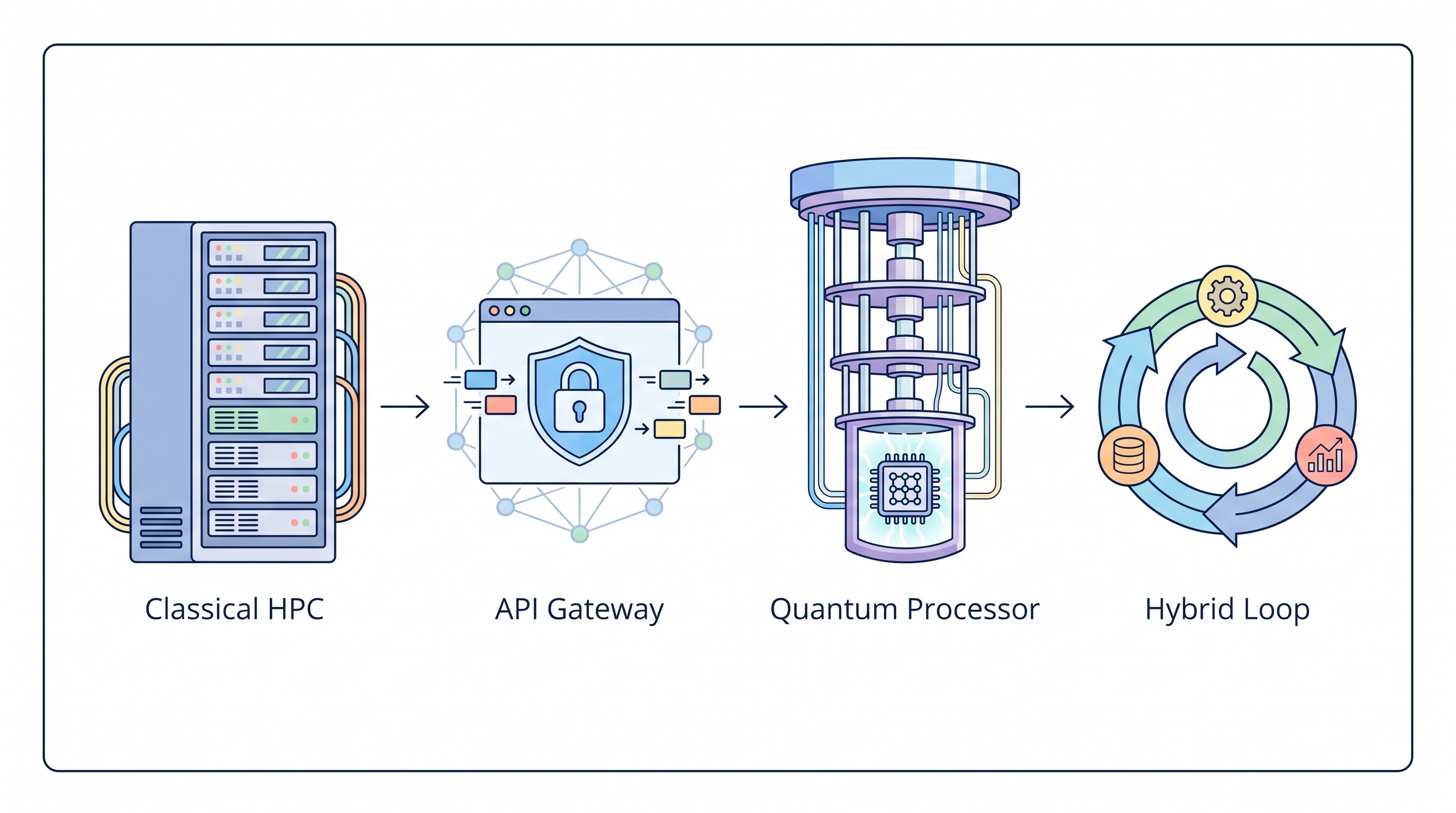
As quantum computing transitions from theoretical physics into commercial execution via Quantum-as-a-Service (QaaS) platforms, enterprise technology leaders face an entirely novel financial and risk operational vector. By 2026, hybrid classical-quantum algorithms—such as the Variational Quantum Eigensolver (VQE) and Quantum Approximate Optimization Algorithm (QAOA)—are actively utilized in production pipelines for complex financial portfolio optimization, molecular dynamics simulation, and supply chain routing.
However, QaaS operates on a radically different unit cost structure than classical compute. Hyperscaler QaaS portals bill not on continuous CPU/GPU server hours, but on a combination of Task Gate Operations, Circuit Execution Shots, and QPU (Quantum Processing Unit) Allocation Seconds. Because hybrid quantum algorithms operate in iterative loops—where a classical computer optimizes parameters, submits thousands of circuit execution shots to a QPU, evaluates the error rates, and repeats the process—a single misconfigured algorithmic loop can generate tens of thousands of dollars in QaaS charges in minutes.
Simultaneously, the impending arrival of cryptanalytically relevant quantum computers (CRQCs) imposes a massive, non-negotiable capital requirement: Post-Quantum Cryptography (PQC) Migration. Organizations that fail to mathematically model their cryptographic migration velocity expose their stateful data to "Harvest Now, Decrypt Later" (HNDL) attacks, creating catastrophic legal and regulatory liability.
This playbook provides the financial and architectural mechanics required to navigate the QaaS landscape. It introduces the Hybrid Quantum Financial Allocation (HQFA) Framework, enabling enterprise architects and FinOps teams to calculate the exact point where a quantum algorithm demonstrates a measurable Quantum Economic Advantage (QEA) over classical HPC clusters. Furthermore, it details the capital allocation models required to execute a phased PQC migration, ensuring the enterprise achieves quantum resilience without bankrupting the R&D budget.
2. Market Gap & Search Intent Failure Analysis
Current literature regarding "Quantum Computing TCO" or "QaaS Pricing" suffers from an extreme dichotomy: it is either written by quantum physicists focusing entirely on algorithmic fidelity and coherence times ($T_1$ and $T_2$), or by vendor marketing teams offering generalized claims about future quantum supremacy.
The structural market gap is the total lack of Hybrid Loop Financial Modeling. Standard search results yield no operational guidance on how to manage the financial volatility of hybrid classical-quantum iterative algorithms. Analysts ignore the "Error Mitigation Cost Multiplier"—the fact that running quantum error mitigation techniques (such as Zero-Noise Extrapolation) requires scaling the number of submitted QPU shots by a factor of 3x to 10x, directly multiplying the cloud bill. Furthermore, existing cybersecurity frameworks fail to provide formulas that link PQC migration CapEx directly to data sensitivity half-lives. This playbook fills these critical gaps with executable mathematical models.
3. Core Strategic Framework
The enterprise must adopt the Hybrid Quantum Financial Allocation (HQFA) Framework. This framework governs the execution of quantum workloads, enforcing strict financial controls over QPU shot submissions and algorithm optimization loops.
+-----------------------------------------------------------------------------------+
|                        HQFA WORKLOAD ROUTING PIPELINE                             |
+-----------------------------------------------------------------------------------+
                                          |
                                          v
                         +----------------------------------+
                         |  Define Problem & Target Accuracy|
                         +----------------------------------+
                                          |
                                          v
                         +----------------------------------+
                         |  Estimate Classical HPC Cost     |
                         |  (GPUs/CPUs required for run)    |
                         +----------------------------------+
                                          |
                                          v
                         +----------------------------------+
                         |  Calculate QPU Cost (HQFA Eq. 1) |
                         |  (Shots * Rate + Task Premium)   |
                         +----------------------------------+
                                          |
                                          v
                         +----------------------------------+
                         |  Run Quantum Economic Advantage  |
                         |  Test (QEA Check: Eq. 2)         |
                         +----------------------------------+
                                   /              \
                                  /                \
                    QEA > 1.25   /                  \   QEA <= 1.25
                                /                    \
                               v                      v
              +----------------------------------+  +----------------------------------+
              | Execute Hybrid Quantum Loop      |  | Route to Classical GPU Cluster   |
              | (Enforce Shot Cap Circuit-Breaker|  | (CuQuantum / Tensor Networks)    |
              +----------------------------------+  +----------------------------------+
Implementation Protocol:
Algorithmic Profiling: Require quantum software engineers to submit a formal mathematical profile of any proposed algorithm, specifying target qubit count, circuit depth, and required shot density (
$N_{shots}$).Execute Classical Emulation Pre-Screen: Force all quantum circuits to run through classical tensor network simulators (e.g., NVIDIA cuQuantum) to verify convergence before submitting to physical QPUs.
Set Hard QPU Shot Circuit-Breakers: Instrument AWS Braket or Azure Quantum API wrappers to enforce strict execution limits per algorithm run.
Decision Matrix:
If
$QEA > 1.25$(Quantum algorithm provides a$>25\%$cost-to-performance advantage over classical HPC), authorize QPU execution.If
$QEA \le 1.25$AND the workload is not an explicitly approved R&D project, force execution onto classical GPU tensor networks.If an iterative VQE loop fails to converge within
$N_{iterations} = 50$, automatically abort the job to prevent runaway QPU shot accumulation.
4. Financial Modeling Layer (MANDATORY)
The financial control of QaaS platforms demands strict mathematical equations that account for non-deterministic quantum execution mechanics.
Core Equations
1. Fully Burdened QaaS Execution Cost ($C_{qaas}$):
Calculates the exact billing charge incurred for a hybrid classical-quantum algorithmic run.
$$C_{qaas} = \sum_{i=1}^{n} \left( P_{task\_fee} + (N_{shots\_i} \times P_{shot}) + (T_{qpu\_sec\_i} \times P_{qpu\_sec}) \right) \times M_{error\_mitigation}$$Where:
$P_{task\_fee}$= Base fee per quantum task submission (charged by AWS Braket/Azure Quantum).$N_{shots}$= Number of times the quantum circuit is measured (typically 1,000 to 100,000 per iteration).$P_{shot}$= Unit price per QPU shot (varies based on hardware: superconducting vs trapped ion vs neutral atom).$T_{qpu\_sec}$= Total physical QPU time consumed.$P_{qpu\_sec}$= Rate per QPU second.$M_{error\_mitigation}$= Multiplier for zero-noise extrapolation or probabilistic error cancellation (typically 2.0x to 8.0x).
2. Quantum Economic Advantage Ratio ($QEA$):
Determines if utilizing a Quantum Processing Unit is financially justified compared to executing the same problem on a classical HPC cluster.
$$QEA = \frac{C_{classical\_hpc\_total}}{C_{qaas\_total}}$$Where:
$C_{classical\_hpc\_total}$= Fully burdened cost to solve the problem to target accuracy on classical GPUs/CPUs.
3. PQC Migration Value at Risk ($VaR_{pqc}$):
Quantifies the financial risk exposure of stateful data assets subject to "Harvest Now, Decrypt Later" (HNDL) attacks based on data longevity and migration timeline.
$$VaR_{pqc} = \sum_{d=1}^{k} \left( Value_{data\_d} \times P_{crqc\_break\_timeline} \right) \times \left( 1 - \frac{V_{migration\_completed}}{V_{total\_sensitive\_assets}} \right)$$A) Sensitivity Analysis Table
This table models the financial cost of a 100-iteration hybrid VQE algorithm run across different QPU hardware architectures and Error Mitigation levels.
Hardware Architecture | Base Shots (1k/iter, No Mitigation) | Med Mitigation (3k/iter, 2x Overhead) | High Mitigation (10k/iter, 5x Overhead) | Financial Impact |
Superconducting ($0.30/task, $0.00035/shot) | $38.00 / run | $240.00 / run | $1,900.00 / run | Highly economical for testing |
Trapped Ion ($0.30/task, $0.01/shot) | $1,030.00 / run | $6,060.00 / run | $50,300.00 / run | Requires strict shot governance |
Neutral Atom ($0.30/task, $0.001/shot) | $103.00 / run | $630.00 / run | $5,150.00 / run | Optimal for mid-depth circuits |
Decision Threshold: Submitting un-optimized circuits with high error mitigation requirements to Trapped Ion hardware without setting shot caps will destroy R&D budgets within hours. Iterative tuning MUST occur on classical simulators first.
B) Break-Even Formula
The Quantum Convergence Break-Even ($N_{max\_shots}$) defines the absolute maximum number of QPU shots an algorithm can consume before the run exceeds the allocated budget for classical HPC alternatives.
$$N_{max\_shots} = \frac{C_{classical\_hpc\_budget} - (N_{iter} \times P_{task\_fee})}{N_{iter} \times P_{shot} \times M_{error\_mitigation}}$$Numerical Example: A classical GPU cluster can solve an optimization problem for $5,000. On a Trapped Ion QPU ($0.30/task, $0.005/shot, 2x Error Mitigation), the algorithm requires 50 iterations. $N_{max\_shots} = (\$5,000 - \$15) / (50 \times \$0.005 \times 2) = \$4,985 / \$0.50 = 9,970\text{ shots per iteration}$. If the algorithm requires 20,000 shots per iteration to resolve noise, quantum execution is mathematically unviable; route back to HPC.
C) Probability-Weighted Risk Table
Quantifying the operational and security risks of the quantum transition.
Scenario | Probability | Financial Impact | Weighted Exposure |
Unbounded VQE Loop (Runaway QaaS Bill) | 18.0% / year | $45,000 (Unexpected cloud bill) | $8,100 per team |
CRQC Early Arrival (HNDL Data Leak) | 5.0% / 3-yr | $50,000,000 (Catastrophic breach) | $833,333 per year |
PQC Algorithm Performance Penalty | 40.0% / project | $150,000 (Latency & CPU overhead) | $60,000 per project |
QaaS Hardware Reservation Stranding | 12.0% / year | $80,000 (Unused QPU capacity) | $9,600 per year |
D) Cost-per-Unit Model
The central unit metric for Quantum FinOps is the Cost Per Validated Circuit Execution (CPVCE):
$$CPVCE = \frac{C_{qaas\_total}}{Total\_Converged\_Quantum\_Circuits}$$Threshold: If $CPVCE > \$500.00$ for standard 20-qubit optimization circuits, the algorithm is suffering from severe decoherence or noise. The job must be pulled from the QPU and refactored.
5. Operational Architecture Integration
Hardware-Agnostic Compilation Layers (Qiskit / PennyLane / Cirq):
Directly coding quantum circuits against a specific vendor's physical QPU API creates severe financial lock-in and leaves the enterprise vulnerable to hardware outages or price increases. Modern quantum architecture requires decoupling the algorithmic layer from the physical backend using hardware-agnostic SDKs (e.g., Qiskit, PennyLane, or Q#). The compiler evaluates the target circuit, translates it into the native gate set of the target QPU (e.g., 1-qubit rotations and 2-qubit MS gates for ion traps, or CZ gates for superconductors), and dynamically selects the cheapest hardware backend that satisfies the required fidelity threshold.
+-----------------------------------------------------------------------------------+
|               HARDWARE-AGNOSTIC QUANTUM COMPILATION ARCHITECTURE                  |
+-----------------------------------------------------------------------------------+
   +-----------------------------------------------------------------------------+
   |                       Application Layer (VQE / QAOA)                        |
   +-----------------------------------------------------------------------------+
                                          |
                                          v
   +-----------------------------------------------------------------------------+
   |                Abstract Circuit Representation (PennyLane/Qiskit)           |
   +-----------------------------------------------------------------------------+
                                          |
                                          v
   +-----------------------------------------------------------------------------+
   |               HQFA Financial & Fidelity Router (Calculates QEA)             |
   +-----------------------------------------------------------------------------+
                               /          |          \
                              /           |           \
                             /            |            \
                            v             v             v
             +------------------+  +------------------+  +------------------+
             | Superconducting  |  |   Trapped Ion    |  | Classical GPU    |
             | Target (Low Cost)|  |  (High Fidelity) |  | Simulator        |
             |                  |  |                  |  | (cuQuantum)      |
             +------------------+  +------------------+  +------------------+
Post-Quantum Cryptography (PQC) Key Management Integration:
To mitigate the $VaR_{pqc}$ risk, enterprise architects must prepare for the NIST-standardized Post-Quantum Cryptography algorithms (e.g., ML-KEM for key encapsulation and ML-DSA for digital signatures). Implementing PQC is an architectural challenge: PQC key sizes and ciphertext lengths are significantly larger than legacy RSA/ECC keys. For example, an ML-KEM-768 public key is 1,184 bytes, compared to 32 bytes for ECC Curve25519. This increase impacts network packet fragmentation, TLS handshake latency, and Hardware Security Module (HSM) storage capacity. The architecture must deploy crypto-agile key management abstraction layers that can swap underlying cryptographic primitives without requiring code rewrites across microservices.
QaaS Telemetry Ingestion to FOCUS Data Lake:
AWS Braket and Azure Quantum billing exports emit unique metadata structure payloads (containing jobArn, deviceArn, shotCount, billedExecutionTime). The FinOps data architecture must construct specific dbt parsing models that extract these raw parameters and map them to the unified FOCUS 1.2 schema under standard EffectiveCost and ListCost structures, tagging them with WorkloadType: Quantum-Experiment or WorkloadType: Production-Hybrid.
6. Failure Scenarios
Scenario 1: The Iterative VQE Financial Explosion
Breakdown: A quantitative finance team deploys a VQE algorithm on an AWS Braket-hosted Trapped Ion QPU to optimize a portfolio. They configure the classical optimizer (e.g., COBYLA) with an overly sensitive convergence tolerance. The classical loop fails to converge due to quantum noise, firing 500 iterations, each requesting 20,000 shots at $0.01/shot.
Financial Exposure: 500 iterations × 20,000 shots ×
$0.01 = $100,000 spent on a single un-converged execution run over a weekend.Governance Prevention Layer: Hard Budget Wrappers & Iteration Caps. Quantum API wrappers must enforce hard execution limits at the SDK level. An automated circuit-breaker cancels any job where cumulative iteration spend exceeds $1,000 or total shots exceed 100,000 without explicitly signed C-level financial override tokens.
Scenario 2: The "Harvest Now, Decrypt Later" Compliance Audit Failure
Breakdown: A healthcare enterprise stores long-lived patient genomic data encrypted with standard RSA-2048 in a public cloud object store. An auditor identifies that the data retention requirement is 30 years, well beyond the projected CRQC break timeline. The company has zero capital allocated for PQC migration and no inventory of its cryptographic assets.
Financial Exposure: Millions in regulatory fines under revised HIPAA/CSRD quantum-readiness mandates, plus catastrophic legal exposure if the encrypted data is exfiltrated by a hostile actor.
Governance Prevention Layer: Crypto-Agility Auditing and PQC Capital Allocation. The Chief Risk Officer must mandate a continuous automated scan of all internal and external TLS/data-at-rest encryption configurations, generating a "Cryptographic Inventory" that maps data sensitivity half-life against the
$VaR_{pqc}$equation to force phased PQC capital allocation.
Scenario 3: The Classical Emulation Blind Spot
Breakdown: A team submits a 15-qubit circuit directly to a high-cost physical QPU for testing. They do not realize that a 15-qubit circuit can be perfectly, deterministically simulated on a standard laptop CPU in milliseconds for $0.00.
Financial Exposure: Wasting thousands of dollars in QPU execution fees for low-qubit circuits that offer zero quantum advantage over classical computation.
Governance Prevention Layer: Mandatory Simulation Gating. The QaaS API gateway automatically evaluates circuit qubit count (
$N_{qubits}$) and depth. Any circuit where$N_{qubits} \le 30$is automatically blocked from physical QPU submission and forcibly routed to classical GPU tensor network simulators (e.g., cuQuantum).
7. Board-Level Translation Layer
EBITDA Delta Modeling: Managed QaaS governance prevents catastrophic, un-budgeted R&D cost overruns from hitting the P&L. Simultaneously, the proactive deployment of Post-Quantum Cryptography insulates the enterprise balance sheet from sudden, multi-million dollar regulatory remediation costs or breach liabilities as quantum capabilities mature globally.
Gross Margin Defense: For high-tech manufacturing, logistics, and financial SaaS platforms incorporating quantum optimization features, strict enforcement of the Quantum Economic Advantage (
$QEA$) ratio ensures that quantum API execution fees do not destroy product gross margins. If an algorithm's$QEA < 1.25$, running it on classical GPUs protects unit economics.Capital Allocation Signal: PQC migration requires significant CapEx for HSM upgrades and code refactoring. The board must evaluate PQC migration not as an discretionary IT upgrade, but as a mandatory capital asset protection program designed to defend long-lived corporate intellectual property against state-sponsored exfiltration.
Risk-Adjusted ROI Formula:
$$ROI_{quantum\_gov} = \frac{\left( \text{Avoided Unbounded QaaS Spend} \right) + \left( VaR_{pqc} \times P_{crqc} \right)}{C_{qaas\_management\_tooling} + CapEx_{pqc\_migration}}$$
8. Data Visualization Suggestions
Quantum Economic Advantage (QEA) Decision Tree: A decision diagram mapping algorithmic problem complexity, qubit count, and shot density to binary execution pathways: "Classical GPU Simulator," "Superconducting QPU," or "Trapped Ion QPU."
Hybrid VQE Convergence vs Cost Heatmap: A dual-axis time-series chart showing Classical Parameter Optimization (X-axis) against Cumulative QaaS Cost ($) and Quantum Noise Error Rate (Y-axis), visually highlighting the divergence point where jobs should be killed.
Cryptographic Asset Longevity vs CRQC Timeline Scatter Plot: A scatter plot mapping internal data assets. X-axis is "Data Sensitivity Half-Life (Years)," Y-axis is "Cost to Migrate to PQC." Assets in the upper-right quadrant represent immediate
$VaR_{pqc}$exposure.QaaS Hardware Price-per-Shot Comparison Bar Chart: A logarithmic bar chart comparing the shot and task fees across AWS Braket, Azure Quantum, and direct IBM Quantum backends for standard 1,000-shot workloads.
PQC Key Size & Latency Overhead Impact Diagram: A technical diagram illustrating the byte-size expansion of ML-KEM keys versus legacy RSA/ECC keys, showing the cascading impact on TLS handshakes, network buffer allocation, and memory overhead.
9. Why Analyst-Style Summaries Fail at Financial Precision
Generic analyst summaries discuss quantum computing using broad narratives like "Quantum computing will disrupt industries within the next decade, and organizations must begin experimenting today." This guidance is financially unanchored.
Narrative advice fails because it provides zero operational guidance on how to manage non-deterministic, shot-based billing architectures. If an enterprise follows generic analyst advice and gives an R&D team an open-ended cloud budget to "experiment with quantum algorithms," the team will predictably deploy un-optimized, noisy hybrid loops that generate six-figure cloud bills without proving a single point of quantum advantage.
Precision financial modeling replaces vague experimentation directives with strict algorithmic governance. By enforcing the $QEA$ equation and mandating classical GPU pre-screening for low-qubit circuits, the enterprise transforms quantum R&D from an un-budgeted financial liability into a mathematically controlled capital investment. Financial engineering demands that we measure every quantum shot against its classical alternative before issuing an execution call to the cloud.
10. Strategic Conclusion
The era of quantum computing as a purely academic pursuit is over. The advent of accessible Quantum-as-a-Service (QaaS) platforms empowers enterprises to tackle historically intractable optimization and simulation problems. However, operating within this landscape requires recognizing that QaaS represents a completely novel financial paradigm.
Uncontrolled hybrid classical-quantum algorithms possess an unprecedented capacity for rapid financial drain. To prevent R&D budget destruction, infrastructure and FinOps leaders must implement the Hybrid Quantum Financial Allocation (HQFA) Framework. Quantum execution must be gated by mathematical rigor: low-qubit circuits must be forcibly routed to classical GPU simulators, and physical QPU jobs must operate within hard, automated shot circuit-breakers.
Simultaneously, technology executives must address the silent, existential threat of the quantum transition: Post-Quantum Cryptography (PQC) migration. Waiting for a cryptanalytically relevant quantum computer to arrive before migrating legacy encryption guarantees data exposure under "Harvest Now, Decrypt Later" scenarios. By quantifying $VaR_{pqc}$ and establishing crypto-agile architectures today, enterprise leaders protect long-lived corporate assets. Quantum technology is a transformational competitive advantage, but only for organizations that govern its operational unit economics and risk profiles with absolute mathematical precision.
11. Implementation Readiness Checklist
Establish QaaS API Execution Wrappers: Build or configure an internal API proxy for AWS Braket and Azure Quantum that enforces mandatory max-shot caps (
$N_{max\_shots}$) on every submitted job.Deploy Classical Simulation Pre-Screening: Integrate cuQuantum or Qiskit Aer into the CI/CD pipeline, forcing all circuits with
$<30$qubits to run on classical GPU simulators before granting QPU access.Map QaaS Metadata to FOCUS 1.2:FinOps data lakehouse
Conduct a Cryptographic Inventory Audit: Scan all enterprise data stores and network perimeters to build an automated inventory of active encryption algorithms (RSA, ECC, AES) and key lengths.
Calculate
$VaR_{pqc}$for Sensitive Data: Identify all stateful data assets with a sensitivity lifespan$>10$years and score them against the PQC Value at Risk equation to prioritize migration capital.Code Convergence Circuit-Breakers for Hybrid Loops: Program VQE and QAOA classical optimizers to automatically terminate execution if parameters do not converge within 50 iterations.
Pilot Crypto-Agile Abstraction Layers: Refactor key microservices to interface with cryptographic abstraction layers that support NIST-approved PQC algorithms (ML-KEM, ML-DSA) without breaking application logic.
Benchmark Hardware Backend Pricing: Run a quarterly cost-to-fidelity audit comparing Superconducting, Trapped Ion, and Neutral Atom QPUs to update the HQFA routing decision matrix.
Enforce Mandatory Workload Tagging: Require all QaaS submission calls to carry metadata tags indicating Project_ID, Algorithm_Type, and Approved_Shot_Budget.
Establish Quantum FinOps Governance Reviews:CISO
$CPVCE$$QEA$
Stop guessing where your Kubernetes budget is going. Schedule a demo here to explore Kubernetes cost monitoring with Cloud Atler.