
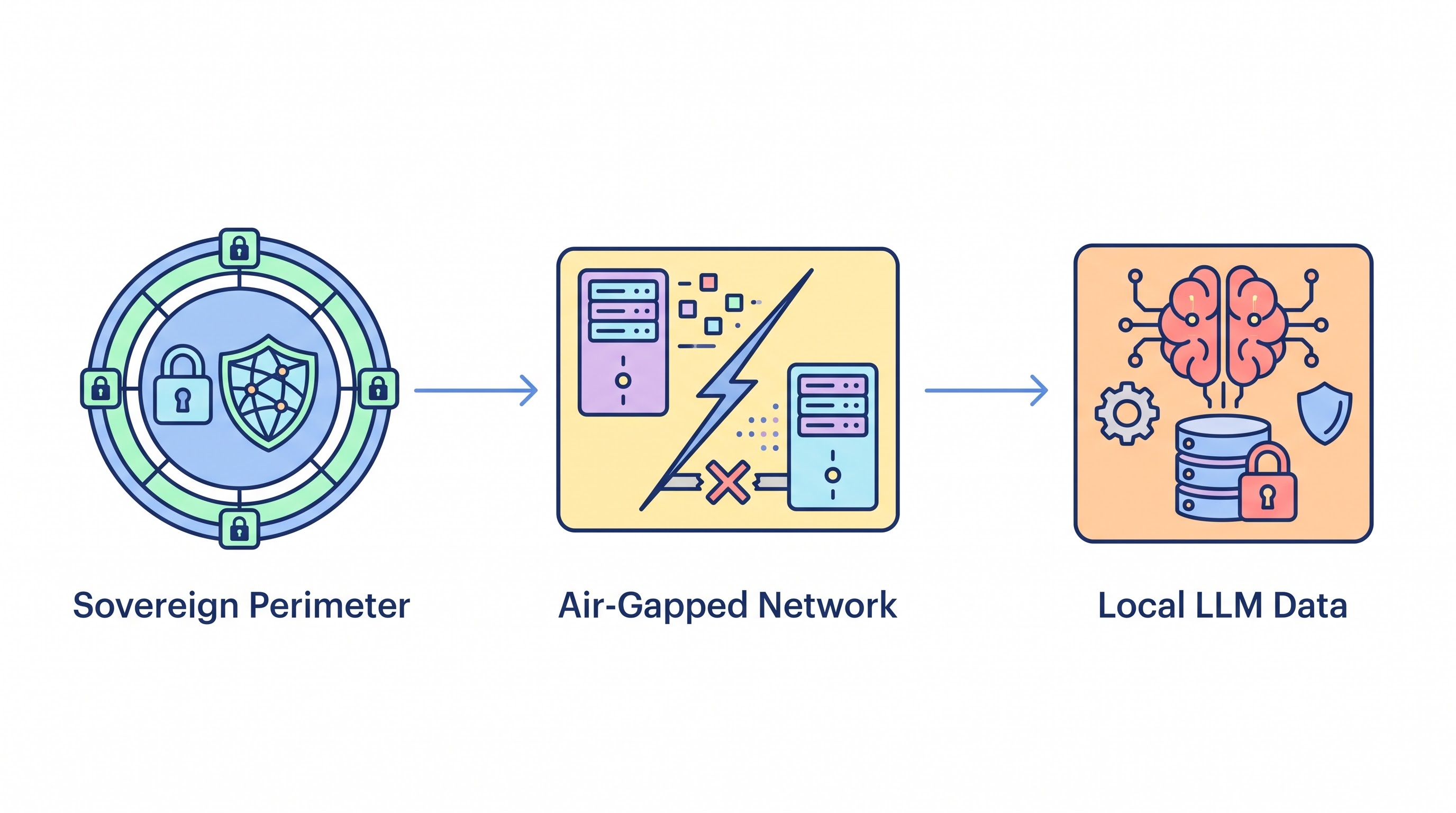
1. Executive Synthesis
By 2026, the strategic debate surrounding artificial intelligence infrastructure has reached a critical pivot point. In the early stages of generative AI, enterprise leadership defaulted to public cloud hyperscalers (AWS, Azure, GCP) to access high-end GPU accelerators. However, as AI models transition from experimental prototypes into high-throughput, continuous core operations—and as national governments enforce strict digital sovereignty, data localization, and AI supply-chain mandates—the unit economics of renting cloud GPUs 24/7/365 have become financially unsustainable for large-scale enterprise workloads.
Hyperscaler cloud GPU margins are extraordinarily high. Renting an 8-GPU node (such as an NVIDIA H100/H200 cluster) in the public cloud costs between $25.00 and $40.00 per hour. When an enterprise operates thousands of GPU accelerators continuously for large-scale model training, fine-tuning, and high-frequency production inference, the annual cloud invoice reaches tens of millions of dollars. This massive OpEx drain has triggered a resurgence in private infrastructure: Sovereign AI Repatriation. Enterprises and nation-states are actively constructing private, on-premises or co-located GPU datacenters to capture absolute data sovereignty and drive down the long-term unit cost of intelligence.
However, building and operating a private, high-density GPU datacenter in 2026 introduces extreme capital exposure and physical engineering complexity. Next-generation AI accelerators draw unprecedented levels of power (e.g., a single server rack of NVIDIA Blackwell GPUs can exceed 100 kW to 120 kW of power draw), rendering traditional air-cooled datacenter facilities physically obsolete. Private AI infrastructure mandates heavy CapEx investments in Direct-to-Chip (DTC) liquid cooling, specialized high-bandwidth networking topologies (Infiniband or RoCEv2), and long-term power purchase agreements (PPAs).
This playbook introduces the . The SGA model provides the definitive corporate finance mechanics required to compare the 36-month fully burdened Total Cost of Ownership (TCO) of an on-premises or co-located GPU cluster against public cloud reservations. By incorporating hardware depreciation velocity, liquid cooling facility CapEx, Weighted Average Cost of Capital (WACC), Power Usage Effectiveness (PUE), and specialized Slurm/Kubernetes SRE labor, enterprise leaders can identify the exact mathematical threshold where building private Sovereign AI infrastructure creates transformative EBITDA expansion versus when it represents a dangerous, capital-destroying mistake.
2. Market Gap & Search Intent Failure Analysis
Enterprise research comparing "On-Premises GPU TCO vs Cloud" is heavily corrupted by vendor bias. Cloud hyperscalers publish whitepapers emphasizing the agility of cloud compute while artificially inflating physical datacenter management costs. Conversely, hardware OEMs and colocation providers publish simplistic calculators that compare the raw server purchase price against three years of public cloud On-Demand pricing, predictably claiming that owning hardware yields an 80% cost reduction.
The structural market gap is the total failure to model Hardware Depreciation Velocity and Facility Thermal CapEx. Standard industry literature ignores the reality that purchasing $20M of AI accelerators today means locking capital into hardware that depreciates rapidly as next-generation architectures arrive. Furthermore, OEM calculators omit the massive capital cost of retrofitting datacenters for high-density liquid cooling, electrical transformer upgrades, and the high-salaried SRE labor required to maintain a high-performance Slurm/Infiniband fabric. This playbook bridges this gap by introducing comprehensive equations that account for WACC, real-world liquid cooling PUE, network fabric depreciation, and silicon obsolescence risk.
3. Core Strategic Framework
The enterprise must operationalize the Sovereign GPU Amortization (SGA) Model. This framework acts as an uncompromising capital allocation gate, determining whether AI workloads must be deployed to public cloud hyperscalers or repatriated to private sovereign GPU infrastructure.
Implementation Protocol:
Workload Utilization Profiling: Audit the enterprise AI portfolio to isolate continuous 24/7 baseline workloads (Model Training, Steady-State Inference) from volatile, intermittent tasks.
Execute Facility & Power Site Audits: Determine the localized Power Usage Effectiveness (PUE), available Megawatt (MW) power capacity, and liquid cooling retrofit CapEx for the target private or colocation facility.
Run the SGA Calculation: Compute the Fully Burdened Sovereign GPU Hour (
$FBGH_{sovereign}$) and measure it directly against 3-year Reserved Cloud GPU pricing using the enterprise's Weighted Average Cost of Capital (WACC).Execution Decision Matrix:
If Workload Continuous Utilization
$> 75\%$AND$FBGH_{sovereign}$is$> 35\%$cheaper than Cloud Reserved Instances, authorize CapEx for private on-premises/colocation GPU infrastructure.If the AI model requires absolute, legally mandated data sovereignty (e.g., classified defense data, strict sovereign health records) where cloud deployment is illegal, mandate private deployment regardless of the cost differential.
If the target AI workload lifecycle is
$< 18\text{ months}$or requires frequent hardware architecture changes, block private CapEx hardware purchases and force execution onto cloud hyperscalers to preserve capital liquidity.
4. Financial Modeling Layer (MANDATORY)
The corporate finance mechanics of private GPU datacenters require strict mathematical models to evaluate capital allocation.
Core Equations
1. Fully Burdened Sovereign GPU Hour ($FBGH_{sovereign}$):
Calculates the true, all-in operational cost per GPU hour for an on-premises or co-located private GPU cluster over a 36-month depreciation lifecycle.
$$FBGH_{sovereign} = \frac{\left( \frac{CapEx_{gpu\_hardware} + CapEx_{facility\_retrofit}}{36} \right) \times (1 + WACC) + OpEx_{power\_monthly} + OpEx_{colo\_lease} + OpEx_{labor}}{N_{gpus} \times 730 \times U_{cluster}}$$Where:
$CapEx_{gpu\_hardware}$= Total cost of GPU servers, Infiniband/RoCEv2 switches, and storage arrays.$CapEx_{facility\_retrofit}$physical security$WACC$= Weighted Average Cost of Capital (e.g., 8% or 0.08).$OpEx_{power\_monthly}$= Monthly electricity bill:$\text{KW Draw} \times 730 \times \text{PUE} \times \text{Utility Rate (\$/kWh)}$.$OpEx_{colo\_lease}$= Monthly colocation rack/space lease fees.$OpEx_{labor}$= Fully burdened monthly salary of specialized Slurm/HPC SREs.$N_{gpus}$= Total physical GPU count in the cluster.$U_{cluster}$= Average expected utilization percentage of the cluster (e.g., 0.85).
2. Cloud Avoidance Arbitrage ($CAA$):
Determines the net 3-year EBITDA expansion achieved by building a sovereign GPU cluster versus renting the equivalent capacity from a cloud hyperscaler.
$$CAA = \left( C_{cloud\_3yr\_reserved\_total} \right) - \left( FBGH_{sovereign} \times N_{gpus} \times 26,280 \times U_{cluster} \right)$$3. Thermal Cooling Overhead ($TCO_{thermal}$):
Calculates the exact financial operational penalty imposed by facility cooling inefficiencies.
$$TCO_{thermal} = (PUE - 1.0) \times \left( kW_{hardware\_draw} \times 8,760 \times Rate_{kWh} \right)$$A) Sensitivity Analysis Table
This table models the Fully Burdened Sovereign GPU Hour ($FBGH_{sovereign}$) for a 1,024-GPU H100 cluster over 3 years, mapped against Colocation Power Rates ($/kWh) and Cluster Utilization ($U_{cluster}$).
Utility Power Rate ($/kWh) | Low Util (50% Cluster Load) | Base Util (80% Cluster Load) | High Util (95% Cluster Load) | Cloud Reserved Comparison |
Cheap Hydro ($0.05/kWh) | $2.10 / GPU hour | $1.35 / GPU hour | $1.15 / GPU hour | Saves 60% vs Cloud ($3.50/hr) |
Average Grid ($0.10/kWh) | $2.35 / GPU hour | $1.55 / GPU hour | $1.30 / GPU hour | Saves 55% vs Cloud ($3.50/hr) |
High Urban ($0.20/kWh) | $2.85 / GPU hour | $1.95 / GPU hour | $1.65 / GPU hour | Saves 44% vs Cloud ($3.50/hr) |
Decision Threshold: At an 80% continuous cluster utilization, an on-premises/colocation GPU cluster delivers an all-in cost of $1.35 to $1.55 per GPU hour, compared to $3.50+ for 3-year Cloud Reserved Instances. For a 1,024-GPU footprint, this yields over $17 Million in raw EBITDA savings over 3 years, mathematically confirming the power of repatriation for baseline AI workloads.
B) Break-Even Formula
The Sovereign GPU Capital Payback Period ($P_{payback\_months}$) calculates the exact number of operating months required for the cumulative cloud savings to fully recover the initial hardware and facility retrofit CapEx.
$$P_{payback\_months} = \frac{CapEx_{gpu\_hardware} + CapEx_{facility\_retrofit}}{\left( \frac{C_{cloud\_monthly\_equivalent} - (OpEx_{power\_monthly} + OpEx_{colo\_lease} + OpEx_{labor})}{1} \right)}$$Numerical Example: Building a 512-GPU liquid-cooled cluster costs $12,000,000 in hardware and $2,000,000 in facility retrofits (Total CapEx = $14,000,000). The equivalent cloud GPU reservation costs $450,000/month. The private monthly OpEx (Power @ $0.08/kWh + Colo + Labor) is $110,000. Net monthly operational savings = $450,000 - $110,000 = $340,000. $P_{payback\_months} = \$14,000,000 / \$340,000 = 41.1\text{ months}$. Because the payback period exceeds 36 months, this specific project is financially risky; the team must negotiate lower hardware prices or higher cloud discount baselines before approving CapEx.
C) Probability-Weighted Risk Table
Quantifying the operational and physical risks of owning sovereign GPU infrastructure.
Scenario | Probability | Financial Impact | Weighted Exposure |
Next-Gen Silicon Release (Accelerated Obsolescence) | 40.0% / 3-yr | $3,000,000 (Asset value drop) | $1,200,000 per cycle |
Liquid Cooling Leak / Facility Outage | 5.0% / yr | $800,000 (Hardware damage & SLA) | $40,000 per year |
Infiniband Fabric Misconfiguration (Idle Nodes) | 25.0% / yr | $150,000 (Wasted compute hours) | $37,500 per year |
Power Grid Tariff Spike (+50% Rate) | 30.0% / yr | $200,000 (OpEx overrun) | $60,000 per year |
D) Cost-per-Unit Model
The central metric for Sovereign AI Infrastructure is the Cost Per Million Tokens Trained/Inferred ($CPMT$):
$$CPMT = \frac{FBGH_{sovereign} \times Total\_GPU\_Hours\_Consumed\_Monthly}{Total\_Tokens\_Processed\_Monthly / 1,000,000}$$Threshold: If $CPMT > \$0.15$ for a 70B parameter model on private infrastructure, the cluster is suffering from severe job scheduling inefficiency or network bottlenecks. Slurm/Kubernetes SREs must immediately optimize the all-reduce collective communication patterns.
5. Operational Architecture Integration
High-Density Liquid Cooling Infrastructure (Direct-to-Chip & Immersion):
Attempting to deploy modern 2026 GPU servers (drawing per server chassis) in traditional air-cooled datacenter racks (limited to 10kW-15kW per rack) is a physical impossibility that causes immediate thermal throttling and hardware failure. Private sovereign infrastructure mandates Direct-to-Chip (DTC) liquid cooling or single-phase immersion cooling. Water or specialized dielectric coolant is piped directly to cold plates mounted on the GPU and CPU dies, heat-exchanging via Computer Room Air Handlers (CRAH) or external dry coolers. This reduces facility PUE from an inefficient 1.6 down to an elite 1.10-1.15, slashing facility power bills by up to 30% and directly optimizing the metric.
Slurm vs. Kubernetes Orchestration for Sovereign AI:
Operating a private GPU cluster requires selecting the workload orchestration plane. For pure, massive-scale LLM pre-training, architecture should deploy Slurm (Simple Linux Utility for Resource Management). Slurm provides bare-metal execution with near-zero OS overhead, interfacing directly with high-speed Infiniband fabrics. However, for multi-tenant enterprise inference and fine-tuning, architecture should deploy bare-metal Kubernetes (via Rancher or Tanzu) utilizing NVIDIA GPU Operator and KubeRay. Kubernetes provides dynamic multi-tenancy, container isolation, and seamless integration with corporate CI/CD pipelines, allowing the enterprise to share the sovereign cluster across multiple business units without job scheduling collisions.
Non-Blocking Infiniband / RoCEv2 Network Topologies:
Distributed AI model training relies heavily on inter-GPU communication during the all-reduce phase of backpropagation. If the network topology is oversubscribed or experiences packet loss, physical GPUs will sit 80% idle, waiting for parameter weights to sync across nodes. Sovereign AI architecture mandates a non-blocking, Fat-Tree network topology utilizing 400Gbps or 800Gbps Infiniband (NDR) or RDMA over Converged Ethernet (RoCEv2). Every GPU server node must have direct, line-rate PCI-e links to the network fabric, mathematically eliminating network-induced idle time and ensuring cluster utilization ($U_{cluster}$) remains above 85%.
6. Failure Scenarios
Scenario 1: The "Air-Cooled" Thermal Disaster
Breakdown: An enterprise purchases $10M of high-density GPU servers and installs them in an existing corporate datacenter designed for traditional web servers (10 kW per rack). Within 10 minutes of launching a 512-GPU training job, the thermal load exceeds the room's cooling capacity. Ambient rack temperatures hit 45°C.
Financial Exposure: The GPUs trigger automated thermal throttling, dropping clock speeds by 60% to prevent physical melt-down. The training job takes 2.5x longer to execute, wasting hundreds of thousands of dollars in power while delivering the performance of an aging GPU tier. The company is forced to spend an unbudgeted $2M in emergency liquid cooling retrofits.
Governance Prevention Layer: Mandatory Thermal Engineering Sign-off. Capital allocation for GPU hardware is physically locked until a certified Data Center Thermal Engineer completes a CFD (Computational Fluid Dynamics) simulation proving that the target facility can sustain a PUE
$< 1.20$at a minimum density of 80 kW per rack.
Scenario 2: The Infiniband "Stranded Compute" Bottleneck
Breakdown: A company builds a private 256-GPU cluster but attempts to save money by utilizing standard 10Gbps Ethernet switches instead of high-speed Infiniband/RoCEv2 networking.
Financial Exposure: During distributed training of a 70B parameter model, the GPUs execute matrix multiplications in milliseconds, but then spend 80% of their operational time stalled, waiting for gradient synchronization over the congested 10Gbps network. The effective utilization (
$U_{cluster}$) drops to 20%. The$FBGH_{sovereign}$spikes to $8.50 per GPU hour, making the private cluster vastly more expensive than renting public cloud GPUs.Governance Prevention Layer: Non-Blocking Fabric Enforcement. IaC and hardware architecture rules strictly forbid provisioning multi-node GPU clusters without dedicated, non-blocking RDMA (Remote Direct Memory Access) network fabrics. The network hardware must be capitalized alongside the GPU nodes as an inseparable compute unit.
Scenario 3: The "Zombie Cluster" Labor Trap
Breakdown: An enterprise builds an on-premises GPU datacenter but fails to hire specialized HPC/Slurm SREs, assigning management to generalist cloud sysadmins. The team struggles with driver incompatibilities, CUDA version drift, and fabric errors. When nodes fail, they sit un-repaired for weeks.
Financial Exposure: Cluster availability drops to 50%. Over a year, $3M of capitalized hardware sits broken or idle, while internal data science teams bypass the broken private cluster and secretly use credit cards to buy public cloud GPU instances (Shadow IT).
Governance Prevention Layer:
$OpEx_{labor}$TCO calculation
7. Board-Level Translation Layer
EBITDA Delta Modeling: Repatriating continuous, baseline AI workloads from public cloud hyperscalers to private sovereign infrastructure is one of the single largest EBITDA expansion levers available to technology executives in 2026. For a large enterprise consuming 1,000+ GPUs continuously, building private infrastructure reduces hourly compute costs from $3.50+ down to $1.35-$1.55, generating tens of millions of dollars in direct, multi-year EBITDA expansion.
Gross Margin Defense: For AI-first SaaS companies and core digital enterprises, the cost of model training and continuous inference is the primary anchor on gross margins. Operating private, liquid-cooled GPU clusters permanently lowers the structural floor of AI COGS, insulating the enterprise from hyperscaler price hikes and securing an unassailable unit-cost advantage over cloud-bound competitors.
Capital Allocation Signal: Building private GPU infrastructure requires executing a massive OpEx-to-CapEx shift. The board must evaluate this through the lens of asset utilization: CapEx is justified only if the enterprise can guarantee high continuous workload volume (
$U_{cluster} > 75\%$). If AI demand is speculative or highly volatile, the board must mandate public cloud execution to preserve corporate capital liquidity.Risk-Adjusted ROI Formula:
$$ROI_{sovereign\_ai} = \frac{\text{3-Year Cloud Avoidance Arbitrage } (CAA) - CapEx_{facility\_retrofit}}{\left( CapEx_{gpu\_hardware} + CapEx_{facility\_retrofit} \right) \times (1 + WACC)}$$
8. Data Visualization Suggestions
Fully Burdened GPU Hour (
$FBGH_{sovereign}$) vs Cloud Cost Comparison: A clean bar chart comparing 3-Year Cloud On-Demand ($8.00/hr), Cloud 3-Year Reserved ($3.50/hr), and Sovereign Private Infrastructure ($1.35/hr), visually driving home the massive cost savings of repatriation.Cumulative Cash Flow Payback Curve: A classic S-curve financial chart plotting cumulative spend over 36 months. The cloud line slopes steeply upward. The private infrastructure line starts with a steep CapEx drop at Month 0, then flattens out, crossing the cloud line at the exact Payback Month (
$P_{payback\_months}$).Liquid Cooling PUE Impact Breakdown: A stacked bar chart comparing the monthly power bill of an Air-Cooled Datacenter (PUE 1.6) vs a Direct-to-Chip Liquid Cooled Datacenter (PUE 1.10), isolating the massive operational energy savings.
Network Fabric Oversubscription vs GPU Utilization: A dual-axis line graph showing Network Oversubscription Ratio on the X-axis against Cluster Utilization (
$U_{cluster}$) on the Y-axis. The line plunges as oversubscription increases, visually highlighting the "Infiniband Tax."Sovereign AI Decision Matrix: A strategic flowchart guiding executive decisions based on Data Sovereignty Requirements, Workload Continuity, and Available Power (MW), leading to binary "Build Sovereign Datacenter" or "Stay in Cloud" directives.
9. Why Analyst-Style Summaries Fail at Financial Precision
When technology analysts publish sweeping statements such as "Enterprises must build sovereign AI infrastructure to maintain data control and reduce long-term cloud costs," they are dispensing high-level strategic narrative that completely ignores computational physics and corporate finance.
This narrative fails because it treats an AI datacenter like a traditional IT server room. An executive who follows this unquantified advice will order millions of dollars in GPUs, attempt to plug them into an air-cooled corporate facility, and instantly trigger thermal failure and massive financial loss. Analysts do not calculate the Fully Burdened Sovereign GPU Hour ($FBGH_{sovereign}$) or the Thermal Cooling Overhead ($TCO_{thermal}$). They fail to warn the CFO that an on-premises GPU cluster running at 30% utilization due to poor Slurm scheduling is vastly more expensive than the cloud.
Equation-backed modeling using the Sovereign GPU Amortization (SGA) framework destroys this operational blindness. By explicitly calculating the Capital Payback Period ($P_{payback\_months}$) and enforcing strict PUE and cluster utilization thresholds, FinOps leaders force the C-suite to evaluate AI infrastructure as a high-density industrial utility. You do not build sovereign AI infrastructure on political mandates or narrative trends; you build it when the mathematics of power, cooling, hardware depreciation, and continuous workload volume yield an indisputable, risk-adjusted financial advantage.
10. Strategic Conclusion
The maturation of artificial intelligence from experimental software to core enterprise infrastructure has made compute cost the dominant operational variable of the decade. While public cloud hyperscalers provide unprecedented agility for unpredictable, early-stage AI projects, relying on rented cloud GPUs for massive, continuous 24/7 baseline workloads is an unsustainable drain on corporate gross margins and EBITDA.
Sovereign AI Repatriation—constructing private, liquid-cooled, high-density GPU datacenters—is the ultimate strategic response for mature enterprises. However, capturing the immense financial savings of private infrastructure requires mastering the physical and financial laws of high-performance computing.
Enterprise leadership must enforce the Sovereign GPU Amortization (SGA) Model. Private GPU clusters must be treated as industrial CapEx investments. Facilities must be engineered with Direct-to-Chip liquid cooling to achieve elite PUE ratings ($<1.20$). Network fabrics must be built with non-blocking Infiniband/RoCEv2 topologies to guarantee that physical GPUs never sit idle. Most importantly, hardware procurement must be strictly gated by workload continuity: private infrastructure is justified only when the business can guarantee high continuous utilization ($>75\%$). By governing sovereign AI through uncompromising mathematical models, enterprise leaders permanently secure data sovereignty, lower the unit cost of intelligence, and lock in an unassailable financial advantage for the next decade of technology competition.
11. Implementation Readiness Checklist
Execute the SGA Financial Model: Run your target GPU workload volume through the
$FBGH_{sovereign}$equation, factoring in local power rates, WACC, and facility retrofits to determine if repatriation is mathematically justified.Audit Data Center Thermal Capabilities: Conduct a physical engineering audit of target on-premises or colocation facilities to verify they can support Direct-to-Chip (DTC) liquid cooling and power densities exceeding 80 kW per rack.
Calculate the Payback Period (
$P_{payback\_months}$): Require the finance team to verify that the projected cloud avoidance savings recover the total hardware and facility CapEx in less than 36 months before approving procurement.Enforce Non-Blocking Networking Fabrics: Architecture plans for multi-node GPU clusters must strictly mandate 400G/800G NDR Infiniband or RoCEv2 non-blocking Fat-Tree topologies to prevent network-induced GPU idle time.
Establish High Cluster Utilization Targets (
$U_{cluster} > 75\%$): Implement Slurm or Kubernetes GPU Operators with aggressive job queuing and backfilling to guarantee the private cluster operates at near-continuous capacity.Budget for Specialized HPC SRE Talent: Fully capitalize the cost of hiring experienced Slurm/Infiniband SREs into the 3-year TCO calculation before committing to private hardware execution.
Negotiate Long-Term Utility PPAs: Secure long-term Power Purchase Agreements (PPAs) with utility providers or colocation operators to lock in fixed, low-cost electricity tariffs ($/kWh) and protect OpEx from energy grid spikes.
Implement Storage Acceleration (NVMe-oF): Pair the sovereign GPU cluster with high-throughput, parallel POSIX storage (e.g., WekaIO, Lustre, or VAST Data) to ensure GPUs are never starved for training data during epoch updates.
Audit Sovereign Legal Mandates: Verify with the Chief Legal Officer that the target AI workloads contain regulated, localized data where private sovereign infrastructure delivers mandatory compliance risk mitigation.
Establish Hardware Liquidation Runbooks: Plan the 36-month hardware refresh lifecycle, establishing secondary market resale or secondary-tier task reallocation runbooks for aging GPU assets as next-generation silicon is procured.
Stop guessing where your Kubernetes budget is going. Schedule a demo here to explore Kubernetes cost monitoring with Cloud Atler.