
1. Executive Synthesis
The transition to serverless architectures (AWS Lambda, Fargate) revolutionized stateless compute by flawlessly aligning infrastructure COGS with actual user invocation. However, extending this paradigm to the stateful layer—specifically relational and NoSQL databases—has triggered a massive financial crisis for the 2026 enterprise. Products like Amazon Aurora Serverless v2 and DynamoDB On-Demand promise the utopia of "zero-management, infinitely scaling databases." In reality, they introduce a hyper-volatile pricing vector driven by aggressive Capacity Unit scaling multipliers and catastrophic TCP connection exhaustion.
Stateful serverless is fundamentally different from stateless serverless. A database cannot instantly spin up from zero to 10,000 connections without severe latency penalties, massive buffer pool re-hydration costs, and extreme billing spikes. When an enterprise connects a highly elastic stateless fleet (e.g., 5,000 concurrent Lambda functions) directly to a serverless relational database, the resulting "Connection Storm" forces the database to violently scale up its compute capacity (ACUs) purely to maintain open TCP connections, not to execute actual queries. This results in database bills that are 300% to 500% higher than a standard, provisioned RDS instance handling the exact same query volume.
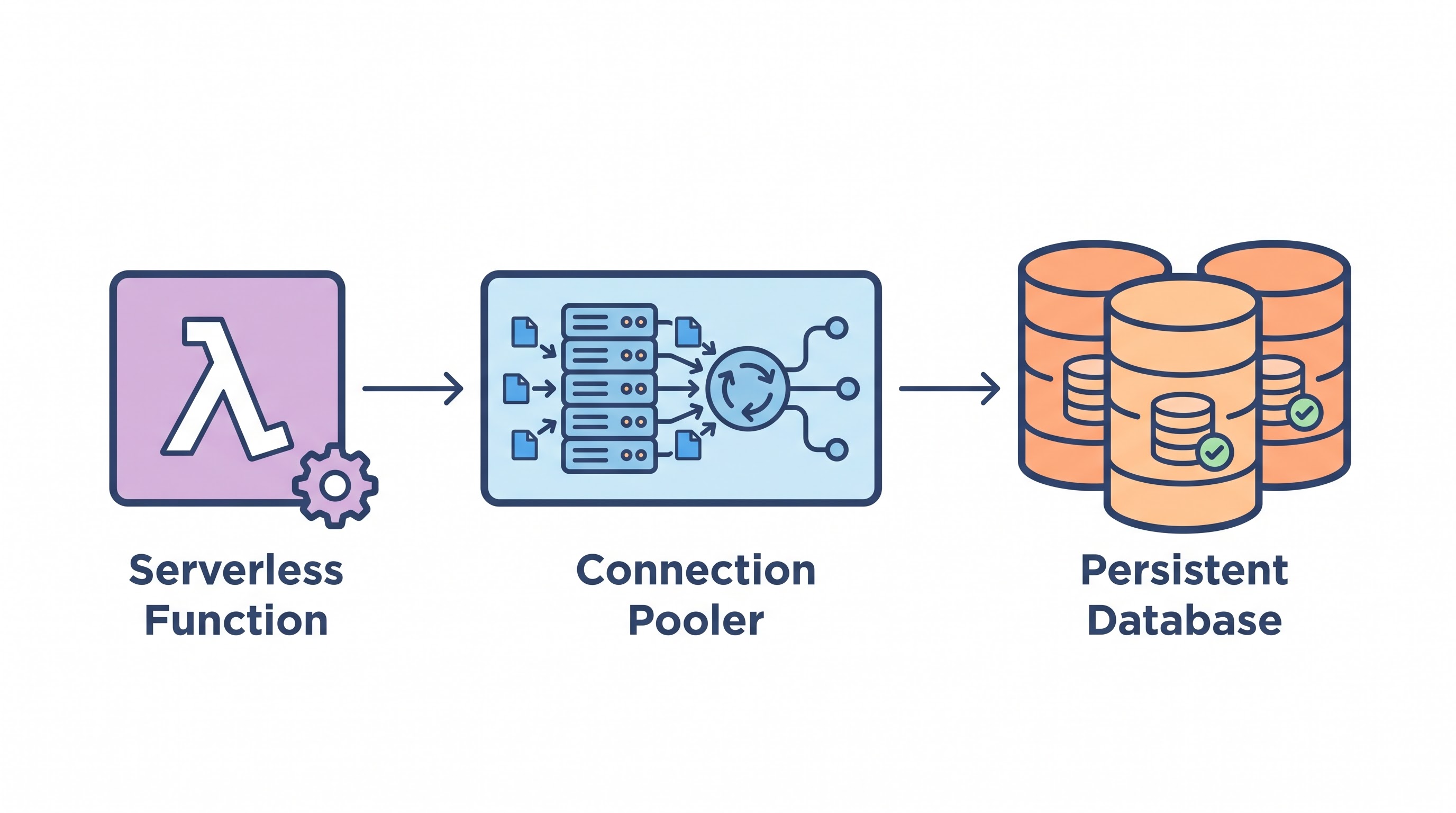
To survive the financial shock of serverless data architectures, enterprises must implement the Stateful Elasticity Threshold (SET) Framework. This framework mathematically prohibits the blind deployment of serverless databases for steady-state, baseline workloads. It demands the implementation of strict architectural buffers—specifically connection pooling proxies (RDS Proxy, PgBouncer)—to shield the database from serverless connection thrashing.
Furthermore, FinOps and Database Administrators (DBAs) must calculate the exact Utilization Inversion Point: the mathematical threshold where a provisioned database instance (locked in with a 3-year Reserved Instance discount) becomes structurally cheaper than the per-second micro-billing of a Serverless database. By executing this playbook, organizations can safely leverage the elasticity of serverless data layers for highly volatile edge cases while defending their baseline gross margins through mathematically optimized, provisioned stateful architecture.
2. Market Gap & Search Intent Failure Analysis
Enterprise research regarding "Aurora Serverless v2 pricing" or "DynamoDB On-Demand vs Provisioned" is heavily skewed by cloud provider marketing materials. Vendors emphasize that serverless databases "scale down to save costs during idle periods." Search intent yields calculators that naively compare the absolute minimum serverless state to the cost of a massive, idle provisioned database.
The structural market gap is the total failure to model the and the . Analysts fail to explain that Aurora Serverless v2 does not scale down to zero; it has a minimum ACU requirement. Furthermore, scaling up a database memory buffer takes time. If a serverless database is scaled down, a sudden spike in queries forces the database to fetch data from disk rather than RAM, destroying application latency while simultaneously spiking the ACU billing rate. Standard playbooks ignore the financial impact of connection overhead, leaving enterprises exposed to massive bills caused simply by Lambda functions opening and closing un-pooled connections. This playbook eliminates these blind spots by providing the exact mathematical limits required to govern stateful serverless adoption.
3. Core Strategic Framework
The enterprise must implement the Stateful Elasticity Threshold (SET) Framework. This framework treats serverless database capacity as a premium, volatile commodity that must be mathematically justified against the discounted stability of provisioned infrastructure.
Implementation Protocol:
Workload Volatility Profiling: Audit the database telemetry over a 14-day window. Calculate the Peak-to-Trough Ratio (PTR) of the IOPS, CPU utilization, and concurrent connections.
Execute the Database Arbitrage (SET) Calculation: Compare the continuous baseline cost of the workload on a 3-year Reserved RDS instance against the projected ACU (Aurora Capacity Unit) scaling profile of Serverless v2.
Deploy the Connection Shield: For any relational database accessed by serverless compute (Lambda/KEDA), strictly mandate the deployment of an intermediate connection pooling proxy (e.g., AWS RDS Proxy, PgBouncer) to multiplex connections and prevent ACU scale-up based purely on connection count.
Execution Decision Matrix:
If Database Peak-to-Trough Ratio
$< 3.0$(steady-state traffic), automatically reject Serverless deployment. Mandate heavily reserved, provisioned instances (e.g., RDS r6g.xlarge).If utilizing DynamoDB and the workload access pattern is highly predictable, strictly block On-Demand billing. Force the use of Provisioned Capacity with auto-scaling to drop the unit cost by up to 80%.
If a serverless database is required for a highly volatile, spiky workload, the IaC must enforce a hard Max_ACU limit to mathematically cap the maximum financial exposure of a runaway query loop.
4. Financial Modeling Layer (MANDATORY)
Defending database budgets against serverless volatility requires rigorous execution of the following equations.
Core Equations
1. Fully Burdened Serverless DB Cost ($C_{serverless\_db}$):
Calculates the exact monthly cost of a serverless database, factoring in base capacity, dynamic scaling, and storage.
$$C_{serverless\_db} = \sum_{t=1}^{hours} \left( ACU_t \times P_{acu\_hr} \right) + (V_{storage\_GB} \times P_{storage\_GB}) + (V_{iops} \times P_{iops})$$Where:
$ACU_t$= Aurora Capacity Units consumed during hour$t$(scales dynamically).$P_{acu\_hr}$= Price per ACU per hour (which carries a massive premium over standard provisioned RAM/CPU).$V_{iops}$= Volume of Input/Output operations (often billed distinctly in serverless models).
2. Stateful Elasticity Inversion Point ($SET_{inversion}$):
Determines the exact percentage of time a serverless database must run at its minimum capacity to be cheaper than a 3-year Reserved provisioned instance.
$$SET_{inversion} = \left( \frac{P_{provisioned\_3yr\_hourly\_rate}}{P_{acu\_hr\_max\_scale}} \right) \times 100$$Where:
If the serverless database scales up to its peak load for more time than the
$SET_{inversion}$percentage, it destroys financial value.
3. Connection Thrashing Penalty ($P_{conn\_thrash}$):
Quantifies the hidden cost of executing stateful queries from ephemeral compute environments without connection pooling.
$$P_{conn\_thrash} = (N_{lambda\_invocations} \times T_{tcp\_handshake\_ms} \times P_{lambda\_ms\_rate}) + \left( C_{db\_acu\_scale\_up\_due\_to\_connections} \right)$$A) Sensitivity Analysis Table
This table models the Monthly Compute Cost for a PostgreSQL database requiring 32 GB of RAM during peak hours, comparing a Provisioned 3-Year Reserved Instance against Aurora Serverless v2 based on workload volatility.
Workload Volatility Profile | Provisioned DB (r6g.2xlarge, 3Yr RI) | Aurora Serverless v2 (0.5 to 16 ACUs) | FinOps Recommendation |
Steady State (Always 32GB) | $320 / month | $1,380 / month | Serverless is financially toxic |
Spiky (Peak 4hrs/day, Idle 20hrs) | $320 / month | $280 / month | Serverless is marginally viable |
Dev/Test (Active 2hrs/day) | $320 / month | $85 / month | Serverless is highly optimal |
Decision Threshold: Aurora Serverless v2 ACUs carry a premium that is roughly 4x the cost of a heavily reserved provisioned instance. If the database sustains peak load for more than 4-6 hours a day, the serverless premium utterly destroys the budget. Serverless databases are for dev/test and extreme edge-case volatility, not steady-state production.
B) Break-Even Formula
The DynamoDB On-Demand vs Provisioned Break-Even ($DDB_{be}$) calculates the exact number of Read Capacity Units (RCUs) per month where switching from On-Demand (pay-per-request) to Provisioned Auto-Scaling saves money.
$$DDB_{be} = \frac{C_{provisioned\_rcu\_hourly\_rate} \times 730}{P_{on-demand\_per\_million\_reads}} \times 1,000,000$$Numerical Example: DynamoDB On-Demand costs $0.25 per million reads. A Provisioned RCU (which provides 1 read/sec, or ~2.6 million reads/month) costs $0.09/month. The Break-Even is astronomically clear. If you pay for 1 Provisioned RCU ($0.09), you get 2.6M reads that would cost $0.65 on On-Demand. On-Demand is 7x more expensive. Unless your traffic is totally unpredictable and spends 90% of the month at absolute zero, Provisioned is mathematically required.
C) Probability-Weighted Risk Table
Quantifying the operational and financial risks of serverless data layers.
Scenario | Probability | Financial Impact | Weighted Exposure |
Lambda Connection Storm (DB OOM Crash) | 25.0% / yr | $45,000 (Downtime/Lost Revenue) | $11,250 per year |
Serverless ACU Scale-Up Floor (Idle Cost Bloat) | 60.0% / mo | $2,500 (Wasted premium compute) | $1,500 per month |
DynamoDB Hot Partition Runaway | 15.0% / yr | $15,000 (Uncapped WCU burn) | $2,250 per year |
Buffer Pool Purge Latency (Scale-down impact) | 35.0% / mo | $3,000 (SLA breach / Timeout) | $1,050 per month |
D) Cost-per-Unit Model
The central metric for Database FinOps is the Cost Per 10,000 Stateful Transactions ($CPST$):
$$CPST = \frac{Total\_Database\_Monthly\_Cost}{Total\_Transactions\_Processed / 10,000}$$Threshold: If the $CPST$ on a serverless database exceeds the $CPST$ of the equivalent provisioned relational tier by more than 15%, FinOps must force a migration back to provisioned instances. You are paying a massive premium for elasticity that the workload is not utilizing.
5. Operational Architecture Integration
The Connection Pooling Proxy Shield (RDS Proxy / PgBouncer):
The most catastrophic error in modern architecture is configuring 5,000 AWS Lambda functions to connect directly to an Aurora Postgres database. Because Lambdas are ephemeral, every invocation opens a new TCP connection, executes a 10ms query, and closes the connection. Establishing a TLS database connection takes ~50ms and massive CPU overhead on the database side. The Serverless v2 engine will violently scale up its ACUs just to handle the connection thrashing, destroying the FinOps budget. Architecture must mandate the deployment of AWS RDS Proxy or an internal PgBouncer fleet. The proxy holds 100 persistent, warm connections to the database, and multiplexes the 5,000 Lambda requests over those warm connections. This drops the database ACU scale-up requirements by magnitudes and eliminates the Connection Thrashing Penalty ($P_{conn\_thrash}$).
Hybrid Stateful Architecture (Provisioned Writer / Serverless Reader):
The optimal 2026 relational architecture balances stability with elasticity. The primary Writer node of the database—which handles the steady, continuous stream of application INSERTs and UPDATEs—must be deployed as a Provisioned Instance (e.g., r6g.4xlarge) backed by a 3-year Reserved Instance discount to anchor the baseline COGS. The Serverless v2 instances are strictly utilized as Auto-Scaling Read Replicas. When a sudden, unpredictable traffic spike hits the application (e.g., a viral marketing event), the serverless read replicas instantly scale up to absorb the read-heavy queries, and then scale back down to zero when the spike passes, perfectly executing the $SET_{inversion}$ math.
DynamoDB FinOps & Partition Key Governance:
DynamoDB On-Demand is a financial trap for predictable workloads. Architecture must mandate that all production DynamoDB tables utilize Provisioned Capacity with AWS Application Auto Scaling configured. However, FinOps must also govern the schema design. If engineering selects a poor Partition Key (e.g., writing all data to a Timestamp key), they create a "Hot Partition." Even with auto-scaling, a hot partition will throttle the application, forcing engineering to artificially inflate the global Write Capacity Units (WCUs) to compensate for the bad schema, burning massive amounts of cash. IaC governance must block deployment of any DynamoDB table that does not utilize high-cardinality partition keys (e.g., User_ID or UUID).
6. Failure Scenarios
Scenario 1: The "Scale to Zero" Cold Start Disaster
Breakdown: An architect deploys Aurora Serverless v1 (or similar scale-to-zero DBs) for a customer-facing SaaS application to save money overnight. A user logs in at 3:00 AM. The database takes 25 seconds to provision compute, load the OS, and hydrate the buffer pool from storage.
Financial Exposure: The application API times out. The user experiences a total failure. While saving $2 on overnight compute, the architecture causes a critical customer churn event costing $50,000 in Annual Recurring Revenue (ARR).
Governance Prevention Layer: SLA-Bound Minimum Capacity. Production, synchronous, user-facing relational databases are strictly mathematically prohibited from scaling to zero. Serverless configurations must enforce a hard minimum ACU floor to ensure the buffer pool (RAM) remains hydrated and ready for sub-millisecond query response, accepting the minor idle cost to protect revenue.
Scenario 2: The ACU Memory Trap
Breakdown: A database workload has low CPU requirements but massive memory (RAM) requirements to hold its working set in the buffer pool. The engineering team migrates to Aurora Serverless v2. Because Serverless v2 scales CPU and Memory symmetrically in locked ACU blocks (1 ACU = ~2GB RAM), the database is forced to scale up to 64 ACUs just to get the 128GB of RAM it needs, massively over-provisioning and over-paying for CPU cycles it isn't using.
Financial Exposure: Paying $5,000+ per month in Serverless v2 ACU charges for a workload that would cost $800 on a memory-optimized, provisioned r6g instance.
Governance Prevention Layer: Workload Memory Profiling. Before any serverless database migration, the FinOps DAG must query the performance insights of the database. If the ratio of active memory utilization to active CPU utilization exceeds 4:1, the workload is classified as "Memory Bound." Memory-bound workloads are explicitly banned from symmetrically scaling serverless platforms and routed to provisioned memory-optimized instances.
Scenario 3: The DynamoDB Scan Runaway
Breakdown: A junior developer needs to generate a report from a DynamoDB table containing 100 million records. Instead of querying a secondary index, they write a script utilizing the Scan API operation without a filter expression. The script runs nightly.
Financial Exposure: A Scan operation reads every single item in the table, consuming millions of Read Capacity Units (RCUs) in seconds. If the table is set to On-Demand, this single script can generate a $500 bill every night ($15,000/mo).
Governance Prevention Layer: API Operation Circuit Breakers. FinOps IaC policies must aggressively restrict IAM permissions. Application roles are strictly denied the dynamodb:Scan action in production environments. Any required full-table analytical queries must be routed through AWS Glue or S3 Export features, shifting the compute to cheap, bulk analytics engines rather than burning expensive transactional RCUs.
7. Board-Level Translation Layer
EBITDA Delta Modeling: Serverless databases carry a massive operational premium. If an enterprise blindly defaults all databases to serverless, the database COGS will spike by 300%. By implementing the SET Framework and repatriating steady-state databases to 3-year Reserved Instances, the CFO immediately reclaims that 300% markup, driving massive, predictable savings directly to the EBITDA line.
Gross Margin Defense: Stateful infrastructure is the heaviest anchor on SaaS margins. By ensuring that the expensive, scaling components of the database (the Serverless Read Replicas) only execute when actual end-user traffic spikes demand them, the architecture perfectly correlates infrastructure spend with top-line usage, defending the gross margin percentage from unpredictable cloud volatility.
Capital Allocation Signal: The decision to utilize Serverless databases is an explicit decision to pay a high OpEx premium to avoid the CapEx risk of capacity planning. The board must demand that engineering teams prove that their workloads are genuinely unpredictable (high Peak-to-Trough ratio) before authorizing this premium.
Risk-Adjusted ROI Formula:
$$ROI_{db\_finops} = \frac{\text{Eliminated ACU/RCU Premiums} + \text{Connection Timeout Prevention}}{\text{Cost of RIs} + \text{Engineering Cost of Proxy Deployment}}$$
8. Data Visualization Suggestions
Stateful Elasticity Threshold (SET) Crossover Chart: A line graph tracking a 24-hour database workload. The flat red line is the cost of a Provisioned 3-year RI. The volatile blue line is the Aurora Serverless ACU cost. The area where the blue line spikes above the red line visually proves the financial penalty of serverless under peak load.
Connection Thrashing CPU Impact: A dual-axis time-series chart showing "Lambda Invocations" spiking, mapped against the "Database CPU Utilization." A vertical line marks the "RDS Proxy Deployed" event, after which Lambda invocations spike, but Database CPU remains perfectly flat and healthy.
DynamoDB On-Demand vs Provisioned Waterfall: A waterfall chart showing the cost of 100 Million Reads. The tall bar represents On-Demand pricing, stepping down massively when applying Provisioned Auto-Scaling, and stepping down again with a 1-year Reserved Capacity commitment.
ACU Symmetric Scaling Trap Diagram: A bar chart showing a database's need: High Memory, Low CPU. Next to it, a bar showing how Serverless v2 forces the purchase of High CPU just to acquire the necessary High Memory, visually highlighting the forced compute waste.
Hybrid Database Topology: An architectural diagram showing a solid, heavy "Writer Node" (Provisioned RI) linked to three ghost-like "Reader Nodes" (Serverless) that dynamically scale up and down based on a load balancer's traffic signals.
9. Why Analyst-Style Summaries Fail at Financial Precision
When cloud analysts publish advice stating, "Adopt serverless databases to eliminate capacity planning and ensure you only pay for what you use," they are dispensing marketing material, not financial engineering.
This narrative fails because it ignores the mathematical reality of the "Scale-Up Premium." Analysts do not explain the Stateful Elasticity Threshold ($SET_{inversion}$). If a CTO follows this generic advice and migrates a steady-state, 24/7 SaaS database to Aurora Serverless v2, they will immediately discover that "paying for what you use" costs 4x more than "provisioning what you need."
Equation-backed modeling destroys the serverless database myth for continuous workloads. By explicitly calculating the Connection Thrashing Penalty ($P_{conn\_thrash}$), FinOps leaders force the architecture team to mathematically reckon with the physics of TCP connections and buffer pool hydration. It proves that stateless compute rules do not apply to stateful data. You cannot run a profitable enterprise data tier on marketing slogans; you run it by mathematically bounding the volatility of serverless compute and explicitly reserving your baseline capacity.
10. Strategic Conclusion
The pursuit of zero-maintenance, infinitely scaling cloud architecture has led enterprises into the Stateful Serverless Trap. While the elasticity of serverless databases is an incredible feat of engineering, it is a specialized tool engineered for extreme volatility, not a default replacement for traditional, provisioned relational tiers.
To defend the corporate cloud budget in 2026, infrastructure leadership must implement the Stateful Elasticity Threshold (SET) Framework. This requires a ruthless financial audit of all database workloads. Steady-state, predictable databases must be forcibly locked into heavily discounted, provisioned compute instances. Serverless database capacity must be treated as a highly taxed premium commodity, deployed strictly for unpredictable read-scaling or highly intermittent dev/test environments.
Furthermore, bridging the gap between stateless compute (Lambdas) and stateful databases requires mandatory architectural shielding. Deploying connection pooling proxies is not an optional engineering optimization; it is a strict FinOps requirement to prevent catastrophic API billing runaway. By merging rigorous workload profiling with disciplined RI (Reserved Instance) commitments, the enterprise can isolate the financial volatility of stateful serverless, ensuring that the foundational data layer remains perfectly optimized, flawlessly performant, and structurally profitable.
11. Implementation Readiness Checklist
Audit DB Peak-to-Trough Volatility: Extract 30 days of CPU and IOPS telemetry for all relational databases. If the variance between peak and trough is
$< 3.0x$, explicitly ban the cluster from serverless migration.Deploy Connection Proxies Globally: Mandate that all serverless compute functions (Lambda, KEDA-scaled pods) must route database traffic through AWS RDS Proxy, PgBouncer, or ProxySQL to eliminate connection thrashing.
Execute DynamoDB Repatriation: Audit all DynamoDB tables for the BillingMode: PAY_PER_REQUEST setting. Force all steady-state production tables back to PROVISIONED with AWS Application Auto Scaling enabled.
Enforce Minimum ACU Floors: Modify all Aurora Serverless v2 IaC deployments to enforce a strict minimum ACU floor for production workloads, guaranteeing buffer pool stability and preventing cold-start SLA breaches.
Implement Hybrid Writer/Reader Topologies: Re-architect mission-critical databases to utilize a Provisioned 3-year RI node for the primary Writer, utilizing Serverless v2 nodes strictly for elastic Read Replicas.
Block DynamoDB Scan Operations: Deploy strict IAM Service Control Policies (SCPs) that physically deny the dynamodb:Scan operation for all application execution roles, preventing catastrophic RCU billing spikes.
Identify Memory-Bound Traps: Review database Performance Insights. If a database is scaling ACUs purely to satisfy memory (RAM) requirements while CPU remains idle, migrate the workload back to a provisioned memory-optimized instance (r6g).
Calculate the
$SET_{inversion}$Threshold: Provide the engineering team with the exact percentage break-even point for your specific enterprise discount level, mathematically bounding their serverless architectural choices.Automate Idle Dev/Test Suspend: For lower environments (Dev/QA), configure scripts to aggressively scale Serverless databases down to minimum capacity or explicitly pause them at 6:00 PM every Friday.
Establish DB FinOps Dashboards: Integrate Database Capacity Units (ACU/RCU/WCU) directly into the central FinOps dashboard, alerting the team instantly if stateful scaling costs decouple from top-line revenue metrics.
Stop guessing where your Kubernetes budget is going. Schedule a demo here to explore Kubernetes cost monitoring with Cloud Atler.