
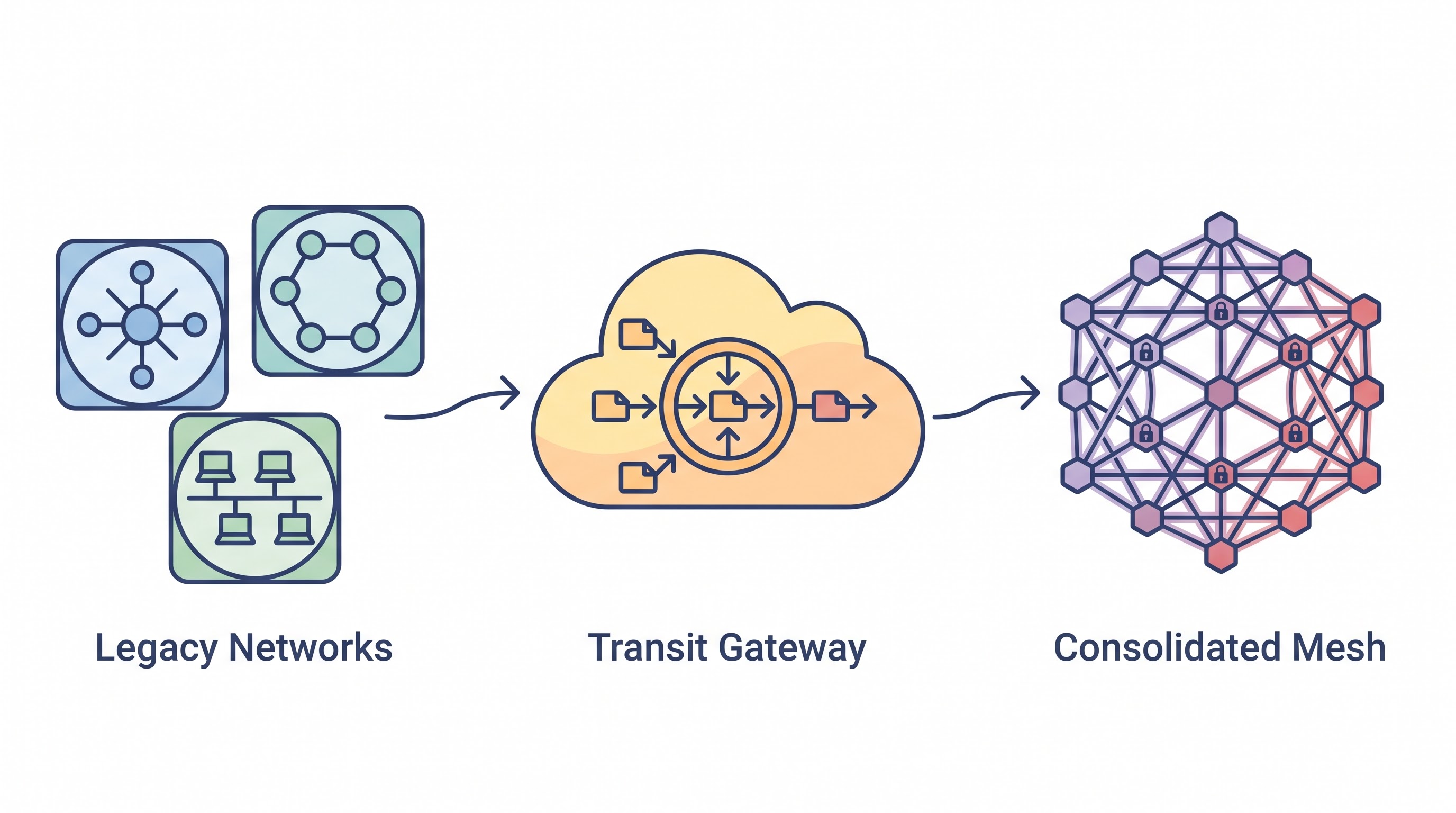
1. Executive Synthesis
In 2026, the mechanics of enterprise Mergers and Acquisitions (M&A) have been fundamentally disrupted by the opacity of cloud infrastructure. Historically, IT due diligence involved auditing physical data centers, counting software licenses, and evaluating hardware depreciation schedules. Today, target companies operate entirely on hyperscaler infrastructure, leveraging complex webs of 3-year Reserved Instances, Savings Plans, custom Enterprise Discount Programs (EDPs), and decentralized serverless architectures.
When an acquiring entity evaluates a target, traditional financial due diligence frequently fails to identify Inherited Cloud Debt. A SaaS target generating $50M in ARR might appear to possess a healthy 75% gross margin. However, if that margin is artificially propped up by a predatory, non-transferable cloud vendor credit that expires in 60 days, or if the architecture is a fragmented multi-cloud disaster requiring $5M in egress fees to consolidate, the post-merger EBITDA accretion will instantly collapse. Cloud infrastructure is no longer a static asset; it is a highly volatile financial liability that must be mathematically audited before the acquisition term sheet is signed.
To prevent value destruction during corporate consolidation, acquiring enterprises must execute the Post-Merger Infrastructure Consolidation (PMIC) Framework. The PMIC Framework mandates that FinOps engineers sit alongside investment bankers during the M&A due diligence phase. It establishes rigorous mathematical models to quantify the exact cost of migrating the target's workloads into the acquirer's master cloud organization.
Furthermore, the PMIC framework operationalizes the "Consolidation Arbitrage." By absorbing the target's cloud spend into the acquirer's massive master billing account, the enterprise can instantly force the hyperscaler into a higher EDP discount tier. By calculating the exact architectural friction of IP overlap routing, Active Directory federation, and legacy discount stranding, FinOps leaders can provide the CFO with a precise, mathematically verified timeline for post-merger integration ROI, ensuring the acquisition delivers its promised financial synergies.
2. Market Gap & Search Intent Failure Analysis
Enterprise research regarding "IT Due Diligence" or "M&A Cloud Integration" is severely antiquated, written primarily by legacy management consulting firms utilizing pre-cloud frameworks. Search intent yields high-level checklists: "Audit security compliance," "Check open-source license usage," or "Inventory source code repositories."
The critical market gap is the total failure to model the Cloud Commitment Collision Factor. Analysts treat cloud spend as a simple, linear operating expense. They fail to warn acquiring CFOs that if Company A (the acquirer) is exclusively hosted on AWS and Company B (the target) recently signed a legally binding, 3-year $10M commit with Google Cloud (GCP) under a "use it or lose it" contract, the acquirer is mathematically trapped. They cannot shut down the GCP environment without paying the $10M penalty, but maintaining a dual-cloud footprint destroys the operational synergies of the merger. Standard M&A playbooks do not provide the equations to calculate the exact break-even point for breaking a hyperscaler contract versus absorbing the stranded commitment. This playbook fills that gap by deploying strict financial mathematics to evaluate cloud infrastructure during corporate acquisitions.
3. Core Strategic Framework
The enterprise must operationalize the Post-Merger Infrastructure Consolidation (PMIC) Framework. This framework dictates that cloud integration is executed as a strict financial arbitrage operation, governed by the timeline of commitment expirations.
Implementation Protocol:
FinOps Clean-Room Audit: During the M&A due diligence phase, secure read-only API access to the target company's AWS Cost & Usage Report (CUR) or Azure EA billing data. Execute the PMIC mathematical models to uncover hidden unit costs.
Commitment Collision Profiling: Map the target's active Reserved Instances, Savings Plans, and EDP commit timelines against the acquirer's master billing account.
Execute the Migration Arbitrage Calculation: Determine if the target's workloads should be physically migrated into the acquirer's VPCs, or if they should remain logically isolated but financially absorbed under a Consolidated Billing mechanism.
Execution Decision Matrix:
If Target Cloud Provider
$\neq$Acquirer Cloud Provider AND Target Penalty$> \$2\text{M}$, strictly freeze physical migration. Maintain multi-cloud isolation until the target's contract naturally decays to a break-even threshold.If Target Cloud Provider
$==$Acquirer Cloud Provider, execute an immediate AWS Organizations / Azure Management Group absorption. The instantaneous spike in aggregated spend must be utilized to trigger a mid-cycle EDP renegotiation with the hyperscaler to capture volume discounts.If Target Architecture relies on proprietary PaaS (e.g., DynamoDB) and Acquirer relies on generic OSS (e.g., PostgreSQL), do not execute a technical refactor unless the
$C_{extract}$(Extraction Cost) payback period is$< 18\text{ months}$.
4. Financial Modeling Layer (MANDATORY)
Executing profitable M&A cloud consolidation requires the deployment of the following strict financial models during due diligence.
Core Equations
1. Inherited Cloud Debt Liability ($D_{cloud\_inherited}$):
Calculates the hidden financial liability the acquirer assumes by taking ownership of the target company's unoptimized cloud architecture and binding contracts.
$$D_{cloud\_inherited} = (C_{stranded\_commits} \times T_{remaining\_months}) + C_{egress\_migration\_penalty} + (V_{tech\_debt\_hrs} \times R_{eng\_hr})$$Where:
$C_{stranded\_commits}$= Monthly value of cloud reservations or volume commitments that the acquirer cannot utilize or seamlessly transfer.$C_{egress\_migration\_penalty}$= The network transit tax required to physically migrate the target's data lakes into the acquirer's cloud perimeter.$V_{tech\_debt\_hrs}$= Engineering hours required to remediate severe security or architectural flaws discovered in the target's environment.
2. Consolidation Arbitrage Margin ($M_{consolidation}$):
Quantifies the direct financial synergy generated by rolling the target company's infrastructure into the acquirer's master billing tier.
$$M_{consolidation} = \left( Spend_{target\_annual} \times (D_{acquirer\_discount\_tier} - D_{target\_discount\_tier}) \right) - \left( C_{migration\_labor} + C_{dual\_run\_overlap} \right)$$Where:
$D_{acquirer\_discount\_tier}$= The acquirer's negotiated hyperscaler discount percentage (e.g., 18%).$D_{target\_discount\_tier}$= The target company's lower discount percentage (e.g., 5%).
3. The Commitment Break-Even Threshold ($T_{commit\_be}$):
Determines the exact month when it becomes financially profitable to pay the contractual penalty for terminating the target's legacy cloud contract and migrating their workloads to the acquirer's highly discounted primary cloud.
$$T_{commit\_be} = \frac{F_{termination\_penalty}}{C_{monthly\_target\_run\_rate} - C_{monthly\_acquirer\_optimized\_run\_rate}}$$A) Sensitivity Analysis Table
This table models the 12-Month Post-Merger EBITDA impact of acquiring a $50M ARR SaaS target, comparing the integration strategies against the Target's existing Cloud Commitments.
Target's Existing Cloud Posture | Strategy: Isolate & Maintain | Strategy: Consolidated Billing (Same Cloud) | Strategy: Force Refactor (Cross-Cloud) | FinOps Recommendation |
No Commitments (100% On-Demand) | $0 Synergy | +$1.5M Synergy (Instant discount) | -$500k (Refactor costs) | Consolidate Billing Instantly |
Heavy Commits (Same Cloud) | -$200k (Missed Volume) | +$2.1M Synergy (Commit merging) | -$1.2M (Stranded assets) | Absorb Commits & Renegotiate |
Heavy Commits (Competitor Cloud) | $0 Synergy (Maintains TCO) | -$50k (IAM Federation overhead) | -$4.5M (Contract Penalties) | Isolate until contracts expire |
Decision Threshold: Forcing a rapid, cross-cloud migration when the target is locked into a competitor's volume commitment contract is a guaranteed mechanism for EBITDA destruction. The acquirer must quarantine the asset until the $T_{commit\_be}$ mathematically justifies the extraction.
B) Break-Even Formula
The Integration Engineering Payback ($P_{integration\_roi}$) calculates the number of months required for the operational savings of a unified architecture to cover the engineering CapEx of merging the target's infrastructure.
$$P_{integration\_roi} = \frac{CapEx_{vpc\_peering} + CapEx_{iam\_federation} + CapEx_{ci\_cd\_merger}}{M_{consolidation\_monthly} + C_{duplicate\_tooling\_avoided}}$$Numerical Example: Merging the target's Jenkins pipelines into the acquirer's GitHub Actions, federating Azure AD, and establishing an AWS Transit Gateway costs $300,000 in engineering labor. The acquirer's EDP discount saves $15,000/month on the target's bill. Eliminating the target's duplicate Datadog and Jenkins licenses saves $10,000/month. Total monthly savings = $25,000. $P_{integration\_roi} = \$300,000 / \$25,000 = 12\text{ months}$. The integration delivers a 1-year payback, making it a highly accretive corporate mandate.
C) Probability-Weighted Risk Table
Quantifying the financial risks discovered during post-merger cloud integration.
Scenario | Probability | Financial Impact | Weighted Exposure |
IP Address Space Overlap (Routing failure) | 45.0% / M&A | $150,000 (Network refactor labor) | $67,500 per acquisition |
Orphaned Account Sprawl (Security Breach) | 60.0% / M&A | $500,000 (Compliance fine / Leak) | $300,000 per acquisition |
Undisclosed Vendor Credits Expiring | 30.0% / M&A | $250,000 (Surprise OpEx spike) | $75,000 per acquisition |
Target EDP Shortfall Penalty | 15.0% / M&A | $1,000,000 (Contract default) | $150,000 per acquisition |
D) Cost-per-Unit Model
The central metric for M&A Cloud FinOps is the Post-Merger Unit Cost Variance ($V_{pmuc}$):
$$V_{pmuc} = \frac{CPTU_{acquirer} - CPTU_{target}}{CPTU_{acquirer}} \times 100$$(Where CPTU = Cost Per Transaction Unit)
Threshold: If the target's $CPTU$ is significantly lower than the acquirer's (i.e., the target has vastly superior engineering efficiency), the acquirer must mathematically block their internal IT teams from forcing the target to adopt the acquirer's bloated corporate infrastructure standards. Do not destroy the target's superior unit economics in the name of "corporate standardization."
5. Operational Architecture Integration
Cross-Tenant IAM & Identity Federation:
The most immediate architectural hurdle post-merger is access control. The target company operates within its own distinct Active Directory (Entra ID) or Okta tenant. Attempting a brute-force user migration in Month 1 is operationally destabilizing. Architecture must execute a Hub-and-Spoke Identity Federation. The acquirer establishes an OIDC/SAML trust relationship between the target's existing Identity Provider and the acquirer's master cloud control plane (AWS IAM Identity Center). This allows the acquirer's SREs and FinOps teams to instantly assume highly privileged, audited roles within the target's cloud perimeter without requiring the immediate disruption of migrating thousands of employee credentials.
Transit Gateway & IP Overlap Mitigation:
When two mid-market or enterprise companies merge, there is a 95% mathematical probability that their internal VPC networks utilize overlapping IPv4 RFC 1918 CIDR blocks (e.g., both use 10.0.0.0/16). Direct VPC peering is physically impossible. FinOps must budget for the architectural workaround: deploying an AWS Transit Gateway or Azure Virtual WAN integrated with Private NAT Gateways. The architecture team configures the NAT to translate overlapping IP spaces dynamically at the network boundary. While this incurs a Transit Gateway processing fee (e.g., $0.02/GB), it completely avoids the millions of dollars in engineering labor required to rip and replace the underlying subnet architecture of production databases.
Master Payer Account (Consolidated Billing) Absorption:
The primary mechanism for capturing the Consolidation Arbitrage Margin ($M_{consolidation}$) is the immediate execution of a Master Payer Account merger. On Day 1 post-acquisition, the target's AWS Organization or GCP Billing Account is detached from their legacy billing profile and invited into the acquirer's Master Billing Account. This requires zero downtime and zero code changes. Instantly, the target's compute usage contributes to the acquirer's global EDP volume metrics, mathematically forcing the hyperscaler to apply the acquirer's elite 15%-25% discount tier to the target's infrastructure, generating immediate, risk-free EBITDA accretion.
6. Failure Scenarios
Scenario 1: The "Credit Cliff" Due Diligence Failure
Breakdown: An enterprise acquires an AI startup generating $5M in ARR. During due diligence, the startup shows a highly profitable $10,000/month cloud bill. The M&A team signs the deal. 45 days after the acquisition closes, the cloud bill suddenly spikes to $180,000/month.
Financial Exposure: The startup's "profitability" was entirely fabricated by a $2M non-renewable AWS Activate / Microsoft for Startups credit that expired shortly after the acquisition. The acquirer is hit with an unbudgeted $2.04M annual OpEx liability, completely wiping out the acquisition's financial rationale.
Governance Prevention Layer: Mandatory FinOps Clean-Room Audits. Investment banking and corporate development teams are mathematically prohibited from accepting standard P&L statements for cloud costs. FinOps must execute API-level analysis of the target's raw CUR data, explicitly stripping out all temporary promotional credits, to calculate the true, un-subsidized unit economics of the target before valuation.
Scenario 2: The EDP Shortfall Default
Breakdown: Company A acquires Company B. Company B had recently signed a massive 3-year EDP contract with AWS requiring a $5M annual spend. Company A ruthlessly optimizes Company B's architecture, right-sizing nodes and deleting orphaned environments, dropping Company B's cloud spend to $2M a year.
Financial Exposure: Company B fails to hit its $5M annual contractual commit. The hyperscaler triggers the shortfall penalty, forcing Company A to write a $3M check for cloud compute they never actually consumed. The engineering optimization punished the corporate balance sheet.
Governance Prevention Layer: Commitment Collision Profiling. FinOps must mandate a complete audit of all target volume commitments. If an optimization plan will trigger a shortfall penalty, the optimization must be paused, or the target's account must be merged into the acquirer's master EDP contract (which usually supersedes and absorbs the target's commitments, neutralizing the penalty).
Scenario 3: "Lift and Shift" Integration Sprawl
Breakdown:CIO
Financial Exposure: The target workloads lose their highly optimized GCP sustained-use discounts and incur massive cross-cloud egress fees during the migration. The resulting AWS footprint is 40% more expensive than the original GCP environment, destroying the promised M&A cost synergies.
Governance Prevention Layer: The Consolidation Arbitrage (
$M_{consolidation}$) Gateway. Physical cloud migrations are strictly banned unless the FinOps team mathematically proves that the long-term unit cost in the destination cloud (accounting for the extraction CapEx) is superior to leaving the workload running natively in the target's original cloud.
7. Board-Level Translation Layer
EBITDA Delta Modeling: Cloud infrastructure is one of the largest controllable operational expenses in an acquisition. By executing the PMIC framework, the M&A team can instantly capture massive synergy targets simply by merging billing accounts to capture volume discount arbitrage. A $20M target cloud bill absorbed into a 20% acquirer discount tier yields $4M in immediate, zero-risk EBITDA expansion on Day 1 of the integration.
Gross Margin Defense: Thorough FinOps due diligence prevents the acquisition of "toxic assets"—startups whose gross margins are propped up entirely by temporary venture capital cloud credits. Identifying the Inherited Cloud Debt Liability (
$D_{cloud\_inherited}$) ensures the board adjusts the acquisition valuation multiple downward to account for the impending cloud OpEx spike, defending the acquirer's balance sheet.Capital Allocation Signal: The decision to physically migrate a target company's infrastructure into the parent company's cloud requires massive engineering CapEx. The CFO must demand the Integration Engineering Payback (
$P_{integration\_roi}$) metric. If the migration takes 3 years to break even, the board must signal engineering to halt the migration, maintain the multi-cloud footprint, and allocate that engineering capital to new product development instead.Risk-Adjusted ROI Formula:
$$ROI_{m\&a\_cloud} = \frac{M_{consolidation\_annual} + \text{Avoided Undisclosed Cloud Liabilities}}{CapEx_{due\_diligence\_audit} + CapEx_{architectural\_integration}}$$
8. Data Visualization Suggestions
Post-Merger Arbitrage Waterfall: A waterfall chart showing the target's pre-merger cloud bill, stepping up for unmasked promotional credits, then stepping massively down as the Acquirer's EDP discount, RI sharing, and orphaned resource pruning are applied, revealing the optimized post-merger run rate.
Commitment Collision Timeline: A Gantt chart overlaying the Acquirer's EDP renewal date against the Target's expiring RIs and Cloud Contracts. The visual intersection points highlight exact months where FinOps must execute migration or negotiation maneuvers.
Inherited Cloud Debt (
$D_{cloud\_inherited}$) Breakdown: A pie chart detailing the hidden liabilities discovered during due diligence: Egress Taxes, Technical Debt Remediation, and Stranded Commitments, proving the value of the FinOps audit to the board.IP Overlap & Transit Gateway Topology: A network diagram showing the Acquirer VPC and Target VPC with identical 10.0.0.0/16 CIDR blocks. A central Transit Gateway acts as the routing arbiter, utilizing NAT to seamlessly pass traffic without triggering an IP collision.
Master Payer Discount Accretion Curve: A line chart plotting Total Organizational Cloud Spend vs Discount Percentage. As the Target's spend is added to the X-axis, the line jumps up into a higher discount bracket on the Y-axis, visually demonstrating the power of consolidated volume leverage.
9. Why Analyst-Style Summaries Fail at Financial Precision
When M&A advisory firms state, "During integration, IT teams should align the target's infrastructure with corporate standards to realize operational synergies," they are delivering a dangerous, unquantified cliché that routinely destroys post-merger value.
This narrative fails because "aligning with corporate standards" usually means a forced, brute-force migration across cloud boundaries. If a CIO follows this advice and forces a highly efficient Azure-native application to run on AWS without rewriting the underlying proprietary dependencies, the extraction cost and performance degradation will annihilate the acquired company's profit margins. M&A analysts do not calculate the Integration Engineering Payback ().
Equation-backed modeling using the Post-Merger Infrastructure Consolidation (PMIC) framework replaces vague synergy targets with absolute mathematical boundaries. By explicitly calculating the Inherited Cloud Debt Liability ($D_{cloud\_inherited}$) during due diligence, the acquiring CFO can directly reduce the cash purchase price of the acquisition. Furthermore, it mathematically proves that sometimes the most financially advantageous integration strategy is to leave the target completely alone physically, while absorbing them purely financially via a master payer account. You cannot integrate cloud architectures with management consulting checklists; you must execute the integration as a ruthless financial arbitrage operation.
10. Strategic Conclusion
Mergers and acquisitions in the 2026 enterprise landscape are defined by the collision of hyper-scaled cloud architectures. Because cloud infrastructure operates as a fluid, highly complex financial instrument, executing an M&A transaction without deploying advanced FinOps due diligence is equivalent to acquiring a company without auditing its tax liabilities. Inherited cloud debt, hidden by expiring venture credits and predatory lock-in contracts, can instantly turn a highly accretive acquisition into a margin-destroying liability.
To capture the true value of corporate consolidation, acquiring entities must enforce the Post-Merger Infrastructure Consolidation (PMIC) Framework. FinOps is no longer a post-merger clean-up crew; it is a Tier-1 due diligence function. Enterprise leaders must mandate API-level audits of target environments to uncover the exact unit economics underlying the target's SaaS gross margins.
Once the acquisition closes, the integration strategy must be governed by strict arbitrage mathematics. Physical migrations must be mathematically gated by the Integration Engineering Payback threshold, physically preventing IT organizations from embarking on multi-million dollar "lift and shift" vanity projects. By executing immediate billing consolidation to capture volume discounts, deploying Transit Gateways to bypass IP collisions, and patiently waiting for the target's legacy cloud contracts to decay below the break-even threshold, the acquirer transforms the chaos of M&A infrastructure into a mathematically guaranteed driver of corporate EBITDA.
11. Implementation Readiness Checklist
Mandate FinOps M&A Clean-Room Audits: Update the corporate M&A due diligence checklist to require programmatic API access to the target's Cloud Billing accounts, explicitly overriding the acceptance of manual PDF invoices.
Calculate the
$D_{cloud\_inherited}$Valuation Adjustment: Run the exact financial math to strip out all expiring vendor credits from the target's P&L. Provide this exact dollar figure to Corporate Development to adjust the final purchase valuation downwards.Execute Day-1 Master Payer Consolidation: Prepare the AWS Organizations or Azure Management Group invitations prior to deal closure to ensure the target's cloud spend rolls into the acquirer's discount tier on the exact day of legal acquisition.
Audit Target EDP Shortfall Liabilities: Review all hyperscaler contracts signed by the target to identify "use-it-or-lose-it" clauses. Model whether planned post-merger optimizations will trigger catastrophic contractual penalties.
Deploy Cross-Tenant IAM Hubs: Configure OIDC/SAML federation between the target's Identity Provider and the acquirer's control plane to grant SREs secure, audited access without waiting for a full active directory migration.
Architect Transit Gateway NAT Topologies: Pre-deploy cloud routing infrastructure capable of handling overlapping RFC 1918 IP spaces, physically preventing network collision disasters during the initial phase of systems integration.
Calculate the
$P_{integration\_roi}$for Migrations: Force the IT organization to mathematically prove that the operational savings of moving a target workload to the corporate cloud standard will pay back the engineering CapEx in under 18 months.Halt Target 3-Year Reservations: Immediately upon acquisition announcement, institute a hard freeze on the target company purchasing any new 1-year or 3-year Reserved Instances or Savings Plans until the global consolidation strategy is finalized.
Identify Orphaned Cloud Sprawl:Security Posture
Execute Global RI Sharing:Savings Plan
Stop guessing where your Kubernetes budget is going. Schedule a demo here to explore Kubernetes cost monitoring with Cloud Atler.