
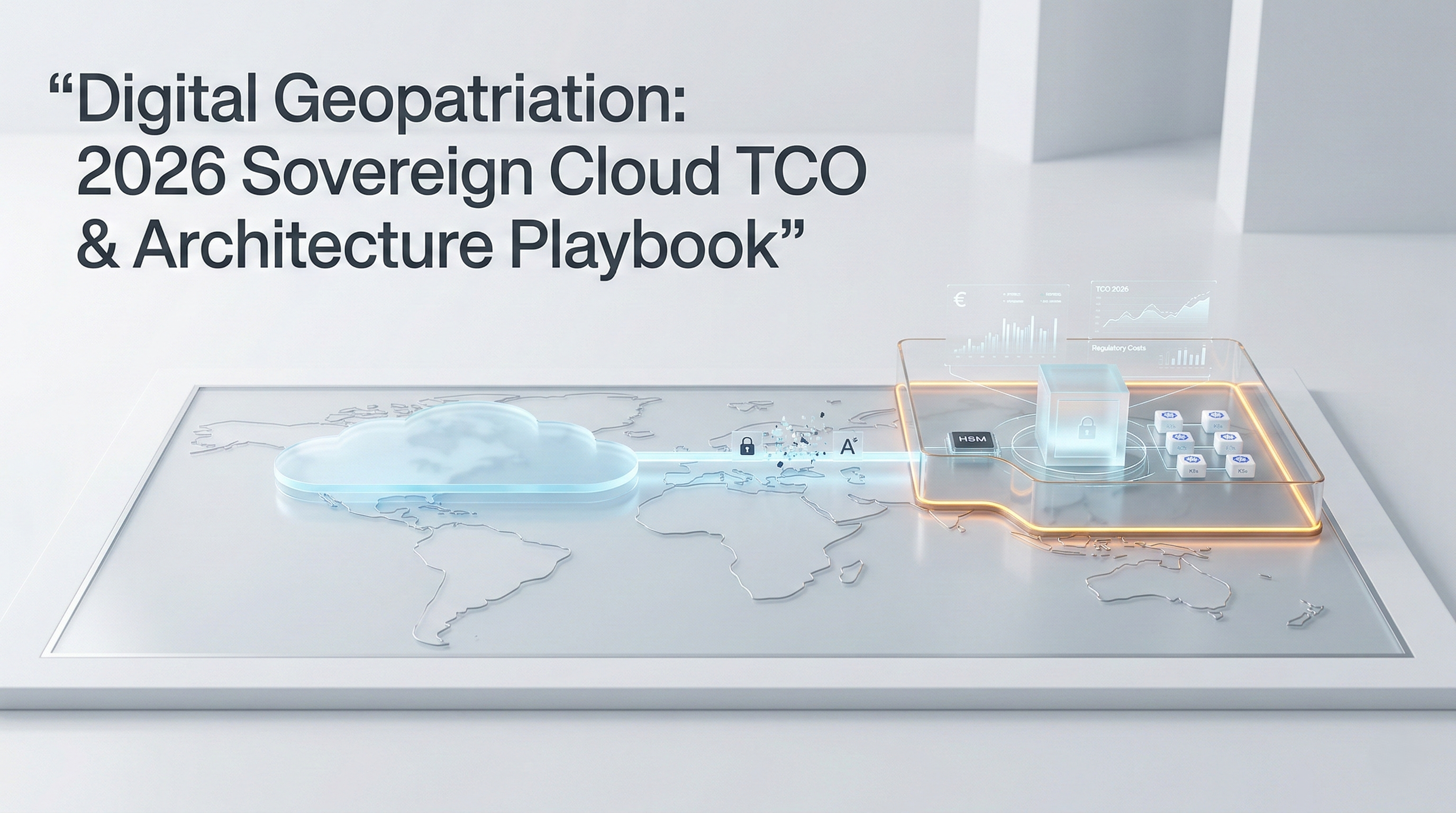
1. Executive Synthesis
The globalization of enterprise cloud infrastructure has fractured. Driven by the enforcement of the EU AI Act, the tightening of cross-border data transfer mechanisms, and the weaponization of technology supply chains, the 2026 operational environment mandates a transition toward Digital Geopatriation. Enterprises can no longer rely on single global control planes or unified public cloud regions without incurring catastrophic regulatory exposure. Sovereign Cloud—ranging from localized data residency zones to physically air-gapped, cryptographically isolated enclaves operated by cleared national citizens—is now a mandatory tier in the enterprise architecture portfolio.
However, sovereign cloud environments fundamentally break traditional FinOps unit economics. The isolation required to guarantee digital sovereignty introduces the "Sovereign Premium"—a structural increase in Total Cost of Ownership (TCO) driven by restricted hardware availability, decoupled Identity and Access Management (IAM), duplicate disaster recovery topologies, and the inability to leverage global spot compute liquidity. Attempting to lift-and-shift existing public cloud workloads into a sovereign partition without mathematically evaluating this premium results in immediate margin compression.
Digital Geopatriation requires treating compliance not as a legal binary, but as a quantifiable financial variable within the infrastructure provisioning lifecycle. The architectural strategy must bifurcate workloads: anonymized, stateless, and non-sensitive compute remains in hyperscale public regions to capture maximum economic efficiency, while regulated PII, sovereign AI model weights, and national security-adjacent datasets are forcefully routed to isolated enclaves. This playbook codifies the Sovereign Premium Arbitrage (SPA) Model, enabling enterprise leaders to financially justify the exact threshold where the cost of physical data localization is out-weighed by the probability-weighted reduction in regulatory sanctions and intellectual property theft.
To execute this, infrastructure leaders must implement Confidential Computing architectures utilizing hardware-level memory encryption (e.g., AMD SEV-SNP, Intel TDX) and localized Hardware Security Modules (HSMs) where the enterprise, not the hyperscaler, holds the cryptographic keys. You must model the exact cost of egressing anonymized telemetry out of the sovereign boundary against the cost of duplicating observability stacks inside the perimeter. This playbook provides the rigorous financial and architectural frameworks required to operate profitably across fragmented geopolitical boundaries.
2. Market Gap & Search Intent Failure Analysis
Enterprise research regarding sovereign cloud consistently fails by conflating "Data Residency" with "Digital Sovereignty." Search queries for "Sovereign Cloud Cost" typically yield generic whitepapers from hyperscalers that focus exclusively on local data center availability zones. This is legally and technically insufficient for 2026 requirements.
The market gap is the total absence of mathematical modeling for the operational friction introduced by cryptographic and operational sovereignty. Analyst reports fail to quantify the cost of running a shadow IT organization specifically cleared to operate an air-gapped environment. They ignore the financial degradation caused by the lack of managed SaaS integrations (e.g., Datadog or Snowflake cannot simply connect to an air-gapped sovereign VPC without breaking the compliance perimeter). By treating sovereign cloud as just another region selection in a Terraform script, enterprises fail to capitalize the massive hidden costs of duplicate CI/CD pipelines, isolated container registries, and degraded AI inference speeds due to older GPU availability in restricted regions. This playbook eliminates that blind spot by introducing hard quantitative models for the Sovereign Premium.
3. Core Strategic Framework
To navigate the fragmented cloud landscape, enterprises must adopt the Sovereign Premium Arbitrage (SPA) Model. This framework dynamically evaluates the regulatory risk of global deployment against the compounded operational costs of sovereign isolation, dictating exact workload placement based on financial viability.
Implementation Protocol:
Data Provenance Tagging: Implement cryptographic tagging at the data-ingestion layer. Datasets are classified automatically:
Global-Public,Regulated-Localized, orSovereign-Airgapped.Infrastructure Bifurcation: Architect a hub-and-spoke multi-cloud network where the "Hub" is the sovereign enclave holding the root of trust (KMS/HSM), and the "Spokes" are public compute regions.
Compute the Sovereign Premium: Algorithmically calculate the cost differential of running a specific containerized workload in a standard region versus the sovereign partition using the SPA equations.
Decision Matrix:
If $Data\_Class == Sovereign$ AND $Risk\_Exposure > TCO_{sov}$, mandate deployment to the Sovereign enclave regardless of the compute premium.
If $Data\_Class == Regulated$ AND $C_{sov\_premium} > \$50,000/mo$, trigger an architectural rewrite to pseudonymize the data, enabling computation in the cheaper public region while storing the mapping key in the sovereign HSM.
If $Data\_Class == Global$, block deployment to the sovereign region to prevent resource exhaustion of high-premium infrastructure.
4. Financial Modeling Layer (MANDATORY)
The following financial models quantify the economics of geopolitical cloud fragmentation.
Core Equations
1. The Sovereign Compliance Premium ($C_{sp}$):
Calculates the absolute premium paid to operate a workload in a sovereign boundary compared to a standard public region.
$$C_{sp} = \left( \sum_{i=1}^{n} (P_{sov\_i} - P_{pub\_i}) \times V_i \right) + C_{clearance\_ops} + C_{duplicate\_tooling}$$
Where:
$P_{sov}$ = Unit price of resource in the sovereign region.
$P_{pub}$ = Unit price of resource in the public region.
$V$ = Volume of resources consumed.
$C_{clearance\_ops}$ = Amortized cost of maintaining specialized, citizen-cleared SRE teams.
$C_{duplicate\_tooling}$ = Cost of localized, disconnected observability and CI/CD tools.
2. Geopatriation Risk-Adjusted Value ($V_{geo}$):
Determines if moving a workload to a sovereign cloud yields a positive financial return when factoring in regulatory avoidance.
$$V_{geo} = (P_{audit\_failure} \times F_{regulatory\_penalty}) - (C_{sp} + C_{migration\_capex})$$
Where:
$P_{audit\_failure}$ = Statistical probability of a data sovereignty breach or compliance failure in the public cloud.
$F_{regulatory\_penalty}$ = Projected financial fine (e.g., 4% of global turnover under GDPR/AI Act).
$C_{migration\_capex}$ = One-time capitalized cost of re-architecting the workload for air-gapped deployment.
3. Sovereign Data Egress Penalty ($SDEP$):
Quantifies the cost of extracting anonymized insights or model checkpoints from the sovereign boundary back to the global control plane.
$$SDEP = (V_{egress\_GB} \times R_{sov\_egress\_rate}) + (T_{anonymization\_compute} \times R_{compute\_hr})$$
A) Sensitivity Analysis Table
This table demonstrates the financial impact (EBITDA delta) of maintaining a 500-node Kubernetes cluster in a Sovereign Cloud based on the required level of isolation and the probability of a regulatory fine.
Variable (Isolation Level) | Low Fine Prob (5%) | Base Fine Prob (15%) | High Fine Prob (40%) | EBITDA Impact |
Data Residency Only | -$120,000 | +$450,000 | +$2.1M | Modest premium, high ROI on compliance |
Confidential Computing | -$350,000 | +$180,000 | +$1.8M | Expensive hardware, justified by medium risk |
Full Air-Gapped Sovereign | -$1.2M | -$450,000 | +$900,000 | Massive structural cost, requires extreme risk to justify |
Decision Threshold: Full air-gapped environments destroy EBITDA unless the workload carries a $>25\%$ probability of triggering a multi-million dollar regulatory event.
B) Break-Even Formula
The Geopatriation Break-Even ($GBE$) point calculates the maximum allowable percentage increase in cloud infrastructure unit costs before sovereign deployment becomes mathematically non-viable, assuming a fixed regulatory penalty exposure.
$$GBE_{\%} = \frac{P_{audit} \times F_{penalty}}{Total\_Public\_Cloud\_Spend\_for\_Workload} \times 100$$
Numerical Example: If a workload costs $1M annually in the public cloud, the probability of an audit failure is 10%, and the fine is $5M. The risk value is $500,000. Therefore, the maximum Sovereign Premium the enterprise should accept ($GBE_{\%}$) is 50%. If the sovereign cloud costs $1.6M (+60%), the enterprise must re-architect rather than migrate.
C) Probability-Weighted Risk Table
Quantifying the operational risks introduced by sovereign isolation.
Scenario | Probability | Financial Impact | Weighted Exposure |
Sovereign GPU Supply Squeeze (Time-to-Market) | 35.0% | $800,000 (Launch delay) | $280,000 per project |
Desynchronized IAM Incident (Lockout) | 12.0% | $45,000 (Downtime) | $5,400 per event |
Cryptoshredding Failure (Key Leakage) | 2.5% | $5,000,000 (Data breach) | $125,000 per event |
Third-Party SaaS Integration Breakage | 45.0% | $60,000 (Custom dev work) | $27,000 per application |
D) Cost-per-Unit Model
The central unit is the Cost Per Sovereign Transaction (CPST).
$$CPST = \frac{C_{sp\_monthly} + C_{local\_compute\_monthly}}{Total\_Regulated\_Transactions}$$
Threshold: If $CPST$ exceeds the standard transaction cost by more than 3.5x, FinOps must force the engineering team to implement data tokenization, moving the transaction processing back to the global cloud while keeping only the token vault in the sovereign region.
5. Operational Architecture Integration
AWS European Sovereign Cloud & Nitro Enclaves:
Enterprises deploying into sovereign boundaries must utilize hardware-level isolation. On AWS, this requires wrapping sensitive processing algorithms inside AWS Nitro Enclaves. The architecture dictates that the primary EC2 instance handles external API requests, but the actual decryption of PII and subsequent computation happens exclusively inside the isolated Nitro Enclave, which has no persistent storage or interactive access. This requires heavy CI/CD modification to build enclave image files (.eif) alongside standard Docker containers.
Azure Confidential Computing & External Key Management:
For Microsoft Cloud for Sovereignty, the critical integration is the disentanglement of Key Management Systems (KMS). The enterprise must deploy External Key Management (EKM) backed by FIPS 140-3 Level 3 HSMs physically located within the geopolitical boundary (e.g., a colocation facility in Frankfurt). Azure Confidential VMs (featuring AMD SEV-SNP) boot by verifying a cryptographic attestation with the external HSM. If the geopolitical situation deteriorates, the enterprise executes a "Cryptoshred," instantly destroying the keys in the HSM, rendering the sovereign cloud data mathematically unrecoverable by the cloud provider or state actors.
Air-Gapped Kubernetes (Rancher/Tanzu):
In fully air-gapped sovereign scenarios, relying on hyperscaler managed services (EKS/AKS) is impossible due to control-plane call-homes. Enterprises must operate self-managed Kubernetes. This requires standing up private container registries (Harbor) inside the boundary. The CI/CD pipeline (GitLab) in the global region compiles the binaries, scans them, and then pushes them through a unilateral secure gateway (data diode) into the sovereign environment.
6. Failure Scenarios
Scenario 1: The "Lift and Shift" Margin Crush
Breakdown: An enterprise responds to a regulatory mandate by lifting an entire global SaaS application—including stateless web frontends, anonymized caching layers, and the sensitive database—directly into a sovereign cloud region.
Financial Exposure: A permanent 40-60% increase in monthly OpEx due to paying the Sovereign Premium on 100% of the architecture, rather than just the 10% that actually handles regulated data.
Governance Prevention Layer: Implement a strict FinOps gateway utilizing the SPA model. Infrastructure-as-Code (IaC) pipelines are blocked from deploying to sovereign regions unless the specific Terraform module contains a signed
Data-Class: Sovereigntoken generated by the Chief Privacy Officer's automated classification engine.
Scenario 2: The Silent Drift Outage
Breakdown: A sovereign environment is physically disconnected from the global control plane. Security patches and IAM policy updates require a manual sync process. The global SRE team updates an OIDC federation policy but fails to sync it to the air-gapped region. The sovereign application suddenly loses the ability to authenticate local users, causing a complete localized outage.
Financial Exposure: $150,000+ per event in SLA violations and immediate dispatch of cleared personnel to physically access the environment.
Governance Prevention Layer: Mandatory "GitOps via Diode" architecture. All state changes to the sovereign environment must be committed to a strictly version-controlled Git repository. A dedicated automated synchronization agent pulls these changes through the security boundary every 5 minutes, ensuring state parity without human intervention.
Scenario 3: Sovereign GPU Starvation
Breakdown: An enterprise commits to training a localized LLM inside a sovereign region to comply with national AI data laws. However, hyperscalers prioritize global regions for deploying new, highly efficient H200s or TPUv5p chips. The sovereign region only offers older A100s.
Financial Exposure: Training time increases by 300%, burning millions in older compute costs and resulting in a massively degraded Effective Token Yield (ETY).
Governance Prevention Layer: AI architecture must utilize federated learning. The model is trained on non-sensitive, global data in the cheapest public region utilizing state-of-the-art silicon. Only the final, parameter-efficient fine-tuning (PEFT) using the restricted datasets occurs on the older, more expensive sovereign GPUs.
7. Board-Level Translation Layer
EBITDA Delta Modeling: Sovereign compliance is fundamentally an EBITDA drain. The board must view the Sovereign Premium ($C_{sp}$) not as IT waste, but as a mandatory insurance premium against regulatory destruction. Tracking the difference between the $C_{sp}$ and the $GBE$ ensures the enterprise is not overpaying for that insurance.
Gross Margin Defense: If a SaaS company is forced to host European clients in a localized sovereign cloud, the COGS for European revenue will be structurally higher than North American revenue. The board must adjust regional pricing models (Sovereign Tier Pricing) to defend gross margins, passing the $C_{sp}$ onto the customer requiring the isolation.
Capital Allocation Signal: Building physical HSMs, hiring cleared citizens, and refactoring applications for Nitro Enclaves requires massive CapEx. This signals to the board that entering highly regulated geopolitical markets requires a distinct capital ROI analysis independent of global expansion metrics.
Risk-Adjusted ROI Formula:
$$ROI_{geo} = \frac{\text{Net New Revenue from Sovereign Market} - C_{sp}}{\text{Cost of Geopatriation CapEx}}$$
8. Data Visualization Suggestions
A waterfall chart starting with base public cloud cost, adding steps for Hardware Premium, Cleared Personnel Ops, Duplicate Observability, ending at the True Sovereign TCO.
An architectural diagram showing PII entering the global public cloud, being tokenized, and only the secure vault existing inside the restricted Sovereign Boundary.
A plot comparing various enterprise workloads. X-axis is "Regulatory Risk Exposure," Y-axis is "Sovereign Premium Cost." A diagonal line represents the break-even threshold.
A visual timeline of a geopolitical crisis triggering an automated API call to an external HSM, securely destroying the tenant keys and instantly rendering the sovereign cloud instances mathematically dead.
A global map color-coded by margin. US East is dark green (high margin/low premium), while an EU Sovereign region is light green or yellow due to the heavy $C_{sp}$ burden on COGS.
9. Why Analyst-Style Summaries Fail at Financial Precision
Traditional industry analysis approaches Sovereign Cloud purely through the lens of legal compliance and geopolitical narrative. Analysts state that "Organizations must adopt sovereign strategies to mitigate data privacy risks in Europe and Asia." This narrative is financially bankrupt.
It fails because it treats sovereignty as an on/off switch. If a CIO follows a narrative analyst report, they will mandate the migration of an entire regional footprint to a sovereign cloud, completely destroying the unit economics of their architecture. Equation-backed modeling, utilizing the SPA framework, explicitly quantifies the Sovereign Premium ($C_{sp}$). It forces the architecture team to mathematically justify what goes into the enclave. You cannot run a globally competitive enterprise if you are paying a 60% compute premium on web-serving layers just because an analyst report scared the board about data residency. Precision modeling restricts the premium specifically to the cryptographic root of trust and the explicitly regulated datasets, preserving global margins.
10. Strategic Conclusion
Digital Geopatriation is the most structurally expensive architectural shift of the 2026 enterprise landscape. The dissolution of a unified, global cloud control plane forces organizations to operate in a state of deliberate fragmentation. Sovereign clouds—whether characterized by logical data residency boundaries or physical, air-gapped isolation—impose a severe Sovereign Premium that directly attacks gross margins.
The strategic imperative is to minimize the blast radius of sovereignty. Enterprises must aggressively refactor applications to decouple stateful, sensitive data from stateless, generic compute. By utilizing tokenization, external key management, and hardware-level enclaves, infrastructure leaders can keep 90% of their workloads running in highly liquid, economically efficient global regions, while mathematically isolating the 10% that carries catastrophic regulatory risk.
Accepting the Sovereign Premium without calculating the Geopatriation Break-Even ($GBE$) point is a failure of fiduciary duty. Board-level executives must demand that every deployment into a restricted geopolitical boundary is accompanied by a rigorous TCO model that accounts for the hidden costs of cleared personnel, duplicate tooling, and hardware starvation. Sovereignty is not a technical feature; it is a profound economic trade-off that must be modeled, minimized, and actively governed.
11. Implementation Readiness Checklist
Define the Enterprise Sovereign Taxonomy: Establish clear, distinct definitions for Data Residency, Confidential Computing, and Air-Gapped Sovereignty, assigning distinct cost premiums to each.
Calculate the Baseline $C_{sp}$: Measure the explicit price difference between your primary public region (e.g.,
us-east-1) and your target sovereign region (e.g.,eu-central-sovereign) across core compute and storage SKUs.Implement Automated Cryptographic Tagging: Deploy tools at the data ingress layer to automatically tag datasets with their regulatory class, enabling programmatic infrastructure routing.
Architect External Key Management (EKM): Decouple your root of trust from the hyperscaler. Procure and provision dedicated HSMs in colocation facilities to retain ultimate control over decryption keys.
Develop a Cryptoshredding Protocol: Write and test the automated runbooks required to instantly revoke KMS keys in the event of a geopolitical compromise, rendering sovereign data unreadable.
Establish Sovereign Tier Pricing: Work with the CFO to implement distinct pricing models for SaaS customers who mandate localized or sovereign hosting to protect aggregate gross margins.
Isolate CI/CD Pipelines: Design a secondary, secure deployment pipeline capable of scanning, building, and pushing artifacts through a unilateral gateway into an isolated environment without requiring external internet access.
Evaluate Sovereign GPU Liquidity: Before committing to a sovereign AI project, audit the cloud provider's SLA for high-end accelerator availability specifically within the restricted partition.
Quantify Duplicate Observability Costs: Capitalize the cost of standing up dedicated SIEM and APM instances inside the boundary that cannot phone home to your global Datadog or Splunk tenants.
Implement SPA Deployment Governance: Integrate the SPA decision matrix into Terraform Cloud/Enterprise, requiring FinOps and Risk sign-off if the modeled sovereign premium exceeds the defined break-even threshold.
Stop guessing where your Kubernetes budget is going. Schedule a demo here to explore Kubernetes cost monitoring with Cloud Atler.