
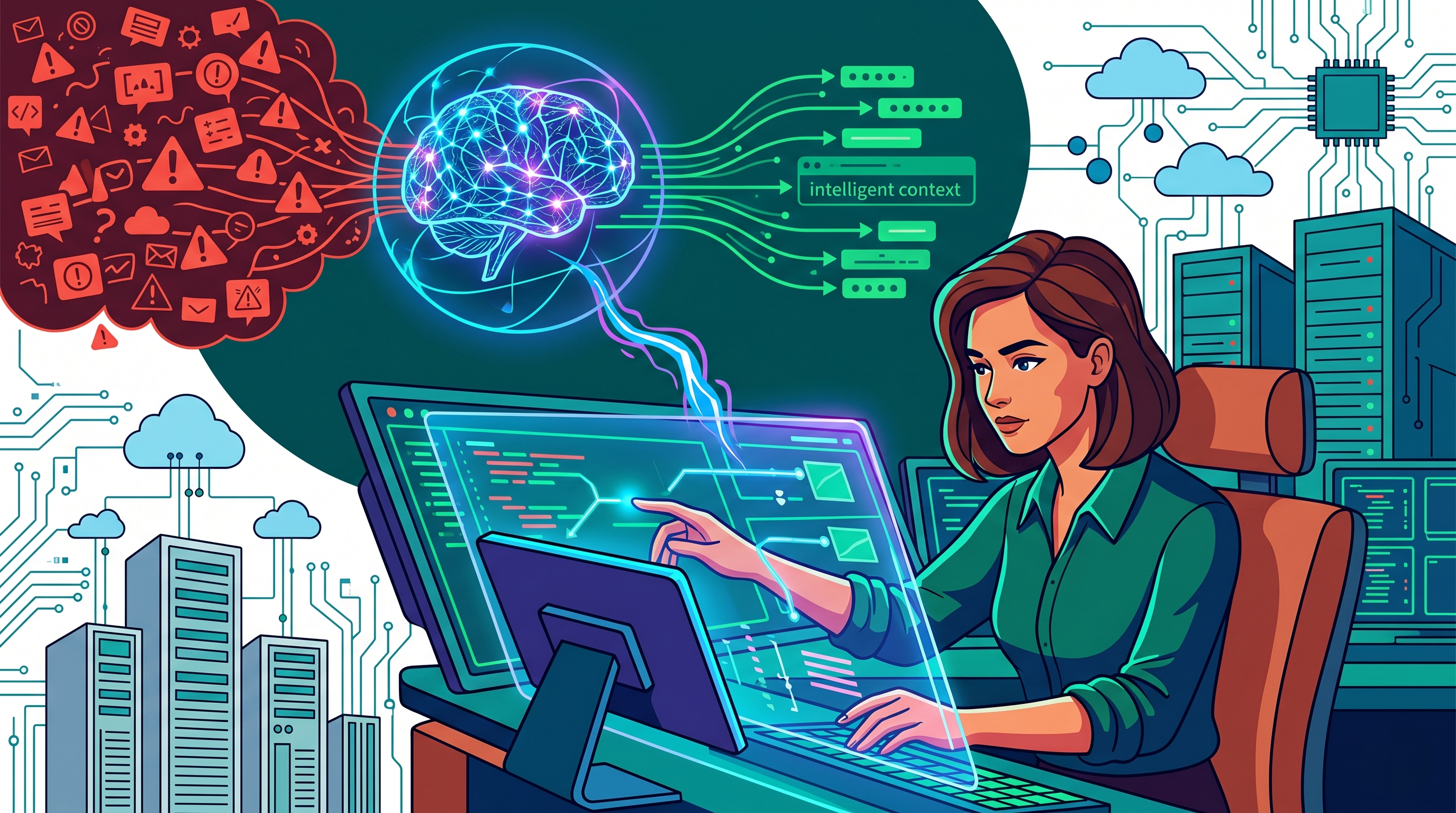
Modern systems move faster than ever. Applications are deployed continuously, infrastructure scales dynamically, and services depend on dozens or sometimes hundreds of interconnected components. While this speed creates innovation, it also creates a new operational challenge of incidents in the environment that are too complex for manual response alone.
A single customer-facing slowdown may involve cloud infrastructure, container orchestration, APIs, third-party integrations, databases, and recent code changes, all at once. By the time engineers manually trace the issue, valuable time has already been lost.
This is why incident responses are changing.
Artificial intelligence is rapidly becoming a practical layer inside DevOps operations. It is helping teams detect anomalies faster, reduce alert noise, surface root causes, automate repetitive tasks, and make better decisions under pressure. AI is not replacing engineers. It is reducing the time engineers spend searching, correlating, and reacting.
For DevOps teams managing always-on systems, that shift is significant. Faster recovery means stronger reliability, lower operational stress, better customer experience, and less revenue impact.
In this blog, let’s break down how AI is transforming incident response, where it delivers real value, and what modern teams should focus on next.
Why Traditional Incident Response Is Under Pressure
Most incident response models were built for simpler environments. Alerts fired when thresholds were crossed, engineers investigated logs manually, and teams coordinated through tickets, chat channels, and runbooks.
That model still works in smaller environments, but it struggles in modern distributed systems. Today, one user issue may trigger alerts across multiple services. A single deployment may impact systems in subtle ways that do not appear immediately. Dependencies stretch across cloud providers, SaaS tools, containers, databases, and external APIs.
As complexity rises, teams face common problems:
Too many alerts with too little context
Slow correlation between symptoms and causes
Manual log searching across fragmented tools
High stress during major incidents
Long mean time to resolution (MTTR)
Repeated incidents with no learning loop
AI is emerging because the volume and speed of operational data now exceed what humans can efficiently process in real time.
Smarter Detection Instead of Static Thresholds
Traditional monitoring often depends on fixed thresholds. CPU above 90 percent. Latency above 500 milliseconds. Error rate above a defined baseline.
The problem is that static thresholds miss nuance. A workload may normally spike every evening. A latency increase during peak traffic may be expected. A smaller anomaly at the wrong time may be far more dangerous than a larger anomaly during low usage.
AI improves detection by learning normal patterns and identifying deviations in context. Instead of simply asking whether a number crossed a line, AI asks whether the behavior is unusual for that service, time, workload, or customer segment.
This helps teams detect subtle incidents earlier and reduce false alarms that drain attention.
Alert Noise Reduction
One of the biggest causes of burnout in DevOps teams is alert fatigue. When hundreds of notifications fire during a cascading issue, responders waste time sorting duplicates instead of solving the real problem.
AI helps by grouping related alerts into a single incident narrative. It can recognize that database latency, API failures, retry storms, and customer login errors may all stem from one underlying event.
This changes the responder experience dramatically. Instead of receiving dozens of disconnected warnings, engineers receive a clearer picture of what is happening and where to start.
Less noise means faster action and lower stress.
Faster Root Cause Analysis
During incidents, time is often lost not in fixing the issue, but in figuring out where it began.
Teams jump between dashboards, traces, logs, deployment histories, infrastructure events, and chat threads, trying to build a timeline. In large environments, this process can consume most of the outage window.
AI accelerates root cause analysis by correlating multiple signals at once. It can connect a spike in errors with a recent deployment, an infrastructure scaling event, a certificate expiration, or a dependency slowdown. It can also surface likely contributing factors based on past incidents.
This does not eliminate engineering judgment, but it gives responders a stronger starting point within minutes instead of hours.
Intelligent Runbook Automation
Many incident steps are repetitive. Restart a service. Roll back a release. Clear stuck jobs. Scale capacity. Verify dependent systems. Notify stakeholders.
AI can help automate these workflows through intelligent runbooks. Instead of static scripts triggered manually, AI-assisted automation can recommend or initiate safe actions based on the incident pattern.
For example, if a known memory leak appears after a deployment, the system may suggest rollback steps immediately. If queue depth spikes due to traffic bursts, it may recommend temporary autoscaling.
Used carefully, this reduces manual load and speeds recovery while keeping humans in control of higher-risk decisions
Better Communication During Incidents
Incidents are not only technical events. They are communication events.
Engineering leaders need updates. Product teams want impact estimates. Support teams need customer messaging. Executives want timelines. Responders need focus.
AI can help summarize complex technical events into clear status updates. It can generate timelines, explain likely customer impact, track remediation progress, and prepare stakeholder summaries in plain language.
This matters because poor communication often amplifies incidents. Even when systems recover quickly, confusion can damage confidence internally and externally.
Learning After the Incident
Postmortems are essential, but they are often rushed, delayed, or incomplete because teams move on to the next priority.
AI can improve post-incident learning by automatically reconstructing timelines, gathering logs, identifying recurring signals, and highlighting systemic patterns across past outages.
For example, teams may discover that multiple unrelated incidents were actually linked to deployment coordination gaps, weak dependency visibility, or capacity forecasting errors.
This turns incidents into learning systems rather than isolated emergencies.
Human Engineers Become More Strategic
There is a common fear that AI in operations means replacing engineers. In reality, the opposite is more likely.
The highest-value engineers should not spend hours triaging duplicate alerts, searching dashboards, or manually compiling updates. Their value lies in architecture decisions, resilience design, automation strategy, and solving complex problems.
AI handles repetitive correlation work so humans can focus on judgment-heavy work.
The result is not fewer engineers. It is more effective for engineers.
Where AI Delivers the Most Immediate Value
Not every organization needs full autonomous operations on day one. Most teams gain strong returns by starting in focused areas.
AI often creates immediate value in:
Alert deduplication and prioritization
Anomaly detection
Incident summarization
Root cause suggestions
Runbook recommendations
Capacity trend prediction
Postmortem timeline generation
These use cases improve response quality without requiring radical process change.
Common Mistakes to Avoid
Some organizations expect AI to solve broken operational fundamentals. That rarely works. If monitoring data is incomplete, ownership is unclear, or runbooks do not exist, AI will have weak inputs.
Others deploy too many tools without integration, creating another layer of noise.
The smartest path is to strengthen fundamentals first: observability hygiene, ownership clarity, incident workflows, and clean operational data. Then apply AI where it removes friction.
AI works best when paired with disciplined operations.
Why This Matters for DevOps Culture
DevOps has always been about speed, collaboration, automation, and continuous improvement. AI aligns naturally with those principles.
It reduces toil. It improves feedback loops. It supports shared visibility. It helps teams move faster without sacrificing reliability.
Most importantly, it changes incident response from reactive firefighting toward proactive operations. Teams spend less time being surprised and more time preventing issues before customers feel them. That is a major cultural shift.
The Smarter Way to Handle Incidents with Atler Pilot
Most DevOps teams already have dashboards, logs, metrics, and alerts. What they often lack is intelligent context.
That is where Atler Pilot can create a meaningful advantage.
Atler Pilot helps teams cut through operational noise, prioritize what matters first, and connect technical signals with actionable decisions. Instead of forcing engineers to manually interpret scattered data during high-pressure incidents, it brings clarity when speed matters most.
For growing engineering teams, the competitive edge is no longer just visibility. It is an intelligent response.
If your systems are scaling faster than your ability to manage incidents, now is the time to explore Atler Pilot and build a smarter operational model.
The Future of Incident Response
The future is not fully autonomous systems making unchecked decisions. It is collaborative intelligence where machines process scale and humans provide judgment.
AI will increasingly predict incidents before they escalate, recommend safer remediation paths, personalize alerts by business impact, and continuously learn from every operational event.
The teams that adopt this thoughtfully will recover faster, innovate with more confidence, and reduce the hidden cost of operational chaos.
Conclusion
Incident response is one of the clearest areas where AI is creating practical value today. Modern systems generate too much complexity for manual workflows alone. AI helps DevOps teams detect faster, prioritize smarter, respond calmly, and learn continuously.
The strongest teams will not use AI to replace people. They will use it to remove friction, reduce noise, and elevate human decision-making.
That is how incident response is changing and why the shift has already begun.
All in One Place
Atler Pilot decodes your cloud spend story by bringing monitoring, automation, and intelligent insights together for faster and better cloud operations.