
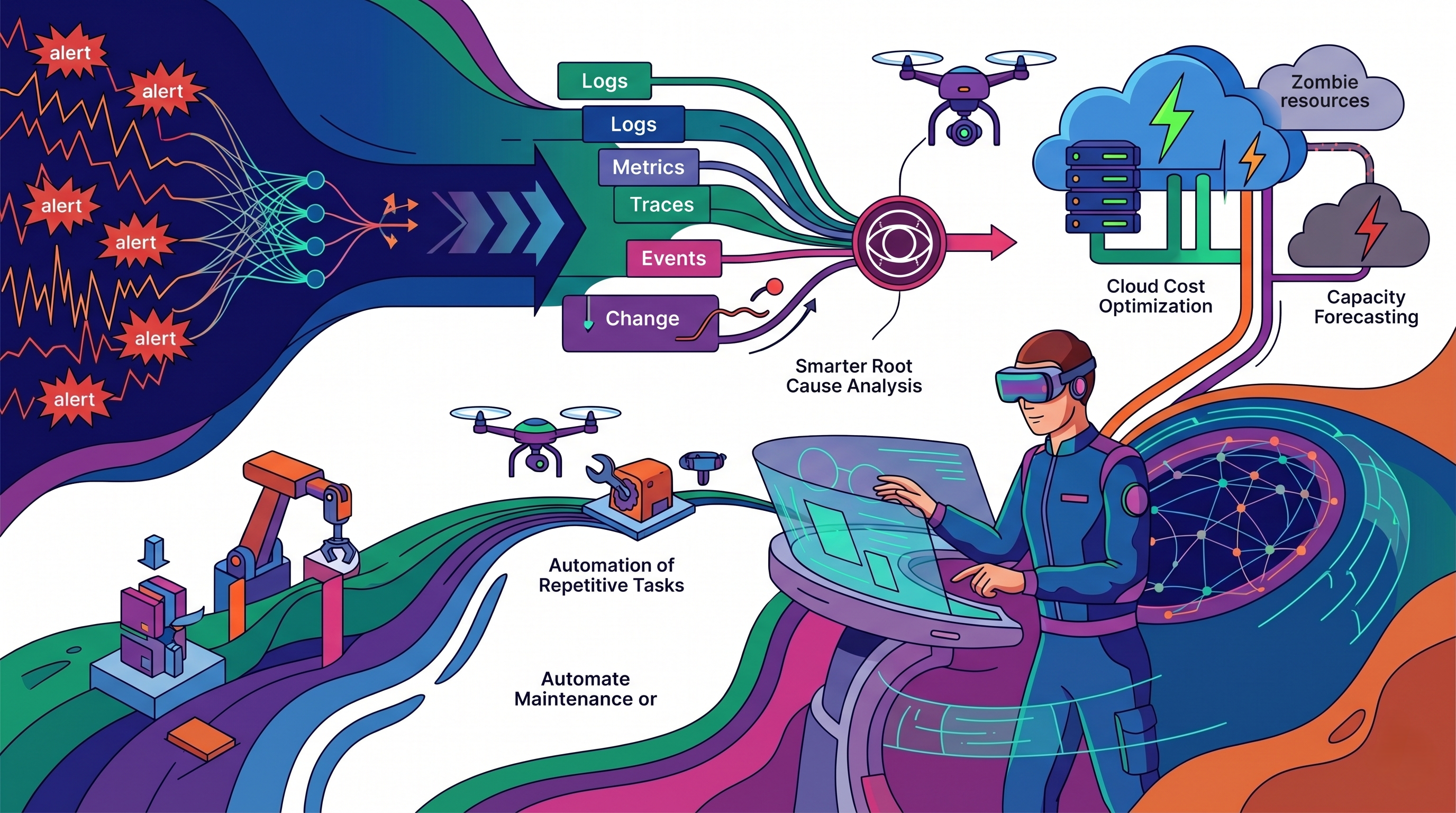
Almost every technology trend goes through the same cycle. First comes excitement. Then inflated promises. Then confusion. Then skepticism. And finally, if the technology truly matters, practical adoption begins.
AI Ops is in that practical stage now.
For years, teams were told that artificial intelligence would magically run IT operations, eliminate outages, predict every incident, and replace manual work overnight. That narrative created curiosity, but it also created unrealistic expectations.
Most engineering leaders today are asking a more grounded question that where does AI Ops actually create value for real teams?
That is the right question. Because operations teams do not need more hype. They need fewer alerts, faster incident response, cleaner data, better capacity planning, lower cloud waste, and stronger system reliability. They need tools that reduce pressure instead of adding another dashboard to maintain.
AI Ops becomes valuable when it solves operational friction that humans face every day. It matters when it helps teams move faster, make better decisions, and spend less time buried in repetitive work.
Used correctly, AI Ops is not about replacing people. It is about amplifying the teams already carrying complex environments.
In this blog, we will break down what AI Ops really means, where it delivers measurable value, where it often disappoints, and how modern teams can use it strategically.
What are AI Ops?
AI Ops stands for Artificial Intelligence for IT Operations. In practical terms, it means using machine learning, automation, analytics, and pattern recognition to improve how systems are monitored, managed, and optimized.
It usually combines signals such as:
Logs
Metrics
Traces
Events
Alerts
Configuration changes
Cloud usage data
Security signals
Historical incidents
The goal is to turn overwhelming operational data into useful actions. That action may include identifying anomalies, reducing noisy alerts, correlating incidents, forecasting demand, recommending fixes, or automating responses. AI Ops is not one tool or one feature. It is an operational capability built into modern platforms.
Why Teams Need It Now
Modern environments are no longer simple.
Applications span cloud services, containers, APIs, serverless workloads, SaaS dependencies, remote users, and global traffic patterns. A single customer request may pass through dozens of services before completion.
Meanwhile, teams are expected to move faster with leaner resources.
This creates a painful gap: Systems become more complex while human attention remains limited. Operations teams cannot manually inspect every log line, correlate every alert, or predict every issue through dashboards alone.
That is where AI Ops creates value. It helps teams manage scale without proportionally increasing operational burden.
Noise Reduction
One of the fastest ways AI Ops creates value is by reducing alert fatigue.
Many teams receive hundreds or thousands of alerts weekly. A large percentage are duplicates, low priority, or symptoms of the same root problem. When everything is urgent, nothing feels urgent.
AI Ops platforms can cluster related alerts, suppress duplicates, prioritize based on impact, and identify patterns linked to real incidents. Instead of ten separate alerts from downstream failures, teams may receive one meaningful incident summary.
This improves signal quality dramatically. Less noise means faster response, lower burnout, and better focus.
Faster Incident Detection
Traditional monitoring often relies on thresholds. CPU crosses 80 percent. Memory spikes. Latency exceeds a fixed number. Queue depth rises.
Useful, but limited.
Many real problems emerge as subtle behavior shifts rather than obvious threshold breaches. AI Ops can detect anomalies based on baselines, seasonality, workload patterns, and multi-signal correlation.
For example, A response time increase that normally happens on Monday mornings may be harmless. The same increase on Saturday midnight may be abnormal.
AI models can recognize that difference faster than static rules. This helps teams catch incidents earlier, sometimes before customers notice them.
Smarter Root Cause Analysis
During outages, teams often spend more time diagnosing than fixing. Is the issue network-related? Was there a deployment? Is the database slowing down? Did a third-party API fail? Is traffic abnormal? Which service failed first?
AI Ops can speed investigation by correlating logs, topology data, dependency maps, change history, and anomaly timelines.
Instead of starting from zero, responders begin with likely causes and impacted systems. That reduction in mean time to resolution can be extremely valuable, especially for revenue-critical services.
Capacity Forecasting
Infrastructure planning has always involved uncertainty.
Buy too much capacity, and budgets suffer. Buy too little and performance degrades.
AI Ops improves forecasting by analyzing historical growth, usage cycles, campaign effects, seasonal spikes, and workload behavior.
This is valuable across:
Cloud compute planning
Storage growth
Kubernetes scaling
Database demand
Network utilization
Licensing requirements
Better forecasting reduces reactive spending and emergency scaling decisions.
Cloud Cost Optimization
Many organizations underestimate how much operational waste hides in cloud environments.
Idle resources, overprovisioned instances, forgotten volumes, poor autoscaling settings, inefficient workloads, and duplicate environments silently consume budget.
AI Ops platforms increasingly analyze usage behavior and recommend optimization actions based on actual demand.
That may include:
Rightsizing workloads
Detecting zombie resources
Scheduling nonproduction shutdowns
Identifying underused services
Improving autoscaling efficiency
This creates direct financial value, which makes AI Ops easier to justify to leadership.
Change Risk Detection
Deployments are one of the most common causes of incidents. Yet many teams still treat releases as separate from operations data.
AI Ops can compare pre-release and post-release signals, identify unusual regressions, detect error-rate shifts, and correlate incidents with recent changes.
This allows faster rollback decisions and safer delivery pipelines.
Over time, teams can also learn which types of changes tend to create risk.
That turns release management from reactive firefighting into measurable engineering improvement.
Automation of Repetitive Tasks
Some operational work should not require constant human effort.
Examples include:
Restarting failed services
Clearing known stuck queues
Scaling resources during predictable peaks
Rotating unhealthy nodes
Routing incidents correctly
Creating tickets with context
Running diagnostics automatically
AI Ops combined with automation can trigger these responses based on confidence thresholds and policies. This frees engineers for higher-value work such as architecture, resilience, and product delivery.
Better Executive Visibility
Leaders often ask simple questions that are surprisingly hard to answer:
Are systems becoming more stable?
Where are we losing money?
Which teams are overloaded?
What risks are growing?
Are incidents improving after investments?
AI Ops platforms can summarize technical complexity into business-level insights.
That might include reliability trends, spend efficiency, service health scores, recurring failure patterns, or risk concentration areas. When leadership gets clear visibility, decisions improve.
Where AI Ops Often Fails
AI Ops is not valuable simply because AI is involved. It usually disappoints in predictable situations.
Poor Data Quality
If logs are incomplete, alerts are noisy, ownership is unclear, and systems lack tagging, AI models inherit that mess. Bad input creates weak output.
Black Box Outputs
If a tool says “anomaly detected” but cannot explain why, teams lose trust quickly. Operational teams need evidence, context, and traceability.
Over-Automation
Automatically acting on low-confidence signals can create more incidents than it solves. Human review still matters for many decisions.
No Workflow Fit
If recommendations live in a separate dashboard that nobody checks, the value remains theoretical. AI Ops must fit into existing tools such as Slack, ticketing, CI/CD, monitoring platforms, and incident workflows.
What High-Performing Teams Do Differently
Successful teams use AI Ops as augmentation, not replacement. They combine strong engineering basics with intelligent automation. That means:
Clean observability data
Clear ownership models
Reliable tagging standards
Mature incident processes
Runbooks for automation
Feedback loops on recommendations
Human review for sensitive actions
AI Ops works best when operations discipline already exists. It accelerates maturity more than it creates maturity.
Create Real Value with Atler Pilot
Many teams already have dashboards, alerts, and reports. What they often lack is clarity.
They know data exists, but not where waste is growing. They know performance issues happen, but not what to prioritize. They know cloud costs rise, but not which actions matter most.
That is where Atler Pilot can create a measurable impact.
Atler Pilot helps teams turn complex cloud and operational signals into actionable decisions. Instead of manually piecing together utilization, optimization opportunities, and efficiency gaps, teams gain a clearer operating picture built for action.
This helps organizations move from passive visibility to active control.
If your environment is scaling faster than your team’s ability to manage it, Atler Pilot can help close that gap.
Start with Atler Pilot and turn operational complexity into confident execution.
How to Start with AI Ops Practically
Do not begin with a grand transformation plan. Start with one painful area where value is measurable. Good starting points include:
Alert noise reduction
Cloud waste detection
Incident correlation
Capacity forecasting
Release risk monitoring
Measure before and after outcomes such as:
Mean time to detect
Mean time to resolve
Alert volume
Infrastructure waste
Engineer hours saved
Customer-impacting incidents
Small wins build trust faster than ambitious promises.
The Human Role Still Matters
AI Ops does not replace experienced engineers. It cannot fully understand business nuance, customer priorities, architectural tradeoffs, or political realities inside organizations.
What it can do is remove repetitive analysis, surface patterns humans miss, and accelerate decisions. The best model is a partnership where machines process scale and humans apply judgment. That combination is where real value appears.
Conclusion
AI Ops is no longer interesting because it is futuristic. It is interesting because operations teams are overloaded, systems are more complex, and manual approaches are reaching their limits.
Its real value is not magic automation. It is practical leverage.
Fewer noisy alerts. Faster diagnosis. Smarter forecasting. Lower cloud waste. Safer releases. Better visibility.
For teams managing modern infrastructure, those outcomes matter far more than hype. The question is no longer whether AI Ops is real.
The question is whether your operations model can keep scaling without it.
All in One Place
Atler Pilot decodes your cloud spend story by bringing monitoring, automation, and intelligent insights together for faster and better cloud operations.