
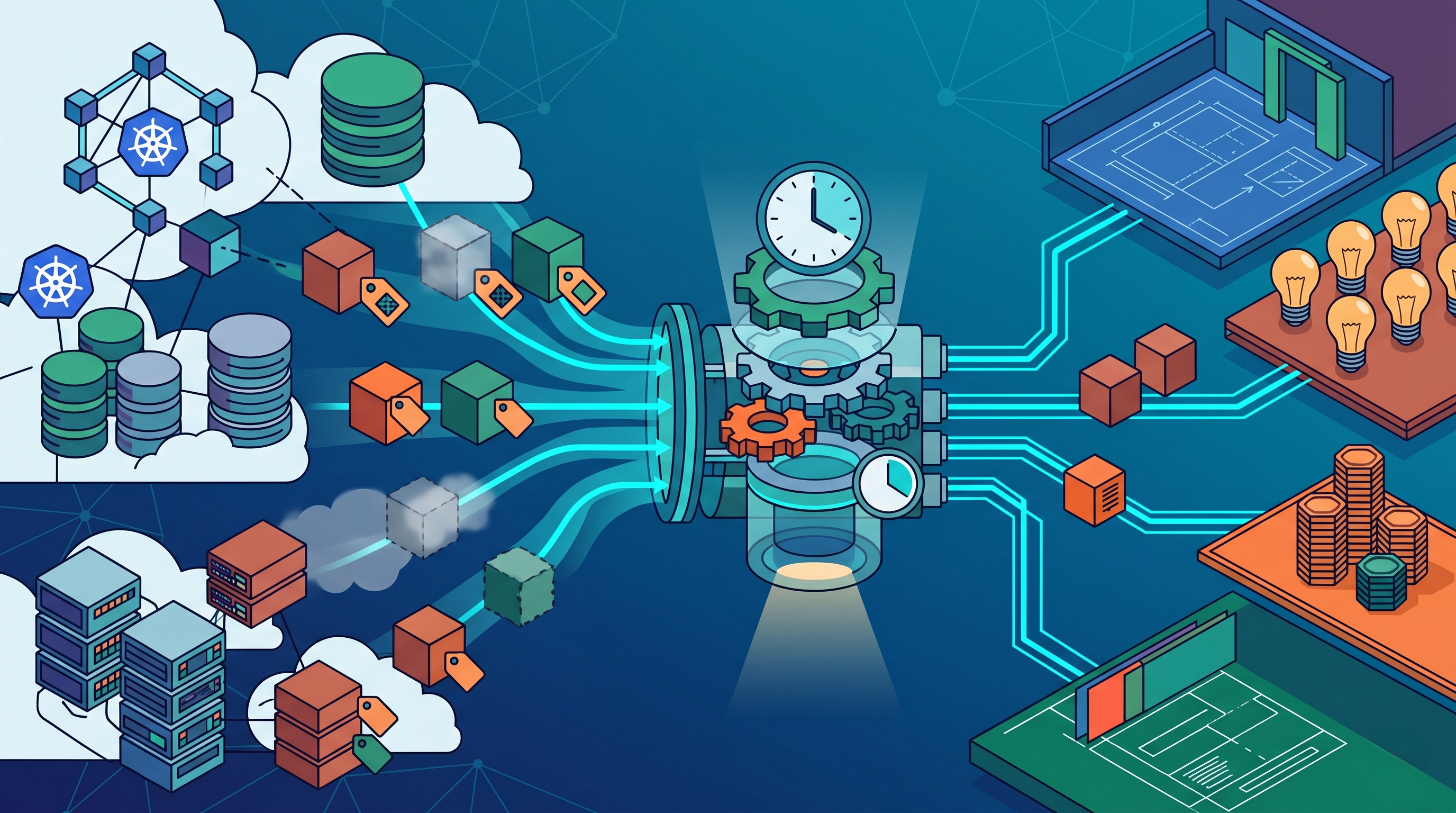
Few pressures in modern cloud operations feel as immediate as a cost review on a deadline. A leadership meeting is scheduled. Finance wants clarity. Engineering wants fairness. Product teams want accountability without friction. And FinOps teams are expected to explain exactly where cloud spend is going, why it changed, and what actions should follow. On paper, this sounds straightforward. In reality, it is rare.
Cloud costs are distributed across shared infrastructure, dynamic workloads, multiple environments, and rapidly changing architectures. Resources scale up and down constantly. Teams provision independently. Tags are inconsistent. Some costs are direct, others are shared, and many are difficult to trace cleanly to a single owner.
When time is limited, manual allocation methods fall apart quickly. This is where automated cloud cost allocation becomes essential. Not just as a reporting tool, but as an operational capability that helps FinOps teams move faster, provide accurate insights, and support better decisions across the organization.
In this blog, we will explore how automated cost allocation works, why it matters for time-constrained FinOps teams, and how organizations can build a system that delivers clarity without slowing down innovation.
Why Cost Allocation Becomes a Bottleneck
Cost allocation appears simple until it meets real-world infrastructure. Shared clusters, distributed services, and multi-team environments make it difficult to assign costs cleanly. Some resources belong to one team, while others support many. This creates ambiguity that manual processes struggle to resolve.
At the same time, tagging inconsistencies and missing ownership information add further complexity. Teams often spend hours reconciling incomplete data, estimating usage, and defending assumptions. Under tight timelines, this creates stress and reduces confidence in the output.
Without automation, cost allocation becomes a recurring operational bottleneck rather than a source of clarity.
Moving Beyond Static Tagging
Tagging is an important starting point for cost allocation, but it is not a complete solution. Even well-governed environments experience gaps in tagging due to human error, legacy systems, or rapidly changing infrastructure.
Relying only on tags often results in incomplete or misleading allocation. Automated systems extend beyond tagging by using fallback logic, usage signals, and resource relationships to fill these gaps. This allows teams to maintain progress even when data is imperfect.
The goal is not perfection in tagging. It is consistency in insight.
Establishing Fair Allocation for Shared Resources
Shared infrastructure is one of the most complex challenges in cost allocation. Resources such as Kubernetes clusters, databases, and networking layers serve multiple teams simultaneously. Assigning costs incorrectly can create tension and reduce trust.
Automated allocation addresses this by distributing costs based on actual usage patterns. Metrics such as compute consumption, request volume, and storage usage provide a more accurate basis for allocation. This creates fairness without requiring manual estimation.
When allocation reflects reality, accountability becomes easier to accept across teams.
Bringing Visibility to Unallocated Spend
Every organization has some portion of cloud spend that cannot be easily attributed. Untagged resources, legacy systems, and orphaned infrastructure create blind spots in cost reporting. Ignoring these areas reduces accuracy and hides optimization opportunities.
Automated systems help by isolating and analyzing unknown spend. They highlight gaps clearly and apply structured logic to assign ownership where possible. Over time, this improves both visibility and governance.
Understanding what is unknown is the first step toward reducing it.
Enabling Real-Time Cost Awareness
Traditional cost allocation often happens after the billing cycle ends. By that time, the opportunity to influence behavior has already passed. Teams can only explain costs, not actively manage them.
Automated allocation enables near real-time visibility into spending patterns. Teams can identify cost changes as they happen and take action immediately. This shifts cost management from retrospective analysis to proactive control.
Speed of insight directly impacts the quality of decisions.
Strengthening Accountability Without Slowing Teams
Cost accountability should empower teams, not create friction. When allocation is unclear or inconsistent, teams may resist ownership or question the data. This slows down collaboration between engineering and finance.
Automated systems provide transparent and consistent allocation logic. Teams can understand how costs are calculated and how their usage contributes to overall spend. This builds trust and encourages responsible usage.
Accountability works best when it feels fair and visible.
Supporting Faster, Data-Driven Decisions
Under deadline pressure, FinOps teams need more than raw data. They need structured insights that can guide decisions quickly. Questions around cost spikes, inefficient workloads, and optimization opportunities require immediate answers.
Automated allocation transforms complex data into clear narratives. Instead of spending time gathering information, teams can focus on interpreting trends and recommending actions. This elevates FinOps from reporting to strategic support.
Better decisions depend on better clarity.
Managing Multi-Cloud Complexity
Multi-cloud environments introduce additional layers of complexity. Different providers use different billing models, formats, and service structures. Without normalization, cost allocation becomes fragmented and difficult to compare.
Automated systems unify cost data across platforms and apply consistent allocation logic. This creates a single, coherent view of spend across environments. Teams can then analyze efficiency, compare usage, and make informed decisions without switching contexts.
Consistency is essential for managing complexity at scale.
A Structured Approach to Cost Intelligence with Atler Pilot
For many FinOps teams, the challenge is not access to data but the ability to turn that data into clear, actionable insight, especially under time constraints. Cloud cost information is often fragmented, inconsistent, and difficult to interpret quickly.
Atler Pilot addresses this by providing a more structured approach to cloud cost intelligence. It helps teams move beyond raw numbers and toward a clearer understanding of how resources are utilized, where inefficiencies exist, and how costs are distributed across the organization.
Instead of manually stitching together allocation logic, FinOps teams can work with a more unified view that supports faster reporting and more confident decision-making. This becomes particularly valuable when deadlines are tight and accuracy cannot be compromised.
In environments where complexity continues to grow, having a system that simplifies cost visibility can quietly shift how teams operate to make allocation less of a burden and more of a strategic advantage.
Common Pitfalls to Avoid
Some organizations delay automation in pursuit of perfect tagging. This often leads to stalled progress without meaningful improvement. Others create overly complex allocation rules that are difficult to maintain over time.
Another common mistake is treating cost allocation as a one-time initiative. Cloud environments evolve continuously, and allocation strategies must evolve with them. Static systems quickly become outdated.
The most effective approach is iterative. Start with a strong foundation, automate early, and refine continuously.
Conclusion
Automated cloud cost allocation is no longer just a reporting enhancement. It is a foundational capability for modern FinOps teams. As environments grow more dynamic and expectations increase, manual processes cannot keep pace.
Automation brings clarity, speed, and consistency. It allows teams to move beyond reactive explanations and toward proactive optimization. It also builds trust across engineering and finance by creating a shared understanding of cost.
For teams working against deadlines, this clarity becomes even more valuable. Because when cost allocation is structured and reliable, decisions become faster, conversations become simpler, and progress becomes easier to sustain.
All in One Place
Atler Pilot decodes your cloud spend story by bringing monitoring, automation, and intelligent insights together for faster and better cloud operations.