
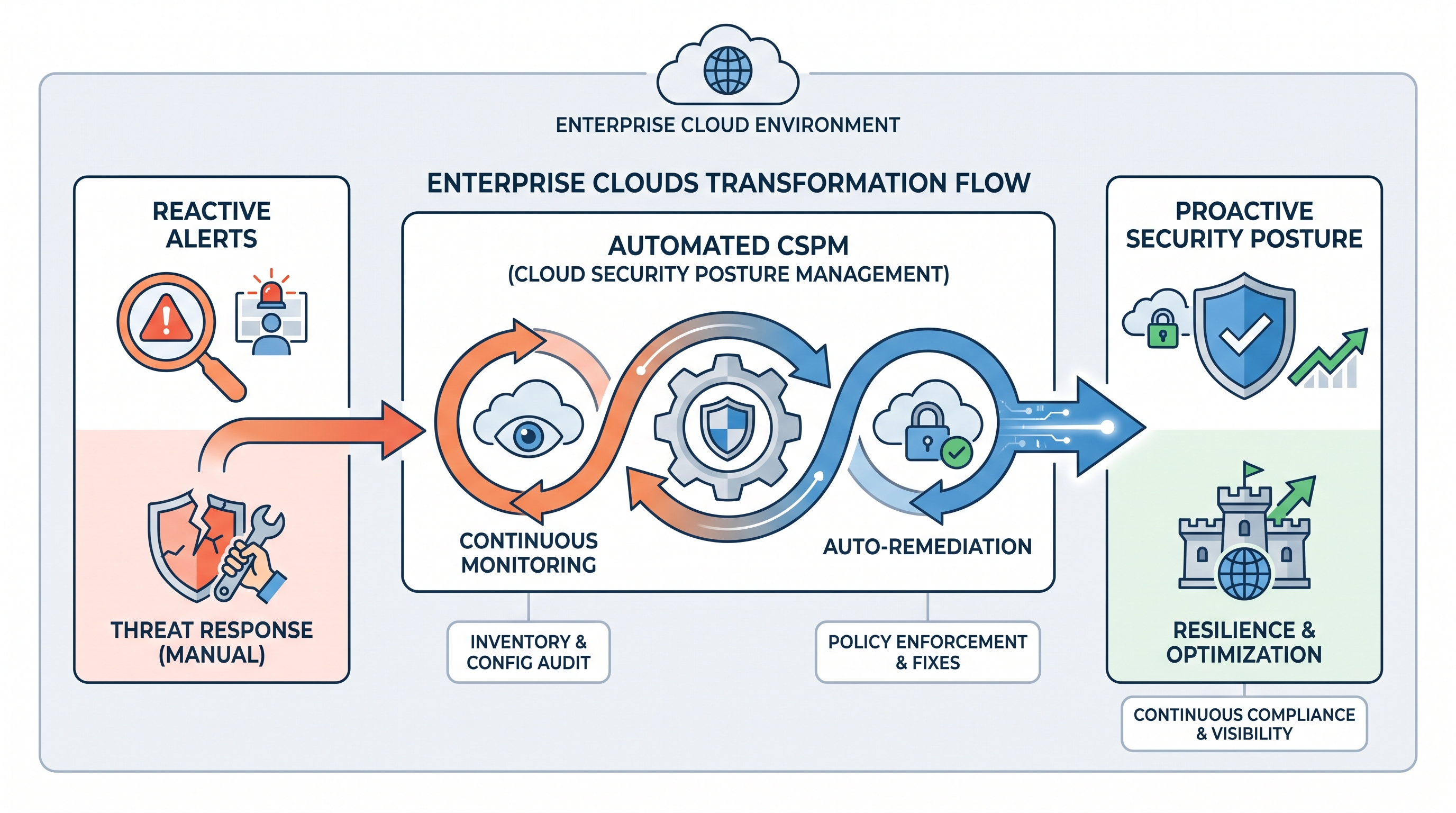
The Evolution of Cloud Security: Beyond Reactive Alerts
In the expansive and dynamic landscape of enterprise cloud environments, security has evolved from a perimeter-based defense to a shared responsibility model focused on configuration, identity, and data. Cloud Security Posture Management (CSPM) emerged as a critical capability to identify misconfigurations, compliance violations, and potential vulnerabilities across vast cloud estates. However, many organizations still find themselves trapped in a reactive security paradigm, where the primary function of their CSPM tools is to generate alerts after a misconfiguration has occurred. This "detect and alert" approach, while a necessary first step, often falls short in the face of modern threats and the sheer scale of enterprise cloud operations.
The consequences of a purely reactive security posture are severe: alert fatigue overwhelms security teams, manual remediation processes introduce significant delays and human error, and the window of exposure for critical assets remains unacceptably wide. In a multi-cloud enterprise operating across AWS, Azure, GCP, and Oracle, this problem is compounded by disparate toolsets, varying policy languages, and an ever-increasing attack surface. The financial implications are equally staggering, with misconfigurations leading to data breaches, compliance fines, and substantial operational costs for incident response. The imperative is clear: enterprises must transition from merely reacting to security incidents to proactively preventing them, embedding security as a foundational element of their cloud architecture and operations.
The Limitations of Traditional Reactive CSPM
Traditional CSPM tools, while essential, often operate with inherent limitations that hinder an enterprise's ability to maintain a robust security posture. These limitations manifest in several critical areas:
Alert Fatigue and Signal-to-Noise Ratio: As cloud environments scale, the volume of security alerts can quickly become unmanageable. Many alerts are low-priority, redundant, or false positives, leading security teams to become desensitized and potentially miss critical threats amidst the noise. Prioritization becomes a constant struggle, often based on heuristics rather than real-time contextual risk.
Manual Remediation Bottlenecks: Identifying a misconfiguration is only half the battle. The remediation process, especially in complex enterprise environments, typically involves manual intervention. This can range from opening tickets for engineering teams, waiting for human approval, to manually applying configuration changes. Such processes are slow, prone to error, and cannot keep pace with the velocity of cloud infrastructure changes.
Lack of Contextual Risk Prioritization: Reactive CSPM often treats all misconfigurations with similar urgency, regardless of the asset's criticality, its network exposure, or the data it holds. A publicly exposed S3 bucket containing sensitive customer data should trigger a far more urgent response than a non-compliant tag on a development server, yet many systems struggle to differentiate this risk effectively.
Limited Integration with Development Lifecycles: Reactive CSPM tools typically scan deployed resources, meaning misconfigurations are only detected post-deployment. This creates a "shift-right" problem, where security issues are discovered late in the development lifecycle, making them more costly and time-consuming to fix.
Inconsistent Multi-Cloud Visibility and Control: For enterprises leveraging a multi-cloud strategy (e.g., AWS for one line of business, Azure for another, GCP for analytics, and Oracle for specific enterprise applications), traditional CSPM solutions often provide siloed views. Consolidating security posture across these diverse environments for a unified risk assessment and policy enforcement becomes a monumental, often manual, challenge.
Disconnection from FinOps Goals: Reactive security incidents invariably lead to unplanned costs – investigation, remediation, potential fines, and reputational damage. Traditional CSPM rarely provides direct insights into the financial impact of security vulnerabilities or the cost-efficiency of proposed remediations, creating a disconnect with broader FinOps objectives.
These limitations underscore the urgent need for a paradigm shift – from merely reacting to identified issues to proactively preventing their occurrence and automatically remediating them when they do arise. This is the core promise of Automated CSPM.
Defining Proactive Security Posture: Shifting Left and Automating Right
A proactive security posture moves beyond simply identifying problems; it aims to prevent misconfigurations from being deployed, continuously enforce security policies, and automatically correct deviations without human intervention. This involves a multi-faceted approach:
Shift-Left Security: Integrating security checks and policy enforcement earlier in the development lifecycle, ideally within CI/CD pipelines, Infrastructure-as-Code (IaC) templates, and container images. This ensures that security issues are identified and remediated before resources are provisioned, significantly reducing the cost and effort of fixes.
Continuous Compliance and Governance: Moving from periodic compliance audits to an always-on, real-time assessment of security posture against defined benchmarks (e.g., CIS Benchmarks, NIST, PCI DSS) and internal corporate policies. This ensures that the environment remains compliant even as it evolves.
Automated Guardrails and Policy Enforcement: Implementing mechanisms that prevent the deployment of non-compliant resources or automatically revert them to a secure state. This is about establishing "security by default" rather than "security by exception."
Self-Healing Infrastructure: Designing cloud environments that can automatically detect and remediate security misconfigurations or policy violations, turning alerts into actions. This significantly reduces mean time to remediation (MTTR) and frees up security teams to focus on strategic initiatives.
Contextual Risk-Based Prioritization: Leveraging intelligence, often AI/ML-driven, to understand the true blast radius and impact of a misconfiguration, allowing for intelligent prioritization of remediation efforts based on asset criticality, data sensitivity, and network exposure.
Unified Multi-Cloud Orchestration: Establishing a single pane of glass and a unified policy engine that can understand, evaluate, and enforce security policies consistently across heterogeneous cloud environments (AWS, Azure, GCP, Oracle), providing a holistic view of enterprise risk.
Achieving this proactive state requires deep technical integration, a robust policy framework, and intelligent automation. It's not just about tools; it's about a fundamental shift in operational philosophy.
Core Pillars of Automated CSPM for Enterprise Clouds
1. Continuous Asset Discovery and Inventory (Multi-Cloud Context)
Before you can secure it, you must know it exists. Automated CSPM begins with comprehensive, real-time discovery of all cloud assets across all accounts, subscriptions, projects, and regions within an enterprise's multi-cloud footprint. This includes not just virtual machines and databases, but also serverless functions, container registries, network configurations, identity policies, and data storage. A robust system will:
Deep Integration with Cloud APIs: Leverage native APIs from AWS, Azure, GCP, and Oracle to continuously enumerate resources and their configurations.
Metadata Enrichment: Automatically pull in metadata, tags, and associated information to provide context (e.g., owner, environment, criticality).
Change Detection: Monitor for new resources, modifications to existing ones, and resource deletions in real-time or near real-time.
Unified Asset Graph: Create a consolidated, normalized view of all assets and their relationships across the entire multi-cloud estate, enabling cross-cloud dependency mapping and impact analysis.
Without this foundational visibility, any subsequent security efforts are operating in the dark. For large enterprises, this requires a solution capable of ingesting and normalizing data from diverse cloud providers and countless accounts.
2. Policy-as-Code and Automated Compliance Checks
The cornerstone of proactive security is defining security policies as code. This allows for version control, automated testing, and consistent application across environments. Automated CSPM leverages policy engines to:
Codify Security Best Practices: Translate industry standards (e.g., CIS Benchmarks, NIST CSF, ISO 27001), regulatory requirements (e.g., HIPAA, GDPR, PCI DSS), and internal organizational policies into machine-readable rules.
Real-time Evaluation: Continuously evaluate discovered cloud resources against these codified policies. This goes beyond periodic scans, providing an always-on compliance posture.
Custom Policy Creation: Enable security teams to define custom policies tailored to unique enterprise requirements or specific application architectures. For instance, ensuring all S3 buckets or Azure Blob storage accounts have server-side encryption enabled and are not publicly accessible.
Automated Reporting and Auditing: Generate detailed compliance reports for internal stakeholders and external auditors, demonstrating continuous adherence to security standards.
Examples include AWS Config Rules, Azure Policy, and GCP Organization Policies, which can be extended and unified by platforms like CloudAtler to ensure consistent enforcement across all clouds.
3. Real-time Threat Detection and Anomaly Analysis (AI/ML Integration)
Automated CSPM integrates advanced analytics to move beyond simple rule-based detection. AI and Machine Learning play a crucial role in:
Baseline Establishment: Learning the normal behavior patterns of resources, users, and network traffic within the cloud environment.
Anomaly Detection: Identifying deviations from established baselines that could indicate a security threat, such as unusual API calls, unauthorized resource modifications, or data exfiltration attempts. For example, detecting an EC2 instance suddenly making outbound connections to known malicious IPs, or an Azure Function accessing a storage account it never has before.
Contextual Risk Scoring: Combining threat intelligence, vulnerability data, and asset criticality to provide a nuanced risk score for each detected issue. This helps prioritize remediation efforts effectively.
Predictive Analytics: Potentially identifying emerging attack patterns or vulnerabilities before they are actively exploited.
This intelligent layer significantly reduces false positives and focuses security teams on high-impact issues, transforming raw alerts into actionable insights.
4. Automated Remediation Workflows (Self-Healing Infrastructure)
This is where Automated CSPM truly differentiates itself from reactive approaches. Instead of merely alerting, the system can automatically take corrective action. This requires carefully designed and tested workflows:
Pre-approved Remediation Playbooks: For common misconfigurations (e.g., public S3 buckets, unencrypted databases, overly permissive IAM policies), pre-defined automated actions can be triggered.
Event-Driven Architectures: Utilizing native cloud event services (e.g., AWS CloudWatch Events/EventBridge, Azure Event Grid, GCP Cloud Pub/Sub) to trigger serverless functions (AWS Lambda, Azure Functions, GCP Cloud Functions) or automation runbooks (Azure Automation, AWS Systems Manager Automation) in response to policy violations.
Examples of Automated Actions:
Automatically disabling public access to storage buckets.
Applying encryption to unencrypted databases.
Revoking overly permissive IAM roles or user policies.
Quarantining non-compliant virtual machines.
Terminating resources that violate critical security policies (e.g., unapproved regions).
Approval Workflows for Complex Changes: For high-impact remediations, the system can initiate an approval workflow (e.g., Slack notification, Jira ticket) before executing the change, ensuring human oversight where necessary.
Implementing self-healing infrastructure significantly reduces MTTR, improves compliance, and frees up valuable security team resources. CloudAtler's automated operations capabilities are designed precisely for this, enabling cross-cloud remediation.
5. Integration with CI/CD and DevOps Pipelines (Shift-Left Security)
True proactive security means shifting left, integrating security checks directly into the development and deployment pipeline. This prevents misconfigurations from ever reaching production environments:
IaC Scanning: Integrating policy engines to scan Infrastructure-as-Code templates (Terraform, CloudFormation, ARM templates, Google Deployment Manager) before deployment. Tools like HashiCorp Sentinel, OPA Gatekeeper, or native cloud policy services can validate templates against security policies.
Container Image Scanning: Scanning container images for vulnerabilities and misconfigurations during the build process, before they are pushed to registries.
Pre-Deployment Gates: Enforcing security gates in CI/CD pipelines that halt deployments if critical security policies are violated.
Developer Feedback: Providing immediate, actionable security feedback to developers, allowing them to fix issues early when they are least expensive.
This integration transforms security from a post-deployment audit function into an inherent part of the development process, fostering a culture of security responsibility across engineering teams.
6. FinOps Synergies: Cost of Insecurity & Efficiency Gains
Automated CSPM has profound implications for FinOps. Security incidents are inherently costly, encompassing direct remediation expenses, potential fines, reputational damage, and lost business. Proactive security directly mitigates these costs:
Reduced Incident Response Costs: By preventing breaches and automating remediation, the need for costly incident response teams and forensic investigations is significantly reduced.
Optimized Resource Utilization: Automated policies can identify and flag unused or incorrectly configured resources that contribute to "cloud waste," aligning security with cost optimization. For example, policies can identify unattached EBS volumes or unutilized public IPs that are also security risks.
Improved Compliance Efficiency: Continuous, automated compliance drastically reduces the manual effort and cost associated with audits and reporting.
Enhanced Operational Efficiency: Security teams spend less time on reactive fire-fighting and more on strategic initiatives, improving overall operational efficiency and reducing labor costs.
Cost Visibility of Security Posture: Advanced platforms like CloudAtler can integrate security posture with FinOps insights, showing the potential cost savings from remediating specific vulnerabilities or the financial impact of non-compliance.
By unifying cloud security and FinOps, enterprises gain a holistic view of their cloud operations, ensuring that security investments deliver tangible financial returns and contribute to overall business resilience. CloudAtler is specifically designed to bridge this gap, offering an AI-powered platform that unifies FinOps, cloud security, and automated operations.
Architectural Patterns for Automated CSPM
Implementing Automated CSPM in an enterprise multi-cloud environment typically involves a combination of native cloud services and specialized third-party platforms.
1. Native Cloud Services for Policy and Configuration
AWS: AWS Config for configuration recording and compliance rules, AWS Security Hub for aggregating findings, AWS GuardDuty for threat detection, AWS Organizations Service Control Policies (SCPs) for preventive guardrails, and AWS Lambda for automated remediation.
Azure: Azure Policy for defining and enforcing policies, Azure Security Center (now part of Microsoft Defender for Cloud) for posture management and threat protection, Azure Sentinel for SIEM, and Azure Automation for remediation runbooks.
GCP: GCP Security Command Center for security posture management and threat detection, GCP Organization Policies for preventive controls, and GCP Cloud Functions for automated remediation.
Oracle Cloud Infrastructure (OCI): OCI Cloud Guard for continuous security posture monitoring and threat detection, OCI Audit for logging, and OCI Functions for automated responses.
While powerful, managing these native services across multiple clouds requires significant expertise and integration effort to achieve a unified view and consistent policy enforcement.
2. Third-Party Platforms for Unified Multi-Cloud Orchestration
This is where platforms like CloudAtler become indispensable for large enterprises. They provide a layer of abstraction and unification over native cloud services:
Centralized Policy Engine: Define policies once and apply them consistently across AWS, Azure, GCP, and Oracle environments.
Aggregated Visibility: A single dashboard for security posture, compliance status, and risk across the entire multi-cloud estate.
Intelligent Automation: AI/ML-driven analytics for smarter threat detection, contextual risk prioritization, and cross-cloud automated remediation workflows.
Integration with Enterprise Tools: Seamless integration with SIEM, ITSM, CI/CD, and FinOps platforms.
Automated Operations Framework: Beyond just security, these platforms can automate a wider range of operational tasks, enhancing efficiency and reducing manual overhead.
3. Serverless Functions and Event-Driven Architectures for Remediation
A common and highly effective pattern for automated remediation involves event-driven serverless functions. When a policy violation is detected (e.g., by AWS Config, Azure Policy, GCP Security Command Center, or a third-party CSPM platform), an event is published. This event triggers a serverless function (AWS Lambda, Azure Function, GCP Cloud Function) that executes a pre-defined remediation script. This architecture is highly scalable, cost-effective, and provides near real-time response capabilities.
For example, an AWS Config rule detects a publicly accessible S3 bucket. This triggers an EventBridge event, which invokes an AWS Lambda function. The Lambda function then uses the AWS SDK to modify the S3 bucket policy, removing public access. Similar patterns exist for Azure and GCP, using Azure Monitor/Event Grid with Azure Functions, or Cloud Pub/Sub with Cloud Functions, respectively. For Oracle environments, OCI Events can trigger OCI Functions for automated responses.
Building a Proactive Security Framework with Automated CSPM
Implementing Automated CSPM is an iterative journey, best approached in phases:
Phase 1: Baseline and Visibility
Comprehensive Asset Discovery: Onboard all cloud accounts/subscriptions across AWS, Azure, GCP, and Oracle into your chosen CSPM platform (e.g., CloudAtler) to gain a complete inventory of all resources.
Initial Posture Assessment: Run an initial scan against industry benchmarks (CIS, NIST) and relevant regulatory frameworks to establish a baseline security posture and identify immediate high-priority misconfigurations.
Risk Prioritization: Focus on understanding the most critical risks based on asset criticality, data sensitivity, and potential blast radius. Address the "low-hanging fruit" first.
Policy Definition: Begin codifying your organization's core security policies and compliance requirements into the CSPM's policy engine.
Phase 2: Policy Enforcement and Automation
Shift-Left Integration: Integrate IaC scanning and container image scanning into your CI/CD pipelines. Educate developers on secure coding and infrastructure provisioning practices.
Automated Remediation (Pilot): Start with low-impact, well-understood misconfigurations. Implement automated remediation workflows for these issues, initially in non-production environments, then gradually roll out to production with careful monitoring.
Proactive Guardrails: Implement preventive policies using native cloud services (e.g., AWS SCPs, Azure Policy deny effects, GCP Organization Policies) to prevent the creation of non-compliant resources.
Continuous Monitoring: Ensure real-time monitoring of all resources against defined policies, leveraging AI/ML for anomaly detection and contextual risk scoring.
Phase 3: Continuous Optimization and Threat Intelligence
Advanced Threat Detection: Integrate with advanced threat intelligence feeds and leverage sophisticated AI/ML models to detect more subtle and emerging threats.
Policy Refinement: Continuously review and refine security policies based on new threats, evolving compliance requirements, and operational feedback. Optimize policies to reduce false positives and improve accuracy.
Automated FinOps Optimization: Leverage CSPM insights to identify and remediate security issues that also contribute to cloud waste, further integrating security and FinOps goals.
Security Chaos Engineering: Periodically test automated remediation workflows and security controls to ensure they function as expected under various failure scenarios.
Incident Response Integration: Ensure automated CSPM findings and remediation actions are seamlessly integrated into your broader incident response processes and tools.
Challenges and Best Practices for Implementation
While the benefits are clear, implementing Automated CSPM at an enterprise scale comes with its own set of challenges:
Policy Sprawl and Complexity: Managing hundreds or thousands of policies across multiple clouds can become unwieldy. Best practice: Categorize policies, use a hierarchical structure, and leverage a unified policy engine like CloudAtler's.
False Positives: Overly aggressive policies can generate numerous false positives, leading to alert fatigue and distrust in the system. Best practice: Start with audit-only policies, refine them, and use contextual data for prioritization before enabling automated remediation.
"Break-Glass" Scenarios: Automated remediation, if not carefully designed, can inadvertently disrupt critical services. Best practice: Implement approval workflows for high-impact changes and ensure robust rollback mechanisms.
Organizational Buy-in: Shifting to automated security requires collaboration between security, DevOps, and FinOps teams. Best practice: Foster a culture of shared responsibility, demonstrate tangible benefits, and involve stakeholders early in the process.
Integration Complexity: Integrating various native cloud services and third-party tools can be complex. Best practice: Choose a platform that offers broad multi-cloud support and pre-built integrations to streamline this process.
Cost Management of CSPM Tools: The tools themselves can incur costs. Best practice: Evaluate solutions that offer a unified platform for FinOps, security, and operations, providing better ROI and reducing tool sprawl.
By addressing these challenges proactively, enterprises can successfully transition to a robust, automated security posture.
The CloudAtler Advantage: Unifying FinOps, Security, and Automated Operations
For enterprises navigating the complexities of multi-cloud environments (AWS, Azure, GCP, Oracle), the challenge of achieving proactive security posture management is significant. This is precisely where CloudAtler provides unparalleled value.
CloudAtler is an AI-powered platform engineered to unify FinOps, cloud security, and automated operations. It moves beyond traditional reactive CSPM by providing:
True Multi-Cloud Visibility: A single, normalized view of all your cloud assets and their security posture across AWS, Azure, GCP, and Oracle, eliminating silos and providing comprehensive risk assessment.
Intelligent Policy Enforcement: An advanced policy engine that codifies security best practices and compliance frameworks, applying them consistently across your heterogeneous cloud estate. Leveraging AI, CloudAtler provides contextual risk prioritization, helping your teams focus on what matters most.
Automated Remediation at Scale: CloudAtler’s cloud security capabilities are deeply integrated with its automated operations framework. This enables the rapid deployment of self-healing infrastructure, automatically correcting misconfigurations and policy violations without manual intervention, dramatically reducing MTTR.
Integrated FinOps Insights: By correlating security posture with cloud spend, CloudAtler helps organizations understand the true financial impact of security risks and the cost benefits of automation. It helps drive FinOps optimization by identifying security issues that also lead to cloud waste.
Shift-Left Security for DevOps: CloudAtler integrates with your CI/CD pipelines, providing early detection of security issues in IaC and container images, empowering developers to build securely from the start.
With CloudAtler, enterprises can transform their cloud security from a burden of reactive alerts into a strategic advantage, ensuring continuous compliance, enhanced operational efficiency, and tangible cost savings across their entire cloud footprint.
Conclusion: Embracing a Proactive, Self-Healing Cloud Future
The journey from reactive alerts to a proactive, self-healing security posture in enterprise clouds is no longer an aspiration but an operational imperative. The scale, complexity, and dynamic nature of modern cloud environments demand a security strategy that anticipates threats, enforces policies continuously, and automates remediation. By embracing Automated CSPM, organizations can significantly reduce their attack surface, improve compliance, mitigate financial risks, and free their security teams to focus on strategic innovation rather than perpetual fire-fighting.
This transformation is not just about adopting new tools; it's about a fundamental shift in how security is integrated into every layer of cloud operations—from development to deployment and ongoing management. The convergence of FinOps, cloud security, and automated operations creates a powerful synergy, driving both resilience and efficiency.
Ready to unify your cloud operations and move beyond reactive security? Discover how CloudAtler's AI-powered platform can transform your enterprise's FinOps, cloud security, and automated operations across AWS, Azure, GCP, and Oracle environments. Visit CloudAtler.com today and schedule a demo to see proactive security in action.
All in One Place
Atler Pilot decodes your cloud spend story by bringing monitoring, automation, and intelligent insights together for faster and better cloud operations.