
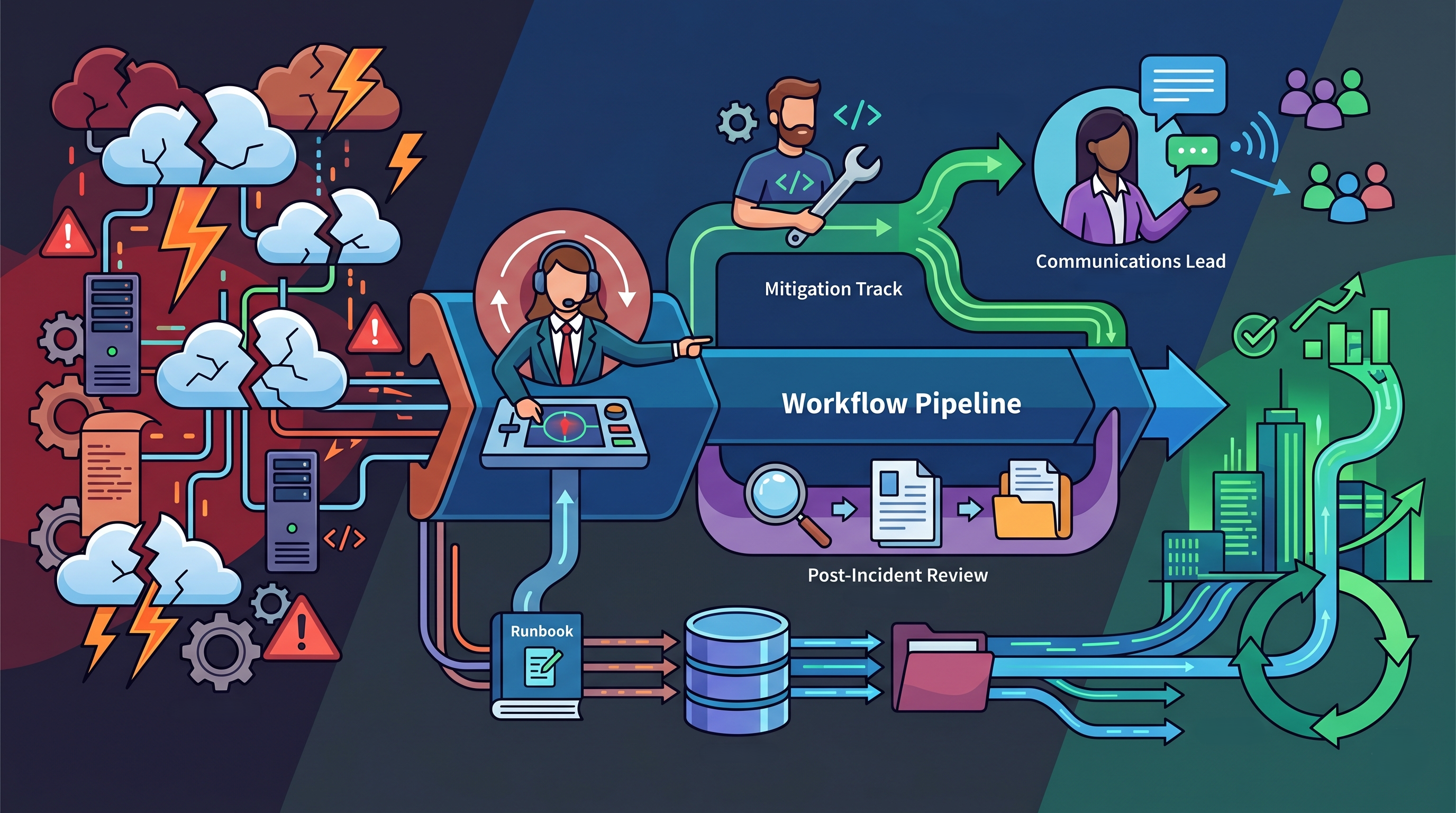
Incidents are inevitable in modern digital systems. Even the most mature engineering organizations with strong reliability practices, automated deployments, and resilient architectures still face service disruptions, performance degradation, dependency failures, and unexpected outages. Complexity has grown too quickly for any environment to remain incident-free forever.
What separates high-performing organizations from struggling ones is not whether incidents happen. It is how they respond when they do.
For Site Reliability Engineering teams, incident management is more than restoring service. It is the discipline of reducing chaos, protecting customers, coordinating people effectively, learning quickly, and strengthening systems after recovery. A weak workflow turns minor issues into prolonged disruption. A strong workflow limits impact and preserves trust.
Modern SRE teams face additional pressure because environments are now distributed across cloud platforms, containers, microservices, APIs, data pipelines, and third-party providers. A single user-facing issue may involve multiple teams, tools, and dependencies within minutes. Traditional ad hoc response methods no longer scale.
This is why incident management workflows matter more than ever.
The best workflows create clarity under pressure. They define roles, streamline communication, accelerate diagnosis, and ensure learning happens after the event. They help teams respond intelligently rather than emotionally.
In this blog, we will explore the best incident management workflows for modern SRE teams, why they work, and how organizations can build calmer, faster, and more resilient response models.
Why Incident Workflows Matter
Many organizations underestimate how much time is lost during incidents due to poor coordination rather than technical difficulty.
Engineers may duplicate investigations, debate ownership, search for context, wait for approvals, or communicate inconsistently with stakeholders. In some cases, systems could be fixed quickly if the right people had the right information sooner.
A clear workflow reduces this waste.
When responders know who leads, where updates happen, how severity is determined, what escalation path exists, and how decisions are documented, incidents become easier to manage. Stress drops, speed improves, and teams make better technical choices.
Good workflows do not remove urgency. They organize it.
Workflow 1: Rapid Detection and Triage
The first minutes of an incident often determine the total impact window.
Modern SRE teams need monitoring systems that quickly detect meaningful issues and avoid drowning responders in noise. Once a signal appears, the triage process should answer several questions immediately:
Is this a real incident or a false alarm?
Which services are affected?
How severe is customer impact?
Who owns the first response?
Is escalation needed now?
Rapid triage prevents both underreaction and overreaction. Minor issues should not trigger full-scale war rooms, while critical failures should not sit unnoticed.
High-performing teams often use runbooks, severity matrices, and intelligent alerting to make triage faster and more consistent.
Workflow 2: Clear Incident Command Structure
One of the most effective modern workflows is assigning defined roles early.
Without structure, incidents become crowded conversations where everyone talks, but ownership remains unclear. Strong teams establish an incident command model with roles such as:
Incident Commander
Technical Lead
Communications Lead
Subject Matter Experts
Scribe or Timeline Owner
The Incident Commander manages priorities, decisions, and coordination. The Technical Lead focuses on diagnosis and mitigation. Communication owners handle stakeholder updates.
This separation allows experts to solve problems while leadership maintains order. Even small incidents benefit from clear ownership.
Workflow 3: Centralized Communication Channels
Fragmented communication slows incident response quickly.
If updates happen across email threads, private chats, ticket comments, and hallway conversations, responders lose time reconstructing status. Important context gets missed.
Modern SRE teams create a dedicated communication channel for each incident. This may be a chat room, bridge call, or collaboration workspace where all key updates happen in real time.
A centralized channel should include:
Current incident status
Owners and responders
Key findings
Decisions made
Customer impact updates
Next steps
Centralization creates a shared operating picture and reduces confusion significantly.
Workflow 4: Parallel Investigation and Mitigation
Some teams make a common mistake during incidents: focusing only on the root cause before restoring service.
While diagnosis matters, customer impact often requires immediate mitigation first.
Strong workflows separate two tracks:
Mitigation Track: restore service quickly
Investigation Track: determine the underlying cause
Examples of mitigation include rolling back a release, shifting traffic, increasing capacity, disabling noncritical features, or failing over to backups.
Once systems stabilize, deeper investigation continues with less pressure.
This dual-track model shortens downtime while preserving long-term learning.
Workflow 5: Runbook-Driven Response
Repeated incidents should not require reinventing decisions each time.
Modern SRE teams build runbooks for known failure scenarios such as database saturation, certificate expiration, queue backlog, dependency outage, or node instability.
Good runbooks include:
Symptoms
Immediate checks
Safe mitigation steps
Escalation rules
Rollback guidance
Validation steps after recovery
Runbooks reduce cognitive load during stressful moments. They also help newer responders contribute effectively without waiting for senior engineers.
Documentation becomes operational leverage.
Workflow 6: Severity-Based Escalation
Not every incident requires the same level of response.
A delayed internal report should not trigger executive escalations. A checkout outage during peak revenue hours absolutely should.
Modern workflows classify incidents by severity using factors such as:
Customer impact size
Revenue risk
Security implications
Duration risk
Regulatory exposure
Core service availability
Severity then determines escalation speed, leadership visibility, and communication cadence.
This protects attention and ensures the organization responds proportionally.
Workflow 7: Real-Time Stakeholder Updates
Technical recovery is only one part of incident management. Stakeholders need confidence that the situation is understood and being managed.
Poor communication creates panic, repeated interruptions, and speculation.
Modern SRE teams define update intervals during active incidents. For example:
Critical incidents: every 15 minutes
High severity: every 30 minutes
Moderate issues: hourly or milestone-based updates
Updates should be concise, factual, and calm. They should cover impact, progress, next actions, and expected timing when known. Clear communication protects trust even before full recovery.
Workflow 8: Automated Evidence Collection
Many teams lose valuable learning after incidents because evidence disappears quickly.
Logs rotate, dashboards change, timelines blur, and responders forget sequence details after long nights.
Strong workflows automate evidence capture during incidents. This may include:
Alert timelines
Deployment changes
Metrics snapshots
Chat transcripts
Ownership actions
Remediation timestamps
This reduces post-incident reconstruction effort and improves root cause quality later.
Good learning depends on accurate memory, and automation helps preserve it.
Workflow 9: Blameless Post-Incident Reviews
The best SRE teams treat incidents as system learning opportunities, not personal failures.
Blame cultures hide problems and discourage transparency. Engineers become defensive rather than curious.
Blameless reviews focus on:
What happened
Why defenses failed
Which signals were missed
What slowed recovery
Which controls should improve
How can recurrence risk be reduced
The purpose is stronger systems, not punishment.
Organizations that learn openly recover faster over time.
Workflow 10: Continuous Workflow Improvement
Incident management should evolve continuously.
After each meaningful event, teams should ask:
Was the detection fast enough?
Were roles clear?
Did communication work?
Were runbooks useful?
Was escalation appropriate?
Which manual steps should be automated?
Even small improvements compound significantly across future incidents.
The strongest workflows are living systems, not static policies.
Where Atler Pilot Creates Strategic Value
Incident response quality depends heavily on operational visibility. Teams need to know where inefficiencies exist, which resources are under pressure, and what signals deserve immediate attention. Without clear intelligence, workflows become slower and more reactive.
That is where Atler Pilot creates measurable value.
Atler Pilot helps organizations transform fragmented cloud and operational data into actionable intelligence. Instead of manually piecing together utilization gaps, unclear priorities, or inefficient spending, teams gain a clearer operating view that supports faster decisions and stronger control.
This helps modern SRE teams reduce friction, improve readiness, and scale operations with more confidence.
If your environment is growing more complex while response speed becomes more important, Atler Pilot can help restore clarity.
Start with Atler Pilot and give reliability teams the insights to respond smarter.
Common Mistakes to Avoid
Some organizations overcomplicate workflows with too many approvals and rigid layers. During incidents, simplicity matters more than bureaucracy.
Others rely entirely on heroic individuals instead of repeatable systems. That creates burnout and inconsistency.
Another mistake is skipping reviews once the service returns. Fast recovery without learning guarantees repeat pain later.
The best workflows balance speed, structure, and continuous improvement.
Conclusion
Incidents will always be part of operating modern systems. Complexity guarantees that failures, regressions, and unexpected disruptions will occur.
What defines resilient organizations is not perfect uptime. It is a disciplined response.
The best incident management workflows help SRE teams detect faster, coordinate calmly, mitigate quickly, communicate clearly, and learn continuously. They transform chaotic moments into manageable processes.
For modern reliability teams, strong workflows are not optional overhead. They are a competitive advantage.
All in One Place
Atler Pilot decodes your cloud spend story by bringing monitoring, automation, and intelligent insights together for faster and better cloud operations.