
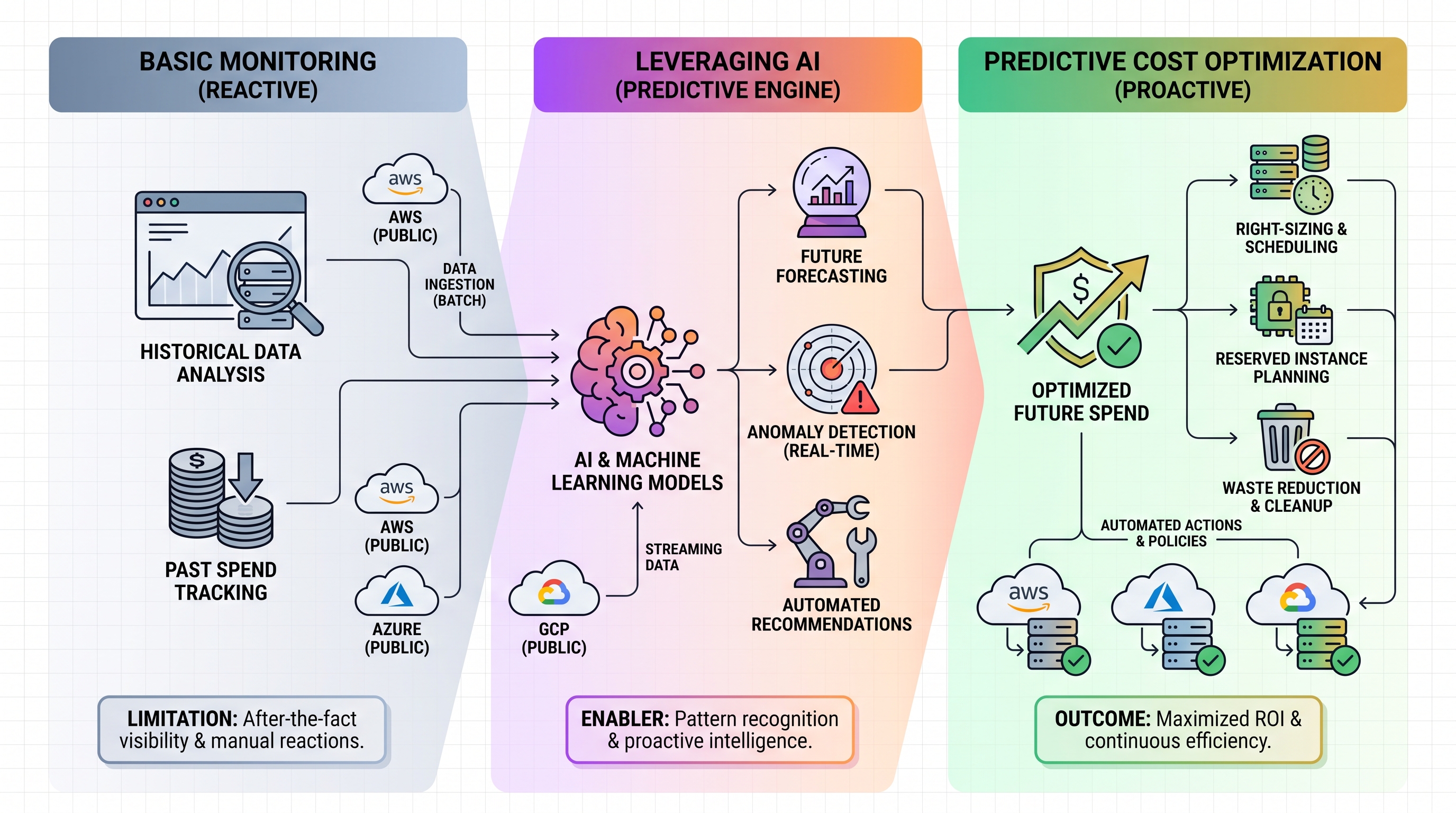
The promise of multi-cloud adoption – agility, resilience, and vendor diversification – often comes with the inherent challenge of spiraling costs and operational complexity. As enterprises scale their infrastructure across AWS, Azure, Google Cloud Platform (GCP), and Oracle Cloud Infrastructure (OCI), traditional, reactive monitoring tools become increasingly inadequate. They offer snapshots of past expenditure, but fail to provide the foresight necessary for strategic, proactive cost management. In this landscape, the evolution from basic monitoring to AI-driven predictive cost optimization isn't merely an enhancement; it's a fundamental shift, essential for maintaining financial governance and operational excellence within the modern enterprise FinOps framework.
At CloudAtler, we understand that true cloud mastery requires more than just visibility. It demands intelligence that can anticipate, recommend, and even automate optimizations across the entire cloud estate. This article will delve deep into the architectural paradigms and practical applications of artificial intelligence (AI) and machine learning (ML) to transform multi-cloud cost management from a reactive firefighting exercise into a predictive, strategic advantage.
The Limitations of Traditional Cloud Monitoring in a Multi-Cloud World
Traditional cloud monitoring typically relies on metrics, logs, and dashboards to present historical data. While invaluable for post-incident analysis and basic resource tracking, its inherent limitations become glaringly obvious in a multi-cloud context:
Reactive Nature: Alerts fire after a cost overrun or an anomaly has occurred, meaning remediation is always catching up. This leads to wasted spend before corrective actions can be implemented.
Lack of Cross-Cloud Correlation: Siloed monitoring tools for each cloud provider make it nearly impossible to gain a unified view of spend, utilization, and performance across the entire multi-cloud footprint. Correlating a spike in AWS egress costs with a corresponding increase in Azure compute usage, for instance, requires significant manual effort.
Inability to Predict: Traditional tools can't forecast future resource needs or cost trends based on historical patterns, seasonal variations, or projected growth. This leaves organizations blind to impending cost escalations.
Alert Fatigue and Manual Analysis: A deluge of alerts without intelligent prioritization or contextual understanding often leads to alert fatigue, where critical issues are missed amidst the noise. Manual analysis of complex billing data across multiple providers is time-consuming, error-prone, and scales poorly.
Limited Optimization Insights: While some tools offer basic recommendations (e.g., idle resource identification), they often lack the sophisticated analysis required for advanced optimizations like optimal Reserved Instance (RI) or Savings Plan (SP) purchasing strategies, dynamic workload placement, or intelligent spot instance utilization across diverse cloud environments.
These limitations highlight the urgent need for a more intelligent, proactive approach – one that leverages the power of AI to transform raw data into actionable, predictive insights.
The Paradigm Shift: AI-Driven Predictive Analytics for FinOps
AI and machine learning introduce a fundamental shift in how enterprises approach FinOps. Instead of merely reporting on past events, AI enables systems to learn from vast datasets, identify complex patterns, detect anomalies, and make informed predictions about future states. For multi-cloud cost optimization, this translates into:
Proactive Cost Management: Anticipating cost increases before they materialize, allowing for preventative action.
Automated Anomaly Detection: Instantly flagging unusual spend patterns that deviate from learned baselines, distinguishing actual problems from normal fluctuations.
Intelligent Forecasting: Predicting future resource demand and associated costs with high accuracy, aiding in capacity planning and budget allocation.
Optimized Resource Allocation: Recommending the most cost-effective resource configurations (instance types, storage, serverless functions) across multiple clouds based on actual usage patterns and performance requirements.
Strategic Procurement: Guiding decisions on Reserved Instances, Savings Plans, and spot market utilization by predicting future committed usage.
Key AI techniques employed in this domain include time-series forecasting models (e.g., ARIMA, Prophet, Long Short-Term Memory networks - LSTMs), regression analysis for predicting resource utilization and cost, and various anomaly detection algorithms (e.g., Isolation Forests, One-Class SVMs, autoencoders) to pinpoint outliers in spending or resource usage. These models, when applied to the rich tapestry of multi-cloud data, provide the predictive power that traditional methods simply cannot.
Architectural Foundations for AI-Powered Cost Optimization
Implementing AI for predictive cost optimization in a multi-cloud environment requires a robust data architecture capable of ingesting, processing, and analyzing vast quantities of diverse data. This architecture forms the backbone of any effective FinOps AI platform.
1. Granular Data Ingestion and Normalization
The first critical step is to collect comprehensive, granular data from all cloud providers. This includes:
Billing and Cost Data: Detailed cost and usage reports (CUR) from AWS Cost Explorer, Azure Cost Management, GCP Billing reports, and OCI Usage Reports. This data is the primary source for understanding spend patterns.
Resource Configuration and Metadata: Information about instance types, storage tiers, database configurations, network services, serverless functions, tags, and associated projects from each cloud's respective APIs (e.g., AWS EC2 API, Azure Resource Graph, GCP Asset Inventory, OCI Resource Manager).
Performance and Utilization Metrics: CPU utilization, memory usage, network I/O, disk I/O, database query latency, serverless invocation counts from services like AWS CloudWatch, Azure Monitor, GCP Cloud Monitoring, and OCI Monitoring.
Security Logs and Events: Data from CloudTrail, Azure Activity Logs, GCP Cloud Audit Logs, and OCI Audit service can provide context for security-related cost impacts or anomalies.
Once ingested, this disparate data must be normalized into a consistent schema. This involves standardizing resource definitions (e.g., mapping different instance families across clouds to a common abstraction), unifying tagging conventions, and converting billing data into a common currency and time granularity. This normalization is crucial for cross-cloud analysis and for training unified AI models. Data pipelines often leverage services like AWS Kinesis, Azure Event Hubs, GCP Pub/Sub, or Apache Kafka for real-time ingestion, feeding into data lakes (e.g., S3, Azure Data Lake Storage, GCP Cloud Storage) for raw storage and subsequent processing by data warehousing solutions (e.g., Snowflake, BigQuery).
2. Advanced Feature Engineering
Raw data needs to be transformed into meaningful features that AI models can learn from. This stage is paramount for model accuracy. Key features include:
Time-Based Features: Day of week, month, quarter, year, holidays, and specific business cycles to capture seasonality and periodicity in usage.
Utilization-Based Features: Average, peak, and minimum CPU, memory, network, and disk utilization over various time windows (hourly, daily, weekly).
Cost-Related Features: Historical spend patterns, cost per resource type, cost per tag/project, and rate of change in spend.
Configuration Features: Instance family, size, region, operating system, database engine, storage type, network configuration.
Business Context Features: Application tags, department tags, owner tags, environment tags (dev, staging, prod), which provide crucial context for FinOps accountability.
External Data: Market pricing for spot instances, economic indicators, and business growth forecasts can also be integrated.
3. Model Training, Deployment, and MLOps
With clean, engineered features, AI models can be trained. This typically involves:
Model Selection: Choosing appropriate algorithms for forecasting (e.g., LSTMs for complex time series), classification (e.g., identifying idle resources), and anomaly detection (e.g., Isolation Forests).
Training Data Preparation: Splitting data into training, validation, and test sets, ensuring proper time-series splits for forecasting models.
Continuous Training and Retraining: Cloud environments are dynamic. Models must be continuously retrained with fresh data to adapt to changes in usage patterns, new services, and pricing updates.
MLOps Pipeline: Implementing robust MLOps practices for automating model training, versioning, deployment, and monitoring. This ensures models are always up-to-date and performing optimally in production, providing reliable insights for FinOps strategies.
Core AI Strategies for Predictive Cost Optimization
Leveraging this architectural foundation, AI can power several critical FinOps strategies across your multi-cloud estate:
1. Anomaly Detection and Spend Spike Prediction
AI models establish a baseline of "normal" spending and resource usage patterns. Any significant deviation from this baseline is flagged as an anomaly. This goes beyond simple threshold-based alerts by understanding the inherent variability and seasonality of cloud spend. For example, an AI model can distinguish between a legitimate spike in compute usage due to a planned marketing campaign and an unexpected surge caused by a misconfigured auto-scaling group or a rogue process. CloudAtler's AI engine learns these patterns across AWS, Azure, GCP, and Oracle, providing unified anomaly detection.
Technical Example: An Isolation Forest model trained on daily aggregated spend for a specific application across all clouds can quickly identify a day where the cost deviates significantly from its predicted range, even if the absolute value is within a generic threshold. Coupled with root cause analysis, it can pinpoint whether it's an unoptimized database query, excessive data egress from a storage bucket, or an abandoned resource.
2. Resource Right-Sizing and Optimization
AI can analyze historical resource utilization (CPU, RAM, network I/O) against provisioned capacity to recommend optimal instance types, storage tiers, and database configurations. It predicts future resource needs based on growth trends and seasonality, preventing both over-provisioning (waste) and under-provisioning (performance bottlenecks).
Technical Example: For a fleet of virtual machines in Azure, an LSTM model can forecast CPU and memory usage for the next 7-30 days. Based on these predictions, the system can recommend scaling down to a smaller, more cost-effective instance family (e.g., from E-series to D-series) or moving to a burstable instance type if the workload exhibits periods of low activity. This analysis considers both cost and performance KPIs to ensure business continuity.
3. Reserved Instance (RI) / Savings Plan (SP) Recommendations
One of the most impactful FinOps strategies is the intelligent purchase of RIs and SPs. AI models can analyze historical committed usage patterns, predict future stable consumption, and recommend optimal RI/SP purchases (e.g., 1-year vs. 3-year, no-upfront vs. all-upfront) across your multi-account, multi-region cloud estate. This includes identifying opportunities for cross-cloud savings plans where applicable (e.g., Azure Savings Plans).
Technical Example: A clustering algorithm (e.g., K-Means) groups similar instance types with consistent historical usage across different AWS accounts. A Prophet model then forecasts the stable baseline usage for each cluster over a 1-year or 3-year horizon. The AI system then calculates the break-even points and potential savings for various RI/SP combinations, recommending the most financially advantageous commitment strategy while minimizing risk of underutilization.
4. Spot Instance / Preemptible VM Utilization
For fault-tolerant or batch workloads, leveraging spot instances (AWS), Spot VMs (Azure), or Preemptible VMs (GCP) can yield significant savings. AI models can predict market volatility and availability of these instances, allowing for intelligent workload placement and bidding strategies to maximize savings while minimizing interruptions.
Technical Example: A Gradient Boosting Machine (GBM) model can be trained on historical spot instance price data and interruption rates for specific instance types and availability zones. This model can predict the likelihood of an interruption or a price spike within the next hour, enabling a container orchestration platform (e.g., Kubernetes) to strategically schedule workloads on the most stable and cost-effective spot instances, or to gracefully drain and reschedule workloads before an anticipated interruption.
5. Waste Identification and Remediation Automation
AI can systematically identify idle, unattached, or underutilized resources that contribute to cloud waste. This includes unattached EBS volumes, unused public IPs, stale snapshots, aged load balancers, and unoptimized serverless functions. Beyond identification, a platform like CloudAtler can facilitate automated operations for remediation, such as deleting unattached resources or scaling down underutilized services, often with approval workflows.
Technical Example: An unsupervised learning model (e.g., DBSCAN) can cluster EC2 instances based on their CPU utilization, network activity, and recent API calls. Instances forming a cluster with near-zero activity over an extended period are flagged as potentially idle. The system then checks for associated resources (e.g., attached EBS volumes, public IPs) and recommends a decommissioning plan, including impact analysis and an automated execution script.
6. Cross-Cloud Workload Placement and Cost Arbitrage
For organizations operating across multiple cloud providers, AI can analyze pricing differentials, service availability, and performance characteristics to recommend the optimal cloud for new deployments or even for migrating existing workloads. This allows for strategic cost arbitrage, placing workloads where they are most cost-effective without compromising performance or compliance.
Technical Example: For a new microservices application, the AI model can ingest requirements like desired latency, data residency, and anticipated compute/storage needs. It then compares the effective cost of running this workload on equivalent services across AWS, Azure, and GCP, factoring in data transfer costs, regional pricing, and potential RI/SP discounts. It might recommend deploying the stateless compute in GCP due to cheaper Preemptible VMs, while storing data in AWS S3 due to existing integrations and lower storage costs.
Integrating Security into Predictive FinOps
FinOps and cloud security are intrinsically linked. Security misconfigurations and vulnerabilities can directly translate into significant financial costs, far beyond the immediate remediation efforts. Data breaches, compliance fines, reputational damage, and even resource hijacking (e.g., cryptojacking) can lead to massive unbudgeted expenses. This is where CloudAtler's unified approach shines, bringing cloud security insights directly into the FinOps equation.
AI plays a crucial role in identifying security risks that have cost implications:
Predicting Breach Costs: AI models can estimate the financial impact of specific vulnerabilities or misconfigurations based on historical breach data and the sensitivity of the data exposed.
Identifying "Shadow IT" and Rogue Resources: Anomalies in resource provisioning or network traffic can indicate unauthorized deployments that pose both security risks and unmanaged costs.
Cost of Compliance Non-Adherence: AI can highlight configurations that violate compliance standards (e.g., GDPR, HIPAA), predicting potential fines or increased auditing costs.
Resource Hijacking Detection: Unusually high compute utilization on instances, particularly outside of business hours, can signal cryptojacking, which directly leads to increased billing.
Data Egress Cost from Misconfigurations: Publicly exposed S3 buckets or Azure Blob Storage containers, while a security risk, can also incur massive data transfer costs if data is exfiltrated or accessed improperly. AI can correlate security findings with billing data to highlight these "costly security gaps."
By unifying FinOps and security, CloudAtler provides a holistic view, enabling organizations to optimize spend while simultaneously strengthening their security posture. For example, the system might flag an S3 bucket with public access (security risk) that also has unusually high egress costs (FinOps risk), recommending immediate remediation for both. This integrated intelligence ensures that security decisions are not made in a vacuum, but with a full understanding of their financial implications.
Operationalizing AI for FinOps with CloudAtler
At CloudAtler, we’ve engineered an AI-powered platform to unify FinOps, cloud security, and automated operations across the diverse multi-cloud landscape of AWS, Azure, GCP, and Oracle. Our platform addresses the complexities discussed by providing a cohesive, intelligent solution.
Here’s how CloudAtler operationalizes AI for predictive cost optimization:
Unified Data Ingestion: CloudAtler seamlessly integrates with your AWS, Azure, GCP, and Oracle environments, ingesting granular billing, usage, configuration, and security data into a centralized data lake. This eliminates data silos and provides a single source of truth.
Intelligent Cost Anomaly Detection: Our proprietary AI engine continuously analyzes your multi-cloud spend patterns. It learns your unique operational rhythms, seasonal trends, and workload behaviors to accurately distinguish legitimate cost fluctuations from true anomalies. When an unusual spend spike is predicted or detected, CloudAtler generates proactive alerts with detailed root cause analysis.
Predictive Forecasting and Budgeting: Leveraging advanced time-series models, CloudAtler forecasts future cloud spend with high accuracy. This enables robust budget planning, helps identify potential overruns before they occur, and supports strategic financial decision-making for your entire cloud portfolio.
Automated Optimization Recommendations: The platform provides data-driven recommendations for resource right-sizing, identifying idle or underutilized resources, optimizing storage tiers, and suggesting optimal Reserved Instance/Savings Plan purchases across all connected clouds. These recommendations are prioritized by potential savings and impact.
Integrated Security and Compliance: CloudAtler’s core strength lies in its ability to correlate cost data with security posture. It identifies security misconfigurations that lead to increased costs (e.g., excessive data egress from insecure storage, unpatched systems vulnerable to cryptojacking) and provides actionable insights to mitigate both financial and security risks simultaneously.
Automated Remediation Workflows: Beyond recommendations, CloudAtler supports automated remediation. With configurable approval workflows, identified waste (e.g., unattached EBS volumes) or security issues (e.g., overly permissive IAM policies that could lead to financial abuse) can be automatically corrected, ensuring continuous optimization and security enforcement. This capability is a cornerstone of our automated operations framework.
Customizable Dashboards and Reporting: FinOps teams gain access to customizable dashboards that provide a real-time, unified view of multi-cloud spend, savings opportunities, and security posture. Comprehensive reports support chargeback, showback, and executive decision-making.
Scenario Example: Imagine CloudAtler identifies an impending 20% increase in Azure compute costs for a specific application in the next month, driven by a predicted surge in customer activity. Simultaneously, it flags an unutilized database instance in GCP that has been running for weeks and an S3 bucket in AWS with public write access contributing to unexpected egress charges. CloudAtler would not only alert the FinOps team to these issues but also recommend right-sizing the Azure instances, decommissioning the idle GCP database, and securing the S3 bucket, potentially automating these actions after approval, thereby preventing financial waste and mitigating security risks proactively.
Challenges and Best Practices in AI-Driven FinOps
While the benefits are substantial, implementing AI for FinOps comes with its own set of challenges and requires adherence to best practices:
Data Quality and Completeness: AI models are only as good as the data they're trained on. Ensuring consistent, high-quality, and complete data ingestion from all cloud providers is paramount. Missing or erroneous data can lead to flawed predictions and recommendations.
Model Explainability (XAI): For FinOps teams to trust and act on AI recommendations, the models cannot be black boxes. Explainable AI (XAI) techniques are crucial to provide transparency into why a particular cost prediction was made or an optimization recommended. This builds confidence and facilitates adoption.
Governance and Policy Enforcement: AI recommendations must align with organizational policies, compliance requirements, and business priorities. Robust governance frameworks are needed to review, approve, and audit automated actions.
Continuous Monitoring and Model Retraining: Cloud environments are dynamic, with new services, pricing changes, and evolving usage patterns. AI models must be continuously monitored for drift and retrained regularly to maintain accuracy and relevance.
The Human Element: AI is a powerful assistant, not a replacement for human expertise. FinOps teams need to collaborate with engineering, finance, and security teams, using AI insights to drive strategic discussions and informed decisions. AI enhances the FinOps practitioner's capabilities, enabling them to focus on higher-value activities.
Conclusion
The journey from basic, reactive cloud monitoring to AI-driven predictive cost optimization is an imperative for any enterprise serious about mastering its multi-cloud financial landscape. By harnessing the power of machine learning, organizations can move beyond simply reacting to past spend, gaining the foresight to anticipate future costs, identify inefficiencies, and proactively implement optimizations across AWS, Azure, GCP, and Oracle environments.
This paradigm shift not only drives significant cost savings but also strengthens security posture, improves operational efficiency, and empowers FinOps teams with actionable intelligence. The future of multi-cloud management is intelligent, predictive, and unified.
Don't let your cloud costs spiral out of control. Take the leap beyond basic monitoring and embrace the power of AI for proactive financial governance. Unify your FinOps, cloud security, and automated operations with CloudAtler. Visit CloudAtler.com today to discover how our AI-powered platform can transform your multi-cloud strategy and drive unparalleled cost optimization and security excellence.
All in One Place
Atler Pilot decodes your cloud spend story by bringing monitoring, automation, and intelligent insights together for faster and better cloud operations.