
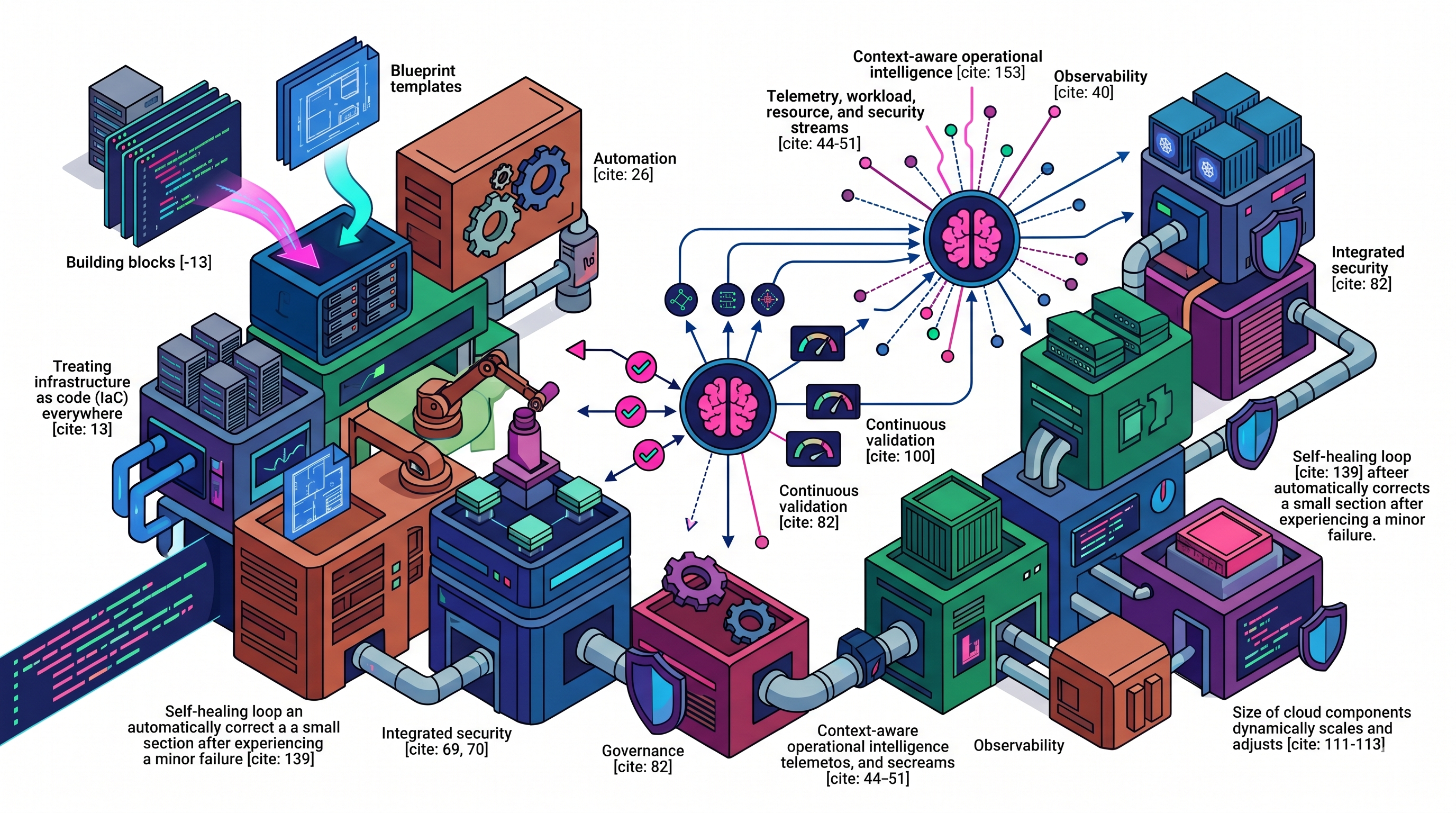
Modern DevOps environments move at extraordinary speed. Applications are deployed continuously, infrastructure scales dynamically, Kubernetes workloads evolve in real time, and cloud-native systems generate constant operational activity across distributed environments.
Without automation, managing this level of operational complexity becomes nearly impossible. Teams would spend enormous amounts of time provisioning infrastructure manually, configuring environments repeatedly, responding to operational issues reactively, and maintaining consistency across cloud ecosystems.
This is why cloud automation has become one of the foundational pillars of modern DevOps practices.
Automation helps organizations accelerate deployments, improve consistency, reduce operational overhead, strengthen scalability, and enable faster infrastructure delivery. But as cloud-native environments become more distributed and complex, simply automating tasks is no longer enough. Poorly designed automation can create hidden operational risk, governance gaps, security issues, and infrastructure instability at scale.
The goal is not automation for the sake of automation. The goal is to build operational systems that remain scalable, reliable, secure, and manageable as infrastructure grows continuously.
In this blog, we will explore the best cloud automation practices for DevOps environments, why these practices matter, and how organizations can build more intelligent and sustainable automation strategies across modern cloud-native infrastructures.
Treat Infrastructure as Code Everywhere
One of the most important cloud automation principles is treating infrastructure as code rather than managing resources manually through cloud consoles or ad hoc operational workflows.
Infrastructure as Code (IaC) allows organizations to define infrastructure configurations declaratively using version-controlled templates and automation frameworks. This creates consistency across environments while reducing configuration drift and manual operational errors.
Using IaC improves:
Environment reproducibility
Deployment consistency
Operational scalability
Change visibility
Infrastructure governance
Most importantly, infrastructure becomes auditable and repeatable instead of being dependent on undocumented manual changes.
As environments scale across Kubernetes, multi-cloud systems, and AI infrastructure, manual infrastructure management becomes increasingly unsustainable without strong IaC practices.
Standardize Automation Across Environments
One of the biggest challenges in DevOps automation is inconsistency. Different teams often automate workflows differently across environments, which creates fragmented operational practices and governance gaps.
For example:
CI/CD pipelines may follow different deployment logic
Infrastructure provisioning may vary between teams
Monitoring standards may differ across clouds
Security policies may be enforced inconsistently
Over time, this inconsistency increases operational complexity and troubleshooting difficulty.
Organizations should establish standardized automation frameworks and operational patterns wherever possible. Standardization improves scalability because teams can manage environments more predictably and collaboratively across infrastructure ecosystems.
Consistency is one of the most valuable outcomes automation can provide.
Build Automation Around Observability
Automation without visibility is dangerous.
Modern cloud environments generate highly dynamic operational behavior through autoscaling, Kubernetes orchestration, AI workloads, CI/CD pipelines, and distributed APIs. Automated systems can create unintended operational consequences if organizations lack clear visibility into how infrastructure behaves.
Before automating operational workflows, teams should ensure they can observe:
Infrastructure health
Workload behavior
Resource utilization
Deployment impact
Dependency relationships
Security posture
Strong observability allows organizations to validate whether automation is improving infrastructure behavior or introducing hidden instability.
The more autonomous the infrastructure becomes, the more important operational visibility becomes as well.
Avoid Automating Poor Processes
One of the most common automation mistakes is automating workflows that are already inefficient or poorly designed operationally.
Automation does not automatically fix broken operational models. In many cases, it simply allows inefficient processes to execute faster and on a larger scale.
Before implementing automation, organizations should evaluate whether workflows themselves are:
Operationally efficient
Clearly defined
Secure
Scalable
Maintainable
Automation should simplify operations, not amplify operational confusion or inefficiency.
The best automation strategies begin with strong operational design rather than rushing directly into tooling implementation.
Design Automation With Security Integrated
Security should never be treated as a separate layer added after automation workflows are already built.
Modern DevOps environments change continuously through automated deployments, Kubernetes orchestration, infrastructure provisioning, and API-driven workflows. Manual security reviews cannot realistically keep pace with this level of operational change.
Organizations should integrate security directly into automation pipelines through practices such as:
Automated policy enforcement
Infrastructure validation
Secret management controls
Vulnerability scanning
Compliance checks
Access governance automation
Security automation improves consistency while reducing operational risk in fast-moving cloud-native environments.
As infrastructure scales, automated governance becomes increasingly important for maintaining secure operations continuously.
Use Modular and Reusable Automation Components
Large-scale DevOps environments become difficult to manage when automation logic is duplicated across teams, environments, or projects.
Organizations should design automation workflows as modular and reusable building blocks rather than isolated scripts or environment-specific configurations.
Reusable automation improves:
Operational consistency
Maintainability
Deployment scalability
Cross-team collaboration
Governance enforcement
For example, organizations can standardize reusable modules for:
Kubernetes deployments
Infrastructure provisioning
Networking policies
Monitoring integration
Security controls
Modular automation reduces operational fragmentation while making infrastructure easier to evolve over time.
Continuously Validate Automation Outcomes
Automation should never operate without validation.
Even well-designed automation can produce unintended infrastructure behavior due to changing workloads, evolving cloud APIs, scaling conditions, or dependency interactions.
Organizations should continuously monitor whether automation is:
Improving operational efficiency
Maintaining infrastructure stability
Reducing operational risk
Supporting scalability goals
Preserving security posture
Validation is especially important in Kubernetes and multi-cloud environments where infrastructure behavior changes dynamically and operational dependencies evolve continuously.
Automation must remain observable and measurable, not blindly trusted.
Use Intelligent Scaling Rather Than Static Rules
Traditional automation often relies on fixed thresholds and static scaling rules. Modern cloud-native environments require more adaptive operational behavior.
For example, autoscaling systems should consider:
Historical workload behavior
Traffic patterns
Resource utilization trends
AI workload intensity
Infrastructure dependency relationships
Intelligent scaling helps organizations avoid both overprovisioning and underprovisioning while improving operational resilience and cost efficiency simultaneously.
The future of cloud automation increasingly depends on context-aware operational intelligence rather than purely static rule execution.
Reduce Alert Noise Through Smarter Automation
Modern DevOps environments generate enormous volumes of alerts, telemetry, logs, and operational notifications continuously.
Without intelligent filtering and prioritization, teams become overwhelmed by operational noise and alert fatigue.
Automation should help reduce operational distraction rather than increase it. Organizations should focus on:
Correlating alerts contextually
Prioritizing meaningful operational events
Automating repetitive remediation workflows
Reducing duplicate notifications
Smarter operational automation improves both engineering productivity and incident response quality.
Cloud automation should simplify operational awareness, not overwhelm teams with more operational complexity.
Build Automation for Failure Recovery Too
Many organizations focus heavily on deployment automation while underinvesting in automated recovery capabilities.
Modern cloud-native systems experience failures constantly at an infrastructure scale. Containers crash, APIs degrade, nodes fail, workloads overload, and dependencies become unstable unpredictably.
Strong DevOps automation strategies should include:
Automated failover
Workload recovery workflows
Infrastructure remediation logic
Self-healing Kubernetes behavior
Operational rollback mechanisms
Automation should improve resilience, not just deployment speed.
The faster systems recover from failure automatically, the more operationally stable the distributed environments become overall.
Multi-Cloud Automation Requires Operational Consistency
As organizations expand across AWS, Azure, Google Cloud, Kubernetes environments, and hybrid infrastructure, automation complexity increases significantly.
Each provider introduces different APIs, tooling systems, governance models, and operational behaviors. Without standardization, automation becomes fragmented across environments.
Organizations should focus on building cloud-agnostic operational automation wherever possible through:
Infrastructure-as-code standardization
Unified deployment practices
Centralized observability
Consistent governance models
The goal is not to eliminate provider-specific capabilities entirely. It is reducing operational fragmentation across environments.
Consistency becomes increasingly important as multi-cloud complexity grows.
AI Infrastructure Requires More Adaptive Automation
AI workloads are changing DevOps automation requirements significantly.
GPU clusters, distributed inference systems, AI training pipelines, and vector databases generate highly dynamic infrastructure behavior that traditional automation models were not designed to handle.
Organizations increasingly need automation capable of:
Optimizing GPU utilization
Managing AI workload scheduling
Scaling inference infrastructure dynamically
Monitoring AI operational efficiency
AI environments evolve rapidly and require far more adaptive operational automation than traditional application infrastructure.
As AI adoption accelerates, intelligent automation becomes increasingly essential for sustainable cloud operations.
Strengthening Automation Visibility with Atler Pilot
One of the biggest challenges in cloud automation is maintaining operational visibility across increasingly dynamic and distributed infrastructure environments.
This is where Atler Pilot helps organizations gain a deeper understanding of workload behavior, infrastructure activity, operational signals, and resource utilization across cloud-native ecosystems. By connecting infrastructure insights, workload visibility, operational intelligence, and utilization patterns into a unified view, teams can better understand how automated systems behave and where inefficiencies, risks, or operational bottlenecks may be emerging.
Instead of relying solely on fragmented dashboards and reactive operational analysis, organizations gain more contextual awareness across evolving cloud environments. This supports stronger automation governance, more informed operational decisions, and improved infrastructure scalability overall.
As DevOps environments continue becoming more automated, distributed, and AI-driven, unified operational visibility becomes increasingly important for maintaining both efficiency and operational control.
Sign up for Atler Pilot and explore how deeper operational visibility can help your team improve cloud automation, strengthen infrastructure resilience, and scale DevOps operations with greater confidence.
Conclusion
Cloud automation is no longer optional in modern DevOps environments. Infrastructure systems now evolve too quickly and operate at too much scale for manual workflows alone to remain sustainable.
But successful automation is not simply about automating more tasks. It is about building operational systems that remain observable, secure, scalable, and resilient as environments grow more distributed and dynamic.
Organizations that succeed with DevOps automation will focus not only on deployment speed but also on operational intelligence, governance consistency, infrastructure visibility, and long-term maintainability.
Because in modern cloud operations, the goal is no longer simply automating infrastructure. It is building infrastructure ecosystems capable of operating intelligently at cloud scale.
All in One Place
Atler Pilot decodes your cloud spend story by bringing monitoring, automation, and intelligent insights together for faster and better cloud operations.