
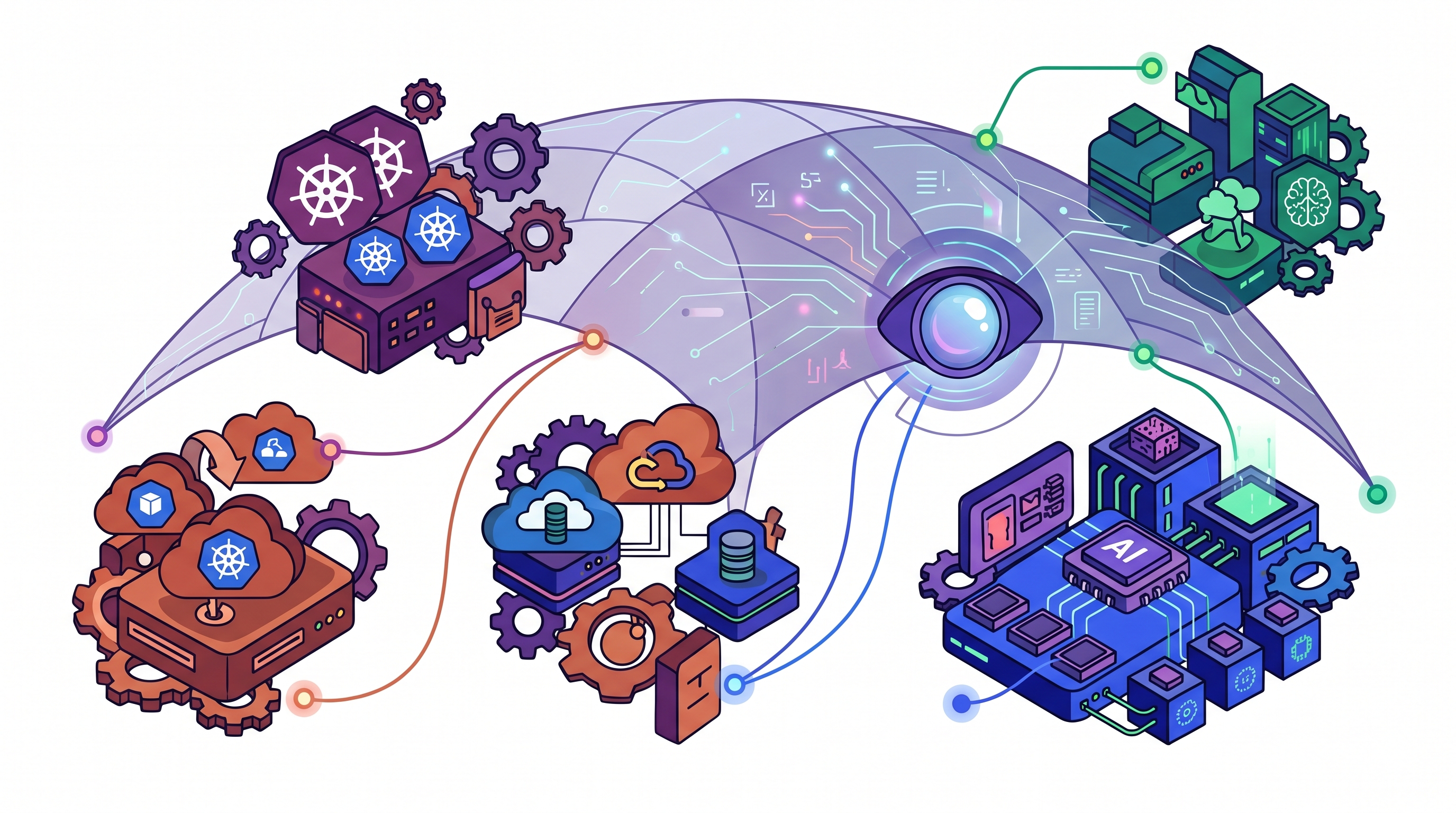
Modern engineering organizations are becoming increasingly decentralized. Enterprises now operate with distributed DevOps teams, autonomous product groups, platform engineering divisions, AI infrastructure teams, and globally distributed development environments working simultaneously across complex cloud-native ecosystems.
This decentralized operating model enables faster innovation, greater engineering autonomy, and improved product delivery velocity. Teams can deploy independently, scale infrastructure dynamically, and respond to operational requirements without waiting for centralized infrastructure approval processes.
But while decentralization improves agility, it also introduces significant governance complexity.
As organizations scale across Kubernetes environments, multi-cloud architectures, AI infrastructure, distributed APIs, and automated deployment pipelines, maintaining consistent infrastructure governance becomes far more difficult operationally. Different teams often adopt different deployment practices, security controls, workload management strategies, and resource allocation behaviors across environments. Over time, this fragmentation can lead to rising cloud costs, inconsistent security posture, operational inefficiencies, compliance drift, and reduced infrastructure visibility.
Traditional governance models built around centralized operational control struggle to keep pace with highly autonomous cloud-native engineering organizations. Governance can no longer depend solely on manual reviews, isolated approval processes, or static policy enforcement.
This is why modern cloud governance strategies must evolve.
The challenge today is not restricting engineering autonomy. It is creating governance systems capable of maintaining operational consistency, visibility, accountability, and scalability without slowing innovation or reducing organizational flexibility.
In this blog, we will explore why decentralized engineering environments create new governance challenges, where traditional governance approaches fail, and the strategies organizations can use to build scalable cloud governance frameworks for modern distributed engineering operations.
Traditional Governance Models Struggle in Decentralized Cloud Environments
Traditional infrastructure governance frameworks were designed for relatively centralized operational structures where infrastructure decisions flowed through controlled approval processes and operational ownership remained concentrated within dedicated infrastructure teams.
Modern cloud-native organizations operate very differently. Engineering teams now provision infrastructure independently, deploy workloads continuously, manage Kubernetes environments autonomously, and scale services dynamically across cloud providers without centralized operational bottlenecks.
While this operational model improves speed and flexibility, it also makes governance significantly harder to enforce consistently. Policies that once relied on centralized oversight become difficult to maintain when dozens or hundreds of engineering teams operate independently across distributed infrastructure ecosystems.
As cloud-native environments evolve continuously, governance models dependent primarily on manual enforcement and periodic review cycles increasingly fail to maintain operational consistency effectively.
Modern governance must adapt to distributed engineering realities rather than attempting to preserve legacy centralized operational models.
Infrastructure Visibility Becomes Fragmented Across Teams
One of the biggest governance challenges in decentralized organizations is fragmented operational visibility. Different engineering teams often use separate tooling systems, observability platforms, deployment workflows, and infrastructure management practices across environments.
Over time, organizations lose a centralized understanding of:
Which teams own specific workloads
How infrastructure resources are utilized
Where operational inefficiencies exist
Which environments drift from governance standards
How cloud spending evolves operationally
This fragmentation creates substantial governance risk because leadership teams may retain high-level cloud spending visibility while lacking deeper operational understanding of infrastructure behavior across environments.
Without unified operational visibility, governance becomes reactive rather than proactive. Organizations often identify inefficiencies, compliance issues, or security inconsistencies only after operational complexity has already scaled significantly.
Distributed engineering requires governance systems capable of maintaining centralized operational awareness without reducing team autonomy.
Kubernetes Expansion Has Increased Governance Complexity
Kubernetes has become foundational to modern cloud-native operations, but it also significantly increases governance complexity within decentralized organizations.
Kubernetes environments evolve continuously through automated deployments, autoscaling systems, namespace creation, workload orchestration, and dynamic resource allocation. Different engineering teams frequently configure Kubernetes environments differently based on local operational preferences or workload requirements.
This often creates inconsistent governance patterns involving:
RBAC permissions
Resource allocation policies
Namespace structures
Autoscaling configurations
Security controls
Workload ownership visibility
Without strong governance frameworks, Kubernetes ecosystems can quickly become fragmented and difficult to manage consistently across distributed teams.
Traditional governance approaches often struggle because Kubernetes environments change too rapidly for static review processes to remain operationally effective. Modern governance increasingly depends on continuous operational visibility integrated directly into Kubernetes workflows.
Multi-Cloud Architectures Intensify Governance Fragmentation
Most enterprise organizations now operate across AWS, Azure, Google Cloud, Kubernetes ecosystems, SaaS platforms, and hybrid infrastructure environments simultaneously. While this improves operational flexibility and resilience, it also creates significant governance fragmentation operationally.
Each provider introduces different APIs, identity systems, security models, observability frameworks, pricing structures, and infrastructure management practices. Different engineering teams frequently adopt provider-specific operational workflows independently, increasing inconsistency across environments over time.
As a result, organizations often struggle to maintain centralized governance visibility into:
Infrastructure ownership
Workload accountability
Resource utilization efficiency
Compliance posture
Security consistency
Operational scalability
Decentralized multi-cloud operations, therefore, require governance models capable of connecting infrastructure awareness across distributed ecosystems continuously rather than managing cloud providers independently.
Engineering Autonomy Must Be Balanced With Governance Consistency
One of the biggest mistakes organizations make is attempting to solve governance complexity by restricting engineering autonomy excessively. Overly centralized governance models often slow innovation, create operational bottlenecks, and encourage teams to bypass governance processes entirely to maintain delivery speed.
Modern engineering organizations require governance strategies that balance operational flexibility with infrastructure consistency. Teams need enough autonomy to innovate and scale independently while still operating within standardized governance frameworks that maintain visibility, accountability, and operational resilience.
The most effective governance models therefore focus less on restricting infrastructure activity and more on creating standardized operational guardrails, automated policy enforcement, workload visibility, and shared infrastructure governance principles across teams.
Governance should enable sustainable scalability rather than becoming an obstacle to operational agility.
Infrastructure Accountability is Essential for Decentralized Operations
Cloud governance becomes extremely difficult when infrastructure ownership remains unclear across distributed teams. In decentralized organizations, workloads, Kubernetes environments, AI infrastructure, and observability systems often scale independently without centralized accountability structures.
Without clear ownership visibility, organizations struggle to identify:
Which teams drive infrastructure growth
Where inefficiencies exist operationally
Which workloads consume excessive resources
How cloud spending aligns with business priorities
This creates environments where infrastructure complexity increases continuously while operational accountability weakens over time.
Modern governance strategies increasingly connect infrastructure utilization directly to engineering teams, operational environments, workloads, and business services. This improves accountability while encouraging more intentional infrastructure scaling and optimization decisions across decentralized engineering ecosystems.
Visibility into operational ownership has become one of the most important foundations of scalable cloud governance.
AI Infrastructure Requires New Governance Models
AI-powered systems are rapidly increasing governance complexity across modern enterprises. GPU clusters, distributed training pipelines, inference environments, vector databases, and AI observability systems all introduce highly dynamic infrastructure behavior requiring specialized operational governance.
AI workloads frequently scale unpredictably, consume expensive infrastructure resources, and operate across distributed computational environments simultaneously. Without strong governance visibility, organizations may struggle to understand:
Which AI workloads consume the most resources
How GPU infrastructure is utilized
Where AI operational inefficiencies exist
Which teams govern model-serving environments
How AI systems affect cloud spending operationally
Traditional governance frameworks were not designed for highly dynamic AI ecosystems. Modern governance increasingly requires real-time operational awareness capable of understanding AI workload behavior continuously as infrastructure evolves.
AI adoption is pushing governance models toward deeper operational intelligence and workload-level infrastructure visibility.
Real-Time Operational Visibility is Replacing Static Governance Reviews
Traditional governance often depended heavily on periodic audits, manual policy reviews, and delayed infrastructure reporting. Modern cloud-native environments evolve far too rapidly for static governance models to remain effective operationally.
Kubernetes workloads scale continuously, AI infrastructure changes dynamically, deployment pipelines introduce infrastructure modifications automatically, and cloud-native systems generate operational activity in real time across distributed ecosystems.
Organizations increasingly require continuous governance visibility capable of identifying:
Infrastructure drift
Security inconsistencies
Resource inefficiencies
Scaling anomalies
Governance violations
Operational fragmentation
Real-time operational awareness allows governance teams to identify emerging risks earlier rather than reacting after operational complexity has already scaled significantly.
The future of cloud governance is becoming increasingly continuous, operational, and infrastructure-aware rather than purely policy-driven.
Intelligent Automation Strengthens Governance Scalability
As decentralized engineering ecosystems grow more complex, organizations increasingly rely on intelligent automation to maintain governance consistency at scale.
Modern governance automation helps organizations:
Enforce policies continuously
Validate infrastructure configurations
Detect governance drift
Improve workload accountability
Optimize infrastructure visibility
Maintain security consistency
Automation reduces reliance on manual governance enforcement while improving scalability across distributed operational ecosystems. The goal is not replacing human oversight entirely, but enabling governance systems capable of scaling alongside modern engineering organizations without creating operational bottlenecks.
Governance is evolving from static policy management toward intelligent operational governance integrated directly into cloud-native infrastructure behavior.
Governance Must Evolve Into an Operational Engineering Discipline
Cloud governance is no longer simply a compliance or infrastructure management function. It now directly influences cloud spending, operational resilience, scalability, security posture, AI infrastructure efficiency, engineering productivity, and long-term business sustainability.
Organizations that treat governance purely as an administrative process often struggle with fragmented visibility, uncontrolled infrastructure growth, inconsistent operational practices, and rising cloud complexity over time.
The most successful decentralized engineering organizations increasingly integrate governance directly into platform engineering strategies, operational visibility systems, workload management practices, and cloud-native infrastructure operations continuously.
Governance is evolving into a strategic operational discipline focused on enabling scalable, resilient, and efficient infrastructure ecosystems rather than merely enforcing static rules.
Building Unified Governance Visibility with Atler Pilot
As decentralized engineering environments become more distributed and operationally complex, maintaining unified infrastructure visibility becomes increasingly important for scalable governance execution. This is where Atler Pilot helps organizations gain a deeper understanding of workload behavior, infrastructure utilization, Kubernetes activity, AI resource allocation, and operational signals across distributed cloud-native ecosystems through a unified operational view.
By connecting infrastructure insights, workload intelligence, operational visibility, utilization awareness, and governance context together, Atler Pilot helps organizations identify inefficiencies, governance drift, underutilized resources, workload anomalies, and operational fragmentation earlier across decentralized environments. Instead of relying solely on fragmented dashboards or delayed governance reviews, engineering and leadership teams gain more contextual operational awareness into how infrastructure behaves and where governance risks emerge operationally.
This allows organizations to strengthen accountability, improve governance consistency, optimize infrastructure efficiency, and scale cloud-native operations more sustainably without reducing engineering autonomy or operational flexibility.
Modern decentralized engineering organizations require governance models capable of scaling alongside infrastructure complexity. Atler Pilot helps teams simplify operational visibility, strengthen governance awareness, and make more informed decisions around workload accountability, infrastructure efficiency, and cloud-native scalability.
Sign up for Atler Pilot and explore how unified operational visibility can help your organization govern distributed cloud environments with greater clarity, control, and operational intelligence.
Conclusion
Decentralized engineering organizations have transformed how modern enterprises build and scale cloud-native infrastructure, but they have also introduced substantial governance complexity across Kubernetes environments, AI ecosystems, multi-cloud architectures, and distributed operational workflows.
Organizations that succeed in modern cloud governance will not attempt to control distributed engineering environments through restrictive centralized oversight alone. Instead, they will build governance frameworks centered around operational visibility, infrastructure accountability, workload awareness, intelligent automation, and continuous governance intelligence.
Because the future of cloud governance is no longer only about enforcing operational control. It is about enabling decentralized innovation while maintaining the visibility, consistency, and infrastructure understanding required to scale sustainably at cloud-native scale.
All in One Place
Atler Pilot decodes your cloud spend story by bringing monitoring, automation, and intelligent insights together for faster and better cloud operations.