
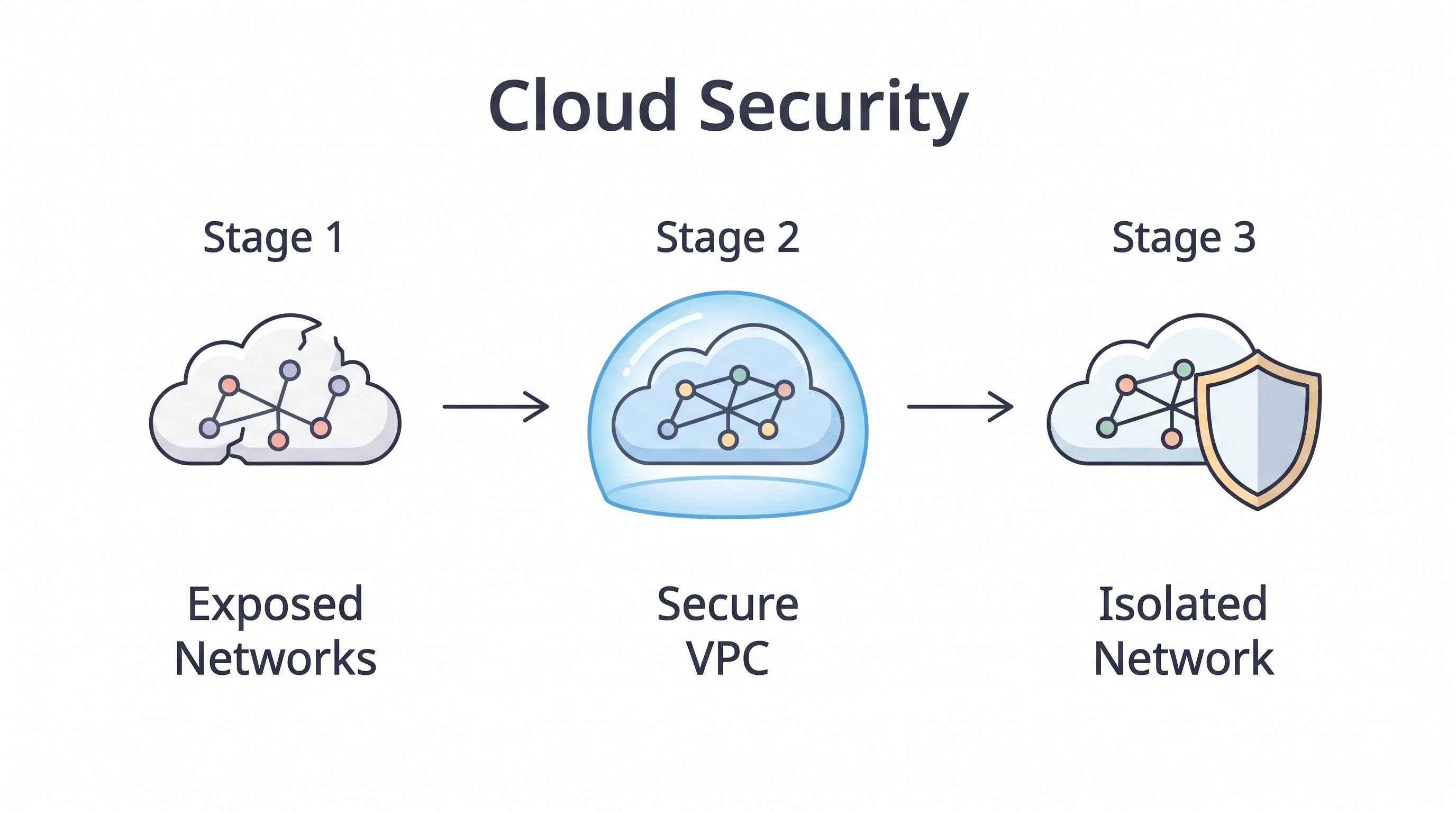
The State of Cloud Security in 2026
The cloud security landscape of 2026 is defined by a striking paradox: our defensive tools have never been more sophisticated, yet the fundamental causes of data breaches remain largely unchanged from a decade ago. We have artificial intelligence scanning multi-cloud environments for anomalous API calls in milliseconds, yet terabytes of sensitive customer data are still routinely leaked via public S3 buckets without basic authentication.
The acceleration of cloud adoption, driven by the mandate to deploy generative AI workloads and edge computing, has vastly expanded the enterprise attack surface. The boundary between "infrastructure" and "application" has dissolved. In a world defined by Infrastructure as Code (IaC) and serverless functions, the configuration is the infrastructure, and a single typo in a Terraform module can instantly compromise a global network.
This guide analyzes the current state of cloud security, separating the marketing hype from the operational reality. We will explore how advanced threats have evolved, why the foundational principles of security are more critical than ever, and how organizations must adapt their defensive posture to survive the rest of the decade.
What Changed: AI, Automation, and Ephemerality
Three macro-trends have fundamentally altered the mechanics of cloud security over the past few years.
1. The Weaponization of AI
The most significant shift is the commoditization of offensive AI. Adversaries no longer rely on manual probing. Automated, AI-driven botnets continuously scan the entire IPv4 address space, identifying newly provisioned cloud resources and testing them for known vulnerabilities or misconfigurations within seconds of their creation. Furthermore, cloud threat modeling must now account for AI-generated phishing campaigns that easily bypass traditional email gateways to steal cloud credentials.
2. The Speed of Ephemerality
The lifespan of a cloud resource has plummeted. In containerized environments managed by Kubernetes, pods may exist for only minutes or seconds. Traditional vulnerability scanners, which run weekly or even daily, are useless against ephemeral infrastructure. If a container spins up, executes a malicious payload, and terminates before the scanner runs, the security team is blind. Security must now operate at the speed of the orchestrator.
3. Identity as the New Perimeter
With remote work solidified and applications distributed across AWS, Azure, GCP, and countless SaaS providers, the corporate network perimeter is dead. Identity is the only perimeter that matters. A compromised IAM role or a leaked long-lived access key is the equivalent of handing an attacker the keys to the physical datacenter. This has driven the aggressive adoption of Zero Trust Architecture.
What Stayed Broken: The Basics
Despite the advanced threats, sophisticated nation-state actors rarely need to burn expensive zero-day exploits. They simply walk through the front door using stolen credentials or exploit fundamental cloud misconfigurations.
The 2026 breach reports tell a familiar story. The top vectors remain:
Exposed Storage: Publicly accessible S3 buckets, Azure Blobs, and unprotected Elasticsearch clusters.
Over-privileged IAM: Roles granted
*.*(administrative) permissions out of developer convenience, allowing an attacker who compromises a low-level service to escalate privileges instantly.Leaked Secrets: Hardcoded API keys, database credentials, and cloud access tokens committed to public (or compromised private) Git repositories.
Unpatched Vulnerabilities: Known CVEs left unpatched on internet-facing EC2 instances because cloud patch management is still treated as a manual chore rather than an automated discipline.
The Final Death of the Perimeter
Historically, organizations built "castle-and-moat" architectures. Once inside the VPN, a user or service was implicitly trusted. In a multi-cloud, containerized world, lateral movement is trivial if implicit trust exists.
The response is Zero Trust. Zero trust is not a product; it is a philosophy stating that no entity (user, device, or microservice) is trusted by default, regardless of its location on the network. Every request must be authenticated, authorized, and continuously validated. Implementing this requires micro-segmentation, mutual TLS (mTLS) for service-to-service communication, and rigorous Cloud IAM best practices prioritizing short-lived credentials over static keys.
Shift-Left: Rhetoric vs. Reality
The industry consensus is that security must "shift left"—integrating security checks earlier into the software development lifecycle (SDLC). The logic is unassailable: fixing an open port in a Terraform file takes seconds; fixing it after it's deployed to production takes hours and carries the risk of a breach.
However, the reality of DevSecOps often involves overwhelming developers with thousands of low-context alerts from disconnected scanning tools, resulting in alert fatigue and ignored warnings. Successful shift-left implementations focus on context and automation. Instead of just flagging a vulnerability, modern tools provide the exact code required to remediate it or automatically generate a pull request with the fix.
The Great Tool Consolidation
In the early 2020s, organizations bought separate tools for Cloud Security Posture Management (CSPM), Cloud Workload Protection (CWPP), Data Loss Prevention (DLP), and vulnerability management. The result was a fragmented security posture where analysts spent more time correlating alerts between dashboards than actually remediating threats.
In 2026, the trend is violent consolidation. Cloud-Native Application Protection Platforms (CNAPP) have emerged to combine these capabilities into a single view. Platforms like CloudAtler analyze the entire stack—from the IaC template to the running container—providing a unified graph of risk. This convergence reduces licensing costs, but more importantly, it drastically reduces the Mean Time to Understand (MTTU) a complex attack path.
Preparing for the Next Wave
To secure the cloud in 2026 and beyond, security leaders must focus on three imperatives:
Automate the Basics: Humans should not be manually checking for public S3 buckets. CSPM tools must automatically detect and automatically remediate basic misconfigurations within seconds of deployment.
Enforce Least Privilege: Transition away from static credentials. Mandate just-in-time (JIT) access and temporary, scoped STS tokens for both human operators and machine identities.
Align with FinOps: Security and cost are inextricably linked. A hijacked AWS account used for crypto-mining is both a security breach and a massive financial anomaly. Integrating security logging with cloud cost anomaly detection provides a critical secondary warning system.
Key Takeaway
The complexity of cloud security has increased, but the fundamental vulnerabilities remain the same. Stop searching for silver-bullet AI defenses until you have mastered the basics: locking down storage, enforcing least privilege IAM, patching aggressively, and eliminating hardcoded secrets. Embrace tool consolidation to gain unified visibility, and automate remediation so your security team can focus on architecture rather than fighting endless fires.
All in One Place
Atler Pilot decodes your cloud spend story by bringing monitoring, automation, and intelligent insights together for faster and better cloud operations.