
The Human Error Reality
Despite the proliferation of advanced persistent threats (APTs) and sophisticated ransomware gangs, the overwhelming majority of successful cloud breaches share a mundane root cause: a cloud misconfiguration.
A cloud misconfiguration occurs when a cloud resource is provisioned or modified in a way that violates security best practices, unintentionally exposing data or infrastructure. It is not a flaw in the cloud provider's architecture; AWS, Azure, and GCP operate exactly as they are instructed. If an engineer instructs an S3 bucket to allow public read access, AWS will faithfully execute that command.
Because modern cloud environments are managed via code (APIs and IaC) rather than physical cables, a single typo by a tired engineer can instantly expose a multi-terabyte database to the entire internet. This guide breaks down the most critical misconfigurations and details how organizations must evolve their defenses to detect and prevent them.
The Classic: Exposed Cloud Storage
The most infamous cloud misconfiguration is the publicly accessible storage bucket (Amazon S3, Azure Blob, GCP Cloud Storage).
The Error: An engineer needs to quickly share a file with an external vendor. Rather than setting up a secure pre-signed URL, they alter the bucket's Access Control List (ACL) to grant
PublicReadorAllUsersaccess. They forget to revert the change. Automated scanning bots find the bucket within hours and siphon the data.The Fix: Organizations must utilize provider-level overrides. In AWS, enabling "Block Public Access" at the Account level mathematically overrides any bucket-level ACLs, ensuring no bucket can ever be made public, regardless of developer intent.
The Dangerous: IAM Over-Privilege
While exposed storage causes data leaks, IAM misconfigurations cause total infrastructure compromise.
The Error: A developer writing a Lambda function that needs to read from DynamoDB encounters a permissions error. To fix it quickly, they attach the
AdministratorAccessmanaged policy to the function's execution role, intending to "fix it later." Later never comes. If an attacker exploits the Lambda function, they inherit administrative control over the entire AWS account.The Fix: Implement continuous IAM analysis. Tools like AWS IAM Access Analyzer evaluate resource policies to identify unintended cross-account access. CSPM tools must generate critical alerts anytime an administrative policy is attached to a non-human identity.
The Hidden: Network and Firewall Flaws
Cloud firewalls (Security Groups, NSGs) are easily misconfigured, especially in complex, rapidly changing environments.
The Error: An administrator troubleshooting a database connectivity issue alters the Security Group to allow inbound traffic on port 3306 (MySQL) from
0.0.0.0/0(the entire internet). The database, which should only be accessible from internal application servers, is now exposed to global brute-force attacks.The Fix: Enforce a strict "Default Deny" posture. Security Groups should rarely reference IP addresses; they should reference other Security Groups (e.g., the Database SG only accepts traffic from the WebServer SG). Utilize tools like AWS Firewall Manager to enforce baseline rules across the organization.
The Careless: Hardcoded Secrets
This misconfiguration bridges the gap between application code and cloud infrastructure.
The Error: A developer hardcodes a cloud provider access key (e.g.,
AKIA...) or a database password directly into an application's source code or a Terraform file. The code is pushed to a public GitHub repository or a compromised private repository. Automated scrapers detect the key within seconds and use it to spin up crypto-mining instances.The Fix: Static keys should be eradicated. Utilize Secrets Managers and IAM Roles for authentication. Implement pre-commit hooks (like
git-secrets) that prevent developers from pushing code that contains string patterns resembling API keys.
Detection: Continuous Posture Management
Manual audits cannot detect misconfigurations in environments that change thousands of times a day. You must deploy a Cloud Security Posture Management (CSPM) platform.
A CSPM connects to the cloud provider's APIs and continuously evaluates the environment against frameworks like CIS Foundations. If it detects a missing MFA configuration, an unencrypted volume, or an open Security Group, it generates an alert. Modern platforms like CloudAtler provide the crucial context, prioritizing a misconfigured EC2 instance highly if it has an administrative IAM role attached to it.
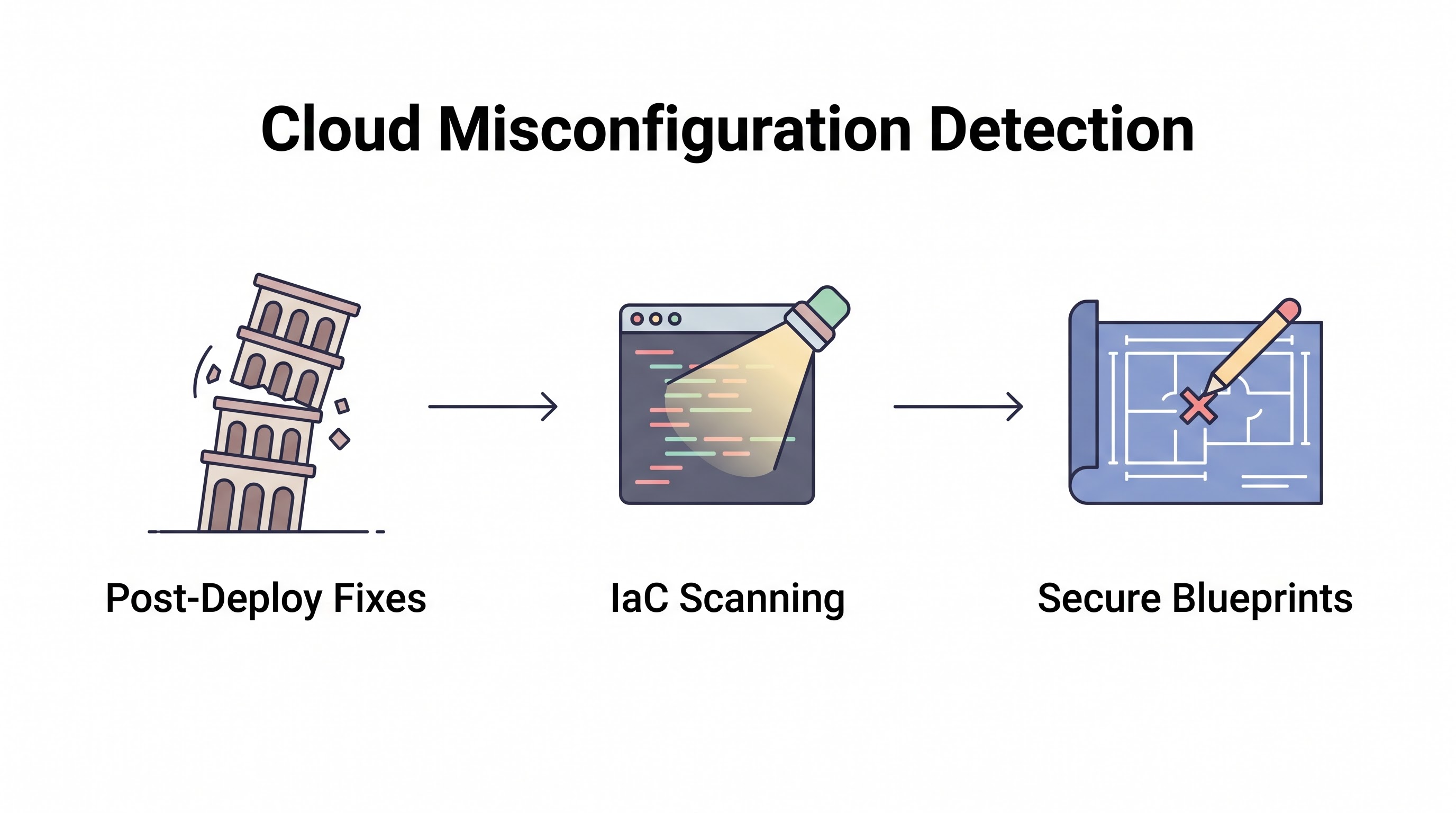
Prevention: Shift-Left IaC Scanning
Detecting a misconfiguration in production via a CSPM is a reactive measure. The vulnerability existed, if only for a few minutes.
The proactive solution is scanning Infrastructure as Code (IaC). Before a Terraform or CloudFormation template is deployed, it must be scanned by tools like Checkov, tfsec, or OPA in the CI/CD pipeline. If the template defines an S3 bucket without encryption, the security scanner fails the build and prevents the misconfiguration from ever existing in reality.
The Goal: Automated Remediation
The ultimate defense against human error is removing humans from the remediation loop. When a highly confident, easily fixable misconfiguration is detected (e.g., AWS CloudTrail logging is disabled), the CSPM or native tools (AWS Config) should trigger a serverless function to automatically re-enable the secure setting within seconds, neutralizing the threat before the security team even reads the alert.
Key Takeaway
Cloud breaches are rarely sophisticated; they are the exploitation of simple misconfigurations like public storage buckets, over-privileged IAM roles, and hardcoded secrets. Relying on engineers to manually configure everything perfectly is a failed strategy. Organizations must implement IaC scanning to prevent errors from reaching production, deploy CSPM tools to continuously monitor the runtime environment, and aggressively automate the remediation of known bad configurations.
All in One Place
Atler Pilot decodes your cloud spend story by bringing monitoring, automation, and intelligent insights together for faster and better cloud operations.