
The Friction Between Speed and Security
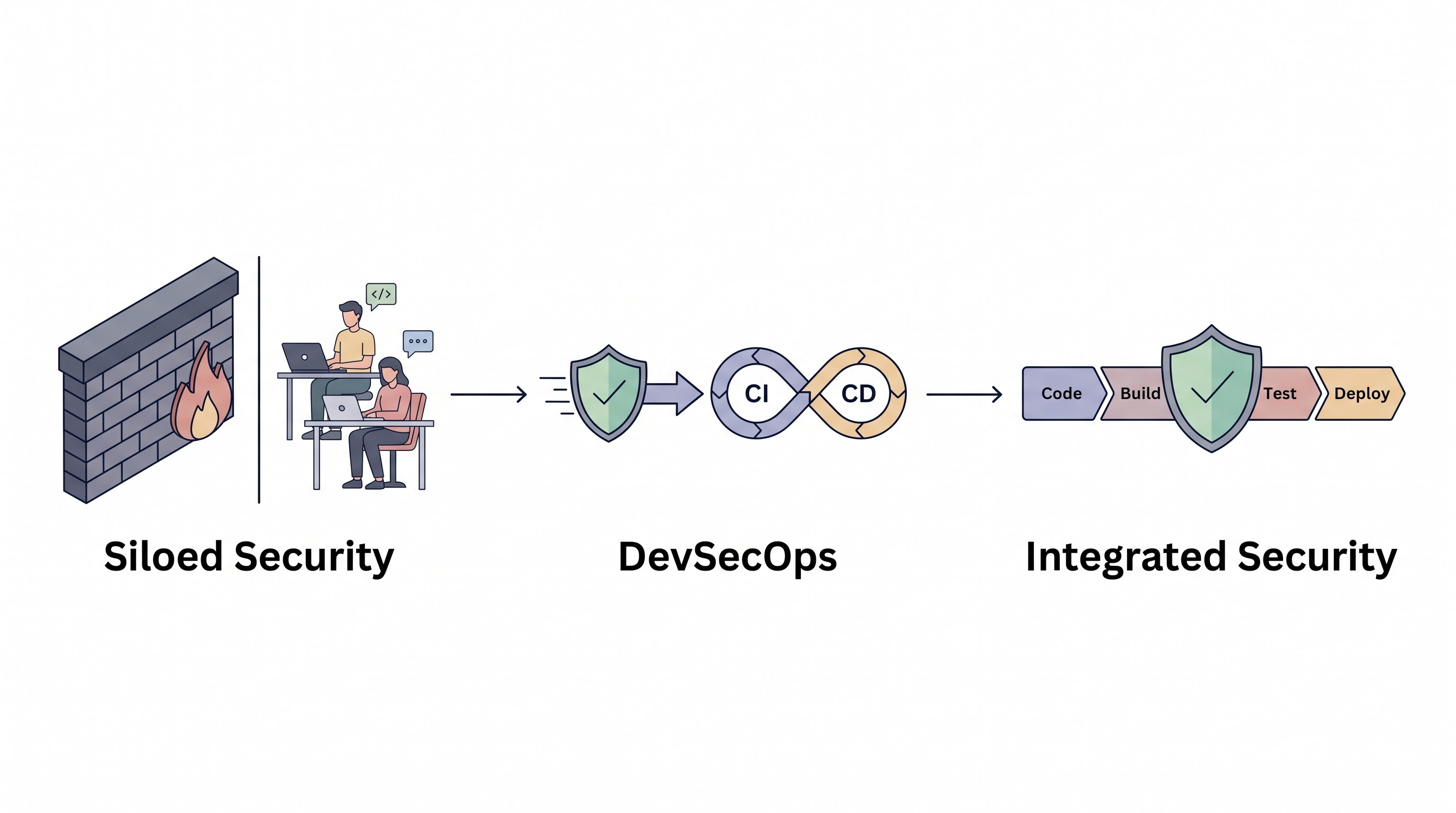
Historically, security and software development were antagonistic forces. Developers were incentivized to ship features rapidly. Security teams were incentivized to prevent breaches, which usually meant stopping or delaying those releases to conduct manual audits. The result was a profound organizational bottleneck: the "Department of No."
The transition to cloud-native architectures and frequent deployments (often multiple times a day) broke this traditional model completely. A security team cannot manually review 50 pull requests a day. The only viable path forward is to automate security checks and integrate them directly into the developer workflow. This is the premise of DevSecOps.
However, many early attempts at DevSecOps failed. Organizations dumped massive security scanning tools into their CI/CD pipelines, blocking builds for minor, false-positive vulnerabilities. The result was destroyed developer velocity and widespread resentment. This guide outlines how to implement DevSecOps in 2026: embedding rigorous security controls without sacrificing the agility of the cloud.
Defining True DevSecOps
DevSecOps is not a specific tool. It is the philosophy of "shifting left"—moving security checks as early in the Software Development Life Cycle (SDLC) as possible. Finding a vulnerability in an IDE while a developer is typing costs dollars to fix. Finding that same vulnerability after it is deployed to a production environment costs thousands of dollars, or millions if exploited.
True DevSecOps adheres to three principles:
Automation: Security checks must be automated within the pipeline. Human gates are removed wherever possible.
Contextual Actionability: Alerts must provide the developer with the exact location of the flaw and the code required to fix it, rather than just a generic CVE warning.
Speed: Security scans cannot add an hour to a 5-minute build process. Scans must be highly optimized or run asynchronously.
Integrating Security into the CI/CD Pipeline
A mature DevSecOps pipeline integrates specialized security checks at specific stages of the developer workflow.
1. Pre-Commit / IDE Stage
The earliest possible intervention. Plugins in the developer's IDE (VS Code, IntelliJ) provide real-time feedback on insecure coding practices. More importantly, pre-commit hooks (using tools like git-secrets or trufflehog) prevent developers from accidentally committing hardcoded API keys, passwords, or AWS credentials into the local Git repository.
2. The Build Stage (Continuous Integration)
When code is pushed to the repository, the CI server (GitHub Actions, Jenkins, GitLab CI) takes over.
Software Composition Analysis (SCA): Scans the
package.jsonorrequirements.txtto identify known vulnerabilities in third-party open-source libraries.Static Application Security Testing (SAST): Analyzes the custom source code for common vulnerabilities (e.g., SQL Injection, Cross-Site Scripting) without executing the application.
Infrastructure as Code (IaC) Scanning: Tools like Checkov or tfsec scan Terraform or CloudFormation templates to identify cloud misconfigurations (e.g., an open security group) before the infrastructure is provisioned.
3. The Test/Deploy Stage (Continuous Deployment)
Once the application is built and deployed to a staging environment.
Dynamic Application Security Testing (DAST): Simulates an external attacker interacting with the running application, probing for vulnerabilities that SAST might miss (e.g., authentication bypasses).
Container Image Scanning: If deploying Docker containers, the final image is scanned in the container registry to ensure the base OS and installed packages are free of known CVEs.
The DevSecOps Toolchain: SCA, SAST, DAST
Selecting the right tools is critical to preventing alert fatigue.
The SAST Problem: Traditional SAST tools are notorious for false positives. If a SAST scan generates 500 warnings that require manual triage, developers will simply bypass the step. Modern SAST tools prioritize speed and high-confidence alerts over exhaustive, noisy scanning. They focus on providing the exact code snippet required for remediation.
The SCA Necessity: Modern applications consist of 80% open-source libraries and 20% custom code. The Log4Shell vulnerability demonstrated the catastrophic risk of the software supply chain. SCA is non-negotiable. However, advanced SCA tools now provide "reachability analysis"—determining not just if a vulnerable library is present, but if the vulnerable function is actually called by the application's code, drastically reducing false positives.
Securing the Container Supply Chain
In a Kubernetes-driven world, securing the container is paramount.
Base Images: Developers should not pull random images from public registries. Organizations must maintain a secure, curated registry of approved, minimal base images (e.g., Alpine Linux or distroless images) that contain only the necessary dependencies, drastically reducing the attack surface.
Admission Controllers: In Kubernetes, use admission controllers (like OPA Gatekeeper) to enforce policies. For example, the cluster can mathematically refuse to run any container image that has not been cryptographically signed by the CI/CD pipeline, preventing malicious or unapproved images from executing.
The Cultural Shift: Developers as Defenders
You cannot buy DevSecOps. It is a cultural transformation. The security team must transition from "auditors" to "tool builders." Their job is to curate the CI/CD pipeline, tune the scanners to eliminate noise, and provide paved roads for the developers.
When a developer breaks a build due to a critical SAST finding, they shouldn't need to open a ticket with security. The tool should provide the remediation guidance necessary for the developer to fix the code and trigger a new build independently. The ultimate goal is to make the secure path the easiest path.
Measuring DevSecOps Success
Track metrics that balance security with velocity:
Mean Time to Remediate (MTTR) Vulnerabilities: Are critical vulnerabilities fixed in 2 days or 20 days?
Deployment Frequency: Did introducing security scanning slow down how often teams push to production? (If yes, the pipeline needs tuning).
Vulnerability Escape Rate: What percentage of vulnerabilities are found in production versus found in the CI/CD pipeline? (A lower escape rate indicates a successful shift-left strategy).
Key Takeaway
DevSecOps is the mandatory evolution of security in a cloud-native world. By embedding automated SCA, SAST, and IaC scanning directly into the CI/CD pipeline, organizations can catch vulnerabilities when they are cheapest to fix. The key to success is aggressive tuning of these tools to eliminate false positives, ensuring that developers view security as a helpful guardrail rather than an operational roadblock.
All in One Place
Atler Pilot decodes your cloud spend story by bringing monitoring, automation, and intelligent insights together for faster and better cloud operations.